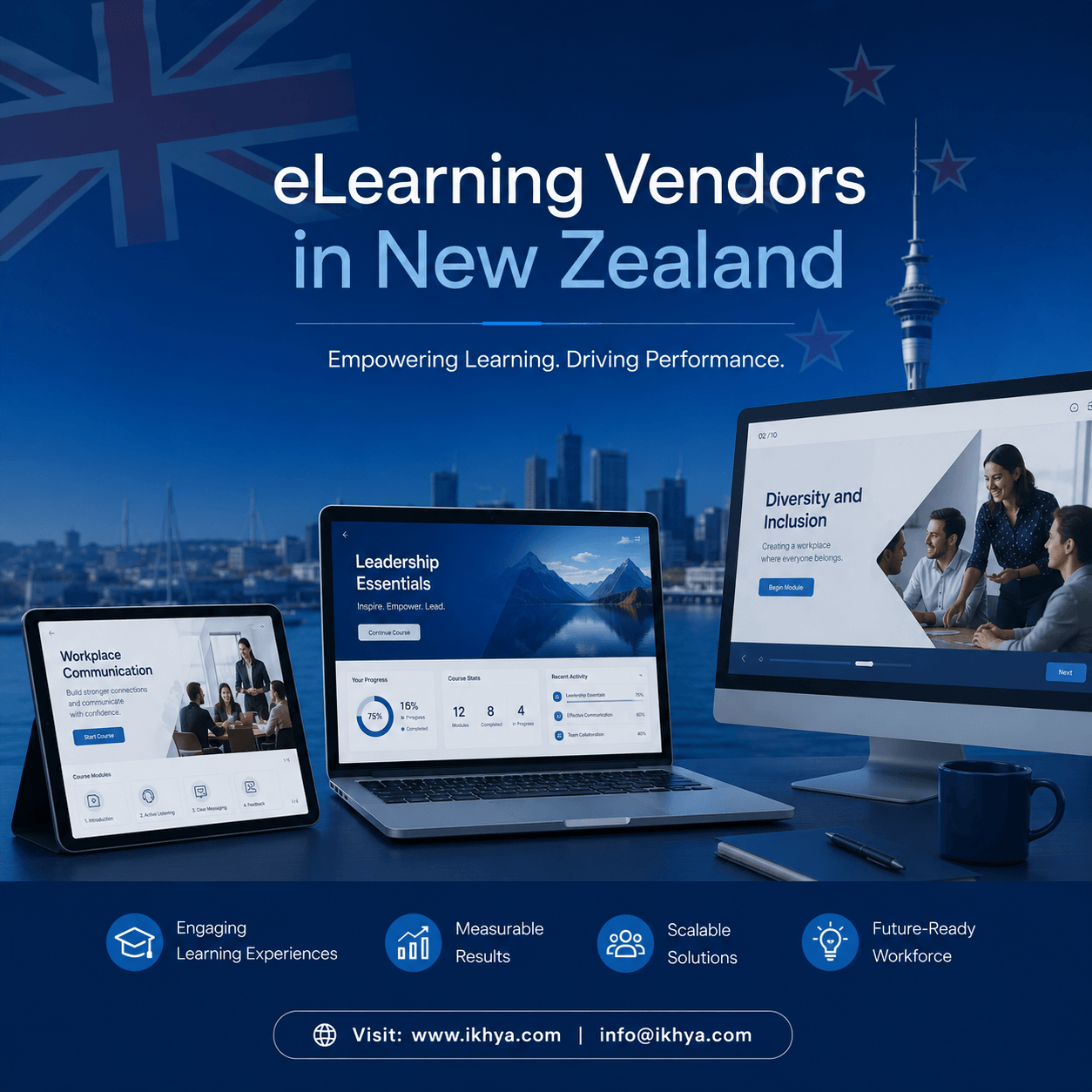



eLearning Vendors in New Zealand
eLearning vendors in New Zealand are helping organisations improve staff training, compliance delivery, and workforce development across distributed teams. Many businesses now need digital learning systems that support remote employees, simplify onboarding, and reduce training delays. Providers in this market offer different levels of instructional design, LMS support, localisation, and reporting capabilities, so choosing the right partner requires careful evaluation.
Poor vendor selection often leads to low course completion rates, weak learner engagement, and expensive redevelopment work later.
IKHYA supports organisations across New Zealand with tailored learning solutions. Contact the team directly at info@ikhya.com.
Why New Zealand Organisations Are Reassessing Their eLearning Strategy
eLearning vendors in New Zealand now play an important role in workforce development, compliance training, and operational consistency. Organisations across healthcare, education, logistics, finance, and retail increasingly depend on digital learning to train distributed employees. Many companies also need learning systems that support remote work and flexible onboarding processes.
Traditional classroom training often creates scheduling delays and uneven learning outcomes. Businesses across New Zealand are replacing manual training methods with digital learning systems that improve tracking and reduce administrative effort. This shift is especially important for organisations with multiple sites or field-based employees.
The New Zealand market also faces growing pressure around compliance reporting and workforce retention. Companies need learning systems that support measurable outcomes rather than static content libraries. Strong vendors now focus on instructional design, learner engagement, analytics, and long-term programme management instead of course production alone.
Decision-makers evaluating eLearning vendors in New Zealand should compare providers carefully. Technology capabilities, localisation support, learner experience, and implementation planning all affect long-term success. The right partner helps organisations improve training quality while reducing operational friction.
eLearning Companies Operating Across New Zealand Businesses
- IKHYA – eLearning Solutions Company provides custom digital learning services for organisations that need scalable training delivery, instructional design, LMS implementation, and compliance-focused learning programmes across New Zealand industries.
- RedSeed focuses on workforce learning for retail and customer-facing organisations. Its platform combines training content, operational learning, and performance support tools.
- LearningWorks develops workplace learning content and digital education programmes for corporate and vocational environments. The company supports blended learning delivery and customised training frameworks.
- Wavelength delivers digital learning and organisational capability programmes for businesses seeking structured employee development and online learning support.
- The Career Academy provides online education and professional development programmes with flexible learning delivery models for individuals and organisations.
- Catalyst supports digital transformation and online learning projects through technical consulting, open-source learning systems, and integration services.
- Pipi Learning creates culturally relevant digital learning experiences with a focus on learner engagement and accessible content delivery.
- Intuto offers cloud-based learning management systems designed for staff onboarding, compliance management, and employee training workflows.
- Synapsys develops digital learning experiences and training support systems for organisations managing operational training across multiple locations.
- Synapsys also supports organisations needing scalable digital learning deployment and structured employee education initiatives.
Understanding the New Zealand eLearning Market Before Vendor Selection
The Compliance Training Pressure Facing New Zealand Organisations
Compliance training has become one of the main reasons organisations invest in digital learning systems. Businesses in healthcare, finance, manufacturing, and transport sectors must prove that employees completed mandatory training. Manual spreadsheets and paper records create reporting gaps that increase operational risk.
eLearning vendors in New Zealand now build systems with audit tracking, automated reminders, and reporting dashboards. These tools help HR and compliance teams monitor training progress without spending hours on administrative work. Organisations also benefit from faster policy updates because digital content can be revised quickly across all locations.
Why Distributed Workforces Need Flexible Learning Systems
Remote work and geographically spread teams have changed how organisations approach staff development. Employees often work across regional offices, customer sites, warehouses, or mobile environments. Traditional classroom delivery no longer supports operational flexibility.
Modern eLearning vendors in New Zealand focus heavily on mobile learning, self-paced training, and cloud-based access. Staff can complete training during operational downtime instead of travelling to central locations. This improves learning consistency while reducing scheduling problems for managers.
Digital Skills Development Across New Zealand Industries
Many organisations now face digital capability gaps among employees. Software adoption, cybersecurity awareness, and customer service training all require structured learning support. Businesses increasingly need vendors that combine technical delivery with instructional design expertise.
Strong providers create learning journeys instead of isolated courses. This approach improves knowledge retention and supports long-term employee development. Organisations also gain better visibility into learner performance through analytics and progress reporting.
What Strong eLearning Vendors in New Zealand Typically Deliver
Custom Learning Content Development
Custom course development remains one of the most requested services in the New Zealand eLearning market. Organisations often need training aligned with internal systems, operational processes, and local compliance obligations. Generic off-the-shelf courses rarely address company-specific workflows.
Effective vendors begin with learner analysis and business goal mapping before creating content. They use instructional design methods that improve learner engagement through scenario-based activities, interactive assessments, and short learning modules. This helps organisations increase completion rates and reduce learner fatigue.
Learning Management System Implementation
Learning management systems help organisations centralise training delivery and reporting. Vendors typically support LMS selection, system setup, migration planning, and learner onboarding. Businesses also require integration with HR systems and internal authentication tools.
Cloud-based LMS platforms remain common because they reduce infrastructure costs and simplify updates. Many New Zealand organisations prefer systems with mobile compatibility, automated reporting, and user-friendly administration panels. Vendors that provide post-launch support usually create better long-term outcomes.
Learning Strategy and Programme Support
Many organisations underestimate the planning needed for successful digital learning adoption. Strong vendors provide learning strategy support before development begins. This includes audience analysis, rollout planning, governance structures, and measurement frameworks.
Programme support also covers communication planning, learner engagement campaigns, and continuous improvement reviews. Organisations benefit when vendors remain involved after deployment instead of ending support immediately after launch. Long-term collaboration often leads to better learner adoption and measurable business outcomes.
How Professional eLearning Support Improves Business Outcomes
- Faster employee onboarding reduces the time required for new hires to become productive in operational roles. Structured digital learning helps organisations maintain training consistency across different locations and departments.
- Better compliance visibility gives managers clear reporting on training completion and assessment performance. This improves audit readiness and reduces manual administration work for HR teams.
- Consistent workforce training helps employees receive the same information regardless of location or trainer experience. Organisations benefit from fewer operational errors and stronger process alignment.
- Improved learner engagement increases knowledge retention through interactive modules, microlearning, and scenario-based activities. Employees are more likely to complete training when content feels practical and relevant.
- Reduced classroom delivery costs lowers travel expenses, venue requirements, and scheduling disruption. Digital learning also supports flexible access for shift-based teams.
- Scalable learning delivery allows organisations to train growing workforces without rebuilding training systems repeatedly. Vendors can expand programmes as operational requirements change.
Inside the New Zealand eLearning Vendor Market
IKHYA – eLearning Solutions Company
IKHYA is an eLearning solutions company based in New York that supports organisations across New Zealand with digital learning services, custom training systems, and workforce education programmes. Our team works with businesses that need scalable learning delivery across distributed operational environments. We support both enterprise organisations and growing businesses seeking structured digital learning support.
We offer custom eLearning development, instructional design, LMS implementation, onboarding systems, compliance learning, and blended learning programmes. IKHYA provides learner-focused development processes that align training with operational goals rather than generic templates. Our team also supports content localisation and learning analytics integration.
Our experience includes projects across healthcare, retail, manufacturing, logistics, professional services, and regulated business sectors. We understand that New Zealand organisations often require training systems that support compliance documentation and workforce consistency. We also support businesses managing regional teams and remote employees.
IKHYA provides LMS consulting, SCORM development, mobile learning delivery, and cloud-based learning integration support. Our team works with widely used learning platforms while also supporting custom workflow integration requirements. We focus on systems that remain practical for administrators and easy for employees to use.
We work closely with client stakeholders throughout planning, development, testing, and deployment phases. Our engagement model includes regular project reviews, transparent communication, and collaborative content validation. This approach helps organisations maintain alignment between operational goals and training delivery.
Organisations seeking support from experienced eLearning vendors in New Zealand can contact our team directly at info@ikhya.com. We help businesses build learning programmes that support measurable workforce outcomes and long-term operational improvement.
RedSeed
RedSeed supports retail and operational workforce training through digital learning systems focused on frontline employees. The company combines training delivery with operational performance support tools. Its services are commonly used by retail businesses seeking scalable onboarding and product knowledge programmes.
LearningWorks
LearningWorks develops workplace learning solutions for vocational and corporate training environments. The company supports blended learning initiatives, instructional design projects, and customised digital course development. Its work often focuses on practical workforce capability development.
Wavelength
Wavelength provides organisational learning support and digital training services for businesses managing employee development programmes. The company supports online learning delivery and structured training frameworks. Its services are used across professional and operational sectors.
The Career Academy
The Career Academy offers online education and workforce development programmes with flexible digital delivery methods. The organisation supports both individual learners and employer-sponsored training initiatives. Its services include vocational learning and professional development support.
Catalyst
Catalyst supports digital learning infrastructure projects and open-source learning platform implementation. The company works with organisations requiring technical consulting and integration services. It also supports digital transformation projects linked to learning delivery.
Pipi Learning
Pipi Learning focuses on accessible and culturally relevant learning experiences. The company develops engaging digital learning programmes designed for practical workforce education. Its work supports learner inclusion and training accessibility.
Intuto
Intuto offers cloud-based LMS solutions designed for employee training management. The platform supports onboarding workflows, compliance tracking, and online course delivery. Businesses often use the system for operational workforce training.
Synapsys
Synapsys develops digital learning support systems and workforce training programmes. The company supports organisations managing operational training at scale. Its services include digital course development and learning deployment support.
Synapsys
Synapsys also provides structured digital learning services for organisations seeking scalable employee education systems. The company supports workforce capability development through online learning deployment and training management support.
How New Zealand eLearning Vendors Compare Across Key Criteria
| Company | Primary Focus | LMS Support | Custom Content | Compliance Training | Industries Supported | Delivery Model |
|---|---|---|---|---|---|---|
| IKHYA | Custom enterprise learning | Yes | Yes | Strong focus | Multi-sector | End-to-end services |
| RedSeed | Retail workforce learning | Yes | Limited customisation | Moderate | Retail | Platform-based |
| LearningWorks | Workplace education | Yes | Yes | Moderate | Corporate and vocational | Blended learning |
| Wavelength | Employee capability | Moderate | Yes | Limited | Professional sectors | Digital programmes |
| The Career Academy | Professional education | Limited | Limited | Low | Education and training | Online courses |
| Catalyst | Technical consulting | Strong | Moderate | Moderate | Government and enterprise | Technical implementation |
| Pipi Learning | Accessible learning | Moderate | Yes | Moderate | Community and workforce | Digital learning |
| Intuto | LMS platform | Strong | Limited | Strong focus | Operational sectors | Cloud-based platform |
| Synapsys | Operational training | Moderate | Yes | Moderate | Business operations | Digital delivery |
| Synapsys | Employee learning support | Moderate | Moderate | Moderate | Corporate sectors | Online learning |
Understanding eLearning Project Budgets in New Zealand
Project pricing depends on course complexity, learner volume, compliance requirements, and platform integration needs. Organisations should compare long-term support costs instead of focusing only on initial development pricing.
| Project Type | Typical Scope | Estimated Range | Main Pricing Factors |
|---|---|---|---|
| Basic onboarding course | Single module with assessments | NZD 3,000–8,000 | Content length and media usage |
| Compliance programme | Multi-module workforce training | NZD 8,000–20,000 | Reporting and certification needs |
| Custom LMS deployment | Platform setup and migration | NZD 10,000–40,000 | Integration and user scale |
| Enterprise learning ecosystem | Multi-department implementation | NZD 40,000+ | Customisation and support scope |
Organisations seeking tailored project estimates can contact IKHYA directly at info@ikhya.com.
The Platforms Used by eLearning Vendors in New Zealand
| Tool or Platform | Primary Use | Best Fit | Adoption Level |
|---|---|---|---|
| Moodle | Learning management | Education and enterprise | High |
| Articulate 360 | Course authoring | Interactive eLearning | High |
| Adobe Captivate | Simulation learning | Technical training | Moderate |
| Docebo | Enterprise LMS | Large organisations | Moderate |
| TalentLMS | Cloud learning delivery | SMEs | Moderate |
| Microsoft Teams | Virtual training support | Hybrid workplaces | High |
How an eLearning Project Moves From Planning to Launch
| Phase | Key Activities | Client Involvement | Typical Duration |
|---|---|---|---|
| Discovery | Business analysis and scope definition | High | 1–2 weeks |
| Learning Strategy | Audience planning and objectives | High | 1–2 weeks |
| Content Planning | Script and storyboard creation | Moderate | 2–3 weeks |
| Design | Visual and interaction design | Moderate | 2 weeks |
| Development | Course production and LMS setup | Low to moderate | 3–6 weeks |
| Testing | User acceptance and QA reviews | High | 1–2 weeks |
| Deployment | Launch and learner onboarding | Moderate | 1 week |
| Post-Launch Support | Analytics review and updates | Moderate | Ongoing |
How New Zealand Industries Use Digital Learning
| Industry | Common Training Topics | Main Challenges | Preferred Delivery Format |
|---|---|---|---|
| Healthcare | Compliance and patient safety | Shift scheduling | Mobile learning |
| Retail | Customer service and product training | High staff turnover | Microlearning |
| Manufacturing | Safety and process training | Operational downtime | Blended learning |
| Finance | Regulatory compliance | Audit requirements | LMS-based learning |
| Government | Policy and process education | Large workforce scale | Structured online modules |
| Logistics | Operational workflows | Distributed teams | Mobile-first training |
Where eLearning Delivery in New Zealand Is Heading Next
AI-Supported Learning Personalisation Across Workforce Training
Organisations increasingly want training systems that adapt to learner behaviour and performance. AI-supported learning tools can recommend content, adjust learning pathways, and improve assessment feedback. This creates more relevant learning experiences for employees.
eLearning vendors in New Zealand are beginning to integrate analytics-driven recommendations into enterprise learning systems. Businesses benefit from stronger learner engagement and better visibility into skill development patterns. Personalised learning also helps reduce unnecessary training repetition.
The Rise of Mobile Learning Among Operational Workforces
Mobile learning continues to grow because many employees work outside traditional office environments. Field workers, warehouse teams, and retail employees often complete learning on smartphones or tablets. Desktop-only learning systems no longer support operational flexibility.
Vendors now prioritise responsive course design and short learning modules. Organisations gain higher completion rates when employees can access learning during natural workflow gaps. Mobile learning also supports faster rollout of urgent compliance updates.
Why Data Reporting Is Becoming Essential for Learning Decisions
Businesses increasingly expect measurable outcomes from training investments. Reporting dashboards help managers track learner engagement, assessment performance, and completion trends. This data supports operational planning and workforce development decisions.
Modern eLearning vendors in New Zealand now build reporting capabilities directly into learning ecosystems. Organisations can identify knowledge gaps earlier and adjust programmes before problems affect performance. Better reporting also supports executive-level visibility into training impact.
Scenario-Based Learning as a Workforce Performance Tool
Scenario-based learning is becoming more common because it improves practical knowledge retention. Employees learn through realistic workplace situations instead of passive information slides. This approach helps staff apply knowledge more effectively in operational environments.
Many New Zealand organisations now request interactive learning experiences that reflect real workplace conditions. Vendors that understand operational workflows often produce stronger training outcomes. Scenario-based learning is especially useful in safety-sensitive industries.
How to Assess eLearning Vendors in New Zealand Before Signing
Organisations should evaluate vendors based on operational fit rather than presentation quality alone. Long-term support, learner engagement, and reporting capabilities often matter more than visual design trends.
- Industry experience shows whether the vendor understands compliance pressures and operational realities in your sector. This reduces redevelopment work later in the project.
- Instructional design capability affects how well employees retain and apply knowledge after training. Strong learning structure improves engagement and completion rates.
- LMS support expertise determines how smoothly the platform integrates with internal systems and workflows. Weak implementation planning often creates adoption problems.
- Scalability planning ensures the learning system can support workforce growth and future training needs. Organisations should avoid solutions that require complete rebuilding later.
- Content localisation matters for organisations serving diverse learner groups and regional teams. Training should reflect operational language and workplace context.
- Reporting and analytics help organisations track performance, compliance, and learner engagement. Good reporting improves decision-making across HR and operations.
- Post-launch support determines whether the vendor remains involved after deployment. Ongoing support improves long-term learning effectiveness.
- Communication and project management affect delivery timelines and stakeholder alignment. Clear collaboration processes reduce project delays.
Businesses comparing eLearning vendors in New Zealand should request workflow examples, implementation plans, and reporting demonstrations before committing to a provider.
How IKHYA Supports New Zealand Organisations
IKHYA works with organisations that need practical learning systems aligned with operational goals. We focus on workforce outcomes, learner engagement, and scalable training delivery instead of template-driven content production.
Our team supports custom eLearning development, onboarding systems, LMS implementation, compliance learning, and blended learning programmes across multiple industries. We also help organisations improve reporting visibility and learner adoption through structured deployment planning.
We understand that New Zealand businesses often manage distributed teams and changing compliance requirements. IKHYA provides flexible learning models that support remote access, mobile learning, and measurable workforce development.
Our approach combines instructional design, technology support, and collaborative project management. We work closely with client teams throughout planning, testing, deployment, and optimisation phases to maintain operational alignment.
Organisations seeking experienced support for digital learning strategy and delivery can contact IKHYA directly at info@ikhya.com.
Start Your eLearning Project With a Team That Understands New Zealand Organisations
Selecting the right eLearning vendor affects workforce performance, compliance visibility, employee engagement, and operational consistency. Organisations should look beyond visual design and focus on strategic capability, implementation planning, and long-term support.
Businesses across New Zealand increasingly need scalable digital learning systems that support remote work, onboarding, and continuous workforce development. A structured learning strategy helps organisations reduce training inefficiencies while improving employee performance outcomes.
IKHYA supports organisations with tailored digital learning solutions designed around practical operational goals. To discuss your training requirements, contact the team directly at info@ikhya.com.
FAQs
Related Top eLearning Companies & Solutions in the New Zealand
New Zealand organizations are adopting digital learning to support hybrid workforces, compliance training, multilingual learning, and workforce development. Businesses increasingly rely on eLearning solutions to improve onboarding, employee engagement, and operational consistency.
Explore leading eLearning providers, LMS platforms, instructional design specialists, and compliance training solutions across New Zealand.
At IKHYA – eLearning Solutions Company, we design impactful, compliance-driven, and performance-focused digital learning solutions tailored to your business goals.
🎯 Custom eLearning Course Development
⚡ Rapid eLearning & PPT Conversion
📊 Workplace Compliance Training
🌍 Localization & LMS-Ready Modules