How eLearning Providers Handle SCORM, xAPI, and LMS Integration: A Complete Guide

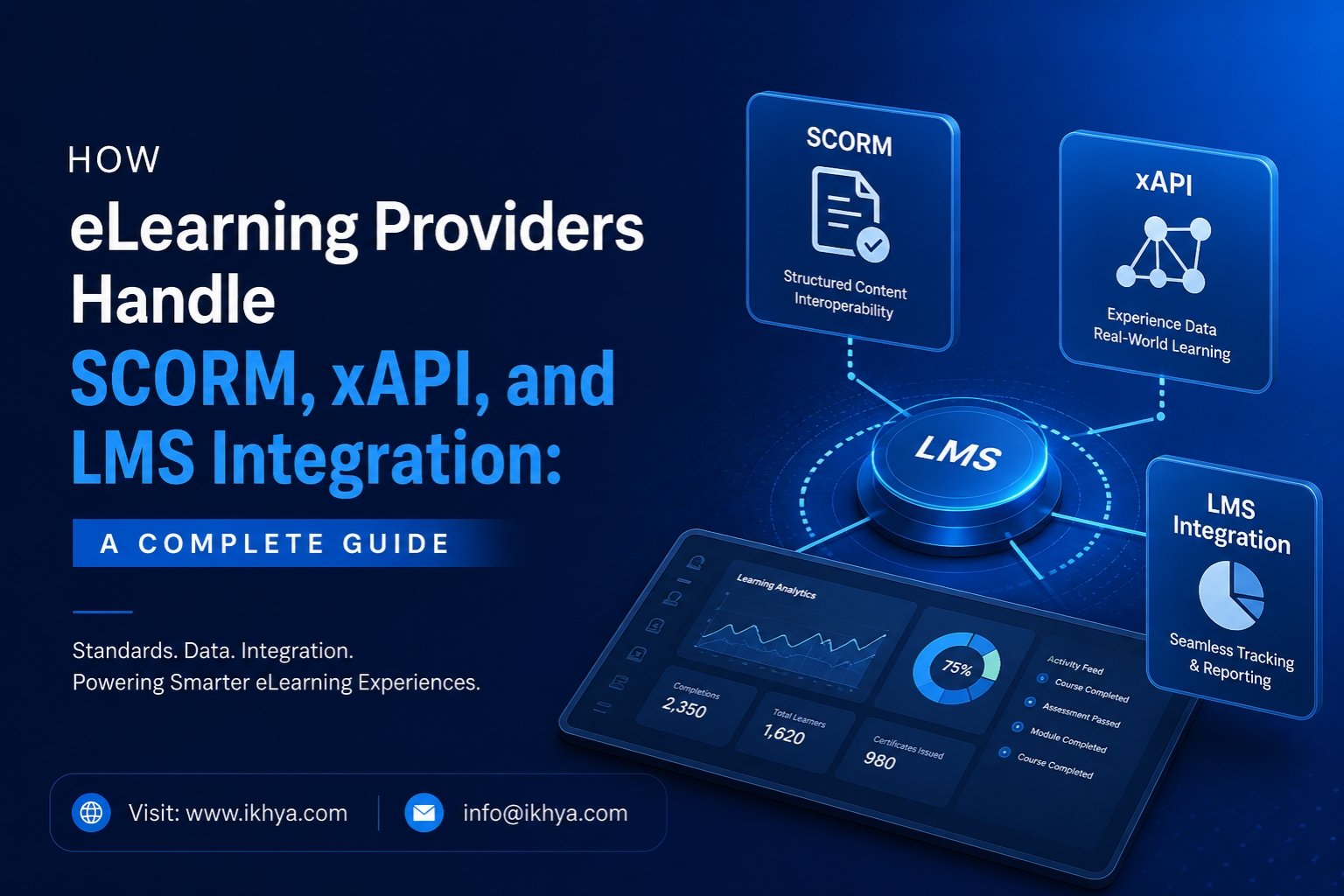
How eLearning Providers Handle SCORM is one of the most common questions businesses ask when planning online training. Many companies struggle to understand how SCORM works, how it connects with LMS platforms, and whether they need expert help. This guide explains everything in simple terms. You will learn how providers create, package, and integrate SCORM courses, how xAPI fits in, and what it costs.
If you are looking for a reliable partner like IKHYA – eLearning Solutions Company, this guide will help you make the right decision and take the next step with confidence.
What is SCORM and Why It Still Matters in eLearning
SCORM stands for Sharable Content Object Reference Model. It is a standard used to make eLearning courses work smoothly inside Learning Management Systems (LMS).
In simple words, SCORM allows:
- Courses to be uploaded into any LMS
- Learner progress to be tracked
- Reports to be generated easily
Even today, SCORM is widely used because it is:
- Reliable
- Compatible with most LMS platforms
- Easy to implement compared to newer standards
For businesses, SCORM ensures that training content works consistently across systems without technical issues.
How eLearning Providers Handle SCORM Step-by-Step
This is the most important part. Understanding how eLearning Providers handle SCORM helps you see the real value they bring.
Step 1 – Understanding Learning Requirements
Providers start by understanding:
- Business goals
- Target audience
- Training outcomes
This step ensures the course is not just technical but also effective.
Many companies rely on Instructional Design Services to create structured and engaging learning experiences.
Step 2 – Instructional Design and Content Structuring
Here, the content is planned and organized.
This includes:
- Storyboarding
- Defining learning flow
- Creating assessments
A strong design ensures the course works well in SCORM format and delivers measurable results.
Step 3 – SCORM Course Development Using Authoring Tools
At this stage, developers use tools like:
- Articulate Storyline
- Adobe Captivate
They create:
- Interactive modules
- Quizzes
- Multimedia content
In many real-world projects, existing training materials are reused and converted into SCORM-compliant formats. For a deeper understanding of how this process works, this guide on converting PowerPoint into SCORM-based eLearning explains the approach in detail.
Step 4 – SCORM Packaging and Compliance Testing
Once the course is ready, it is converted into a SCORM package.
This includes:
- Creating a ZIP file
- Ensuring SCORM 1.2 or SCORM 2004 compliance
- Testing in SCORM Cloud or LMS
This step is critical to avoid errors after upload.
Step 5 – Uploading and Integration with LMS
The SCORM package is uploaded into the LMS.
Providers ensure:
- Smooth integration
- Course launches correctly
- Tracking works properly
If you are unsure how to proceed, you can always Request RFP to get expert guidance.
Step 6 – Tracking, Reporting, and Optimization
After deployment, providers monitor:
- Completion rates
- Scores
- Learner engagement
Based on data, they improve the course for better performance.
SCORM vs xAPI – How eLearning Providers Choose the Right Standard
Both SCORM and xAPI are used in eLearning, but they serve different purposes.
Key Differences Between SCORM and xAPI
| Feature | SCORM | xAPI |
|---|---|---|
| Tracking | Basic (completion, score) | Advanced (behavior tracking) |
| Offline Learning | Not supported | Supported |
| Data Storage | LMS only | Learning Record Store (LRS) |
| Flexibility | Limited | Highly flexible |
When Providers Prefer SCORM
- Standard LMS training
- Compliance training
- Simple tracking needs
When xAPI is the Better Choice
- Advanced analytics
- Mobile learning
- Offline learning
Many eLearning Providers combine both for better results.
How LMS Integration Works with SCORM Content
Understanding LMS integration is important for smooth learning delivery.
SCORM Upload Process in LMS
- Upload SCORM ZIP file
- Configure settings
- Assign course to learners
Common LMS Compatibility Challenges
- Version mismatch
- Tracking errors
- Content not loading
How Providers Solve Integration Issues
Experienced teams:
- Test across multiple LMS
- Fix compatibility issues
- Optimize performance
You can Book a Free eLearning Demo to see how integration works in real projects.
Tools and Technologies Used by eLearning Providers
Providers use a mix of tools for development and testing:
- Authoring tools
- LMS platforms
- SCORM testing tools
These tools ensure quality and compatibility.
Common Challenges in SCORM Implementation (and Solutions)
- Challenge 1: LMS Compatibility Issues
Solution: Proper testing before deployment
- Challenge 2: Limited Tracking
Solution: Use xAPI where needed
- Challenge 3: Content Errors
Solution: Follow SCORM standards strictly
Why Businesses Choose eLearning Providers for SCORM Development
Companies prefer experts because:
- They save time
- They reduce technical errors
- They ensure high-quality output
A professional eLearning Vendor can handle everything from design to deployment.
Cost of SCORM eLearning Development (With Examples)
Pricing depends on complexity, length, and customization.
Estimated Pricing
| Course Type | Duration | Cost (USD) |
|---|---|---|
| Basic Course | 30 mins | $1,000 – $3,000 |
| Interactive Course | 60 mins | $3,000 – $8,000 |
| Advanced Simulation | 60+ mins | $8,000 – $20,000 |
What Affects Cost
- Level of interactivity
- Multimedia usage
- Customization needs
How to Choose the Right eLearning Provider for SCORM Projects
When selecting a provider, consider:
- Experience in SCORM
- LMS integration expertise
- Portfolio and case studies
- Support and maintenance
A trusted partner like IKHYA – eLearning Solutions Company offers complete eLearning Services tailored to your needs.
Conclusion
Understanding how eLearning Providers Handle SCORM helps you make better decisions for your training programs. From design to LMS integration, every step requires expertise and careful planning. Choosing the right partner ensures your courses are effective, scalable, and future-ready.
If you are planning your next eLearning project, you can Contact Us to discuss your requirements, Request RFP for detailed solutions, or Book a Free eLearning Demo to see how it works in action.
FAQs Related to How eLearning Providers Handle SCORM?
Q1. What does “How eLearning Providers Handle SCORM” actually mean?
It refers to the complete process eLearning providers use to design, develop, package, and integrate SCORM-compliant courses into an LMS. This includes ensuring compatibility, tracking learner progress, and testing performance.
Q2. Why is SCORM important for eLearning courses?
SCORM ensures that courses can work across different LMS platforms and allows tracking of learner progress, scores, and completion. It makes training content reusable and consistent.
Q3. How do eLearning providers create SCORM-compliant courses?
They use authoring tools like Articulate Storyline or Adobe Captivate to build interactive courses, then package them into SCORM format and test them for LMS compatibility.
Q4. What is the difference between SCORM and xAPI in eLearning?
SCORM tracks basic data like completion and scores, while xAPI tracks detailed learner behavior, including offline and mobile learning activities.
Q5. Can SCORM courses work in any LMS?
Most modern LMS platforms support SCORM, but compatibility can vary depending on the SCORM version (1.2 or 2004) and LMS configuration.
Q6. How do providers ensure SCORM courses work correctly in LMS?
They test courses using tools like SCORM Cloud and perform multiple checks inside the LMS to ensure proper functionality and tracking.
Q7. What are the common challenges in SCORM implementation?
Common issues include LMS compatibility problems, tracking errors, and content loading failures. Providers solve these through testing and optimization.
Q8. How long does it take to develop a SCORM course?
It depends on complexity. A basic course may take 1–2 weeks, while advanced interactive courses can take several weeks or months.
Q9. What tools do eLearning providers use for SCORM development?
Popular tools include Articulate Storyline, Adobe Captivate, and iSpring Suite, along with LMS platforms and testing tools.
Q10. Is SCORM still relevant today?
Yes, SCORM is still widely used because it is reliable, simple, and supported by most LMS platforms worldwide.
Q11. When should a business choose xAPI over SCORM?
xAPI is better when you need advanced tracking, mobile learning, offline access, or detailed analytics beyond basic completion data.
Q12. How much does SCORM eLearning development cost?
Costs vary from $1,000 to $20,000 or more depending on course complexity, interactivity, and customization.
Q13. Do eLearning providers handle LMS integration as well?
Yes, most providers manage the full process, including uploading SCORM packages, configuring LMS settings, and ensuring proper tracking.
Q14. What is SCORM packaging in eLearning?
SCORM packaging involves converting the course into a ZIP file with specific files and structure so it can be uploaded and run inside an LMS.
Q15. Can existing training materials be converted into SCORM courses?
Yes, providers can convert PPTs, documents, or instructor-led training into SCORM-compliant eLearning modules.
Q16. How do eLearning providers improve SCORM course performance?
They analyze learner data, update content, improve interactivity, and optimize user experience based on feedback.
Q17. What should I look for in an eLearning provider for SCORM projects?
Look for experience in SCORM development, LMS integration expertise, strong portfolio, and ongoing support services.
Q18. Is SCORM suitable for mobile learning?
SCORM has limitations for mobile and offline tracking. For better mobile experiences, providers may use xAPI.
Q19. Can SCORM track detailed learner behavior?
No, SCORM tracks basic data like completion and scores. For deeper insights, xAPI is preferred.
Q20. Why should I hire an eLearning provider instead of doing it in-house?
Providers bring expertise, save time, reduce technical risks, and deliver high-quality SCORM courses that work seamlessly across LMS platforms.
Take the Next Step with Expert eLearning Solutions
If you are planning to build SCORM-based eLearning courses or struggling with LMS integration, the right expertise can make all the difference. A well-designed and properly integrated course not only improves learning outcomes but also saves time and reduces technical issues.
IKHYA – eLearning Solutions Company offers end-to-end support—from instructional design to SCORM development and seamless LMS integration—so you can focus on your business goals while experts handle the complexity.
Whether you need a new course, want to upgrade existing content, or explore advanced tracking with xAPI, now is the right time to take action.
- Request RFP to get a customized solution tailored to your needs
- Book a Free eLearning Demo to see real project workflows in action
- Contact Us to discuss your requirements with experts
Start building smarter, scalable, and high-performing eLearning experiences today.