
Ultimate Guide: eLearning Localization Services vs Translation Services – Which One Is Right for You?

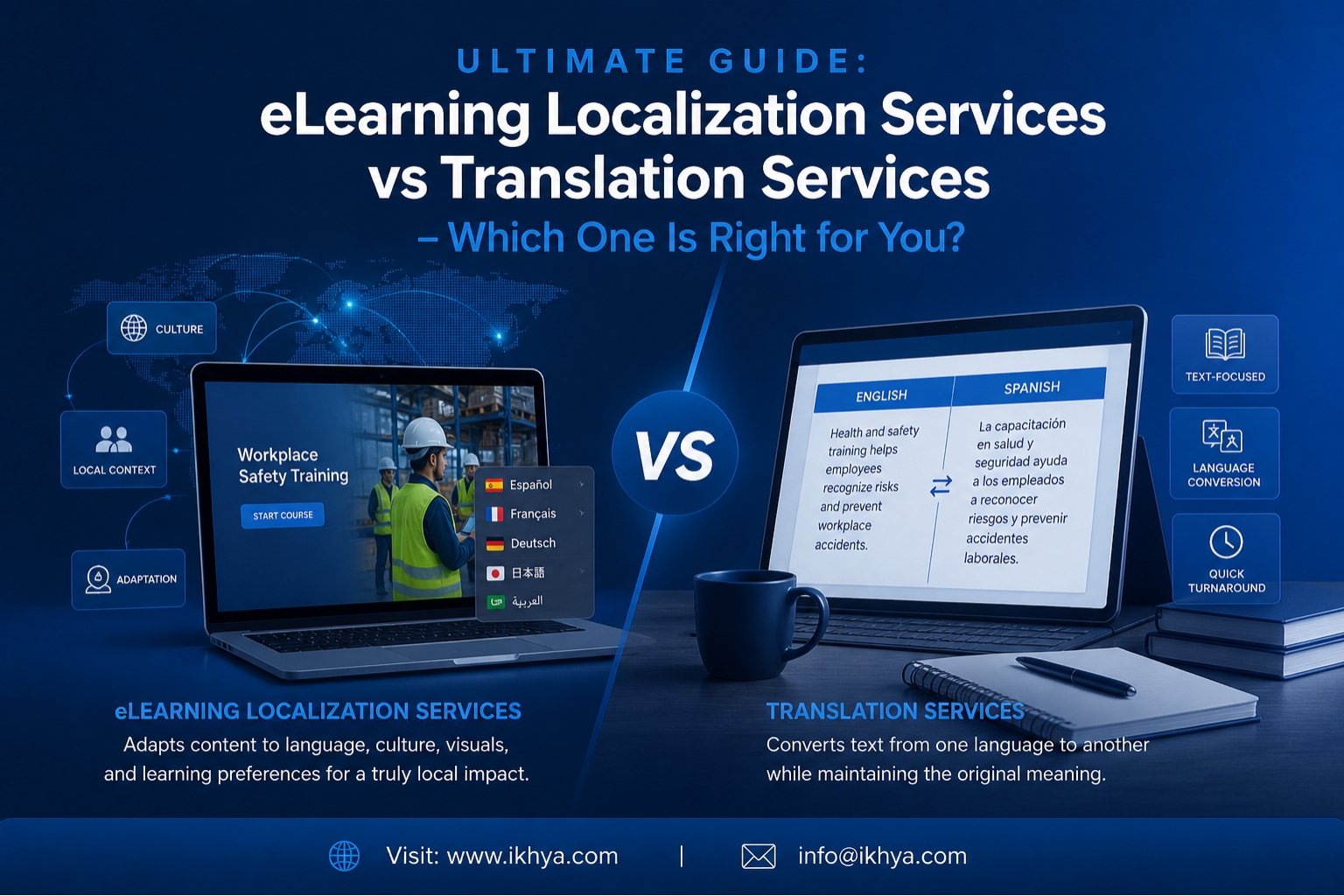
When organizations expand globally, one common challenge is choosing between eLearning Localization Services vs Translation Services. Many businesses think both are the same, but they serve very different purposes. Choosing the wrong approach can lead to poor learner engagement, compliance issues, and wasted budget.
In this guide, you will learn the exact difference, when to use each service, and how to make the right decision for your organization. If you are planning global training, this will help you avoid costly mistakes and get better results.
If you need expert help, you can connect with IKHYA – eLearning Solutions Company or Book a Free eLearning Demo to explore the best approach for your needs.
What Are eLearning Translation Services?
eLearning translation services focus on converting content from one language to another while keeping the original meaning intact. It is mainly about language accuracy, not cultural adaptation.
For example, if your training course is in English, translation services will convert it into Spanish, French, or Arabic word by word.
Key Features of Translation Services
- Converts text into another language
- Keeps original structure unchanged
- Faster and more cost-effective
- Ideal for simple content
Where Translation Works Best
- Internal documents
- Basic training modules
- Informational content
- Non-customer-facing materials
Many organizations use eLearning Translation Services when they need quick multilingual support without major changes.
What Are eLearning Localization Services?
eLearning localization services go beyond translation. They adapt your content to match culture, language, visuals, tone, and learning preferences of a specific region.
Localization ensures that learners feel the content is created specifically for them.
Key Features of Localization
- Adapts language and tone
- Changes images, examples, and scenarios
- Adjusts formats (date, currency, etc.)
- Improves learner engagement
Example
A safety training course in the USA may include American workplace examples. When localized for the UAE, it will include region-specific workplace rules, visuals, and cultural references.
This is where eLearning Translation & Localization becomes critical for global success.
eLearning Localization Services vs Translation Services – Key Differences
Understanding the difference clearly helps you make better decisions.
Comparison Table
| Feature | Translation Services | Localization Services |
|---|---|---|
| Focus | Language conversion | Cultural adaptation |
| Scope | Text only | Text + visuals + context |
| Complexity | Low | High |
| Cost | Lower | Higher |
| Engagement | Moderate | High |
| Best For | Simple content | Global training |
- Scope of Work: Translation only handles text. Localization includes audio, visuals, UI, and learner experience.
- Cultural Adaptation: Translation does not consider culture. Localization ensures content fits local expectations and norms.
- Cost Differences: Localization costs more because it involves multiple layers of customization.
- Time & Complexity: Translation is faster. Localization takes more time but delivers better results.
When Should You Choose Translation Services?
Translation is a good choice when your goal is speed and cost efficiency.
Ideal Scenarios
- Limited budget
- Internal training
- Quick rollout
- Non-sensitive content
For example, converting onboarding documents into multiple languages can be handled with Rapid eLearning Development Services combined with translation.
When Should You Choose eLearning Localization Services?
Localization is the best option when impact and engagement matter.
Ideal Scenarios
- Global workforce training
- Compliance training
- Customer-facing courses
- Cultural-sensitive topics
For instance, compliance training in healthcare or finance requires localized content to avoid misunderstandings.
Organizations often combine localization with Instructional Design Services to improve learning outcomes.
Cost Comparison: Localization vs Translation (USD)
Understanding cost helps in planning your budget effectively.
Pricing Table
| Service Type | Average Cost (USD) | Description |
|---|---|---|
| Translation | $0.08 – $0.20 per word | Basic language conversion |
| Localization | $5 – $25 per slide/minute | Full adaptation |
| Multimedia Localization | $20 – $100 per minute | Includes audio, video |
ROI Perspective
- Translation saves cost but may reduce engagement
- Localization increases cost but improves completion rates and learning effectiveness
Choosing the right option depends on your business goals.
Real-World Use Cases
- Corporate Training: Global companies use localization to ensure consistent training across regions.
- Compliance Training: Localized training ensures employees understand legal requirements in their region.
- Product Training: Localization helps customers understand products better in their native language.
- Conversion Projects: Many organizations convert classroom training into digital using ILT to eLearning Course Conversion and then localize it for global teams.
Common Mistakes Organizations Make
Choosing the wrong approach can lead to serious issues.
- Using Translation for Cultural Content: This leads to confusion and poor engagement.
- Ignoring Local Regulations: Compliance training without localization can cause legal risks.
- Focusing Only on Cost: Cheap solutions may reduce learning effectiveness.
- Not Choosing the Right Partner: Working with inexperienced vendors can impact quality.
How to Choose the Right eLearning Partner
Selecting the right partner is critical for success.
What to Look For
- Experience in global projects
- Strong localization expertise
- End-to-end solutions
- Proven results
Working with an experienced elearning development company ensures better outcomes.
You can also Request RFP to evaluate solutions tailored to your needs.
Why IKHYA is the Right Choice for Global eLearning
IKHYA – eLearning Solutions Company provides complete solutions for organizations looking to scale training globally.
What Makes IKHYA Different
- Expertise in customized e Learning Solutions
- Strong focus on learner engagement
- Global delivery capabilities
- End-to-end services
From Custom eLearning Development Services to localization, IKHYA helps businesses deliver impactful learning experiences.
If you want expert guidance, you can Contact Us to discuss your project requirements.
Final Thoughts
Choosing between eLearning Localization Services vs Translation Services is not just a technical decision—it is a business decision.
If your goal is simple language conversion, translation is enough. But if you want to improve engagement, ensure compliance, and deliver better learning outcomes, localization is the right choice.
The key is to align your decision with your training goals, audience, and budget.
For organizations planning global training programs, working with the right partner makes all the difference.
You can start by exploring eLearning Services In USA or connect with experts to build a strategy that works for your business.
FAQs Related to eLearning Localization Services vs Translation Services
Q1. What is the main difference between eLearning localization services vs translation services?
The main difference is that translation focuses only on converting text into another language, while localization adapts the entire learning experience, including culture, visuals, and context. Localization provides better engagement for global audiences.
Q2. When should I use eLearning translation services?
You should use translation services when you need quick and cost-effective language conversion for simple or internal training content where cultural adaptation is not critical.
Q3. When is eLearning localization the better choice?
Localization is better when your training involves global learners, compliance requirements, or customer-facing content where cultural relevance is important for understanding and engagement.
Q4. Is localization more expensive than translation?
Yes, localization is usually more expensive because it includes multiple elements like visuals, audio, and cultural adaptation, while translation only focuses on text.
Q5. Does localization improve learning outcomes?
Yes, localized content improves learner engagement, understanding, and completion rates because it feels more relevant to the audience.
Q6. Can translation alone be enough for global training?
Translation may work for basic content, but for important or sensitive training, localization is recommended to avoid misunderstandings and improve effectiveness.
Q7. What industries need eLearning localization services the most?
Industries like healthcare, finance, manufacturing, and compliance-heavy sectors benefit the most from localization due to strict regulations and diverse global audiences.
Q8. How long does eLearning localization take compared to translation?
Translation is faster because it focuses only on text, while localization takes more time due to additional customization and adaptation processes.
Q9. What are examples of localization in eLearning?
Examples include changing images, adapting scenarios, modifying language tone, and adjusting content to match local culture and regulations.
Q10. Is localization necessary for compliance training?
Yes, localization is often necessary for compliance training to ensure employees clearly understand regional laws and requirements.
Q11. Can I combine translation and localization in one project?
Yes, many organizations start with translation and then apply localization to specific modules that require cultural adaptation.
Q12. What is the cost difference between translation and localization?
Translation typically costs per word, while localization costs per course or module and includes additional services like multimedia adaptation.
Q13. Does localization include voice-over and multimedia changes?
Yes, localization often includes voice-over, subtitles, graphics, and video adjustments to match the target audience.
Q14. How do I choose between localization and translation for my business?
You should consider your audience, training goals, budget, and content type. If engagement and cultural accuracy are important, localization is the better option.
Q15. What are the risks of choosing translation instead of localization?
The main risks include poor learner engagement, cultural misunderstandings, and ineffective training outcomes.
Q16. Are eLearning localization services suitable for small businesses?
Yes, small businesses can benefit from localization, especially if they operate in multiple regions or serve diverse audiences.
Q17. What role does culture play in eLearning localization?
Culture plays a major role in how learners understand and engage with content. Localization ensures the training feels relevant and appropriate.
Q18. Can localization increase training ROI?
Yes, localization can improve ROI by increasing engagement, reducing errors, and improving knowledge retention among learners.
Q19. What should I look for in an eLearning localization provider?
Look for experience, global expertise, strong instructional design, and the ability to deliver customized solutions for different regions.
Q20. How can I get started with eLearning localization services?
You can start by evaluating your training needs, identifying target regions, and consulting with an experienced provider to create a tailored strategy.
Take the Next Step Toward Global eLearning Success
Choosing between eLearning Localization Services vs Translation Services can directly impact how well your global training performs. The right decision helps you improve learner engagement, ensure compliance, and maximize your training investment.
If you are still unsure which approach fits your business, it is always better to consult experts who understand both strategy and execution.
IKHYA – eLearning Solutions Company helps organizations across the USA, UK, Australia, UAE, and globally design, translate, and localize eLearning content that delivers real results.
Whether you need simple translation or full localization, our team can guide you with the right solution based on your goals, audience, and budget.
Take the next step toward effective global training:
- Request a tailored solution → Request RFP
- See how it works in real-time → Book a Free eLearning Demo
- Discuss your requirements → Contact Us
Start building training that truly connects with your global workforce today.




