What Are eLearning Localization Services? Ultimate Guide + Key Differences From Translation

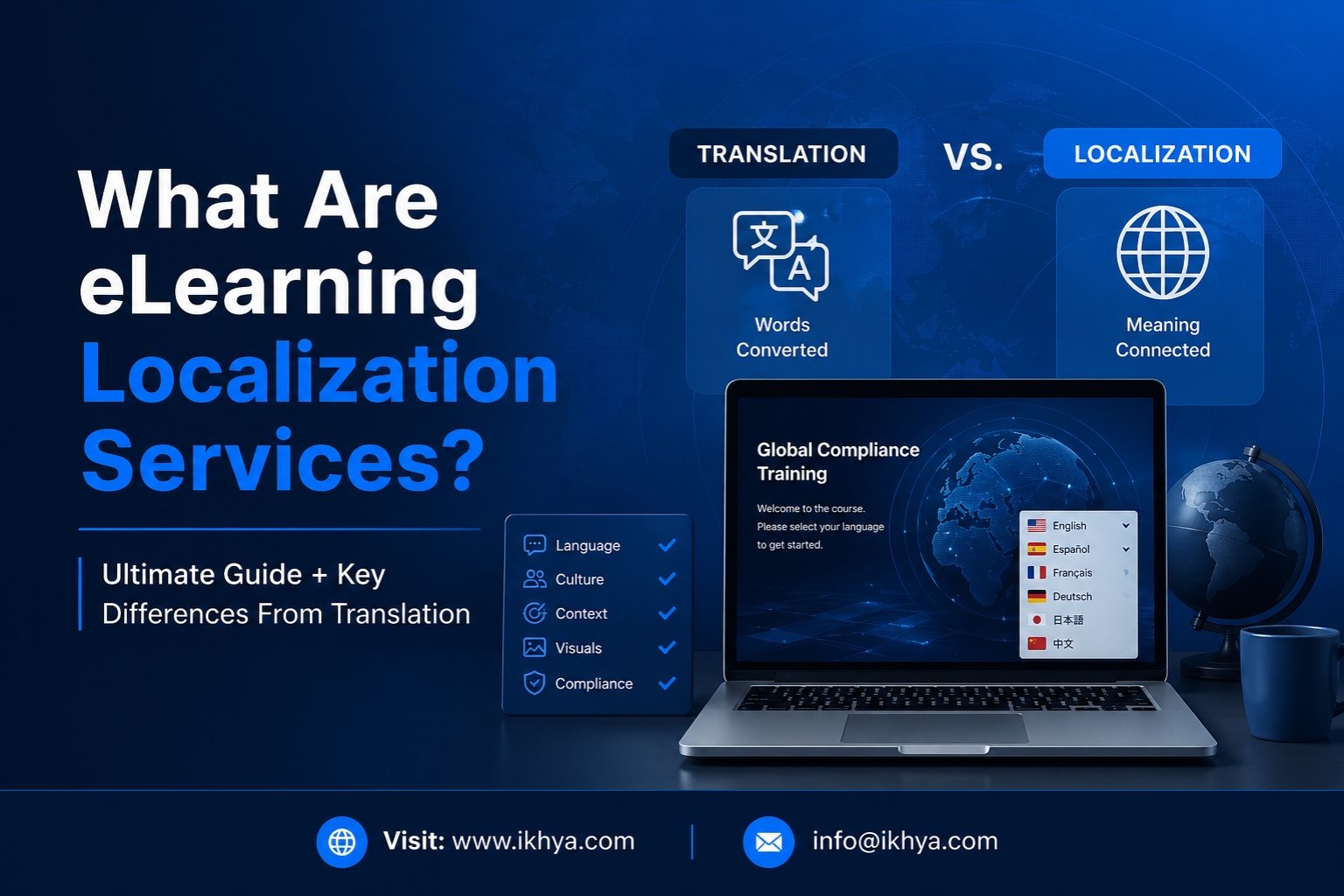
eLearning Localization Services help businesses deliver training that works across different languages, cultures, and regions. Many companies think translation is enough, but that often leads to poor learning results. Localization goes beyond words—it adapts the entire learning experience.
In this guide, you will clearly understand what localization means, how it is different from translation, and why it matters for global training. If you want your workforce to truly understand and apply training, this guide will help you make the right decision.
If you’re planning global training, you can connect with IKHYA – eLearning Solutions Company to explore the right approach for your needs.
What Are eLearning Localization Services?
eLearning Localization Services involve adapting training content so it feels natural and relevant to learners in different countries.
This includes:
- Language translation
- Cultural adaptation
- Visual and design changes
- Voiceovers and audio adjustments
- Technical adjustments for LMS platforms
Unlike simple translation, localization ensures that learners understand content in their own context.
For example, a training created in the US may not work the same way in Japan or UAE unless it is properly localized.
Businesses often combine this with Instructional Design Services to create effective learning experiences from the start.
Why eLearning Localization Services Matter for Global Training
Companies today operate globally. Employees, customers, and partners come from different cultures and languages.
Without localization:
- Training feels confusing
- Engagement drops
- Learning outcomes suffer
With proper localization:
- Learners feel comfortable
- Training becomes relatable
- Knowledge retention improves
Localization is not just about language—it directly impacts business performance.
Many global organizations rely on experienced eLearning Providers who understand both learning and localization.
eLearning Localization Services vs Translation – Key Differences
Understanding this difference is critical when planning global training.
Comparison Table
| Feature | Translation | Localization |
|---|---|---|
| Focus | Words only | Entire learning experience |
| Language | Direct conversion | Context-based adaptation |
| Cultural Fit | Ignored | Fully adapted |
| Visuals | Same as original | Modified if needed |
| Audio | Basic translation | Native voiceovers |
| Learning Impact | Low to medium | High |
What Translation Covers
Translation focuses only on converting text from one language to another. It does not consider cultural tone, examples, or learner behavior.
What Localization Includes
Localization adapts the entire learning experience, including visuals, tone, voiceovers, and user interface. It ensures the course feels locally created, not translated.
Why Translation Alone Fails in eLearning
Translation often fails because learners cannot relate to the content. Cultural mismatches create confusion, and engagement drops significantly.
That is why companies prefer eLearning Translation & Localization instead of only translation services.
Key Components of eLearning Localization Services
A complete localization solution includes multiple elements working together.
- Language Adaptation: Accurate translation with local tone and context.
- Cultural Customization: Adapting examples, visuals, and scenarios to match local expectations.
- UI/UX Localization: Adjusting layouts, navigation, and design for regional usability.
- Multimedia Localization: Voiceovers, subtitles, animations, and interactive elements.
- LMS Compatibility: Ensuring smooth delivery across learning platforms.
Many organizations also use Custom eLearning Development to build fully localized courses from the ground up.
Step-by-Step eLearning Localization Process
A structured process ensures consistent and high-quality results.
- Content Analysis: Review the source content and identify localization needs.
- Translation & Adaptation: Convert content and adapt it for cultural relevance.
- Multimedia Localization: Localize audio, visuals, and interactions.
- Quality Assurance: Test accuracy, usability, and learning effectiveness.
- Deployment: Launch the course and monitor performance.
This approach ensures a seamless and effective learning experience for global audiences.
Real Business Use Cases of eLearning Localization Services
Localization plays a key role across different business scenarios.
- Corporate Training: Deliver consistent training across global teams.
- Compliance Training: Ensure training meets regional regulations.
- Sales Training: Adapt messaging to suit local markets.
- Customer Education: Improve understanding for global users.
Organizations expanding globally often partner with a trusted eLearning Vendor to manage localization efficiently.
Benefits of eLearning Localization Services for Businesses
Localization delivers clear and measurable results:
- Higher learner engagement
- Better knowledge retention
- Faster onboarding
- Reduced errors in training
- Improved global consistency
It helps businesses scale training without losing effectiveness.
If you want to see how this works in practice, consider Book a Free eLearning Demo to explore real examples.
Cost of eLearning Localization Services (With Pricing Insights)
The cost of localization varies depending on several factors.
Estimated Cost Table
| Service Type | Estimated Cost (USD) |
|---|---|
| Basic Translation | $0.08 – $0.15 per word |
| Full Localization | $1,000 – $5,000 per hour of content |
| Voiceover | $100 – $500 per language |
| Multimedia Adaptation | $500 – $3,000 per course |
Factors Affecting Cost
- Number of languages
- Course complexity
- Multimedia elements
- Level of customization
- Delivery timeline
Although localization requires investment, it delivers strong ROI by improving learning outcomes and business performance.
For detailed pricing tailored to your needs, you can Request RFP.
How to Choose the Right eLearning Localization Company
Selecting the right partner is essential for success.
Look for:
- Experience in global training projects
- Strong instructional design expertise
- End-to-end service capability
- Proven results and case studies
- Technology and LMS expertise
Avoid providers who only offer translation without full localization capabilities.
Why IKHYA is the Right Partner for eLearning Localization Services
IKHYA – eLearning Solutions Company provides complete localization solutions designed for global organizations.
Key advantages:
- End-to-end eLearning services
- Industry-specific expertise
- Strong instructional design and localization capabilities
- Focus on measurable business outcomes
You can also explore eLearning Services for a complete solution approach.
Conclusion – Go Beyond Translation, Choose True Localization
Translation alone is not enough for modern global training needs.
eLearning Localization Services ensure that your training is not only understood but also effective across different regions.
If your goal is to create impactful global training, localization is the right strategy.
To get started, reach out via Contact Us and build training that truly connects with your global audience.
FAQ Related to What Are eLearning Localization Services?
Q1. What are eLearning Localization Services?
eLearning Localization Services adapt training content for different languages, cultures, and regions. They go beyond translation by adjusting visuals, tone, and user experience to make learning effective for local audiences.
Q2. How are eLearning localization services different from translation?
Translation only converts text from one language to another, while localization adapts the entire learning experience, including visuals, cultural context, and user interface, to suit the target audience.
Q3. Why is eLearning localization important for global training?
Localization ensures that learners understand and connect with the training content. It improves engagement, knowledge retention, and overall training effectiveness across different regions.
Q4. When should a company use eLearning Localization Services?
Companies should use localization when training employees, customers, or partners across multiple countries where language and cultural differences impact learning outcomes.
Q5. Can translation alone work for eLearning courses?
Translation alone is often not enough because it does not consider cultural differences or learning preferences. This can lead to confusion and reduced engagement.
Q6. What does eLearning localization include?
It includes language adaptation, cultural customization, multimedia adjustments, UI/UX changes, and LMS compatibility to ensure a seamless learning experience.
Q7. How does localization improve learner engagement?
Localization makes content relatable and easy to understand, which helps learners stay interested and interact more with the training material.
Q8. What industries benefit from eLearning Localization Services?
Industries like corporate training, healthcare, finance, retail, manufacturing, and technology benefit from localization when training global teams.
Q9. What is the process of eLearning localization?
The process typically includes content analysis, translation and adaptation, multimedia localization, quality assurance, and final deployment on LMS platforms.
Q10. How long does eLearning localization take?
The timeline depends on course complexity, number of languages, and content type. It can range from a few days to several weeks.
Q11. What is the cost of eLearning Localization Services?
Costs vary based on factors like language count, course length, and multimedia elements. Full localization can range from $1,000 to $5,000 per hour of content.
Q12. How do I choose the right eLearning localization company?
Look for a provider with experience in global training, strong instructional design skills, end-to-end services, and proven results in localization projects.
Q13. What are the benefits of eLearning Localization Services?
Benefits include better engagement, improved learning outcomes, faster onboarding, reduced errors, and consistent global training.
Q14. Does localization include voiceovers and multimedia?
Yes, localization often includes voiceovers, subtitles, animations, and interactive elements adapted for the target audience.
Q15. Can existing eLearning courses be localized?
Yes, existing courses can be adapted through localization without rebuilding them completely, depending on their structure and design.
Q16. What is LMS localization?
LMS localization ensures that the learning platform interface, navigation, and features are adapted for different languages and regions.
Q17. Is localization needed for compliance training?
Yes, compliance training must be localized to meet regional regulations and ensure learners fully understand legal requirements.
Q18. How does localization impact business performance?
It improves training effectiveness, reduces errors, and helps employees perform better, leading to stronger business outcomes.
Q19. What are common challenges in eLearning localization?
Challenges include maintaining consistency, adapting multimedia content, managing multiple languages, and ensuring cultural accuracy.
Q20. Why choose IKHYA for eLearning Localization Services?
IKHYA offers end-to-end eLearning solutions with strong expertise in localization, instructional design, and global training, ensuring high-quality results.
Ready to Make Your Global Training Truly Effective?
If your training is not connecting with learners across different regions, it may be time to move beyond basic translation and invest in true localization.
With the right eLearning Localization Services, you can deliver training that feels natural, improves engagement, and drives real business results.
Whether you are planning new courses or adapting existing ones, the right strategy and partner can make a big difference.
Take the next step with IKHYA – eLearning Solutions Company and build training that works globally.
- Share your requirements → Request RFP
- See real solutions in action → Book a Free eLearning Demo
- Talk to experts directly → Contact Us
Start building learning experiences that truly connect with your global audience.