
Lectora Inspire for Healthcare Compliance Training

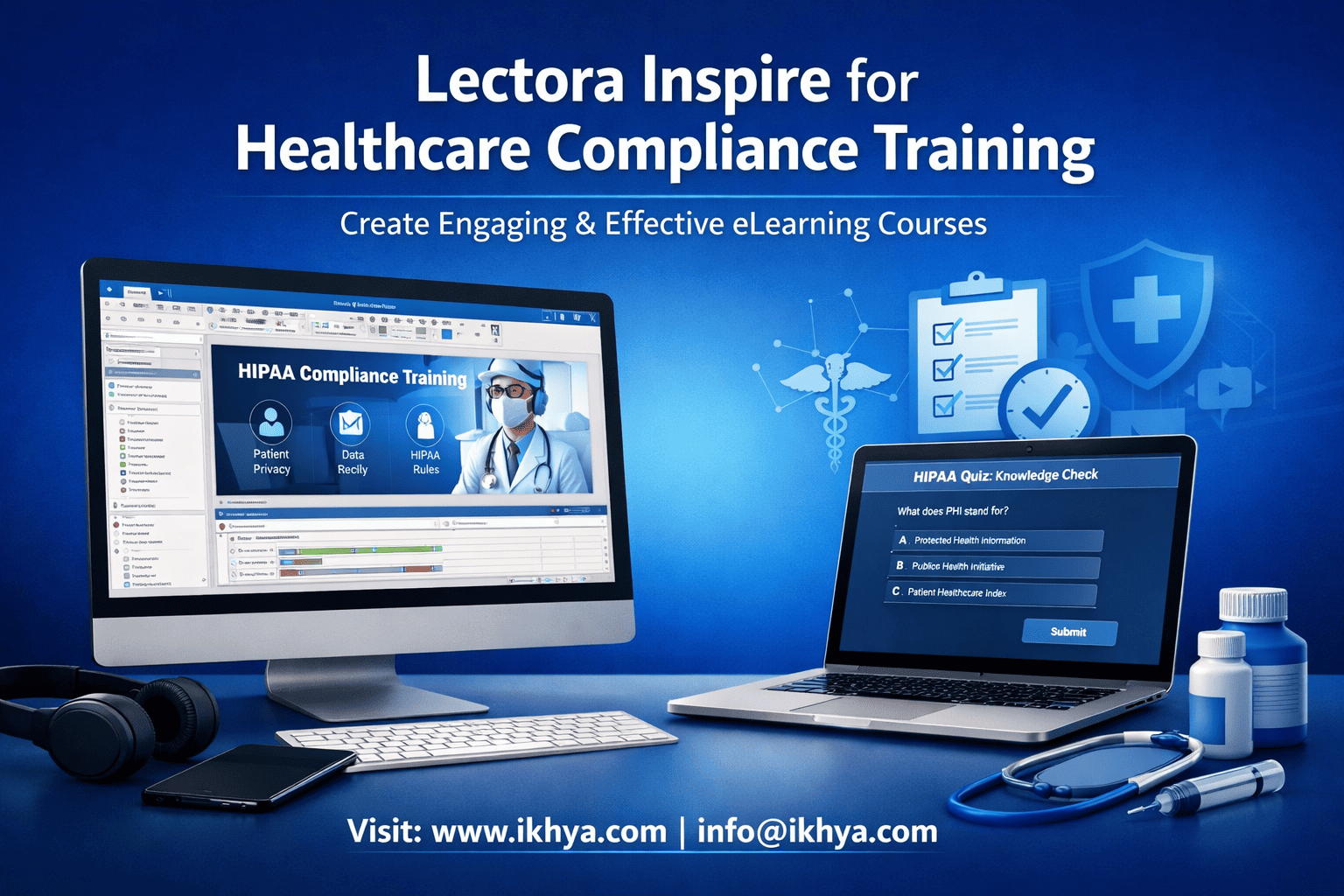
Healthcare organizations face constant regulatory pressure. Compliance training must be accurate, auditable, scalable, and accessible across hospitals, clinics, and distributed healthcare teams. Many healthcare providers are therefore turning to enterprise eLearning platforms like Lectora Inspire to build compliant, trackable, and LMS-ready training programs.
When designed correctly, Lectora-based courses allow healthcare organizations to deploy standardized compliance learning across multiple facilities while maintaining strict reporting and audit readiness. With the right development partner, organizations can implement training aligned with HIPAA, OSHA, patient safety regulations, and global healthcare compliance frameworks.
Healthcare enterprises that want to explore how modern compliance training can be implemented at scale can also Book a Free eLearning Demo to see how enterprise healthcare learning solutions are designed and deployed.
Why Healthcare Organizations Use Lectora Inspire for Compliance Training
Healthcare organizations adopt Lectora Inspire because it supports complex regulatory training environments that require strong accessibility, LMS compatibility, audit-ready reporting, and scalable deployment across multiple healthcare facilities.
Compliance training in healthcare must satisfy strict regulatory requirements while ensuring that medical professionals, administrative staff, and support teams understand critical procedures and policies.
Compliance Training Challenges in Healthcare
Healthcare compliance training is significantly more complex than training in many other industries. Organizations must continuously train staff on regulatory standards while ensuring documentation and reporting remain accurate.
Common challenges include:
- Rapidly changing healthcare regulations
- Multi-location hospital networks
- Diverse employee roles and responsibilities
- Audit-ready training documentation
- Mandatory recurring compliance certifications
Hospitals and healthcare systems in the United States, United Kingdom, Australia, and the UAE must maintain accurate compliance records to meet regulatory audits and accreditation reviews.
For example:
- U.S. healthcare organizations follow HIPAA training requirements
- UK healthcare institutions align with NHS compliance frameworks
- Australian providers follow national vocational healthcare training standards
- UAE healthcare providers implement health authority compliance programs
Without a centralized digital learning system, maintaining this level of compliance becomes extremely difficult.
Why Traditional Compliance Training Often Fails
Traditional training methods such as classroom sessions or static PowerPoint presentations often fail to meet modern compliance requirements.
Key limitations include:
- Lack of centralized reporting
- No audit-ready training records
- Limited learner engagement
- Poor scalability across hospital networks
- Inconsistent training delivery
Healthcare regulators increasingly expect organizations to demonstrate measurable learning outcomes, training completion records, and documented compliance programs.
Interactive eLearning developed using enterprise authoring tools solves many of these problems.
Organizations modernizing legacy training programs often begin by converting existing materials using services like PPT to eLearning Conversion Services to transform static content into interactive learning modules.
Why Lectora Inspire Works Well for Regulated Training Environments
Lectora Inspire is widely used for compliance training because it provides capabilities that are particularly important for regulated industries such as healthcare.
These capabilities include:
1. Advanced Accessibility Compliance
Healthcare training must often meet accessibility standards such as:
- Section 508 compliance
- WCAG accessibility guidelines
Lectora allows developers to build fully accessible learning experiences for healthcare staff with diverse accessibility needs.
2. SCORM and xAPI Compatibility
Healthcare organizations typically deploy training through Learning Management Systems (LMS). Lectora supports industry standards such as:
- SCORM
- xAPI
- AICC
This allows organizations to integrate training seamlessly with enterprise LMS platforms.
Organizations implementing LMS-compatible courses can explore LMS Compatible eLearning Course Development Services to ensure full integration and tracking capability.
3. Scenario-Based Healthcare Training
Healthcare training requires real-world decision-making scenarios such as:
- patient safety incidents
- infection control protocols
- emergency response procedures
- medication administration practices
Lectora allows instructional designers to build interactive branching scenarios that simulate clinical decision-making environments.
These simulations help healthcare professionals practice compliance behaviors in realistic situations.
Organizations seeking to build advanced training simulations can explore eLearning Simulation Based Training Services to create immersive compliance learning experiences.
Why Healthcare Enterprises Partner with Specialized eLearning Companies
While Lectora provides powerful development capabilities, creating enterprise-grade healthcare training requires deep expertise in:
- instructional design
- regulatory compliance frameworks
- healthcare subject matter collaboration
- LMS deployment
- global training governance
Many healthcare organizations therefore partner with specialized providers like IKHYA eLearning Solutions Company to design scalable compliance training ecosystems.
Experienced partners help organizations:
- transform complex healthcare policies into interactive courses
- integrate training with enterprise LMS platforms
- ensure regulatory alignment
- deploy global healthcare training programs
This partnership approach allows hospitals and healthcare networks to modernize compliance training while maintaining strict regulatory standards.
Healthcare Compliance Training Requirements Every Organization Must Address
Healthcare compliance training ensures that medical staff, administrators, and support teams follow regulatory standards that protect patient safety, privacy, and operational integrity. Effective training programs must address multiple regulatory frameworks while maintaining consistent reporting, documentation, and LMS-based tracking across all healthcare locations.
Healthcare organizations operate under strict regulatory oversight. Compliance training must therefore cover legal requirements, clinical safety protocols, and operational procedures.
Below are the major compliance areas healthcare organizations must address.
HIPAA Training Requirements
In the United States, healthcare organizations must provide HIPAA training to all employees who handle patient information.
Training typically includes:
- Protection of patient health information (PHI)
- Privacy and confidentiality regulations
- Secure data handling procedures
- Reporting data breaches
- Healthcare cybersecurity awareness
Hospitals, insurance providers, and healthcare technology companies must ensure that staff understand how to properly manage patient data.
Modern eLearning helps organizations deliver HIPAA training consistently across departments while maintaining completion records for regulatory audits.
Interactive compliance courses can also include:
- scenario-based learning
- role-specific compliance training
- automated LMS tracking
OSHA Safety Training for Healthcare Staff
Healthcare workers face workplace risks such as infection exposure, medical device handling, and emergency response scenarios.
Compliance training must include:
- infection prevention protocols
- bloodborne pathogen training
- hazardous material handling
- workplace safety procedures
- emergency preparedness
Interactive eLearning modules allow organizations to simulate workplace safety scenarios, helping staff understand how to respond correctly in high-risk situations.
Hospitals increasingly use interactive safety training developed through Custom Articulate Storyline Development for Compliance and Safety Training or similar advanced development frameworks.
Clinical Compliance and Patient Safety Training
Clinical staff must follow standardized procedures to ensure patient safety and medical accuracy.
Compliance training often includes:
- medication administration protocols
- infection control procedures
- patient identification standards
- medical equipment usage
- documentation accuracy
Scenario-based training built with enterprise authoring tools such as Lectora allows medical professionals to practice real-world clinical decisions without risk to patients.
This approach significantly improves retention and reduces compliance errors.
Documentation and Audit Readiness
Healthcare regulators frequently audit training records to verify that organizations maintain proper compliance education.
Training systems must therefore provide:
- timestamped completion records
- assessment scores
- certification tracking
- audit-ready reports
- role-based compliance requirements
Modern healthcare learning ecosystems use LMS platforms that track training data through SCORM or xAPI integration.
Organizations building scalable compliance programs often rely on Custom eLearning Development Services to create training aligned with regulatory documentation standards.
Multi-Location Training Governance
Large healthcare systems often operate:
- multiple hospitals
- regional clinics
- diagnostic centers
- telehealth networks
- international healthcare facilities
Training governance must therefore ensure consistent compliance education across all locations.
Key governance strategies include:
- centralized LMS administration
- standardized course content
- automated certification renewals
- multilingual training delivery
- role-specific learning paths
When implemented correctly, enterprise eLearning enables healthcare networks to maintain regulatory consistency across thousands of employees.
Organizations exploring strategic learning governance frameworks can also refer to Corporate eLearning Development: The Complete Enterprise Guide for a broader understanding of enterprise training ecosystems.
Key Capabilities of Lectora Inspire for Healthcare Compliance Training
Lectora Inspire offers several capabilities that make it particularly suitable for healthcare compliance training, including accessibility support, advanced LMS compatibility, scenario-based simulations, and scalable course architecture for large healthcare organizations.
These capabilities allow hospitals and healthcare enterprises to deploy compliance training across global workforces while maintaining regulatory alignment.
SCORM and xAPI Compliance Tracking
One of the most important capabilities for healthcare compliance training is learning data tracking.
Lectora supports major eLearning standards such as:
- SCORM 1.2
- SCORM 2004
- xAPI
- AICC
These standards allow healthcare organizations to track:
- course completion
- assessment performance
- training certifications
- compliance renewal deadlines
When integrated with enterprise LMS platforms, these standards create an auditable learning record system.
Organizations planning LMS-compatible courses often partner with providers offering LMS Compatible eLearning Course Development Services to ensure seamless deployment.
Advanced Accessibility and Inclusive Learning
Healthcare organizations must ensure that training is accessible to all employees, including those with disabilities.
Lectora is widely used in regulated industries because it supports strong accessibility features such as:
- screen reader compatibility
- keyboard navigation
- accessible multimedia content
- WCAG and Section 508 compliance
Accessibility is especially important for large healthcare employers where workforce diversity is high.
Organizations developing inclusive training programs may also implement Accessible eLearning Solutions to ensure regulatory accessibility compliance.
Scenario-Based Compliance Training
Healthcare training must go beyond theoretical instruction. Staff must understand how to apply compliance procedures in real-world situations.
Lectora supports advanced interactive learning features including:
- branching scenarios
- decision-based learning
- simulated patient interactions
- compliance case studies
These learning methods help healthcare professionals understand the consequences of incorrect decisions.
Simulation-driven learning is widely used in:
- infection control training
- emergency response training
- patient safety education
- medical equipment operation
Organizations designing immersive compliance programs often combine Lectora development with eLearning Simulation Based Training Services to create realistic learning experiences.
Localization for Global Healthcare Training
Many healthcare organizations operate internationally, requiring training in multiple languages.
Lectora allows developers to design courses that support:
- multilingual training content
- region-specific regulatory requirements
- cultural localization
- global deployment through enterprise LMS platforms
Healthcare companies with international operations frequently implement eLearning Translation & Localization Services to ensure regulatory training is culturally and linguistically appropriate.
Rapid Updates for Changing Healthcare Regulations
Healthcare regulations change frequently. Training programs must therefore be easy to update.
Lectora supports rapid course updates, enabling organizations to:
- revise compliance policies
- update regulatory guidelines
- modify assessments
- deploy updated training quickly
Healthcare systems modernizing their learning ecosystems often combine Lectora development with Rapid eLearning Development Services to accelerate compliance training deployment.
Lectora vs Other eLearning Authoring Tools for Healthcare Compliance Training
Selecting the right authoring tool is critical for healthcare compliance training because it affects accessibility, LMS integration, content scalability, and regulatory audit readiness. While several tools exist, Lectora Inspire stands out for organizations that require advanced compliance features, accessibility control, and enterprise-level customization.
Healthcare training teams often evaluate multiple authoring tools before choosing a platform that meets regulatory and operational requirements.
Below is a comparison of commonly used enterprise eLearning authoring tools.
Enterprise Authoring Tool Comparison for Healthcare Compliance Training
| Feature | Lectora Inspire | Articulate Storyline | Adobe Captivate | Articulate Rise |
|---|---|---|---|---|
| Accessibility Compliance | Excellent (WCAG, Section 508) | Moderate | Good | Limited |
| SCORM/xAPI Support | Yes | Yes | Yes | Yes |
| Custom Interactions | Highly customizable | Strong | Strong | Limited |
| Scenario-Based Learning | Advanced | Advanced | Advanced | Basic |
| Responsive Design | Manual control | Limited | Strong | Fully responsive |
| Enterprise Compliance Use Cases | Excellent | Very Good | Very Good | Moderate |
Lectora is often preferred in highly regulated industries like healthcare because developers have greater control over accessibility settings and compliance tracking.
Organizations evaluating tools often compare development ecosystems such as Articulate Storyline vs Adobe Captivate: Which Tool is Better? to determine which technology aligns with their training strategy.
When Healthcare Organizations Choose Lectora
Healthcare organizations typically select Lectora when they require:
- strict accessibility compliance
- detailed LMS reporting
- complex branching scenarios
- customizable user interfaces
- enterprise-scale training deployment
For large healthcare systems managing thousands of employees, these capabilities significantly improve compliance governance.
When Other Authoring Tools May Be Used
Other authoring tools can also be useful depending on training requirements.
For example:
Articulate Storyline
Often used for:
- interactive simulations
- onboarding training
- scenario-based learning
Organizations implementing Storyline-based training may rely on Articulate Storyline Development Services to build advanced courses.
Adobe Captivate
Commonly used for:
- software training
- technical system simulations
- responsive course design
Healthcare IT training teams often explore Adobe Captivate Development Services when building system training modules.
Articulate Rise
Rise is ideal for:
- rapid training development
- mobile-friendly compliance courses
- microlearning modules
Healthcare organizations implementing mobile-first learning strategies frequently leverage Articulate Rise Development Services.
Why Many Healthcare Enterprises Use Multiple Tools
Large healthcare organizations rarely rely on a single authoring tool.
Instead, they often use:
- Lectora for compliance-heavy training
- Storyline for interactive simulations
- Rise for microlearning
- Captivate for system training
A strategic learning architecture ensures that each tool is used for the type of training it performs best.
Organizations designing enterprise learning ecosystems often start with eLearning Consultancy Services to define the optimal technology stack.
Enterprise Process for Developing Healthcare Compliance Training with Lectora
Developing healthcare compliance training requires a structured enterprise process that combines instructional design, subject matter expertise, regulatory validation, and LMS deployment. This process ensures that training programs meet legal requirements while remaining engaging and scalable.
Healthcare training development typically follows several structured phases.
Phase 1: Compliance Needs Analysis
The first step is identifying regulatory requirements that the training must address.
This phase typically involves collaboration between:
- compliance officers
- medical subject matter experts
- HR leaders
- learning and development teams
Key outputs include:
- compliance training objectives
- regulatory requirements mapping
- target learner profiles
- training frequency requirements
This analysis ensures the training program addresses real compliance risks.
Phase 2: Instructional Design Framework
Instructional designers translate complex regulatory policies into structured learning experiences.
Healthcare compliance training commonly uses instructional design models such as:
- ADDIE framework
- scenario-based learning
- microlearning reinforcement
- competency-based assessments
Organizations that require advanced course architecture frequently work with specialists offering Instructional Design Services to transform regulatory content into effective learning experiences.
Phase 3: Content Development in Lectora
Once the learning architecture is defined, developers build the training modules using Lectora Inspire.
Course elements often include:
- compliance scenarios
- interactive assessments
- policy walkthroughs
- medical safety simulations
- certification tests
Healthcare training modules must also incorporate visual aids such as diagrams, clinical workflows, and procedural demonstrations.
Phase 4: Compliance Review and Regulatory Validation
Before deployment, courses must be reviewed by:
- legal teams
- compliance officers
- clinical experts
- training managers
This validation step ensures the training accurately reflects current regulatory standards.
Any incorrect information could expose the organization to regulatory penalties.
Phase 5: LMS Integration and Deployment
After validation, courses are exported in SCORM or xAPI format and uploaded to the organization’s Learning Management System.
This enables:
- learner enrollment
- completion tracking
- automated reporting
- compliance certification management
Organizations deploying enterprise LMS-compatible training can leverage LMS Compatible eLearning Course Development Services to ensure seamless integration.
Phase 6: Continuous Compliance Monitoring
Compliance training is never a one-time activity.
Healthcare organizations must continuously:
- update regulatory content
- monitor training completion
- analyze learner performance
- identify compliance gaps
Modern LMS platforms support analytics dashboards that help compliance leaders monitor training effectiveness.
Partnering with an Enterprise eLearning Provider
Developing healthcare compliance training at scale requires deep expertise in instructional design, compliance frameworks, LMS technology, and healthcare regulations.
Many healthcare enterprises therefore partner with experienced providers like IKHYA eLearning Solutions to design and deploy enterprise training programs.
Organizations looking to modernize healthcare training programs can Request an eLearning RFP to explore how enterprise compliance training solutions can be implemented across hospitals, clinics, and healthcare networks.
How Hospitals and Healthcare Enterprises Scale Compliance Training
Healthcare organizations scale compliance training by standardizing learning content, integrating training with enterprise LMS platforms, and deploying role-based courses across hospitals, clinics, and international healthcare facilities. A scalable learning architecture ensures consistent regulatory compliance across thousands of healthcare employees.
Large healthcare organizations operate in highly complex environments. Staff members include:
- physicians
- nurses
- technicians
- administrative teams
- healthcare IT staff
- support personnel
Each role requires different compliance training requirements.
Without a centralized learning system, delivering consistent training across a large workforce becomes extremely difficult.
Training Across Hospitals, Clinics, and Healthcare Networks
Large healthcare systems often operate across multiple facilities and geographic regions.
These may include:
- hospital networks
- outpatient clinics
- diagnostic laboratories
- telemedicine units
- international healthcare partnerships
To manage training at scale, healthcare organizations implement centralized enterprise learning systems that deliver standardized compliance training.
Key strategies include:
- centralized LMS governance
- standardized course libraries
- role-based training assignments
- automated certification renewals
- continuous regulatory updates
When implemented properly, enterprise eLearning allows healthcare systems to maintain consistent training quality across thousands of employees.
Organizations modernizing enterprise training programs often start with Enterprise eLearning Development Process: Step-by-Step Guide to understand the architecture behind scalable corporate training programs.
Global Healthcare Training Deployment
Many healthcare providers operate internationally or partner with global healthcare institutions.
This creates additional challenges such as:
- regulatory differences between countries
- multilingual training requirements
- regional healthcare compliance frameworks
- localized patient safety protocols
For example:
- U.S. healthcare systems follow HIPAA regulations
- UK healthcare organizations align with NHS compliance standards
- Australian healthcare providers follow national vocational healthcare training frameworks
- UAE healthcare authorities enforce regional regulatory standards
Enterprise eLearning platforms like Lectora allow healthcare organizations to deploy standardized training content while adapting modules for regional regulations.
Organizations delivering training globally often rely on eLearning Translation & Localization Services to ensure content remains culturally and legally appropriate.
Multi-Language Compliance Training
Healthcare organizations frequently employ diverse international workforces.
Training must therefore support multiple languages to ensure all employees understand critical compliance requirements.
Multilingual training strategies include:
- localized course interfaces
- translated medical terminology
- culturally adapted case studies
- region-specific regulatory examples
These approaches significantly improve learner comprehension and compliance adherence.
Organizations deploying multilingual compliance programs often build training ecosystems supported by Mobile Learning Development Solutions to ensure accessibility across mobile devices used by healthcare staff.
Outsourcing Lectora Development for Healthcare Compliance Training
Outsourcing Lectora development allows healthcare organizations to accelerate training deployment, reduce development costs, and access specialized instructional design expertise required for regulated compliance training environments.
Healthcare compliance training development requires multiple areas of expertise including:
- regulatory knowledge
- instructional design
- multimedia development
- LMS integration
- accessibility compliance
Many healthcare organizations do not maintain large in-house development teams. As a result, outsourcing becomes a practical and strategic option.
Why Healthcare Organizations Outsource eLearning Development
Healthcare organizations outsource eLearning development for several strategic reasons.
Common motivations include:
- faster training deployment
- access to specialized instructional designers
- reduced internal workload
- lower development costs
- scalable training production
External development teams also provide expertise in modern learning technologies and compliance frameworks.
Organizations evaluating outsourcing models often review Outsource eLearning Development: Benefits, Costs and Best Practices to understand the strategic advantages.
Cost and Timeline Advantages of Outsourcing
Developing healthcare compliance training internally can require:
- instructional designers
- developers
- multimedia designers
- LMS specialists
- compliance reviewers
Building and maintaining such teams internally can be expensive.
Outsourcing provides several operational benefits:
- predictable project timelines
- flexible development capacity
- reduced hiring overhead
- access to experienced eLearning specialists
Healthcare organizations can therefore focus on patient care and operational priorities while external partners handle training production.
Governance and Security Considerations
Because healthcare training often involves sensitive information, organizations must ensure outsourced development partners follow strict security protocols.
Key governance considerations include:
- HIPAA data handling policies
- secure content transfer procedures
- compliance review workflows
- documentation and audit readiness
Experienced enterprise eLearning providers follow structured development frameworks that ensure regulatory compliance and data security.
Healthcare organizations evaluating outsourcing partners can Contact IKHYA Experts to discuss enterprise compliance training requirements and implementation strategies.
How to Choose the Right Lectora Development Partner
Choosing the right development partner is critical for healthcare organizations implementing large-scale compliance training programs. The right partner should combine healthcare domain expertise, instructional design capability, LMS integration knowledge, and scalable development infrastructure.
Healthcare training projects are complex and often involve multiple stakeholders.
A strong development partner helps organizations manage this complexity while ensuring compliance training remains accurate and effective.
Healthcare Training Experience
The first evaluation criterion is industry experience.
A qualified partner should have experience designing training for:
- hospitals
- pharmaceutical companies
- healthcare service providers
- medical device organizations
Healthcare training requires understanding of medical terminology, clinical workflows, and regulatory frameworks.
Compliance Training Expertise
Healthcare training content must accurately represent regulatory requirements.
A capable development partner should demonstrate expertise in:
- HIPAA compliance training
- patient safety training
- infection control training
- medical device compliance training
- healthcare documentation standards
This expertise ensures that training programs support real-world regulatory expectations.
LMS Integration Capability
Enterprise healthcare organizations rely heavily on Learning Management Systems to track training.
A strong development partner should support:
- SCORM and xAPI standards
- LMS reporting integration
- certification tracking
- automated compliance reporting
Organizations deploying large-scale LMS-compatible training may benefit from LMS Compatible eLearning Course Development Services to ensure technical compatibility.
Global Training Deployment Support
Healthcare organizations increasingly operate across international markets.
A development partner should therefore provide support for:
- multilingual course development
- regulatory localization
- global LMS deployment
- scalable training updates
Organizations seeking long-term enterprise learning partnerships can explore About IKHYA eLearning Solutions Company to understand how specialized eLearning providers support global healthcare training programs.
Real-World Enterprise Use Cases of Lectora in Healthcare Training
Healthcare organizations use Lectora Inspire to develop a wide range of compliance and safety training programs that support regulatory adherence and patient safety.
Common enterprise use cases include:
HIPAA Compliance Training
Interactive courses help employees understand:
- patient privacy laws
- secure data handling procedures
- healthcare cybersecurity practices
Scenario-based learning allows staff to practice responding to real-world privacy situations.
Patient Safety Training
Hospitals use simulation-based learning modules to train staff on:
- infection prevention procedures
- medication safety protocols
- emergency response practices
- surgical safety checklists
Interactive learning improves knowledge retention compared with traditional classroom training.
Medical Device Training
Healthcare staff must understand how to properly operate complex medical equipment.
Lectora-based courses allow organizations to build:
- interactive device simulations
- troubleshooting guides
- compliance assessments
This training reduces operational errors and improves patient safety.
Global Pharmaceutical Compliance Training
Pharmaceutical companies often deploy Lectora-based training for:
- regulatory compliance programs
- drug safety training
- clinical trial compliance education
These training programs help ensure that employees follow strict pharmaceutical regulations.
Future of Healthcare Compliance Training with Advanced eLearning Technologies
Healthcare compliance training is evolving rapidly as organizations adopt new learning technologies that improve training effectiveness and regulatory oversight.
Several innovations are shaping the future of compliance learning.
Learning Analytics for Compliance Monitoring
Modern LMS platforms provide analytics dashboards that allow compliance managers to monitor:
- training completion rates
- assessment scores
- certification renewals
- regulatory compliance gaps
These insights help organizations identify risk areas and improve training programs.
Adaptive Compliance Learning
Adaptive learning technologies personalize training experiences based on learner performance.
Healthcare employees can receive:
- targeted refresher training
- role-specific compliance modules
- performance-based assessments
This approach improves training efficiency while maintaining compliance standards.
Continuous Compliance Learning Ecosystems
Healthcare organizations are increasingly moving toward continuous learning models.
Instead of annual training programs, organizations now deploy:
- microlearning modules
- periodic compliance refreshers
- scenario-based reinforcement training
These ecosystems ensure that healthcare staff remain continuously aligned with regulatory requirements.
Conclusion: Building Scalable Healthcare Compliance Training with the Right eLearning Partner
Healthcare compliance training must be accurate, auditable, scalable, and continuously updated to reflect evolving regulations. Authoring tools such as Lectora Inspire allow healthcare organizations to create interactive training that integrates with enterprise LMS platforms, supports accessibility standards, and enables scenario-based learning for clinical and administrative staff.
However, the success of compliance training programs depends not only on the technology used but also on the development strategy behind it. Healthcare organizations must combine strong instructional design, regulatory expertise, LMS integration, and scalable deployment frameworks to ensure training programs meet operational and regulatory expectations.
When implemented effectively, enterprise eLearning enables healthcare organizations to:
- deliver standardized compliance training across hospital networks
- maintain audit-ready documentation and reporting
- improve staff understanding of safety and privacy regulations
- deploy multilingual training across global healthcare teams
- continuously update training as regulatory requirements evolve
For organizations planning large-scale healthcare training initiatives, partnering with an experienced eLearning provider can significantly reduce implementation complexity.
Healthcare leaders exploring enterprise compliance training solutions can Contact IKHYA Experts to discuss how scalable healthcare eLearning programs can be designed, developed, and deployed across hospitals, clinics, and healthcare networks.
FAQs
1. What is Lectora Inspire used for in healthcare training?
Lectora Inspire is used to develop interactive compliance training, patient safety simulations, and regulatory learning modules that integrate with healthcare LMS platforms.
2. Why is compliance training important in healthcare?
Compliance training ensures that healthcare staff follow regulations related to patient privacy, safety protocols, and legal requirements.
3. Can Lectora courses integrate with healthcare LMS platforms?
Yes. Lectora supports SCORM, xAPI, and AICC standards, allowing seamless integration with enterprise learning management systems.
4. What regulations are typically covered in healthcare compliance training?
Training commonly includes HIPAA, OSHA safety standards, infection control procedures, and patient safety protocols.
5. How often should healthcare compliance training be updated?
Most healthcare organizations update compliance training annually or whenever new regulatory guidelines are introduced.
6. Can Lectora support accessible healthcare training?
Yes. Lectora supports WCAG and Section 508 accessibility standards, making it suitable for inclusive healthcare learning environments.
7. Is Lectora suitable for large healthcare organizations?
Yes. Lectora is widely used by enterprise organizations that require scalable, customizable compliance training.
8. What types of healthcare training can be built with Lectora?
Organizations can create compliance training, medical device training, patient safety simulations, and onboarding programs.
9. What is the role of instructional design in healthcare compliance training?
Instructional design transforms complex regulatory policies into structured, engaging learning experiences.
10. Can healthcare organizations outsource Lectora development?
Yes. Many organizations outsource eLearning development to specialized providers to accelerate training deployment.
11. What are the benefits of outsourcing healthcare eLearning development?
Outsourcing provides access to experienced instructional designers, faster development timelines, and reduced internal workload.
12. How does scenario-based training improve healthcare learning?
Scenario-based training helps healthcare staff practice real-world decision-making, improving knowledge retention and compliance behavior.
13. Can Lectora support multilingual healthcare training?
Yes. Courses can be localized and translated to support global healthcare teams.
14. How long does it take to develop healthcare compliance training?
Development timelines vary depending on course complexity but typically range from several weeks to a few months.
15. What LMS features support healthcare compliance training?
Important LMS features include completion tracking, certification management, reporting dashboards, and automated compliance reminders.
16. How do healthcare organizations measure training effectiveness?
Organizations measure effectiveness using learner assessments, completion rates, compliance reporting, and performance analytics.
17. What role does learning analytics play in compliance training?
Learning analytics help compliance managers monitor training progress and identify areas where employees may require additional training.
18. What industries within healthcare use Lectora training?
Hospitals, pharmaceutical companies, healthcare service providers, and medical device manufacturers frequently use Lectora-based training.
19. Can existing training materials be converted into Lectora courses?
Yes. Legacy materials such as PowerPoint presentations or documents can be converted into interactive eLearning modules.
20. How can organizations start implementing healthcare compliance eLearning?
Organizations typically begin by conducting a training needs analysis and selecting an experienced eLearning development partner.
Related Resources
The following resources provide additional insights into enterprise eLearning development, authoring tools, and outsourcing strategies for corporate training programs.




