Designing Microlearning Modules Using Articulate Rise 360: Strategy, Steps, and Best Practices

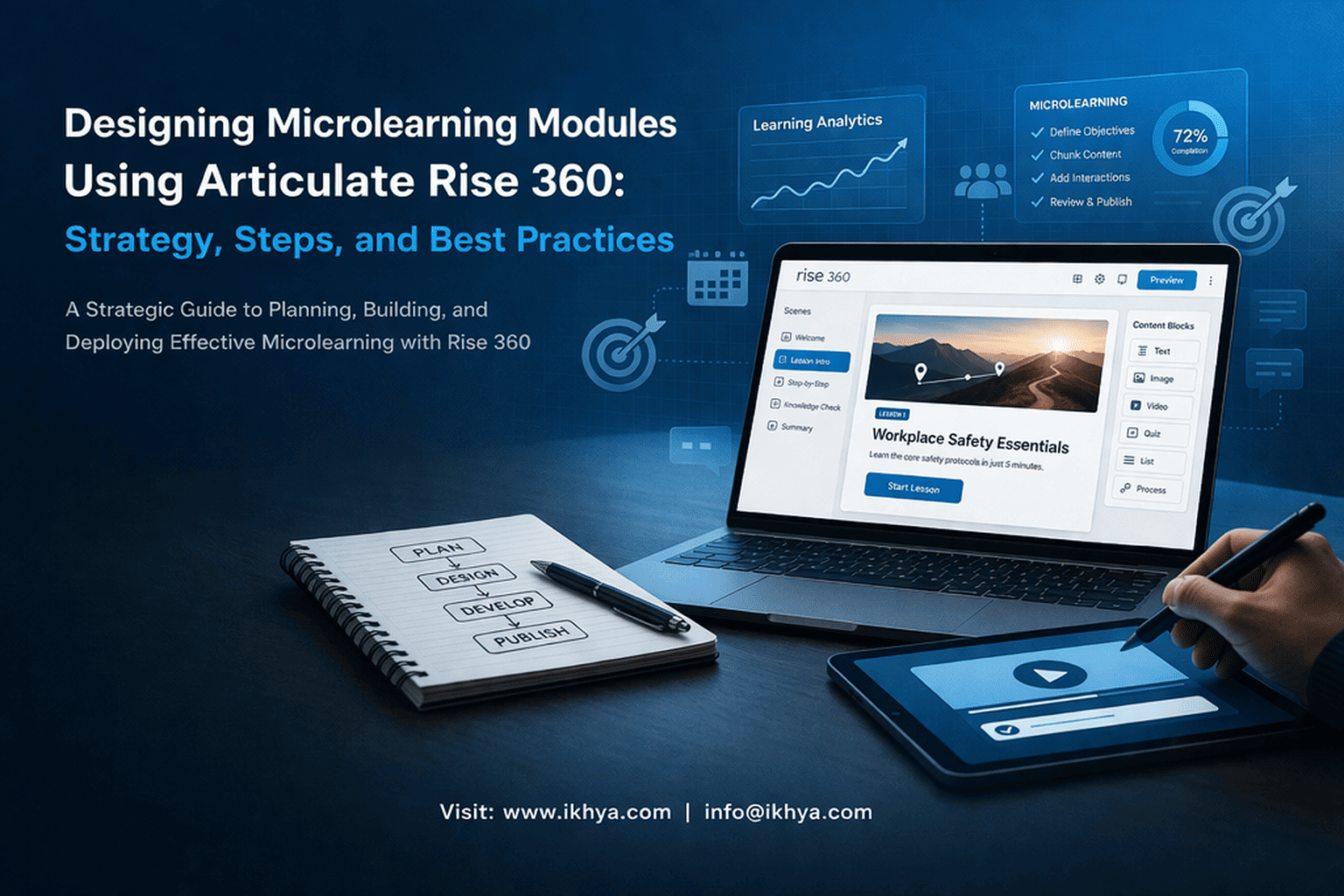
Designing microlearning modules using Articulate Rise has become a go-to approach for organizations that want fast, engaging, and mobile-friendly training. Traditional long-form courses often fail to retain attention, while microlearning delivers focused, bite-sized content that improves completion rates and knowledge retention.
For organizations looking to scale training quickly, working with an experienced partner can simplify the process. You can explore how this works in practice through these IKHYA eLearning Solutions offerings like custom eLearning development services tailored for enterprise needs.
In this guide, you’ll learn how to create microlearning modules:
- How microlearning works in corporate training
- Why Articulate Rise 360 is ideal for it
- Step-by-step design process
- Real-world use cases, costs, and strategies
What Is Microlearning in eLearning and Why It Works
Microlearning is a training approach that delivers content in short, focused modules designed to achieve a single learning objective. These modules are typically 3–7 minutes long and optimized for quick consumption on any device.
Why microlearning is effective
- Improves retention through spaced learning
- Reduces cognitive overload by focusing on one concept
- Fits into busy schedules of modern learners
- Boosts engagement with interactive and visual content
In corporate environments, microlearning is often used for:
- Compliance training
- Product training
- Sales enablement
- Employee onboarding
Organizations adopting microlearning often combine it with structured instructional design strategies. If you’re exploring this further, understanding instructional design services can help align learning outcomes with business goals.
Key characteristics of effective microlearning modules
A well-designed microlearning module should:
- Focus on one clear objective
- Deliver content in 3–7 minutes
- Include interactive elements (quizzes, scenarios)
- Be mobile-first and responsive
- Support SCORM/xAPI tracking in LMS systems
Microlearning vs traditional eLearning
| Factor | Microlearning | Traditional eLearning |
|---|---|---|
| Duration | 3–7 minutes | 30–60 minutes |
| Focus | Single objective | Multiple objectives |
| Engagement | High | Moderate |
| Development time | Faster | Longer |
| Device compatibility | Mobile-first | Often desktop-heavy |
When to use microlearning
Microlearning works best when:
- You need just-in-time training
- Content needs frequent updates
- Learners access training on mobile devices
- Training must be scaled across global teams (USA, UK, UAE, AUS)
For example:
- A healthcare organization delivering compliance updates
- A manufacturing firm training workers on safety procedures
- A retail company onboarding seasonal staff quickly
If your goal is to build such scalable solutions, many organizations rely on specialized microlearning development services to accelerate production and ensure quality.
Business impact of microlearning
Organizations implementing microlearning typically see:
- 30–50% higher course completion rates
- Faster rollout of training programs
- Reduced development costs
- Better learner engagement
Why Use Articulate Rise for Microlearning Development
Articulate Rise 360 is one of the most efficient tools for creating microlearning modules because it combines speed, responsiveness, and simplicity. It is specifically designed for modern learners who access training on mobile devices, tablets, and desktops.
If your goal is rapid deployment without compromising quality, Rise offers a strong balance between instructional design flexibility and production speed. Many organizations leverage dedicated IKHYA eLearning Solutions expertise through Articulate Rise development services to scale microlearning efficiently.
What makes Articulate Rise ideal for microlearning?
Articulate Rise is built for bite-sized learning experiences, making it naturally aligned with microlearning principles.
Key advantages include:
- Block-based authoring for quick content creation
- Responsive design by default (no manual adjustments needed)
- Pre-built templates for rapid development
- Cloud-based collaboration for distributed teams
- SCORM and xAPI compatibility for LMS tracking
Core features that support microlearning design
1. Block-based content structure
Rise uses a modular system where content is added as “blocks”:
- Text
- Image
- Video
- Interactive knowledge checks
- Scenario-based interactions
This makes it easy to design microlearning modules using Articulate Rise:
- Break content into small, digestible units
- Rearrange modules quickly
- Maintain consistency across lessons
2. Fully responsive learning experience
Unlike traditional tools, Rise automatically adapts content to:
- Mobile phones
- Tablets
- Desktops
This is critical because most microlearning consumption happens on mobile devices. Organizations focusing on mobile-first strategies often combine Rise with mobile learning development solutions for better accessibility and reach.
3. Rapid development capability
Rise significantly reduces development time compared to traditional tools.
Typical development comparison:
| Project Type | Traditional Tools | Articulate Rise |
|---|---|---|
| 10-module course | 4–6 weeks | 1–2 weeks |
| Minor updates | Days | Hours |
| Content restructuring | Complex | Easy |
This makes microlearning modules using Articulate Rise ideal for:
- Compliance updates
- Product launches
- Frequent training revisions
For faster turnaround, many companies also explore rapid eLearning development using Storyline and Rise 360 to combine speed with interactivity.
When Rise is the best choice for microlearning
Use Articulate Rise when:
- You need fast deployment
- Content is information-driven rather than highly complex simulations
- Training must be accessible across devices
- You want consistent design without heavy customization effort
When Rise may NOT be enough
While Rise is powerful, it has limitations:
- Limited advanced animations
- Less control over complex branching scenarios
- Not ideal for highly customized simulations
In such cases, organizations often combine Rise with Storyline. If you’re evaluating this decision, reviewing Articulate Rise vs Storyline: which should you use can help clarify the right approach.
Real-world example
A retail company needed to train 5,000+ employees across multiple regions (USA, UK, UAE):
- Converted onboarding content into microlearning modules
- Built using Rise in under 2 weeks
- Delivered via LMS with SCORM tracking
Result:
- 40% increase in completion rates
- 60% faster onboarding time
Where Rise fits in your eLearning ecosystem
Articulate Rise works best as part of a broader eLearning strategy that includes:
- Instructional design frameworks
- LMS integration
- Content conversion workflows
For example, many organizations start by transforming legacy training using convert PowerPoint to eLearning complete guide before redesigning it into microlearning modules.
Articulate Rise is not just a tool—it’s a rapid execution engine for microlearning.
It helps organizations:
- Launch training faster
- Maintain consistency
- Scale globally
- Reduce production costs
Key Features of Articulate Rise for Microlearning Modules
Articulate Rise 360 offers a set of built-in features that directly support the creation of engaging, scalable, and instructionally sound microlearning modules. These features reduce development effort while maintaining consistency across courses.
Organizations aiming to standardize development often align these capabilities with structured approaches like instructional design best practices for Articulate Rise, ensuring both speed and learning effectiveness.
1. Lesson-Based Modular Structure
Rise organizes content into lessons and sections, which naturally supports microlearning design.
This allows you to:
- Break training into single-objective lessons
- Create learning paths with multiple micro modules
- Maintain a clear content hierarchy
Example structure:
- Course → Section → Lesson → Blocks
This aligns perfectly with microlearning principles where each lesson delivers one key takeaway.
2. Pre-Built Interactive Blocks
Rise includes ready-to-use interactive elements that enhance engagement without requiring custom development.
Common blocks used in microlearning:
- Knowledge checks (quiz questions)
- Flashcards
- Labeled graphics
- Timeline interactions
- Scenario-based blocks
For organizations building interactive training at scale, these can be combined with interactive eLearning development using Lectora Inspire approaches for more advanced learning ecosystems.
3. Scenario-Based Learning Capabilities
Microlearning becomes more effective when learners apply knowledge immediately.
Rise supports:
- Branching scenarios
- Decision-based learning
- Real-world simulations (basic level)
These are especially useful in:
- Compliance training
- Customer service training
- Sales training
If deeper interactivity is needed, teams often extend this with scenario-based learning in Articulate Rise to improve learner engagement.
4. Built-In Assessments and Knowledge Checks
Rise allows you to embed quizzes within lessons, making learning continuous rather than end-loaded.
You can:
- Add quick checks after each concept
- Use multiple question formats
- Reinforce learning instantly
This supports:
- Better retention
- Immediate feedback
- Performance tracking via LMS
5. Responsive Media Integration
Rise supports seamless integration of:
- Videos
- Images
- Audio
- Embedded content
All media automatically adapts to screen size, ensuring a consistent experience across devices.
For organizations targeting global learners, this is often paired with eLearning translation and localization services to deliver region-specific content across markets like the USA, UK, UAE, and Australia.
6. Collaboration and Cloud-Based Development
Since Rise is cloud-based, teams can:
- Collaborate in real time
- Share previews instantly
- Collect feedback quickly
This is especially useful for:
- Distributed L&D teams
- Multi-stakeholder approvals
- Agile development cycles
7. SCORM and xAPI Compatibility
Rise supports industry standards like:
- SCORM 1.2 / SCORM 2004
- xAPI (Tin Can API)
This enables:
- LMS integration
- Learner tracking
- Analytics and reporting
Organizations building LMS-ready content often align development with LMS-compatible eLearning course development services to ensure seamless deployment.
8. Consistent UI and Design System
Rise enforces a clean, modern UI that ensures:
- Consistency across modules
- Reduced design effort
- Faster development
While customization is limited, this constraint actually benefits microlearning by:
- Keeping content focused
- Avoiding unnecessary distractions
- Improving usability
9. Rapid Content Updates
One of the biggest advantages of Rise is how quickly content can be updated.
This is critical for:
- Compliance changes
- Product updates
- Policy revisions
Instead of rebuilding entire courses, teams can:
- Edit specific lessons
- Republish instantly
The real power of Rise lies in how these features work together:
- Modular structure → supports microlearning
- Interactivity → boosts engagement
- Responsiveness → ensures accessibility
- Rapid updates → enables scalability
Together, they create a system where organizations can design, deploy, and maintain microlearning at scale.
Step-by-Step Process to Design Microlearning Modules in Articulate Rise
Understanding how to create microlearning modules using Articulate Rise is most effective when you follow a structured process that aligns learning goals with business outcomes. A clear microlearning design process ensures consistency, faster development, and better learner engagement.
If you’re starting from existing materials like PPTs or legacy courses, it helps to first understand structured conversion approaches before breaking content into microlearning units.
Step 1: Define a Single Learning Objective
When learning how to create microlearning modules, every module should focus on one specific outcome.
Instead of:
- “Understand workplace safety”
Break it into:
- “Identify 3 common workplace hazards”
- “Follow the correct emergency exit procedure”
Why this matters:
- Keeps content focused
- Improves retention
- Makes modules measurable
Step 2: Chunk Content into Micro Units
Once the objective is defined, divide the content into small, logical chunks.
A standard microlearning structure:
- Introduction (context or problem)
- Core concept (main idea)
- Example or scenario
- Quick assessment
Example:
For a finance compliance module:
- What is AML
- Red flags
- Real scenario
- 2-question quiz
Organizations scaling this approach often rely on rapid eLearning development services to speed up chunking and production.
Step 3: Choose the Right Rise Blocks
Select blocks based on the type of content you want to deliver.
Mapping content to blocks:
| Content Type | Rise Block |
|---|---|
| Concepts | Text + Image |
| Processes | Timeline |
| Decision making | Scenario |
| Reinforcement | Flashcards |
| Assessment | Knowledge Check |
This step ensures that learning is not just informative, but interactive.
Step 4: Design for Engagement, Not Just Information
Microlearning is not about shrinking content—it’s about designing experiences.
To improve engagement:
- Use visuals instead of long text
- Add interactions every 2–3 screens
- Include real-world examples
- Keep language simple and direct
For organizations aiming to improve engagement, combining microlearning with eLearning simulation-based training services can create more immersive learning experiences.
Step 5: Apply Mobile-First Design Principles
Since most learners access content on mobile devices, ensure:
- Short paragraphs (2–3 lines)
- Large, readable fonts
- Minimal scrolling fatigue
- Clear navigation
This aligns with broader strategies like mobile learning development solutions that prioritize accessibility and usability.
Step 6: Add Knowledge Checks and Reinforcement
Reinforcement is critical in microlearning.
Include:
- Quick quizzes after each concept
- Scenario-based questions
- Instant feedback
This helps:
- Improve retention
- Identify knowledge gaps
- Track performance via LMS
Step 7: Ensure LMS Compatibility (SCORM/xAPI)
Before publishing, confirm that your course is:
- SCORM or xAPI compliant
- Tested in your LMS
- Properly tracking learner progress
Organizations deploying at scale often align with LMS-compatible eLearning course development services to avoid integration issues.
Step 8: Review, Test, and Optimize
Before launch:
- Test across devices (mobile, tablet, desktop)
- Validate content accuracy
- Collect stakeholder feedback
- Optimize based on pilot results
Example Project Timeline
Rapid Development Model (2 Weeks)
| Phase | Duration |
|---|---|
| Content chunking | 2–3 days |
| Development in Rise | 5–6 days |
| Review & revisions | 3–4 days |
| LMS deployment | 1–2 days |
Structured Development Model (4–6 Weeks)
| Phase | Duration |
|---|---|
| Instructional design | 1–2 weeks |
| Development | 2–3 weeks |
| QA & testing | 1 week |
Real-World Scenario
A manufacturing company needed safety training for 2,000 workers:
- Converted a 60-minute course into 10 microlearning modules
- Built using Rise in 3 weeks
- Delivered via LMS
Outcome:
- 45% improvement in completion rates
- Faster onboarding of new employees
Key Takeaway
Designing microlearning modules using Articulate Rise is not just about using a tool—it’s about following a structured design approach:
- Define → Chunk → Design → Engage → Deploy → Optimize
When done right, this approach enables organizations to deliver scalable, high-impact training with minimal development time.
Best Structure for Microlearning Modules in Corporate Training
The effectiveness of microlearning depends heavily on how each module is structured. A well-structured module ensures learners can quickly understand, retain, and apply information without feeling overwhelmed.
In corporate training environments, structure is not just about content flow—it directly impacts engagement, completion rates, and performance outcomes.
Organizations aiming for consistent results often align structure with proven frameworks used in microlearning development services to standardize learning across teams and regions.
The Ideal Microlearning Module Structure
A high-performing microlearning module typically follows a simple, repeatable format:
- Hook (Context or Problem)
- Learning Objective
- Core Content
- Real-World Application
- Knowledge Check
- Summary or Reinforcement
1. Hook: Capture Attention Immediately
Start with a real-world problem or relatable situation.
Examples:
- “What would you do if a customer refuses compliance verification?”
- “A minor safety mistake can cause major accidents—here’s how to avoid it.”
This creates curiosity and relevance.
2. Learning Objective: Set Clear Expectations
Clearly state what the learner will achieve.
Keep it simple and measurable:
- “Identify phishing emails”
- “Follow 3 steps for safe equipment handling”
This aligns the learner’s focus from the beginning.
3. Core Content: Deliver Focused Information
Present only what is necessary to achieve the objective.
Best practices:
- Use short text blocks
- Add visuals (images, icons, videos)
- Break content into 2–3 screens max
Avoid:
- Overloading information
- Combining multiple topics
4. Real-World Application: Make It Practical
This is where learning becomes actionable.
Include:
- Scenarios
- Case-based examples
- Decision-making situations
For example:
- A retail employee handling a difficult customer
- A healthcare worker following compliance protocols
Organizations building deeper application-based learning often combine this with scenario-based learning in Articulate Rise for better engagement.
5. Knowledge Check: Reinforce Learning
Add a quick assessment immediately after the concept.
Types of checks:
- Multiple-choice questions
- Scenario-based decisions
- True/false
Keep it short:
- 2–3 questions per module
6. Summary: Reinforce Key Takeaways
End with a quick recap:
- Key points
- Do’s and don’ts
- Practical tips
This strengthens retention and prepares learners for the next module.
Example Microlearning Flow
| Step | Content |
|---|---|
| Screen 1 | Scenario (Hook) |
| Screen 2 | Objective |
| Screen 3–4 | Core concept |
| Screen 5 | Real-world example |
| Screen 6 | Quiz |
| Screen 7 | Summary |
Microlearning Duration Guidelines
An effective module should be:
- 3–5 minutes (ideal)
- Maximum 7 minutes
- Focused on one outcome only
Shorter modules lead to:
- Higher completion rates
- Better engagement
- Easier updates
Structuring Multiple Modules into a Learning Path
Microlearning works best when modules are connected into a sequence.
Example learning path (Finance – AML Training):
- Module 1: What is AML
- Module 2: Key regulations
- Module 3: Red flags
- Module 4: Reporting process
For organizations scaling such programs globally, structured deployment often aligns with global training deployment using Articulate Rise development and localization.
Industry-Specific Structuring Examples
Healthcare
- Infection control steps
- Patient safety protocols
- Compliance updates
Manufacturing
- Equipment safety checks
- Emergency procedures
- Hazard identification
Retail
- Customer interaction training
- POS system usage
- Product knowledge
IT / Software
- Feature walkthroughs
- Security awareness
- Troubleshooting steps
Common Structuring Mistakes to Avoid
- Including too many objectives in one module
- Overloading content with text
- Skipping real-world application
- Adding long assessments
- Ignoring mobile experience
Strategic Insight
Structure is what transforms microlearning from “short content” into effective learning experiences.
A strong structure ensures:
- Clarity
- Engagement
- Retention
- Scalability
Instructional Design Best Practices for Microlearning in Articulate Rise
Effective microlearning is not just about short content—it is about how well that content is designed for learning. Instructional design principles ensure that microlearning modules are engaging, meaningful, and aligned with real business outcomes.
Organizations that achieve strong results typically combine tools like Rise with structured approaches found in instructional design services to ensure consistency and effectiveness.
Focus on One Learning Outcome Per Module
Each module should solve one specific problem or teach one clear skill.
This improves:
- Clarity for the learner
- Retention of information
- Measurable outcomes
Instead of combining topics, create a sequence of micro modules.
Apply the “Chunking” Principle
Break content into small, digestible pieces.
Effective chunking looks like:
- One concept per screen
- 2–3 screens per module
- Visual separation of ideas
This reduces cognitive overload and makes learning easier to process.
Use Real-World Context for Better Retention
Learners retain more when content feels relevant.
Include:
- Scenarios
- Examples from the workplace
- Problem-solving situations
For instance:
- A compliance officer identifying fraud signals
- A technician handling a machine error
For deeper contextual learning, organizations often integrate scenario-based learning in Articulate Rise.
Design for Action, Not Just Awareness
Microlearning should enable learners to do something, not just understand.
Shift from:
- “What is…” → to → “How to apply…”
Examples:
- Identify safety risks → Take corrective action
- Understand policy → Apply it in real situations
Use Spaced Learning and Reinforcement
Microlearning works best when delivered over time.
Best practices:
- Release modules in a sequence
- Reinforce key concepts
- Include periodic assessments
This improves long-term retention.
Optimize Visual Design for Clarity
In Articulate Rise, design is minimal by default—use this to your advantage.
Guidelines:
- Use whitespace effectively
- Avoid clutter
- Keep visuals meaningful
- Use icons and images to support content
Keep Interactions Frequent but Simple
Engagement increases when learners interact regularly.
Add:
- Knowledge checks
- Click-to-reveal interactions
- Flashcards
Avoid:
- Overcomplicated interactions
- Long passive content sections
Align Content with LMS Tracking and Analytics
Design modules so performance can be measured.
Ensure:
- Each module has trackable completion
- Assessments provide measurable data
- SCORM/xAPI tracking is properly configured
For organizations managing large-scale deployments, this is often handled through LMS-compatible eLearning course development services.
Design for Global and Mobile Learners
Modern training programs are often delivered across regions like the USA, UK, UAE, and Australia.
To ensure accessibility:
- Use simple language
- Avoid cultural bias
- Keep content mobile-friendly
For global rollout, many organizations combine microlearning with eLearning translation and localization services.
Balance Speed with Quality
Articulate Rise enables rapid development—but speed should not compromise learning quality.
Maintain balance by:
- Following a clear instructional design framework
- Reviewing content before deployment
- Testing learner experience
Organizations scaling quickly often rely on rapid eLearning development using Articulate Rise while maintaining structured design standards.
Example: Instructional Design in Action
A financial services company needed AML training:
- Broke content into 12 micro modules
- Each module focused on one compliance rule
- Included real-world fraud scenarios
- Added 2-question assessments per module
Results:
- 35% increase in retention
- Faster compliance certification
- Reduced training time by 40%
Key Takeaway
Strong instructional design turns microlearning into a performance tool, not just content delivery.
It ensures:
- Learners stay engaged
- Knowledge is retained
- Skills are applied in real work scenarios
Real-World Use Cases of Microlearning Using Articulate Rise Across Industries
Microlearning using Articulate Rise is widely adopted across industries because it delivers fast, scalable, and role-specific training. Its flexibility allows organizations to address different training needs while maintaining consistency and quality.
Many enterprises implement these solutions through specialized partners like IKHYA eLearning Solutions, leveraging services such as Articulate Rise course development services for corporate training teams to deploy training at scale.
Healthcare: Compliance and Patient Safety Training
Healthcare organizations require frequent training updates due to changing regulations and protocols.
Microlearning use cases:
- Infection control procedures
- HIPAA compliance
- Patient handling guidelines
Example scenario:
A hospital in the UK converted a 2-hour compliance course into 15 micro modules using Rise.
Outcome:
- 50% faster completion
- Improved compliance audit scores
- Better retention of critical procedures
For specialized implementations, organizations often align with healthcare training eLearning solutions.
Manufacturing: Safety and Equipment Training
Manufacturing environments require precision and safety awareness, making microlearning highly effective.
Use cases:
- Machine operation training
- Hazard identification
- Emergency procedures
Example scenario:
A manufacturing company in the UAE deployed microlearning modules for safety training across multiple plants.
Outcome:
- 40% reduction in safety incidents
- Faster onboarding of workers
- Standardized training across locations
These programs are often supported by manufacturing training eLearning solutions.
Finance: Compliance and Risk Management
Financial institutions deal with strict regulatory requirements and frequent policy updates.
Use cases:
- Anti-money laundering (AML) training
- Fraud detection
- Regulatory compliance updates
Example scenario:
A financial services firm in the USA created microlearning modules for AML training using Rise.
Outcome:
- 35% improvement in knowledge retention
- Faster certification cycles
- Reduced compliance risks
For similar implementations, organizations rely on financial services training eLearning solutions.
Retail: Employee Onboarding and Customer Experience
Retail training needs to be fast, scalable, and easy to consume, especially for distributed teams.
Use cases:
- Product knowledge
- Customer service skills
- POS system training
Example scenario:
A retail chain rolled out microlearning modules for seasonal staff onboarding.
Outcome:
- 60% faster onboarding
- Improved customer satisfaction scores
- Reduced training costs
These initiatives are often aligned with retail training eLearning solutions.
IT / Software: Product and Technical Training
IT companies frequently update products and systems, making microlearning ideal for continuous learning.
Use cases:
- Software feature updates
- Troubleshooting guides
- Security awareness
Example scenario:
A SaaS company used Rise to deliver feature update training in micro modules.
Outcome:
- Faster product adoption
- Reduced support tickets
- Improved user proficiency
Organizations typically scale such programs using IT and software training eLearning solutions.
Oil & Gas: Safety and Compliance Training
High-risk industries like oil and gas require strict adherence to safety protocols.
Use cases:
- Hazardous environment training
- Equipment handling
- Emergency response
Example scenario:
An oil & gas company deployed microlearning modules for field workers across remote locations.
Outcome:
- Improved safety compliance
- Better knowledge retention in high-risk scenarios
- Reduced training downtime
These are often implemented using oil and gas training eLearning solutions.
Cross-Industry Insight
Across all industries, successful microlearning programs share common traits:
- Short, focused modules
- Real-world scenarios
- Mobile-first delivery
- Continuous updates
- LMS tracking (SCORM/xAPI)
Global Deployment Example
A multinational organization operating across the USA, UK, UAE, and Australia implemented microlearning using Rise:
- Created 50+ modules across departments
- Localized content for regional compliance
- Delivered via LMS
Results:
- 45% increase in learner engagement
- 30% reduction in training costs
- Faster global rollout
For such large-scale implementations, organizations often rely on global training deployment using Articulate Rise development and localization.
Microlearning with Articulate Rise is not limited to one industry—it is a universal training strategy adaptable to different business needs.
It enables organizations to:
- Deliver targeted training
- Scale across regions
- Improve performance outcomes
- Reduce training time and cost
Converting Existing Training into Microlearning Using Articulate Rise
Most organizations already have large volumes of training content in formats like PowerPoint, PDFs, or lengthy eLearning courses. The challenge is not creating content from scratch—but transforming existing material into effective microlearning modules.
When done correctly, this approach reduces cost, saves time, and accelerates deployment. Many organizations streamline this process using structured workflows like converting legacy courses to Articulate Storyline and Rise services guide.
Why Convert Existing Content into Microlearning?
Instead of rebuilding training programs, conversion allows you to:
- Reuse existing content efficiently
- Reduce development time
- Improve learner engagement
- Make training mobile-friendly
This is especially useful for:
- Compliance updates
- Onboarding programs
- Product training
Step-by-Step Conversion Process
Step 1: Audit Existing Content
Start by reviewing your current materials:
- PowerPoint presentations
- PDFs and documents
- Instructor-led training (ILT)
- Legacy eLearning courses
Identify:
- Outdated content
- Redundant information
- High-priority topics
For structured conversions, many teams follow frameworks used in ILT to eLearning course conversion services.
Step 2: Define Microlearning Objectives
Break down large content into smaller learning goals.
Example:
Instead of:
- “Complete workplace safety training”
Convert into:
- Identify workplace hazards
- Follow safety protocols
- Respond to emergencies
Each objective becomes one microlearning module.
Step 3: Chunk Content into Bite-Sized Modules
Divide content into logical sections:
- One topic = one module
- Keep duration 3–5 minutes
- Remove unnecessary details
This is the most critical step in microlearning transformation.
Step 4: Redesign Content for Engagement
Do not copy-paste content into Rise.
Instead:
- Convert text into visuals
- Add interactions
- Use scenarios
For example:
- Replace long paragraphs with labeled graphics
- Turn examples into decision-based questions
Organizations modernizing content often combine this with modernizing corporate training using Articulate Storyline and Rise development.
Step 5: Build Modules in Articulate Rise
Use Rise blocks to structure content:
- Text + image for concepts
- Timeline for processes
- Scenario blocks for decision-making
- Knowledge checks for reinforcement
This ensures consistency and speed.
Step 6: Optimize for Mobile Learning
Ensure:
- Short content blocks
- Clear navigation
- Minimal scrolling
- Readable formatting
This aligns with modern learning behavior where most users access content on mobile devices.
Step 7: Integrate with LMS
Publish modules in:
- SCORM
- xAPI
Test for:
- Completion tracking
- Quiz scoring
- Reporting accuracy
Organizations deploying at scale often rely on LMS-compatible eLearning course development services.
Example Conversion Scenario
Before Conversion:
- 60-slide PowerPoint
- 1-hour training session
After Conversion:
- 10 microlearning modules
- 5 minutes each
Development time:
- 2–3 weeks using Rise
Results:
- 40% higher completion rates
- Improved learner engagement
- Easier updates
Conversion Timeline Options
| Approach | Timeline | Use Case |
|---|---|---|
| Rapid conversion | 2–3 weeks | Urgent compliance training |
| Structured redesign | 4–6 weeks | Complex training programs |
Cost Considerations
Typical microlearning conversion costs (global estimates):
| Project Type | Cost Range |
|---|---|
| Basic conversion | $300–$800 per module |
| Interactive microlearning | $800–$1500 per module |
| Advanced scenario-based modules | $1500+ |
Microlearning development cost varies based on:
- Interactivity level
- Content complexity
- Volume of modules
Organizations looking to optimize cost often explore outsource eLearning development benefits, costs, and best practices.
Common Conversion Mistakes to Avoid
- Directly copying content without redesign
- Keeping modules too long
- Ignoring instructional design
- Skipping real-world application
- Not optimizing for mobile
Content conversion is not just a technical process—it is a learning transformation strategy.
It allows organizations to:
- Modernize legacy training
- Improve engagement
- Reduce development costs
- Scale training globally
Microlearning Development Timeline and Cost Breakdown
Planning microlearning modules using Articulate Rise requires a clear understanding of time, cost, and resource allocation. Whether you build in-house or outsource, having a structured estimate helps avoid delays and budget overruns.
Organizations often streamline planning by working with experienced partners like IKHYA eLearning Solutions through rapid eLearning development services to accelerate timelines without compromising quality.
Typical Microlearning Development Timeline
The timeline depends on:
- Content readiness
- Number of modules
- Level of interactivity
- Review cycles
Rapid Development Model (2–3 Weeks)
Best for:
- Compliance training
- Product updates
- Urgent rollouts
Breakdown:
| Phase | Duration |
|---|---|
| Content analysis & chunking | 2–3 days |
| Development in Rise | 5–7 days |
| Review & revisions | 3–4 days |
| LMS deployment | 1–2 days |
Total: 2–3 weeks
Standard Development Model (4–6 Weeks)
Best for:
- Structured training programs
- Multi-module learning paths
- High-impact corporate training
Breakdown:
| Phase | Duration |
|---|---|
| Instructional design | 1–2 weeks |
| Storyboarding | 1 week |
| Development | 2–3 weeks |
| QA & testing | 1 week |
Total: 4–6 weeks
Enterprise-Scale Deployment (6–12 Weeks)
Best for:
- Global training rollout
- Multi-language programs
- Large content libraries
Includes:
- Localization
- LMS integration
- Stakeholder approvals
- Pilot testing
Organizations deploying globally often combine development with eLearning translation and localization services to ensure regional relevance.
Cost Breakdown for Microlearning Development
Costs vary based on complexity, interactivity, and scale.
1. Basic Microlearning Modules
- Text + images + simple quizzes
- Minimal interactivity
Estimated Cost:
$300 – $800 per module
2. Interactive Microlearning Modules
- Scenarios
- Visual storytelling
- Enhanced engagement
Estimated Cost:
$800 – $1500 per module
3. Advanced Microlearning (Scenario-Based / Simulation)
- Decision-based learning
- Branching scenarios
- Custom interactions
Estimated Cost:
$1500 – $3000+ per module
For highly interactive learning, organizations often combine Rise with simulation-based training approaches.
Cost Comparison: In-House vs Outsourced
| Factor | In-House Team | Outsourced Vendor |
|---|---|---|
| Initial cost | High (tools + hiring) | Lower upfront |
| Speed | Moderate | Faster |
| Scalability | Limited | High |
| Expertise | Varies | Specialized |
| Maintenance | Internal effort | Vendor-supported |
Companies evaluating this decision often refer to in-house vs outsourced eLearning development cost comparison to choose the right model.
Real-World Cost Scenario
A global retail company needed onboarding training:
- 20 microlearning modules
- Moderate interactivity
- Multi-device delivery
Project scope:
- Timeline: 4 weeks
- Cost: ~$20,000 – $25,000
Results:
- 50% faster onboarding
- Reduced training costs long-term
- Improved employee performance
Hidden Cost Factors to Consider
- Content rework due to unclear objectives
- Multiple stakeholder revisions
- Localization requirements
- LMS integration issues
- Ongoing updates and maintenance
Planning for these early helps avoid budget overruns.
ROI of Microlearning
Despite upfront costs, microlearning delivers strong ROI:
- Reduced training time
- Faster employee onboarding
- Improved retention and performance
- Lower long-term update costs
Microlearning using Articulate Rise is not just cost-effective—it is cost-efficient over time.
It enables organizations to:
- Develop faster
- Update easily
- Scale globally
- Maximize training impact
Articulate Rise vs Storyline for Microlearning: Which Should You Choose?
Choosing between Articulate Rise and Storyline is a common decision when designing microlearning modules. Both tools are powerful, but they serve different purposes depending on the complexity, interactivity, and scale of your training.
If you’re evaluating both tools in depth, this detailed comparison on Articulate Rise vs Storyline: which should you choose provides additional clarity.
Core Difference Between Rise and Storyline
- Articulate Rise → Best for rapid, responsive, and structured microlearning
- Articulate Storyline → Best for highly interactive, custom, and simulation-based learning
Feature Comparison
| Feature | Articulate Rise | Articulate Storyline |
|---|---|---|
| Development speed | Very fast | Moderate |
| Responsiveness | Automatic | Manual design required |
| Interactivity | Moderate | Advanced |
| Customization | Limited | High |
| Mobile optimization | Built-in | Needs adjustment |
| Learning curve | Easy | Steeper |
When to Use Articulate Rise
Choose Rise if your goal is:
- Rapid microlearning development
- Mobile-first training
- Consistent design across modules
- Frequent updates and scalability
Typical use cases:
- Compliance training
- Product updates
- Onboarding modules
Organizations aiming for fast delivery often rely on rapid eLearning development using Articulate Rise to accelerate production.
When to Use Articulate Storyline
Choose Storyline if you need:
- Complex branching scenarios
- Software simulations
- Custom animations
- Advanced learner interactions
Typical use cases:
- Safety simulations
- Technical training
- High-stakes decision training
For such requirements, many organizations explore Articulate Storyline development services to handle complexity efficiently.
Hybrid Approach: Best of Both Worlds
Many enterprises use a combined approach:
- Use Rise for:
- Core microlearning modules
- Knowledge-based training
- Use Storyline for:
- Advanced simulations
- Complex scenarios
This hybrid strategy ensures:
- Speed + interactivity
- Scalability + customization
Organizations adopting this approach often align with modernizing corporate training using Articulate Storyline and Rise development.
Real-World Decision Scenario
A healthcare organization needed compliance training:
- Used Rise for:
- Policy updates
- Awareness modules
- Used Storyline for:
- Scenario-based patient safety simulations
Outcome:
- Faster rollout of training
- Improved engagement
- Better learning outcomes
Decision Framework
Use this quick framework:
Choose Rise if:
- Speed is critical
- Content is informational
- You need mobile-first delivery
Choose Storyline if:
- Interactivity is critical
- Training involves simulations
- Custom behavior is required
Use both if:
- You want scalable + immersive learning
The choice is not about which tool is better—it’s about which tool fits your learning strategy.
- Rise → efficiency and scalability
- Storyline → depth and interactivity
Key Takeaway
For most microlearning needs, Articulate Rise is the preferred choice due to its:
- Speed
- Simplicity
- Mobile responsiveness
However, combining it with Storyline creates a more powerful and flexible learning ecosystem.
When to Choose In-House vs Outsourced Microlearning Development
Deciding whether to build microlearning modules in-house or outsource to an expert partner is a strategic choice that impacts cost, speed, scalability, and quality. The right decision depends on your internal capabilities, timelines, and long-term training goals.
If you’re exploring outsourcing options, it’s worth reviewing practical insights from outsource eLearning development benefits, costs, and best practices to understand the full picture.
In-House Microlearning Development
In-house development means your internal L&D or training team handles the entire process—from instructional design to development and deployment.
When in-house works best
- You have a skilled instructional design team
- Training needs are ongoing and predictable
- You require full control over content and updates
- Budget allows investment in tools and resources
Advantages
- Full control over content
- Faster internal communication
- Better alignment with company culture
Limitations
- High initial setup cost (tools, hiring, training)
- Limited scalability for large projects
- Longer development time for complex modules
Outsourced Microlearning Development
Outsourcing involves partnering with specialized eLearning vendors who handle design, development, and delivery.
Organizations often collaborate with experienced providers like IKHYA eLearning Solutions through offerings such as custom eLearning development services to accelerate project timelines and ensure quality.
When outsourcing is the better choice
- You need fast turnaround
- Internal resources are limited
- Projects require specialized expertise
- You are scaling training across regions
Advantages
- Faster development cycles
- Access to expert instructional designers
- Scalable production capacity
- Reduced internal workload
Limitations
- Less direct control
- Requires clear communication
- Dependency on vendor timelines
Cost Comparison: In-House vs Outsourcing
| Factor | In-House | Outsourcing |
|---|---|---|
| Setup cost | High | Low |
| Per module cost | Lower long-term | Moderate |
| Speed | Moderate | Fast |
| Scalability | Limited | High |
| Expertise | Depends on team | Specialized |
Organizations evaluating this trade-off often refer to in-house vs outsourced eLearning development cost comparison for a deeper analysis.
Hybrid Model: A Practical Approach
Many organizations adopt a hybrid model:
- In-house team handles:
- Strategy
- Content ownership
- Reviews
- Outsourced team handles:
- Development
- Design
- Scaling production
This approach offers:
- Control + speed
- Flexibility + scalability
Real-World Scenario
A global IT company needed to roll out training across the USA, UK, UAE, and Australia:
- Internal team defined learning objectives
- External vendor developed 40+ microlearning modules using Rise
Results:
- 50% faster rollout
- Consistent quality across regions
- Reduced internal workload
Vendor Selection Framework
When choosing an outsourcing partner, evaluate:
- Experience in Articulate Rise
- Instructional design capability
- Industry expertise
- Turnaround time
- Support and maintenance
If you’re in the evaluation stage, this guide on how to choose the eLearning vendor can help structure your decision.
Risks to Watch For
- Poor communication leading to delays
- Misalignment on learning objectives
- Lack of LMS compatibility
- Hidden costs in revisions
Mitigate these by:
- Defining clear scope
- Setting timelines
- Establishing review cycles
The decision is not just operational—it’s strategic.
- In-house → control and long-term capability
- Outsourcing → speed and expertise
- Hybrid → balance of both
Key Takeaway
For most organizations:
- Use in-house teams for strategy and oversight
- Use outsourcing for execution and scalability
This ensures faster delivery without compromising quality.
How to Choose the Right eLearning Vendor for Microlearning Development
Selecting the right vendor is critical to the success of your microlearning initiative. The right partner will not just develop courses—they will help you design scalable, engaging, and business-aligned learning experiences.
If you are starting your evaluation, this detailed guide on how to choose the eLearning vendor provides a strong foundation.
What Makes a Good eLearning Vendor?
A reliable vendor should combine:
- Instructional design expertise
- Technical proficiency in tools like Articulate Rise
- Industry-specific experience
- Ability to scale production
Organizations often partner with experienced providers like IKHYA eLearning Solutions for end-to-end support—from strategy to deployment.
Key Evaluation Criteria
1. Expertise in Articulate Rise and Microlearning
Ensure the vendor has:
- Proven experience in Rise 360
- Strong microlearning portfolio
- Ability to design structured learning paths
Ask for:
- Sample modules
- Case studies
- Demo courses
2. Instructional Design Capability
Development alone is not enough—design matters more.
Evaluate:
- How they structure content
- Their approach to learner engagement
- Use of real-world scenarios
Vendors aligned with strong instructional design services frameworks typically deliver better results.
3. Industry Experience
A vendor familiar with your industry will:
- Understand compliance requirements
- Use relevant examples
- Reduce onboarding time
Look for experience in:
- Healthcare
- Manufacturing
- Finance
- Retail
- IT / Software
4. Development Speed and Scalability
Ask:
- How many modules can you deliver per week?
- What is your turnaround time?
- Can you handle large-scale projects?
For fast execution, many vendors specialize in rapid eLearning development services.
5. LMS and Technical Compatibility
Ensure the vendor supports:
- SCORM / xAPI standards
- LMS integration
- Cross-device compatibility
This is critical for tracking and reporting.
6. Communication and Collaboration
A good vendor should offer:
- Clear communication channels
- Regular progress updates
- Structured review cycles
Poor communication is one of the biggest causes of project delays.
Questions to Ask Before Finalizing a Vendor
- What is your experience with microlearning projects?
- Can you share similar project examples?
- What is your development process?
- How do you handle revisions?
- What is your pricing model?
Red Flags to Watch Out For
Avoid vendors who:
- Lack a clear development process
- Cannot provide relevant samples
- Offer extremely low pricing (quality risk)
- Do not understand instructional design principles
Vendor Evaluation Scorecard
| Criteria | Weight | Vendor Score |
|---|---|---|
| Instructional design | 25% | |
| Tool expertise (Rise) | 20% | |
| Industry experience | 15% | |
| Cost | 15% | |
| Speed | 15% | |
| Communication | 10% |
This helps make an objective decision.
Real-World Selection Example
A finance company evaluating vendors shortlisted three options:
- Vendor A: Low cost, limited experience
- Vendor B: High cost, strong expertise
- Vendor C: Balanced cost and experience
They selected Vendor C based on:
- Proven microlearning experience
- Faster turnaround
- Better communication
Outcome:
- Smooth project execution
- High-quality modules
- On-time delivery
Choosing the right vendor is not about the lowest price—it’s about long-term value and reliability.
A good vendor will:
- Reduce development time
- Improve learning outcomes
- Support scalability
Key Takeaway
Before finalizing a vendor:
- Evaluate expertise, not just cost
- Review real work samples
- Ensure alignment with your business goals
Common Mistakes to Avoid in Microlearning Design
Even with the right tools like Articulate Rise, microlearning can fail if it is not designed properly. Many organizations focus on shortening content but overlook learning effectiveness, structure, and engagement.
Avoiding these common mistakes can significantly improve training outcomes and ROI.
1. Trying to Cover Too Much in One Module
One of the most frequent mistakes is combining multiple learning objectives into a single module.
What goes wrong:
- Learners feel overwhelmed
- Retention drops
- Engagement decreases
Better approach:
- Stick to one objective per module
- Break content into multiple micro units
2. Converting Content Without Redesigning It
Simply copying content from PowerPoint or PDFs into Rise does not create effective microlearning.
What goes wrong:
- Long text-heavy screens
- Low engagement
- Poor learner experience
Better approach:
- Convert text into visuals
- Add interactions
- Use scenarios
If you’re working with legacy content, structured approaches like convert PowerPoint to eLearning complete guide can help redesign content effectively.
3. Ignoring Instructional Design Principles
Microlearning is not just short content—it must follow learning science.
What goes wrong:
- Content lacks clarity
- Learners don’t retain information
- No measurable outcomes
Better approach:
- Use chunking
- Apply real-world context
- Reinforce learning with assessments
Organizations often improve quality by aligning with instructional design best practices for Articulate Rise.
4. Overloading Modules with Text
Too much text defeats the purpose of microlearning.
What goes wrong:
- Reduced engagement
- Higher drop-off rates
- Poor mobile experience
Better approach:
- Use short paragraphs
- Add visuals and icons
- Keep screens simple
5. Lack of Real-World Application
If learners cannot apply what they learn, the training fails.
What goes wrong:
- Knowledge is not retained
- Learners lose interest
Better approach:
- Include scenarios
- Add decision-making activities
- Use practical examples
6. Skipping Knowledge Checks
Without reinforcement, learning fades quickly.
What goes wrong:
- No validation of learning
- Low retention
Better approach:
- Add 2–3 quick questions per module
- Provide instant feedback
7. Ignoring Mobile Optimization
Even though Rise is responsive, poor content design can still affect mobile usability.
What goes wrong:
- Difficult navigation
- Long scrolling
- Poor readability
Better approach:
- Keep content concise
- Use clear headings
- Optimize for small screens
8. Not Aligning with Business Goals
Training must solve a real problem.
What goes wrong:
- Content feels irrelevant
- Low engagement
- No measurable impact
Better approach:
- Define clear learning objectives
- Align modules with business outcomes
- Track performance metrics
9. Lack of Consistency Across Modules
Inconsistent design creates confusion.
What goes wrong:
- Different formats across modules
- Poor user experience
Better approach:
- Use standardized templates
- Maintain consistent structure
Organizations scaling training often rely on Articulate Rise course development services for corporate training teams to ensure consistency.
10. Ignoring Feedback and Optimization
Launching training without improvement cycles limits effectiveness.
What goes wrong:
- Repeated mistakes
- Reduced long-term impact
Better approach:
- Collect learner feedback
- Analyze LMS data
- Continuously improve modules
Real-World Example
A manufacturing company initially created microlearning modules by directly converting PowerPoint slides.
Issues:
- Low engagement
- High drop-off rates
After redesign:
- Added scenarios and visuals
- Reduced content length
- Improved structure
Results:
- 35% increase in completion rates
- Better knowledge retention
Most microlearning failures are not due to tools—they are due to design mistakes.
Avoiding these ensures:
- Better learner engagement
- Higher retention
- Improved business outcomes
Key Takeaway
Microlearning success depends on:
- Clear objectives
- Strong instructional design
- Engaging content
- Continuous improvement
Future Trends: AI, Adaptive Learning, and the Evolution of Microlearning
Microlearning is rapidly evolving beyond static modules. With advancements in AI, automation, and data analytics, organizations are now building smarter, more personalized, and performance-driven learning ecosystems.
Articulate Rise continues to play a key role in this evolution by enabling fast content delivery, while integrating with broader learning technologies.
AI-Powered Content Creation
Artificial Intelligence is transforming how microlearning content is created.
Key applications:
- Automated content summarization from documents
- AI-generated quiz questions
- Personalized learning paths
- Voiceovers and translations
This significantly reduces development time and cost while maintaining quality.
Organizations adopting modern strategies often combine AI workflows with rapid eLearning development using Articulate Rise to accelerate production.
Adaptive Learning and Personalization
Traditional microlearning delivers the same content to everyone. Adaptive learning changes that.
How it works:
- Learner performance is tracked
- Content adjusts based on behavior
- Personalized learning paths are created
Example:
- A learner struggling with compliance gets additional modules
- A high-performing learner skips basic content
This improves:
- Engagement
- Retention
- Learning efficiency
Data-Driven Learning with xAPI and Analytics
Modern learning systems go beyond completion tracking.
With xAPI:
- Every learner interaction is tracked
- Data is stored in Learning Record Stores (LRS)
- Detailed insights are generated
Organizations can analyze:
- Time spent on modules
- Question-level performance
- Learning behavior patterns
This enables continuous optimization of training programs.
Integration with Learning Experience Platforms (LXPs)
LXPs are replacing traditional LMS systems in many organizations.
Key features:
- Personalized content recommendations
- Social learning
- AI-driven content discovery
Microlearning modules built in Rise can be integrated into LXPs to create:
- Netflix-style learning experiences
- Continuous learning journeys
Mobile-First and On-Demand Learning
Mobile learning is no longer optional—it is the standard.
Future trends include:
- Offline learning capabilities
- App-based delivery
- Just-in-time learning support
Organizations focusing on accessibility often align with mobile learning development solutions to enhance learner experience.
Microlearning + Performance Support
Microlearning is increasingly used as a performance support tool, not just training.
Examples:
- Quick reference guides
- Troubleshooting modules
- Job aids
This helps employees:
- Solve problems instantly
- Reduce dependency on formal training
Gamification and Engagement Enhancements
To improve engagement, organizations are integrating:
- Badges and rewards
- Progress tracking
- Leaderboards
While Rise has limited gamification features, it can be extended through:
- LMS integrations
- Hybrid Storyline modules
Multi-Language and Global Training Expansion
With global workforces, training must be accessible across regions.
Future-ready microlearning includes:
- Multi-language support
- Cultural adaptation
- Region-specific compliance training
Organizations scaling globally often use eLearning translation and localization services to ensure effective delivery.
Real-World Example
A global IT company implemented AI-driven microlearning:
- Used AI to generate content summaries
- Delivered personalized learning paths
- Integrated with LXP
Results:
- 40% increase in engagement
- Reduced training time
- Improved skill development
The future of microlearning is not just about shorter content—it is about smarter learning experiences.
Organizations that adopt these trends will:
- Deliver personalized training
- Improve performance outcomes
- Scale learning globally
Final Thoughts
Understanding how to create microlearning modules using Articulate Rise is not just a tactical decision—it is a strategic investment in modern learning.
When done right, it enables organizations to:
- Deliver fast, engaging training
- Improve learner retention
- Reduce development time and cost
- Scale training across global teams
Whether you are starting from scratch or converting existing content, the key lies in combining:
- Strong instructional design
- The right tools
- A clear development strategy
If you’re planning to implement or scale microlearning in your organization, the best next step is to explore a solution tailored to your needs.
You can book a free eLearning demo to see how it works in practice, or contact our team to discuss your specific requirements.
FAQs: Designing microlearning modules using Articulate Rise
1. What are microlearning modules using Articulate Rise?
Microlearning modules using Articulate Rise are short, focused training units created using the Rise 360 tool. These modules are designed to deliver one learning objective in a concise and engaging format, typically lasting 3–7 minutes.
2. How to create microlearning modules using Articulate Rise?
To create microlearning modules using Articulate Rise, define a single objective, break content into small chunks, use interactive blocks, add knowledge checks, and publish in SCORM or xAPI format for LMS delivery.
3. Why are microlearning modules effective in corporate training?
Microlearning modules improve retention, reduce cognitive overload, and fit into busy schedules. They are especially effective for just-in-time training and mobile learning environments.
4. What is the ideal duration of a microlearning module?
An effective microlearning module should be between 3 to 5 minutes, with a maximum of 7 minutes, focusing on a single learning outcome.
5. What tools are used to create microlearning modules?
Popular tools include Articulate Rise, Articulate Storyline, Adobe Captivate, and Lectora. Among these, Articulate Rise is preferred for rapid and responsive microlearning development.
6. What is the microlearning design process?
The microlearning design process includes defining objectives, chunking content, selecting appropriate interactions, designing for mobile, adding assessments, and optimizing for LMS delivery.
7. What is the cost of microlearning development?
Microlearning development cost typically ranges from $300 to $3000+ per module depending on complexity, interactivity, and level of customization.
8. Can existing training content be converted into microlearning?
Yes, existing content such as PowerPoint, PDFs, and ILT materials can be converted into microlearning modules by restructuring and redesigning them for engagement.
9. Is Articulate Rise suitable for microlearning development?
Yes, Articulate Rise is highly suitable for microlearning because it offers responsive design, rapid development, and structured content blocks.
10. What industries use microlearning modules?
Industries like healthcare, manufacturing, finance, retail, IT, and oil & gas widely use microlearning modules for training and development.
11. How does microlearning improve learner engagement?
Microlearning improves engagement by delivering short, interactive, and visually rich content that is easy to consume and apply immediately.
12. Can microlearning modules be accessed on mobile devices?
Yes, microlearning modules using Articulate Rise are fully responsive and optimized for mobile, tablet, and desktop devices.
13. What are the key features of Articulate Rise for microlearning?
Key features include block-based authoring, responsive design, pre-built templates, SCORM/xAPI compatibility, and cloud-based collaboration.
14. How long does it take to develop microlearning modules?
Development time typically ranges from 2 to 6 weeks depending on the number of modules, complexity, and review cycles.
15. What is the difference between microlearning and traditional eLearning?
Microlearning focuses on short, single-objective modules, while traditional eLearning covers multiple topics in longer sessions.
16. Can microlearning modules be tracked in an LMS?
Yes, microlearning modules can be tracked using SCORM or xAPI standards, enabling performance analytics and reporting.
17. What are common mistakes in microlearning design?
Common mistakes include overloading content, skipping instructional design, ignoring mobile optimization, and lacking real-world application.
18. Is microlearning suitable for onboarding training?
Yes, microlearning is ideal for onboarding as it enables quick, scalable, and role-specific training for new employees.
19. Should organizations build microlearning in-house or outsource it?
Organizations can choose based on resources. In-house offers control, while outsourcing provides speed, scalability, and specialized expertise.
20. What is the future of microlearning?
The future of microlearning includes AI-driven personalization, adaptive learning, mobile-first delivery, and integration with advanced learning platforms.