How to Choose an eLearning Localization Services Partner for Your Organization?

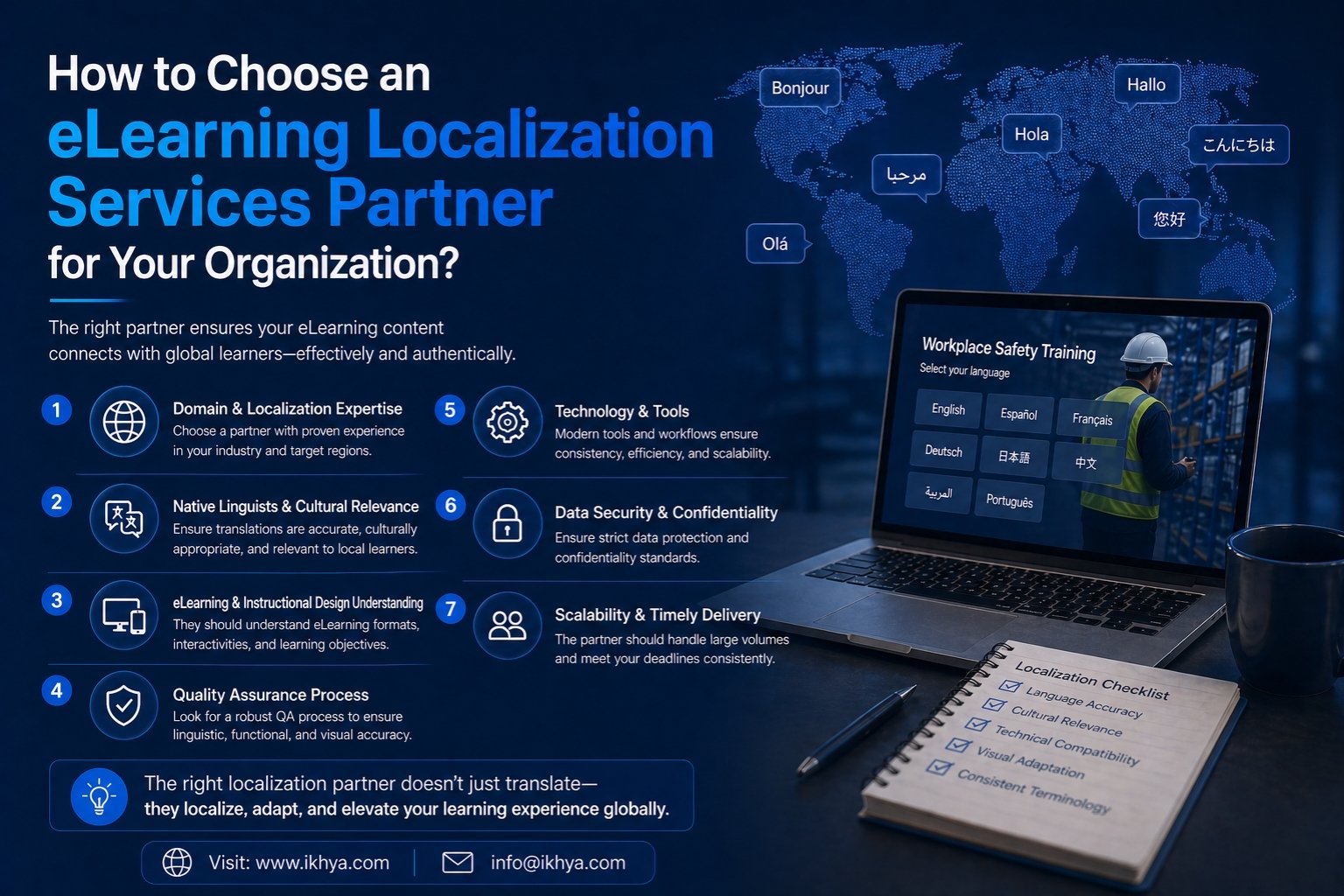
Choosing the right eLearning Localization Services Partner can save your organization time, cost, and training risk. If your teams work across countries, languages, and cultures, one standard course is rarely enough. You need a partner who can adapt learning content for every audience while keeping quality high and rollout fast. This guide explains how to compare vendors, what pricing to expect, what mistakes to avoid, and how to select a reliable provider.
If you need expert help now, Book a Free eLearning Demo with IKHYA.
Why the Right eLearning Localization Services Partner Matters
Global training only works when learners clearly understand the content. Direct translation often misses tone, examples, visuals, and local meaning. That leads to confusion, poor completion rates, and weak learning results.
A skilled eLearning Localization Services Partner helps you:
- Deliver training in local languages
- Adapt examples for regional relevance
- Improve learner engagement
- Protect compliance standards
- Launch courses faster across markets
- Maintain one consistent brand message
For growing companies, localization is not just language work. It is a business growth tool.
What an eLearning Localization Services Partner Should Deliver
Many buyers think localization means simple translation. In reality, strong vendors provide complete learning adaptation.
Translation vs Full Localization
Translation changes text into another language. Localization goes further by adjusting:
- tone and writing style
- currencies and units
- local examples
- date and time formats
- visuals and symbols
- cultural references
Technical Course Publishing
Your partner should support tools such as:
- Articulate Storyline
- Rise 360
- Adobe Captivate
- HTML5 modules
- SCORM packages
- xAPI content
LMS Testing
Courses must work correctly after language conversion. A provider should test:
- navigation
- tracking
- quizzes
- completion status
- mobile responsiveness
Media Adaptation
Good localization often includes:
- voiceover replacement
- subtitle creation
- on-screen text edits
- image redesign
This is where eLearning Translation Services and full localization become different.
10 Must-Have Qualities in an eLearning Localization Services Partner
Use this checklist before signing any contract.
| Criteria | Why It Matters | What to Ask |
|---|---|---|
| Industry Experience | Faster understanding of training topics | Have you worked in our sector? |
| Native Experts | Better quality and tone | Who reviews language output? |
| QA Process | Fewer errors | What checks are included? |
| Technical Skills | Smooth deployment | Can you republish SCORM files? |
| Speed | Faster launches | What is your average timeline? |
| Scale | Multi-country support | How many languages can you handle? |
| Security | Protects IP and data | What security process do you follow? |
| PM Support | Easier communication | Will we get a project manager? |
| Transparent Pricing | Easier budgeting | What costs are extra? |
| Revision Support | Better final quality | How many revisions are included? |
A dependable eLearning Localization Services Partner should answer each point clearly.
Red Flags to Avoid When Hiring a Vendor
Some vendors look affordable at first but create expensive problems later.
Warning Signs
- Very low pricing with no review process
- No sample work or case studies
- No LMS testing after localization
- Only text translation, no media support
- Slow communication during sales stage
- No dedicated project manager
- Hidden fees for edits or publishing
If you notice these signs, continue your search.
Pricing Guide for eLearning Localization Services Partner
Pricing depends on language count, source file type, media complexity, and deadlines. Below are common market ranges in USD.
| Service Type | Typical Price Range (USD) |
|---|---|
| Text Translation | $0.08–$0.22 per word |
| Full Course Localization | $500–$3,000 per course |
| Voiceover per Language | $250–$1,500 |
| Subtitle Creation | $100–$600 per module |
| SCORM Republish & Testing | $150–$900 |
| Multi-language Bundle Projects | Custom Quote |
Low price does not always mean value. Review quality controls, speed, and technical support before deciding.
If you need exact project pricing, Contact Us for a tailored estimate.
Best Partner Model for Different Organizations
Not every company needs the same vendor model.
Small Businesses
Best choice:
- flexible pricing
- quick turnaround
- fewer minimum commitments
Mid-Size Companies
Best choice:
- recurring project support
- multi-language capacity
- dedicated manager
Global Enterprises
Best choice:
- large-scale rollout ability
- strong governance
- compliance workflows
- regional review systems
Regulated Industries
Healthcare, finance, and manufacturing firms often need extra review accuracy and legal alignment.
How to Compare Vendors in a Smart Way
Use a scorecard instead of choosing by price alone.
| Factor | Weight |
|---|---|
| Quality | 30% |
| Speed | 20% |
| Technical Capability | 20% |
| Communication | 15% |
| Price | 15% |
Ask 3 vendors to complete a sample project. Compare real output quality before selecting your eLearning Localization Services Partner.
Why Organizations Choose IKHYA – eLearning Solutions Company
IKHYA – eLearning Solutions Company supports organizations that need scalable and practical digital learning solutions.
Businesses choose IKHYA because of:
- end-to-end learning execution
- fast global delivery models
- dependable project communication
- strong quality processes
- flexible engagement options
IKHYA also supports related services such as:
- Custom eLearning Development Services
- Rapid eLearning Development Services
- Instructional Design Services
- eLearning Localization Services
- eLearning Translation Services
If you are also searching for an experienced elearning development company, IKHYA can support both development and localization under one team.
Common Mistakes Buyers Make
Many organizations delay success by making simple buying mistakes.
- Choosing Only on Lowest Price — Cheap vendors may increase rework cost later.
- Ignoring Technical Testing — Translated courses can break in LMS systems.
- No Pilot Project — Always test one module first.
- No Review Timeline — Internal reviewer delays often slow launch dates.
- No Growth Plan — Choose a vendor that can scale as your business expands.
What Success Looks Like After Choosing the Right Partner
When you select the right eLearning Localization Services Partner, you should see:
- faster rollout in new countries
- better learner completion rates
- stronger training consistency
- fewer support tickets
- improved employee confidence
- smoother global onboarding
That is real ROI from localization.
How to Get Started
Use this simple process:
- Define languages and countries needed
- Count courses and file formats
- Identify deadlines
- Request a pilot sample
- Compare vendors using scorecards
- Start with one rollout phase
Need help planning the process? Request RFP and receive a tailored response.
Final Thoughts
Choosing an eLearning Localization Services Partner is a strategic decision, not just a vendor purchase. The right provider helps your teams learn faster, understand better, and perform consistently across regions. Focus on quality, technical ability, speed, and long-term scale.
If your organization wants a reliable partner for global training success, Book a Free eLearning Demo, Request RFP, or Contact Us to speak with IKHYA – eLearning Solutions Company today.
FAQs
Q1. What is an eLearning Localization Services Partner?
An eLearning Localization Services Partner helps organizations adapt training courses for different languages, regions, and cultures. This usually includes translation, media updates, LMS testing, and cultural adjustments so learners understand the content clearly.
Q2. How do I choose the best eLearning Localization Services Partner?
Choose a partner based on quality control, industry experience, native language experts, technical capability, turnaround time, and pricing transparency. Always request sample work before making a final decision.
Q3. Why is eLearning localization important for global organizations?
Localization helps employees learn in their preferred language and local context. This improves course completion, engagement, knowledge retention, and compliance across countries.
Q4. What is the difference between translation and localization in eLearning?
Translation converts text into another language. Localization goes further by adapting visuals, tone, examples, formats, voiceovers, and cultural references for local learners.
Q5. What services should an eLearning Localization Services Partner provide?
A strong provider should offer text translation, voiceover, subtitles, graphic edits, SCORM republishing, LMS testing, multilingual QA, and project management.
Q6. How much does eLearning localization cost?
Costs vary by language, course length, media complexity, and timeline. Pricing may range from per-word translation fees to full-course localization packages in USD.
Q7. How long does eLearning localization take?
Simple modules may take a few days, while larger multilingual projects can take several weeks. Timelines depend on review cycles, languages, and technical updates.
Q8. Can a localization partner work with Storyline or Rise courses?
Yes. Many professional vendors support Articulate Storyline, Rise 360, and other common authoring tools. Always confirm tool expertise before starting.
Q9. What languages can an eLearning Localization Services Partner support?
Most established vendors support major global languages such as Spanish, French, Arabic, German, Chinese, and many more. Ask if they can scale to your required regions.
Q10. How do I know if localization quality is good?
Review sample output for language accuracy, learner clarity, tone, formatting, and technical performance. Native reviewer checks are also important.
Q11. Should I choose the cheapest eLearning localization vendor?
Not always. Very low pricing can lead to poor quality, missed deadlines, and expensive rework later. Compare total value, not only cost.
Q12. What industries use eLearning localization services most?
Common industries include healthcare, finance, manufacturing, retail, technology, and compliance-heavy sectors that train teams across multiple countries.
Q13. Can localized courses track progress in our LMS?
Yes, if properly tested. A skilled partner should ensure SCORM or xAPI tracking works after localization.
Q14. What are common mistakes when hiring a localization partner?
Common mistakes include choosing only by price, skipping pilot projects, ignoring LMS testing, and not checking revision policies or timelines.
Q15. Do I need voiceover and subtitles for localized training?
Not always, but they improve accessibility and learner experience. Video-based courses often perform better with subtitles or local voice narration.
Q16. How many vendors should I compare before selecting one?
Comparing at least three vendors is a smart approach. Use a scorecard for quality, speed, communication, pricing, and technical support.
Q17. Can one company handle both development and localization?
Yes. Some providers offer course creation plus localization, which can improve speed and consistency. This is useful when working with an IKHYA or similar full-service provider.
Q18. When should I localize my eLearning courses?
Localize when expanding to new countries, onboarding global teams, launching compliance training, or improving results in multilingual workplaces.
Q19. What should I ask before signing with an eLearning Localization Services Partner?
Ask about turnaround time, language reviewers, security, sample work, revisions, LMS testing, communication process, and pricing structure.
Q20. How can I get started with eLearning localization quickly?
Start by listing languages, courses, deadlines, and formats. Then request a pilot project or quote from a trusted provider and review the sample before scaling.
Your global workforce deserves training that every learner can understand, trust, and complete successfully. Choosing the right eLearning Localization Services Partner can improve engagement, speed up international rollouts, and protect training quality across every region.
If you need a reliable team for multilingual course translation, technical publishing, LMS testing, or full-scale global learning delivery, IKHYA is ready to help.
Whether you need one course localized or an enterprise-wide rollout, our team can build a practical solution around your goals, timelines, and budget.
Take the Next Step Today
- Request RFP for a custom proposal based on your project needs
- Book a Free eLearning Demo to see how we deliver results
- Contact Us to discuss languages, timelines, and pricing
- Need end-to-end support? Talk with an experienced elearning development company
Strong global training starts with the right partner. Connect with IKHYA today and move your learning programs forward with confidence.