
How to Choose the Right eLearning Translation Services Provider

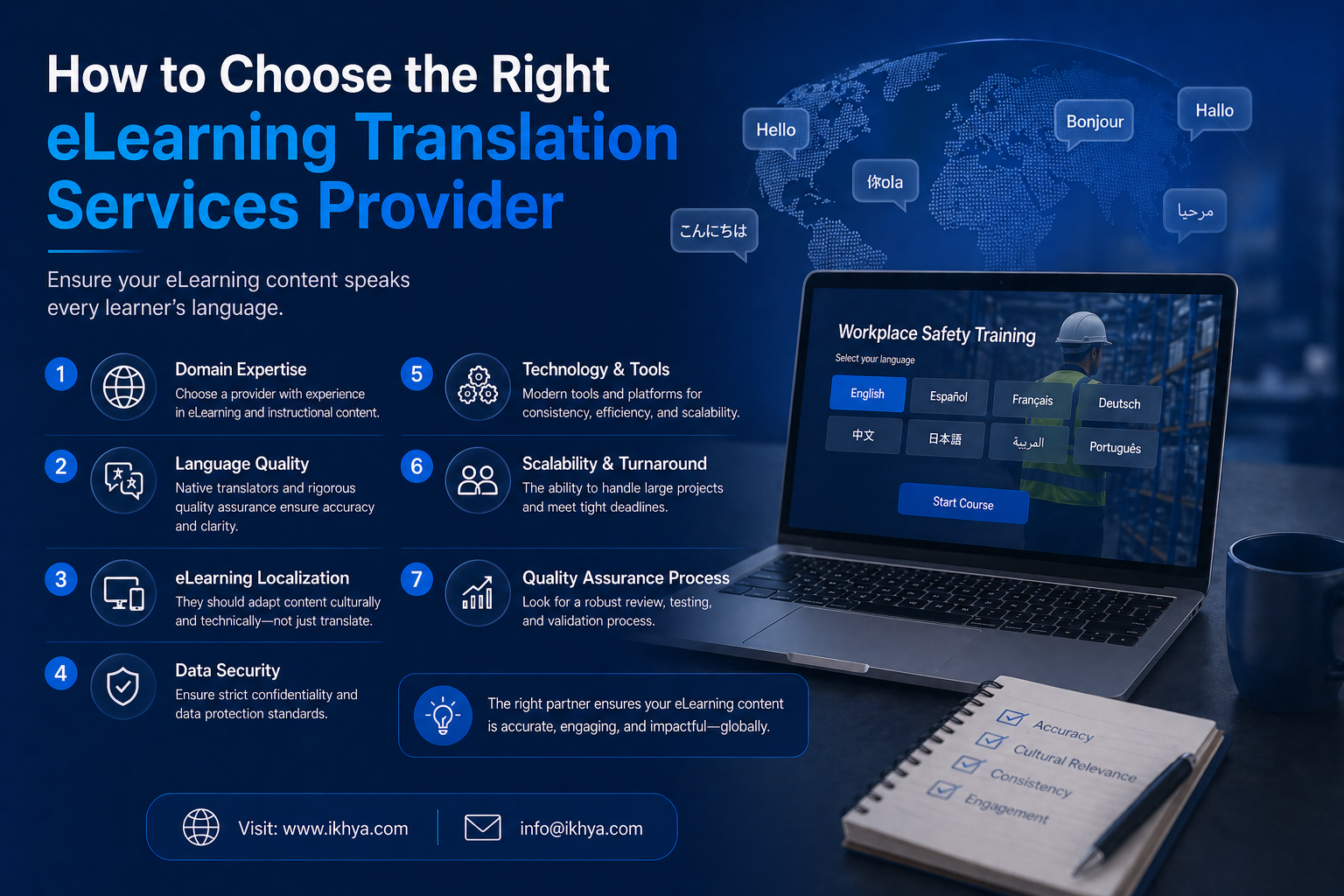
Choosing the right eLearning Translation Services Provider is important when you want to train teams across many countries. A poor choice can create confusion, delays, and low learner engagement. The right provider helps you deliver clear, accurate, and culturally relevant training that people understand and complete. This guide explains how to compare providers, costs, quality, and technical skills so you can make the best decision.
If you need expert help now, Request RFP or Book a Free eLearning Demo with IKHYA – eLearning Solutions Company.
Why Choosing the Right eLearning Translation Services Provider Matters
Global companies often train employees, partners, and customers in different languages. If the translation is weak, learners may misunderstand key topics such as safety, compliance, product knowledge, or workplace rules.
A strong eLearning Translation Services Provider helps you:
- Improve learner understanding
- Increase course completion rates
- Maintain brand consistency
- Reduce training errors
- Launch faster in multiple markets
- Support business growth worldwide
Good translation is not only about language. It is also about learning results.
What Services a Professional eLearning Translation Services Provider Should Offer
Many companies think translation means changing text from one language to another. In reality, quality multilingual training needs much more.
Course Translation
This includes translating:
- On-screen text
- Quiz questions
- Menus
- Navigation labels
- PDFs and handouts
- Job aids
Localization for Culture and Region
Localization adjusts content for local users. This may include:
- Date formats
- Currency formats
- Images
- Colors
- Symbols
- Examples and case studies
- Regional regulations
This is why eLearning Localization Services are often as important as translation itself.
Voiceover, Subtitles, and Media Support
Modern courses use video and audio. Your provider should support:
- Professional voiceovers
- Subtitle translation
- Closed captions
- Script adaptation
- Audio syncing
LMS Compatibility
Courses must work inside your LMS. Ask if they support:
- SCORM
- xAPI
- AICC
- HTML5 packages
QA and Testing
A good provider tests translated courses before launch to remove language and technical errors.
10 Proven Ways to Choose the Best eLearning Translation Services Provider
1. Check Industry Experience
Choose a provider with experience in your industry. Healthcare, finance, retail, manufacturing, and software training all need different language accuracy.
A provider with industry knowledge reduces mistakes and speeds up delivery.
2. Ask for Native Language Experts
Native translators understand tone, local usage, and cultural meaning better than generic translators.
This improves learner trust and clarity.
3. Look for Learning Design Knowledge
Translation alone is not enough. A provider with Instructional Design Services can improve learning flow, engagement, and course usability.
That means learners understand content faster.
4. Confirm Authoring Tool Expertise
Ask if they work with:
- Articulate Storyline
- Adobe Captivate
- Rise 360
- Lectora
- HTML5 custom builds
This avoids rebuilding costs.
5. Review Turnaround Time
If you launch training globally, speed matters. Ask about timelines for:
- 1 course
- 10 courses
- urgent projects
- ongoing monthly work
If speed is critical, providers with Rapid eLearning Development Services can be valuable.
6. Check Scalability
Can they support 2 languages today and 20 languages later? Growth planning matters.
7. Understand Pricing Clearly
Avoid hidden costs. Ask for a clear pricing model before starting.
8. Review Quality Process
Ask how they manage:
- translation review
- proofreading
- linguistic QA
- functional testing
- final sign-off
9. Check Communication Standards
Strong communication prevents delays. You need a responsive project manager and clear updates.
10. Ask About Post-Launch Support
Sometimes updates are needed after launch. Make sure the provider supports revisions and future versions.
Comparison Table: Good Provider vs Poor Provider
| Feature | Good Provider | Poor Provider |
|---|---|---|
| Native Translators | Yes | Rarely |
| LMS Testing | Yes | Limited |
| Cultural Localization | Strong | Weak |
| Fast Turnaround | Structured | Delayed |
| Transparent Pricing | Clear | Hidden fees |
| Project Management | Dedicated support | Slow response |
| Revision Support | Included options | Difficult |
eLearning Translation vs Localization: What Is the Difference?
Many buyers confuse these terms.
| Service | Meaning | Best Use |
|---|---|---|
| Translation | Converts text into another language | Basic language change |
| Localization | Adapts content for region and culture | Better learner engagement |
| Full eLearning Adaptation | Translation + media + LMS + UX | Global enterprise rollout |
If you want stronger learning results, choose both translation and localization.
That is why many global teams request eLearning Translation Services together with localization support.
Common Mistakes to Avoid When Choosing an eLearning Translation Services Provider
- Choosing Lowest Price Only: Cheap services often create rework, learner confusion, and delays later.
- Ignoring Technical Testing: A translated course that fails inside the LMS creates bigger problems than text errors.
- Hiring General Translators: General translators may not understand learning language, assessments, or compliance content.
- No Review Process: Without QA, mistakes reach learners.
- No Long-Term Support: Training content changes often. Choose a partner ready for updates.
How Much Does an eLearning Translation Services Provider Cost?
Pricing depends on course size, number of languages, media complexity, and deadlines.
Typical Pricing in USD
| Service Type | Estimated Cost |
|---|---|
| Small text-based module (1 language) | $500 – $1,500 |
| Interactive course with media | $1,500 – $5,000 |
| Multi-language enterprise rollout | $5,000 – $25,000+ |
| Voiceover per language | $300 – $2,000+ |
| Subtitle package | $150 – $800 |
Common Pricing Models
- Per word pricing
- Per hour pricing
- Per course pricing
- Monthly retainer for ongoing needs
Always request a custom quote based on scope. For exact pricing, Contact Us.
Why Businesses Choose IKHYA – eLearning Solutions Company
IKHYA – eLearning Solutions Company supports organizations that need reliable multilingual training solutions across global markets.
What Makes IKHYA Different
- Strong experience in enterprise learning
- Fast project delivery
- Scalable multi-language support
- Learning-first approach
- Technical LMS compatibility
- Dedicated support teams
Complete Learning Support
Along with translation, IKHYA also helps with:
- Custom eLearning Development Services
- PPT to eLearning Conversion Services
- eLearning Course Redesigning Services
- ILT to eLearning Course Conversion
- End-to-end learning strategy support as an experienced elearning development company
This allows businesses to manage all learning needs with one trusted partner.
When Should You Hire an eLearning Translation Services Provider?
You should consider hiring a provider when:
- Expanding into new countries
- Training remote global teams
- Launching multilingual compliance training
- Standardizing product training worldwide
- Updating old English-only courses
- Rebranding global learning content
The earlier you involve the provider, the smoother the rollout.
Simple Buying Checklist Before You Decide
Before selecting a vendor, confirm these points:
- Do they understand eLearning projects?
- Do they offer localization, not only translation?
- Can they support your LMS?
- Are timelines realistic?
- Is pricing clear?
- Can they scale globally?
- Do they offer future updates?
- Is communication responsive?
If yes, you may have found the right partner.
Final Thoughts
Choosing the best eLearning Translation Services Provider is not only about converting words into another language. It is about creating training that people understand, trust, and complete. The right provider improves learner success, saves time, and helps your business grow across borders.
If you are planning multilingual training and need a dependable partner, Request RFP, Book a Free eLearning Demo, or Contact Us today with IKHYA – eLearning Solutions Company.
FAQs About Choosing the Right eLearning Translation Services Provider
Q1. What is an eLearning Translation Services Provider?
An eLearning Translation Services Provider helps businesses convert online training courses into multiple languages. They also improve content so learners in different countries can understand and complete training easily.
Q2. Why do I need an eLearning Translation Services Provider?
If your company trains global teams, a provider helps deliver accurate and culturally relevant learning content. This improves engagement, compliance, and course completion rates.
Q3. How do I choose the right eLearning Translation Services Provider?
Look for industry experience, native translators, LMS compatibility, quality checks, clear pricing, and strong communication. A provider should also support future updates and scaling.
Q4. What is the difference between eLearning translation and localization?
Translation changes text into another language. Localization adapts content for culture, images, examples, date formats, and regional expectations for better learner experience.
Q5. How much does an eLearning Translation Services Provider cost?
Costs depend on course size, languages, media complexity, and deadlines. Small projects may start at $500, while enterprise multilingual rollouts can cost several thousand dollars.
Q6. Which industries use eLearning translation services most?
Healthcare, finance, retail, manufacturing, software, logistics, education, and compliance-focused industries often use eLearning translation services for global workforce training.
Q7. Can an eLearning Translation Services Provider translate SCORM courses?
Yes. Professional providers can translate SCORM, xAPI, AICC, and HTML5-based learning courses while keeping LMS functionality intact.
Q8. How long does eLearning course translation take?
Simple courses may take a few days, while larger interactive or multi-language projects may take several weeks. Timelines depend on content volume and complexity.
Q9. Do I need localization or only translation?
If learners are in different regions, localization is usually the better choice. It creates stronger engagement by adapting content to local culture and language use.
Q10. What languages can eLearning Translation Services Providers support?
Most professional providers support common global languages such as Spanish, French, German, Arabic, Chinese, Japanese, Hindi, and many others.
Q11. Can providers also translate voiceovers and subtitles?
Yes. Many providers offer multilingual voiceover recording, subtitle translation, script adaptation, and audio syncing for video-based training.
Q12. What should I avoid when hiring an eLearning Translation Services Provider?
Avoid choosing only by lowest price, ignoring quality checks, using non-specialist translators, and skipping LMS testing before launch.
Q13. How can translated eLearning improve employee training?
Translated training helps learners understand content faster in their preferred language. This can improve retention, productivity, and completion rates.
Q14. Is eLearning localization important for compliance training?
Yes. Compliance topics need clear language and local relevance. Localization reduces misunderstanding and helps meet regional requirements.
Q15. Can an eLearning Translation Services Provider update old courses?
Yes. Providers can refresh older English-only courses, translate them, redesign layouts, and modernize learning experiences for new markets.
Q16. What tools should a provider support?
A strong provider should support tools like Articulate Storyline, Rise 360, Adobe Captivate, Lectora, and common LMS platforms.
Q17. How do I know if a provider offers quality work?
Ask about proofreading, linguistic review, functional testing, sample work, client references, and revision support before selecting them.
Q18. Should I choose one provider for all languages?
Usually yes. One experienced provider can manage consistency, timelines, and project communication better than multiple vendors.
Q19. Can small businesses use eLearning translation services?
Yes. Even small businesses expanding globally can use translation services for onboarding, product training, and customer education.
Q20. Why choose IKHYA – eLearning Solutions Company for multilingual training?
IKHYA offers end-to-end learning expertise, translation support, scalable delivery, and global eLearning solutions that help businesses train teams worldwide.
Ready to Launch Global Training in Multiple Languages?
Choosing the right eLearning Translation Services Provider can improve learner understanding, increase course completion, and help your business grow across global markets. If you need accurate translations, fast delivery, and learning-focused solutions, now is the right time to act.
IKHYA – eLearning Solutions Company helps businesses create and translate high-quality training for teams in the USA, UK, Australia, UAE, and worldwide.
Get Started Today
- Request RFP for your upcoming multilingual training project
- Book a Free eLearning Demo to see our capabilities in action
- Contact Us for custom pricing and expert consultation
Whether you need one course or a full global rollout, IKHYA is ready to support your success.




