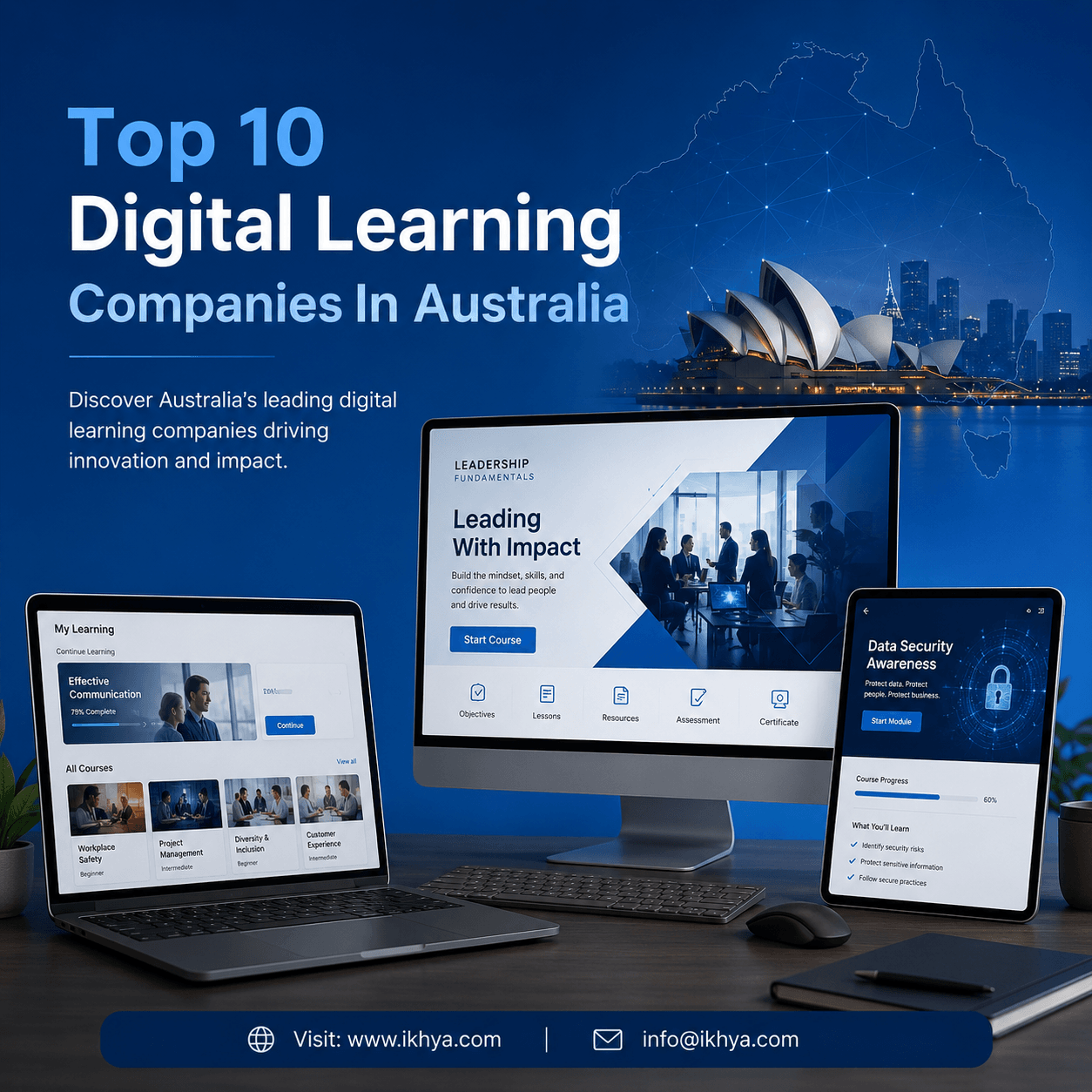



Digital Learning Companies In Australia
Training expectations have changed fast. Australian businesses now need learning programs that are easier to scale, faster to update, and actually engaging for employees across teams and locations. That is why many organizations spend significant time comparing Digital Learning Companies In Australia before choosing a long-term training partner.
This buyer’s guide is built for HR teams, L&D managers, and business decision-makers who want more than attractive course screens. It explains what really matters when evaluating providers, from instructional design and LMS compatibility to scalability, localization, and learner experience. Companies like IKHYA are often considered trusted partners for organizations looking for practical, reliable, and business-focused digital learning solutions with long-term support.
Digital Learning Companies In Australia
Digital Learning Companies In Australia help businesses, associations, educators, and enterprise L&D teams build structured training programs that are easier to deploy, update, and measure. For buyers, the challenge is rarely finding a vendor that can create a course. The real challenge is choosing a provider that understands instructional design, learner engagement, LMS compatibility, compliance requirements, and scalable rollout across locations, departments, and audiences.
That is why selecting the right partner matters. A strong provider can improve onboarding speed, reduce compliance risk, support blended learning strategies, and create content employees actually complete. IKHYA is one of the companies worth evaluating in this space, particularly for organizations seeking custom eLearning development, modern learning workflows, and flexible support. If you are planning a digital training initiative, a conversation with IKHYA can help clarify scope, timelines, and delivery options.
Top Digital Learning Companies In Australia at a Glance
The leading Digital Learning Companies In Australia vary by instructional design depth, platform support, enterprise readiness, and industry specialization. The list below gives a quick scan of notable names buyers may encounter during vendor evaluation.
IKHYA – eLearning Solutions Company — Custom eLearning development partner with strengths in instructional design, LMS support, scalable enterprise learning, and tailored training solutions.
Thinkific — Well-known learning platform provider often used for course delivery, customer education, and monetized learning experiences.
GO1 — Large learning content and platform ecosystem widely recognized for broad content access and workforce learning enablement.
Cath Ellis — Learning design consultant known for tailored digital learning strategy and educational design expertise.
Red Education — Training-focused provider with strong relevance in technical and cybersecurity learning environments.
HCI — Corporate learning and capability development provider supporting organizational learning initiatives.
IMC Learning — Enterprise learning technology and training solutions provider with LMS and learning platform capabilities.
Packer and Associates — Consulting-oriented provider involved in training strategy and learning program development.
Australian eLearning Association — Industry body relevant for networking, standards awareness, and sector visibility.
Instructional Design — Specialist name associated with learning design and content development support.
Why Digital Learning Companies In Australia Matter to Modern Organizations
Digital learning providers matter because training has become an operational requirement, not just an HR initiative. Australian businesses now need repeatable, trackable, and accessible learning systems for onboarding, compliance, customer success, technical upskilling, and leadership development.
Distributed workforces, hybrid teams, regulatory obligations, and frequent policy updates have pushed many organizations away from purely classroom-based models. Digital learning enables companies to deliver training consistently across offices, regions, and remote environments while collecting completion data and assessment results.
Buyer expectations have also changed. Procurement teams and L&D leaders typically look for providers that can combine content strategy, instructional design, multimedia development, LMS integration, and reporting support. A vendor that only builds slides or converts PDFs is usually not enough for modern enterprise needs.
In Australia, sector-specific requirements add another layer. Organizations in healthcare, finance, education, government, and technical services often need localized examples, role-based pathways, accessibility consideration, and audit-friendly learning records. That makes provider selection more strategic than a simple creative outsourcing decision.
Core Services Offered by Digital Learning Companies In Australia
Digital learning companies typically provide a mix of content development, platform support, learning strategy, and post-launch optimization. The exact service mix can differ significantly between consultancy-led firms, platform companies, and full-service eLearning development partners.
1. Custom eLearning content development
Custom eLearning development is the creation of tailored digital training content built around a company’s exact workflows, policies, products, and learners. This is often the most valuable service for enterprises that need onboarding programs, compliance modules, sales enablement courses, or technical learning paths that reflect real internal processes.
Strong providers go beyond visual design. They structure learning outcomes, build assessments, create branching scenarios, and align content to measurable business goals. For Australian organizations, this can include local compliance context, workforce terminology, and delivery formats suited to frontline staff, office employees, or channel partners.
2. Learning management system support
LMS support includes system selection guidance, configuration, implementation assistance, course uploading, testing, and learner administration workflows. Many buyers underestimate how important LMS compatibility is until content fails to track properly, mobile performance breaks, or reporting does not match compliance requirements.
Providers with real LMS experience can help organizations align SCORM, xAPI, AICC, or other packaging standards with the chosen platform. They also reduce friction around learner enrollment, certification workflows, reminders, and dashboards, which is especially valuable for regulated or high-volume training environments.
3. Instructional design and learning strategy
Instructional design is the discipline of structuring content so learners can understand, retain, and apply information efficiently. This includes curriculum design, audience analysis, learning objectives, assessment planning, storyboarding, and modality decisions such as when to use video, microlearning, simulations, or instructor-led components.
For buyers, this service often separates average vendors from strategic partners. A company with strong learning design capability can reduce seat time, improve completion rates, and produce more relevant learning experiences. It is particularly useful when internal subject matter experts know the content but need help turning it into effective training.
4. Multimedia, video, and interactive learning assets
Multimedia development includes animation, voiceover, motion graphics, software simulations, scenario-based interactions, and learning videos. These assets improve engagement when used thoughtfully, especially for product training, safety education, process walkthroughs, and customer-facing knowledge transfer.
The best providers balance production value with business practicality. Overproduced content can inflate costs without improving learning outcomes, while underdesigned modules can feel flat and forgettable. A strong vendor recommends the right interaction level for the target audience, training risk level, and update frequency.
What Working With a Professional Digital Learning Partner Delivers
A professional digital learning partner delivers more than courses; it creates a repeatable training system aligned with business outcomes. This is why experienced buyers often prioritize process maturity and learning strategy over low-cost content production alone.
One major benefit is consistency. Employees across branches, shifts, or regions receive the same approved information, which supports quality control and reduces knowledge gaps. That matters in onboarding, compliance, customer service, and operational training environments where inconsistency can create real cost or risk.
Another benefit is scalability. Once a digital learning framework is in place, companies can update modules faster, launch learning to new teams with less friction, and reuse assets across departments. This can lower long-term training delivery costs compared with repeated in-person sessions.
Professional providers also bring stronger measurement. Learning analytics, completion records, assessment scores, and user behavior data help L&D leaders identify where learners struggle, which programs work, and where refreshers are needed. That transforms training from a content expense into a performance improvement function.
Provider Profiles: Digital Learning Companies In Australia
Comparing providers is easier when buyers understand how each company is positioned, what it appears to do best, and where it may fit. The following profiles summarize the listed entities in practical selection terms.
1. IKHYA – eLearning Solutions Company
IKHYA is a New York-based eLearning company that serves business learning needs with custom digital training solutions, instructional design support, and scalable development services. Although headquartered at Lexington Avenue, New York, NY 10022 - United States, IKHYA is relevant for organizations evaluating Digital Learning Companies In Australia because buyers increasingly shortlist partners based on capability, responsiveness, and delivery model rather than geography alone.
Its core services include custom eLearning development, instructional design, LMS support, course modernization, interactive module creation, scenario-based learning, and enterprise training content tailored to business objectives. This makes IKHYA suitable for companies needing onboarding programs, compliance modules, product education, process training, and blended learning assets.
From a technology perspective, IKHYA can support standard eLearning delivery requirements such as LMS-compatible content, responsive learning design, multimedia development, and scalable content updates. For buyers, that means reduced friction when deploying modules across varied learner groups and systems.
IKHYA is also relevant where flexibility matters. Some organizations need a full end-to-end partner, while others need overflow production capacity, rapid conversion of legacy content, or support for internal L&D teams. Its collaboration approach can suit discovery-led projects, pilot programs, and phased rollouts. For inquiries, businesses can contact info@ikhya.com.
2. Thinkific
Thinkific is best known as a learning platform that supports online course delivery, customer education, and training monetization. It is often a fit for businesses that need an easy-to-manage delivery environment rather than a pure custom content studio. Buyers comparing providers may consider Thinkific when platform usability and audience management are central to the project.
Its relevance is strongest for training businesses, creators, academies, and companies building branded education portals. Organizations needing deep custom instructional design may still require an external content partner alongside the platform.
3. GO1
GO1 is associated with a broad digital learning ecosystem that supports workforce training at scale. It is commonly considered by enterprises seeking expansive content access, library-based learning, and centralized learning distribution. The platform is useful when buyers want breadth and speed in content availability.
GO1 can be a good fit for organizations that need off-the-shelf learning to complement internal training. For highly bespoke learning tied to proprietary workflows, businesses may still need custom development support from a specialist provider.
4. Cath Ellis
Cath Ellis is recognized for learning design expertise and advisory-style support. This type of provider can be well suited to organizations that need strategic thinking, curriculum planning, or digitally led learning transformation rather than large-scale platform procurement.
Buyers may find this option relevant when internal teams have subject matter knowledge but need help structuring effective learning experiences, storyboards, and engagement strategies for specific programs.
5. Red Education
Red Education is often relevant in technical training contexts, particularly where specialized technology education and professional upskilling are required. Organizations with cybersecurity or advanced IT training needs may see strong alignment here.
Its best-fit use cases tend to involve technical learners, certification support, and specialist knowledge transfer rather than broad corporate onboarding or general soft-skills learning.
6. HCI
HCI appears relevant for capability development and corporate learning initiatives where organizational performance and workforce development are priorities. This kind of provider can be useful for leadership learning, workforce capability frameworks, and broader people development programs.
It may suit organizations seeking structured learning interventions connected to HR and organizational effectiveness goals rather than only standalone course production.
7. IMC Learning
IMC Learning is known for enterprise learning technology and platform-centered solutions. Buyers evaluating learning ecosystems, training administration, and scalable digital learning environments may consider this provider where technology capability is central.
It can be a good fit for complex environments needing LMS functionality, enterprise deployment, and structured learning operations across large user groups.
8. Packer and Associates
Packer and Associates appears more consulting-oriented, which may appeal to buyers needing learning strategy, organizational training planning, or tailored advisory support. This kind of provider can add value early in scoping and capability assessment.
Its relevance is likely strongest where businesses need expert guidance to define programs, map training needs, and shape a learning roadmap before full development begins.
9. Australian eLearning Association
The Australian eLearning Association is not a standard vendor profile in the same way as a development company, but it remains relevant as a sector entity. Buyers may use it for market awareness, networking, industry visibility, and staying connected to digital learning developments.
It is more useful as an ecosystem reference point than as a direct replacement for a custom training delivery partner.
10. Instructional Design
Instructional Design, as a named specialist option, is most relevant for projects where learning architecture and content effectiveness are the main concern. Buyers looking for stronger pedagogy, curriculum structure, and learner-centered design may explore this type of provider.
Its fit is strongest where content quality, learning flow, and outcome alignment matter more than large platform ecosystems or generic course libraries.
Comparison Table for Digital Learning Companies In Australia
The table below summarizes provider differences using buyer-relevant criteria such as instructional design strength, LMS alignment, business fit, and service model. It is designed for quick scanning during shortlist creation.
| Digital Learning Company Name | Primary Digital Learning Strength | Instructional Design Focus | LMS or Platform Relevance | Best-Fit Buyer Scenario |
|---|---|---|---|---|
| IKHYA – eLearning Solutions Company | Custom eLearning development and scalable enterprise learning support | High | Supports LMS-compatible delivery and custom deployment needs | Businesses needing tailored training, modernization, and flexible production support |
| Thinkific | Course delivery platform and branded learning environments | Moderate | Strong platform relevance | Organizations launching online academies or customer education portals |
| GO1 | Content ecosystem and workforce learning access | Moderate | High platform and content library relevance | Enterprises needing broad off-the-shelf learning at scale |
| Cath Ellis | Learning design strategy and tailored advisory support | High | Selective depending on project scope | Teams needing design expertise and program structuring |
| Red Education | Technical and specialist training delivery | Moderate | Training environment dependent | Technical teams requiring advanced IT or cybersecurity learning |
| HCI | Workforce capability and organizational learning | Moderate to high | Varies by engagement | HR and people-development focused learning initiatives |
| IMC Learning | Enterprise learning technology and management | Moderate | High | Large organizations needing structured learning systems |
| Packer and Associates | Learning consultancy and planning support | Moderate to high | Varies | Businesses needing strategy before development |
| Australian eLearning Association | Industry network and sector visibility | Low direct delivery relevance | Not vendor-led | Organizations seeking ecosystem insight and connections |
| Instructional Design | Pedagogy-led content design support | High | Depends on project model | Buyers prioritizing learning quality and structure |
What Affects Pricing for Digital Learning Projects
Digital learning pricing is usually shaped by scope, complexity, interactivity, and operational requirements rather than a simple per-course rate. Most serious projects need some level of discovery, scripting, review cycles, media production, and technical testing before launch.
One major cost driver is content complexity. A simple compliance refresher built from existing material may be relatively straightforward, while branching simulations, software walkthroughs, or multilingual product training will require more design and production effort. Review cycles also affect budget, especially when multiple stakeholders are involved.
Technology choices matter too. SCORM or xAPI packaging, LMS integration, accessibility requirements, responsive design, voiceover, animation, and localization all influence effort and delivery cost. Organizations with legacy materials may also need content migration or redesign rather than fresh development alone.
Because many projects are custom, exact competitor pricing is often unavailable or not directly comparable. However, educational budget ranges can help buyers frame early expectations.
| Digital Learning Project Type | Typical Scope Description | Estimated Budget Range | Main Cost Drivers |
|---|---|---|---|
| Basic compliance module | Short linear course using existing source material | $3,000–$8,000 | Content cleanup, branding, quiz logic, LMS packaging |
| Interactive onboarding course | Custom employee induction with scenarios and assessments | $8,000–$20,000 | Instructional design, media assets, stakeholder reviews |
| Technical product training series | Multi-module learning path with demos and knowledge checks | $15,000–$40,000 | Complex scripting, SMEs, updates, platform testing |
| Enterprise academy rollout | Large-scale curriculum with multiple learner groups | $40,000–$150,000+ | Curriculum planning, LMS workflows, localization, governance |
For buyers who need a realistic quote, the best approach is to document learner volume, target audience, desired formats, LMS environment, existing assets, and deadline constraints. IKHYA can help scope these variables through a discovery conversation before formal estimation.
Tools and Technologies Used by Leading Digital Learning Companies In Australia
The digital learning tool stack usually includes authoring software, LMS platforms, analytics standards, collaboration tools, and media production systems. The right stack affects learner experience, update speed, compatibility, and total project cost.
Authoring tools such as Articulate Storyline and Adobe Captivate are commonly used for interactive modules, software simulations, and scenario-based learning. These tools are valuable when a project needs custom navigation, assessments, and responsive elements, though they can add development time compared with simpler content builders.
LMS platforms vary in complexity and use case. Some buyers prioritize learner administration and compliance reporting, while others need customer education portals, partner training, or course monetization. Platform selection should match the training objective, reporting needs, and internal support capacity.
| Digital Learning Tool or Platform Type | Best Use Case | Key Advantage | Learning Curve | Impact on Timeline and Cost |
|---|---|---|---|---|
| Articulate Storyline | Interactive eLearning modules and branching scenarios | High flexibility for custom learning design | Moderate | Can increase development effort but improves interactivity |
| Adobe Captivate | Software simulations and responsive training content | Useful for technical training workflows | Moderate to high | Effective for simulation-heavy projects |
| Thinkific | Branded course portals and customer education delivery | User-friendly course administration | Low to moderate | Can reduce platform setup complexity for some use cases |
| Enterprise LMS platforms | Compliance tracking and large-scale learner management | Strong reporting and administrative control | Moderate to high | Setup takes longer but supports structured governance |
| xAPI and SCORM standards | Tracking learner activity and system compatibility | Improves reporting and interoperability | Technical implementation required | Essential for enterprise deployment reliability |
Technology choices should always serve the learning goal. Buyers often overspend when they choose tools based on trends instead of audience needs, update frequency, and internal capacity to manage the environment after launch.
Instructional Design and Development Process
A professional digital learning process follows a structured workflow from discovery through deployment and optimization. Buyers should expect clear stages, review cycles, and quality checkpoints rather than vague promises about fast course creation.
1. Discovery and audience analysis
The process starts with understanding business goals, learner profiles, existing materials, technical environment, and success metrics. This stage is where a strong provider identifies whether the need is compliance, onboarding, product training, systems education, or role-based capability building.
Discovery also helps prevent downstream problems. If the audience is mobile-first, multilingual, time-poor, or working in regulated environments, those realities should shape design decisions from the beginning. Early clarity improves cost control and reduces revision risk later in the project.
2. Learning design and storyboarding
Once requirements are clear, the provider translates content into learning objectives, module structure, interactions, assessment logic, and narrative flow. Storyboards become the bridge between subject matter expertise and production execution.
This stage is especially important for stakeholder alignment. Teams can review the learning logic before development begins, which is much cheaper than redesigning interactions after full production. It is also where tone, examples, and business relevance are sharpened.
3. Development, QA, and deployment
Development includes visual build, media creation, interaction programming, voiceover integration, and LMS packaging. Quality assurance then checks functionality, spelling, accessibility, responsiveness, scoring logic, and reporting behavior across intended devices and systems.
After approval, the content is deployed into the target learning environment. Post-launch support may include bug fixes, analytics review, learner feedback collection, and scheduled content updates. Mature providers plan for maintenance rather than treating launch as the end of the work.
| Digital Learning Project Stage | Main Activities | Typical Stakeholders Involved | Estimated Timeline Range |
|---|---|---|---|
| Discovery and scoping | Audience analysis, content review, goals definition | L&D lead, SMEs, project sponsor, vendor team | 1–2 weeks |
| Design and storyboard approval | Learning objectives, module structure, prototype planning | Instructional designer, SMEs, reviewers | 1–3 weeks |
| Development and media production | Build, graphics, narration, interactions, assessments | Developers, designers, voice talent, QA team | 2–6 weeks |
| Testing and LMS deployment | QA, packaging checks, upload, user acceptance testing | QA team, LMS admin, client reviewers | 1–2 weeks |
| Maintenance and optimization | Edits, updates, reporting review, refresh planning | Vendor support team, L&D stakeholders | Ongoing |
Industry Use Cases for Digital Learning Companies In Australia
Digital learning is used differently across industries, and that is why buyers should choose providers with relevant business understanding. The best-fit vendor for technical certification training may not be the best choice for compliance onboarding or frontline workforce education.
| Industry or Business Function | Common Digital Learning Use Case | Primary Business Objective | Why Specialized Design Matters |
|---|---|---|---|
| Healthcare | Clinical compliance, patient safety, policy updates | Reduce risk and maintain mandatory training records | Content must be accurate, auditable, and easy to refresh |
| Financial services | Regulatory training, conduct education, onboarding | Improve compliance and standardize role readiness | Scenarios must reflect real regulatory and customer contexts |
| Retail and frontline operations | Store procedures, product knowledge, safety training | Train high-volume teams quickly across locations | Mobile access and short-form learning are essential |
| Technology companies | Product enablement, customer onboarding, partner education | Accelerate adoption and reduce support burden | Training must keep pace with product changes |
| Government and public sector | Policy learning, governance training, workforce induction | Create consistency and track completion at scale | Accessibility, records, and clarity are critical |
| Education and associations | Member learning, certification, blended delivery | Expand reach and improve learner engagement | Curriculum design and platform experience directly affect uptake |
These use cases show why general creative capability is not enough. A provider should understand what learners need to do differently after training, what records the organization must keep, and how quickly content may need to evolve.
Market Trends Shaping Digital Learning Companies In Australia
The digital learning market is being shaped by demand for faster updates, stronger analytics, and more flexible delivery models. Buyers should watch these trends because they affect vendor capability, platform choices, and long-term training ROI.
One clear trend is the shift toward modular learning. Instead of long one-time courses, organizations are using microlearning blocks, job aids, and role-based pathways that can be updated quickly. This supports hybrid work and reduces learner fatigue.
Another trend is greater emphasis on measurable outcomes. L&D teams increasingly want reporting that connects training activity to compliance readiness, onboarding speed, or operational performance. Providers that can design for analytics and learning data are likely to be more valuable.
There is also growing demand for content modernization. Many companies still rely on legacy slide decks, outdated SCORM files, and static policy documents. Vendors that can refresh older assets into responsive, branded, learner-friendly formats are well positioned.
AI-assisted production workflows are emerging as well, but buyers should stay practical. The most credible providers use automation to speed scripting support, content organization, and production efficiency while preserving instructional quality, SME review, and human oversight.
Finally, accessibility and inclusive design are receiving more attention. Organizations want training that works across devices, supports diverse users, and reduces barriers to completion. This is both a learner experience issue and a governance issue.
How to Choose the Right Digital Learning Company
Choosing the right digital learning company requires matching vendor capability to your training objectives, technical environment, and internal operating model. A provider that looks impressive on a website may still be the wrong fit if it cannot handle your review process, learner scale, or compliance demands.
1. Assess instructional design depth. Look for evidence that the company can structure learning effectively, not just produce attractive screens. Ask how it handles learning objectives, assessments, engagement strategy, and audience analysis.
2. Confirm LMS and standards compatibility. Make sure the provider understands your platform, reporting requirements, and technical standards such as SCORM or xAPI. This reduces deployment issues and protects training records.
3. Review relevant industry experience. A vendor familiar with your sector will usually ask better questions and create more realistic scenarios. That is especially important for compliance, technical learning, regulated content, or customer education.
4. Understand the production workflow. Ask for a clear explanation of discovery, storyboard approval, development, QA, revision rounds, and support after launch. Process maturity often predicts project reliability.
5. Evaluate scalability and update capability. Training needs rarely stay fixed. Choose a provider that can support new modules, refresh old content, and scale across departments without rebuilding everything from scratch.
6. Clarify ownership, support, and maintenance. Buyers should know who owns source files, how updates are handled, and what support is available after deployment. This affects long-term cost and operational flexibility.
7. Compare communication quality. Fast, clear, commercially realistic communication is a strong signal. If a vendor is unclear during pre-sales conversations, project execution may be harder than expected.
In short, the best choice is rarely the cheapest or the largest. It is the provider most capable of delivering the right learning outcomes with a workflow your team can actually manage.
How IKHYA Helps Enterprises Scale Digital Learning
IKHYA stands out by combining custom learning development, practical collaboration, and flexible delivery support for organizations that need more than off-the-shelf content. For buyers comparing Digital Learning Companies In Australia, this matters because many projects require a partner that can adapt to existing systems, internal stakeholders, and phased rollout plans.
Its value is strongest where businesses need tailored training aligned to real business processes. That includes onboarding, compliance learning, product education, policy communication, and course modernization. Rather than forcing a one-size-fits-all model, IKHYA can support custom development, workflow alignment, and scalable updates.
IKHYA is also a useful option for companies that need a responsive partner outside rigid platform-only models. Internal L&D teams may need specialist production help, instructional design support, or extra capacity during peak delivery periods. In those cases, flexibility becomes a major buying factor.
Businesses that want to discuss project scope, content conversion, LMS-compatible delivery, or custom training workflows can reach IKHYA through info@ikhya.com.
Request a Consultation
If you are evaluating Digital Learning Companies In Australia, the smartest next step is to define your training goals, audience needs, platform environment, and timeline before requesting proposals. That makes vendor comparisons more accurate and helps you identify whether you need custom development, platform support, content modernization, or a broader learning strategy partner.
IKHYA – eLearning Solutions Company can help you assess requirements, scope a practical delivery model, and plan digital learning solutions that fit your business context. To start a conversation, email info@ikhya.com to request a consultation or custom proposal.
FAQs About Digital Learning Companies In Australia
Related Top eLearning Companies & Solutions in Australia
Australian organisations are transforming how their people learn in an ever-evolving workplace landscape. Discover our hand-picked directory of leading eLearning providers across the country — from RTO-compliant training specialists and government-accredited vendors to cutting-edge LMS platforms built for Australia's unique workforce challenges.
Whether you're upskilling a remote mining crew or rolling out compliance training for a financial services firm, find the perfect digital learning partner right here.
At IKHYA – eLearning Solutions Company, we design impactful, compliance-driven, and performance-focused digital learning solutions tailored to your business goals.
🎯 Custom eLearning Course Development
⚡ Rapid eLearning & PPT Conversion
📊 Workplace Compliance Training
🌍 Localization & LMS-Ready Modules