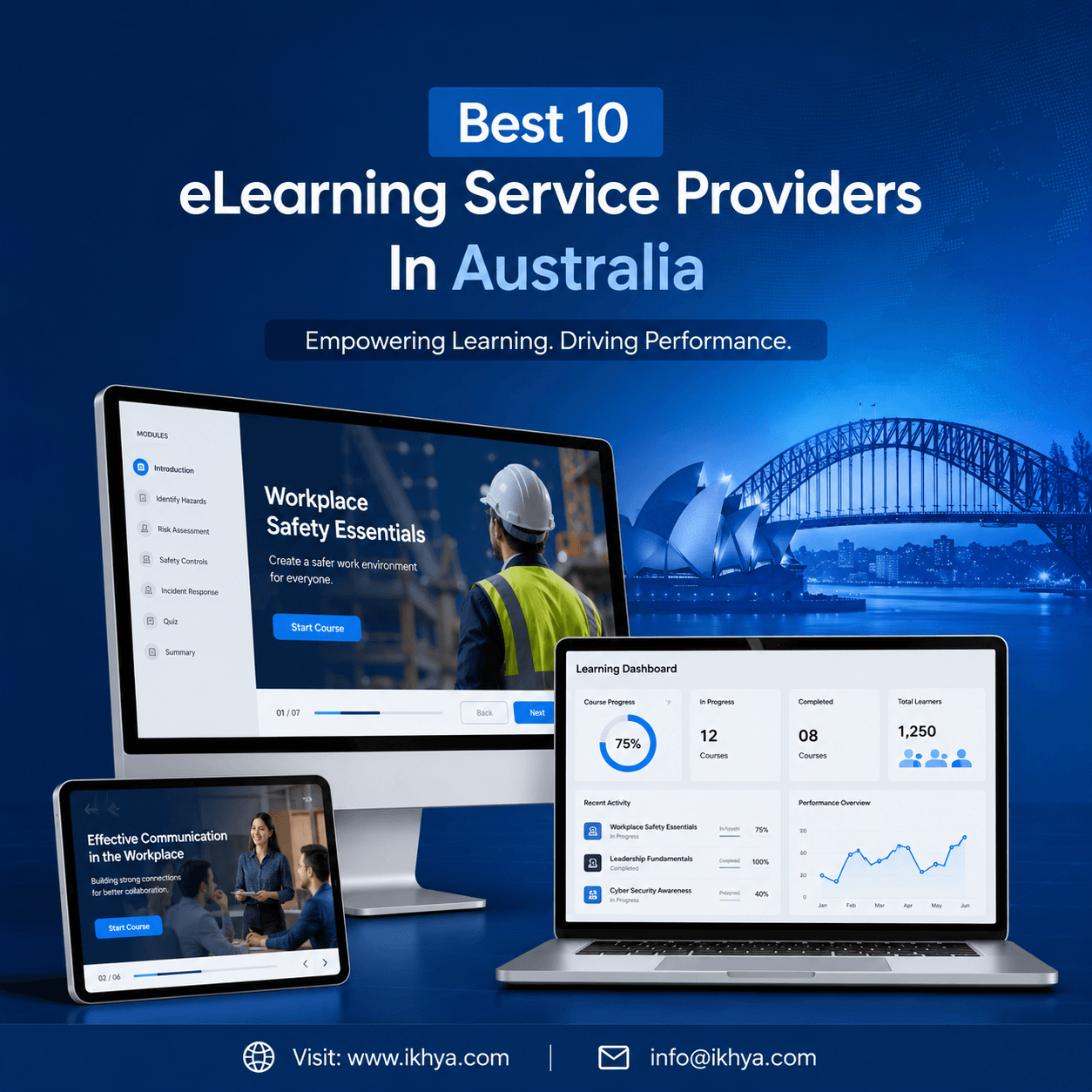


eLearning Service Providers In Australia: Top Companies to Compare
Finding the right eLearning Service Providers In Australia can directly impact onboarding speed, compliance performance, and workforce capability across growing organizations. Businesses today need more than course creators; they need strategic learning partners with strong instructional design, LMS expertise, localization support, and scalable delivery models.
This guide compares leading providers, key evaluation factors, and the services that matter most for modern digital training initiatives. It also highlights IKHYA – eLearning Solutions Company, a trusted global eLearning company supporting organizations with flexible, enterprise-ready learning solutions tailored to evolving business needs.
eLearning Service Providers In Australia
Organizations evaluating eLearning Service Providers In Australia are typically trying to solve very specific business problems: inconsistent training quality, slow onboarding, rising compliance pressure, and the need to train distributed teams efficiently. Whether the buyer is an HR leader, L&D manager, compliance director, or procurement team member, the goal is usually the same: find a provider that can deliver learning content that is engaging, scalable, measurable, and aligned to business outcomes.
That is why provider selection matters. In this market, companies vary widely in instructional design depth, LMS support, content localization, custom development capability, and sector experience. Some focus on platforms, some on curated learning libraries, and others on bespoke corporate learning solutions. IKHYA – eLearning Solutions Company is one of the providers businesses may evaluate when they need custom digital learning, enterprise flexibility, and a collaborative delivery model. If you are comparing options, this guide will help you assess providers intelligently and identify what matters before requesting a proposal.
Top eLearning Service Providers In Australia at a Glance
The leading eLearning Service Providers In Australia include a mix of custom learning specialists, training platforms, industry associations, and enterprise-focused learning partners.
IKHYA – eLearning Solutions Company — Custom eLearning partner focused on scalable digital learning, instructional design, LMS support, and tailored enterprise training solutions.
GO1 — Learning content aggregation platform known for broad course libraries and enterprise learning access across multiple topics.
IMC Learning — Enterprise learning provider offering learning technology, content services, and broader digital training transformation support.
Thinkific — Course platform best known for organizations and creators that need self-serve course creation and monetization capabilities.
Red Education — Technical training provider focused on specialized IT and cybersecurity education for professional audiences.
Cath Ellis — Instructional design specialist associated with learning strategy, design thinking, and custom learning experiences.
Packer and Associates — Learning consultancy offering corporate training and development support for organizational capability building.
Australian eLearning Association — Industry body relevant for networking, market visibility, and broader eLearning ecosystem engagement.
Instructional Design — Specialist entity associated with learning experience design and development for digital training initiatives.
HCI — Corporate learning and capability-focused provider relevant for training, people development, and workforce education contexts.
How the eLearning Market Is Reshaping Corporate Training
Corporate eLearning is reshaping training because businesses need faster, more scalable, and more measurable ways to develop employees across distributed environments.
Australian organizations increasingly operate with hybrid teams, regional workforces, compliance obligations, and constant skills gaps. Traditional classroom training is still useful in some contexts, but it is often too slow, too costly, and too difficult to standardize across multiple locations. eLearning solves this by turning training into a repeatable digital process that can be updated, translated, tracked, and rolled out quickly.
This demand changes what buyers expect from eLearning Service Providers In Australia. They are no longer looking only for slide conversion or basic modules. They want providers that can map learning to business outcomes, design for engagement, support LMS ecosystems, and build content suited to onboarding, compliance, systems training, product education, and leadership development. Providers stand apart based on how well they combine pedagogy, production quality, and operational reliability.
The market is also becoming more specialized. A healthcare buyer may need policy-driven learning with assessment records, while a financial services team may prioritize auditability, regulatory updates, and role-based learning paths. A retail business may need high-volume frontline training that works on mobile devices. This is why a generic vendor shortlist is rarely enough; the right choice depends on the training problem being solved.
Core Services Offered by eLearning Service Providers In Australia
The most valuable providers offer more than content production; they support the full digital learning lifecycle from strategy to launch and optimization.
When buyers assess service scope, they should look beyond whether a company can “build a course.” Strong eLearning providers usually offer a connected set of services that improve both learning quality and implementation success. These services often determine whether a program drives adoption or becomes another underused training asset.
1. Custom eLearning design and development
Custom eLearning development is the creation of tailored digital training content built around a company’s learners, workflows, systems, and business goals. This is especially important for organizations with unique processes, regulatory requirements, or proprietary products that cannot be served well by off-the-shelf content.
High-quality custom development typically includes learning needs analysis, storyboard creation, scripting, visual design, multimedia production, interactions, assessments, and stakeholder reviews. Among eLearning Service Providers In Australia, the difference often comes down to how effectively they translate subject matter expertise into practical learning journeys that are concise, clear, and measurable.
2. LMS consulting, integration, and support
LMS support involves selecting, configuring, integrating, and maintaining a learning management system so content can be delivered and tracked effectively. For many buyers, this is just as important as course design because even strong content underperforms if the learner experience is poor or reporting is unreliable.
Providers may help with SCORM or xAPI compatibility, user management, reporting structures, branding, SSO integration, and migration from legacy systems. Businesses comparing vendors should pay close attention to whether the provider can work within their existing LMS environment or recommend a realistic path forward without unnecessary complexity.
3. Compliance, onboarding, and capability training
Compliance and workforce capability programs are among the most common reasons businesses hire external learning partners. These use cases require training that is consistent, auditable, easy to update, and suitable for broad employee populations. In regulated sectors, content accuracy and assessment logic matter as much as design quality.
Providers may support code of conduct modules, workplace safety programs, induction journeys, cybersecurity awareness, system adoption training, and role-specific knowledge pathways. This service area is where industry understanding becomes a major differentiator, because the learning must reflect operational realities rather than generic theory.
4. Localization, updates, and managed learning support
Managed support services help organizations keep training relevant after launch. Many learning programs fail not at the design stage, but in the maintenance phase when policies change, systems are updated, or training is no longer aligned to current operations. A provider that offers structured support can extend the life and performance of learning assets.
Localization is also important for organizations serving multilingual or geographically dispersed audiences. Adaptation may include language translation, cultural contextualization, voiceover replacement, format changes, and mobile optimization. For larger organizations, this ongoing service capability is often more valuable than one-time development alone.
What Working With a Professional eLearning Company Delivers
A professional eLearning partner helps organizations reduce delivery friction, improve learner engagement, and align training investment with measurable business goals.
One of the biggest advantages is consistency. Internal teams often struggle to produce high-quality learning while balancing day-to-day operational demands. External specialists bring established instructional design frameworks, production workflows, and QA processes that improve speed and quality. This matters when organizations need to launch training across departments or locations without reinventing content each time.
Another benefit is scalability. As training demand grows, businesses need content that can be reused, updated, translated, and delivered through LMS or blended learning ecosystems. Leading providers build with scale in mind, which lowers long-term training costs and improves governance. This is particularly relevant for enterprises, franchises, healthcare groups, finance teams, and national employers managing complex learning portfolios.
Professional providers also improve learning effectiveness. Stronger course structure, better scenario design, more relevant assessments, and improved user experience lead to stronger completion rates and knowledge retention. In commercial terms, that can mean faster onboarding, fewer compliance gaps, smoother system adoption, and better workforce performance.
Provider Profiles: Best eLearning Service Providers In Australia
The companies below represent different types of providers, which is why fit matters more than name recognition alone.
1. IKHYA – eLearning Solutions Company
IKHYA is a New York-based eLearning company that serves enterprise clients with custom learning solutions, digital training design, LMS-aligned development, and scalable content delivery. Although headquartered at Lexington Avenue, New York, NY 10022 - United States, IKHYA supports organizations seeking flexible global delivery models, including companies evaluating eLearning Service Providers In Australia for distributed workforces and tailored learning programs.
Its core services are relevant to buyers that need bespoke eLearning rather than generic course libraries. These services include instructional design, interactive module development, onboarding programs, compliance learning, product and process training, learning modernization, and support for enterprise rollouts. IKHYA is well suited to organizations that need content shaped around business context, learner behavior, and performance goals.
From a technology perspective, IKHYA supports modern digital learning environments through LMS-compatible development, multimedia production, mobile-friendly content design, assessment structures, and scalable update workflows. That makes it relevant for businesses that need content to work inside established learning systems without creating unnecessary deployment friction.
Its collaboration model is also a practical differentiator. Projects typically benefit from discovery workshops, stakeholder alignment, content mapping, iterative reviews, quality assurance, deployment planning, and post-launch support. For buyers managing multiple internal stakeholders, this structured workflow reduces risk and makes approvals easier. Businesses that want to discuss project scope, timelines, or solution fit can contact info@ikhya.com.
IKHYA is especially relevant for organizations that value flexibility, cross-industry capability, and scalable support. Whether the requirement is a single custom program or a broader digital learning roadmap, the company is positioned as a business-focused partner rather than a one-size-fits-all vendor.
2. GO1
GO1 is best known as a learning content aggregation platform that gives organizations access to a large library of courses from multiple publishers. It is often a fit for businesses that want fast access to broad topic coverage rather than fully bespoke content development. Typical use cases include compliance basics, professional development, and workforce upskilling at scale.
For buyers comparing service depth, GO1 is more platform-and-library oriented than a custom instructional design studio. It may work well for organizations that need speed and breadth, but less so where highly specific internal workflows or proprietary knowledge need to be taught through tailored learning experiences.
3. IMC Learning
IMC Learning is an enterprise learning provider with capabilities spanning learning technology, content services, and digital training transformation. It is often relevant for larger organizations looking for integrated learning ecosystems and structured enterprise support. Its offering may appeal to complex organizations with broader transformation goals.
Buyers considering IMC Learning should evaluate how well its model aligns with their internal systems, governance needs, and desired balance between platform capability and content specialization. It may be a stronger fit for enterprise environments than for smaller teams needing highly agile project execution.
4. Thinkific
Thinkific is primarily known as a course creation platform that enables businesses, consultants, and training brands to create and sell online courses. It is a useful option when the need centers on self-serve course building, audience management, and digital product delivery rather than outsourced custom enterprise content development.
For corporate buyers, Thinkific can be relevant in external education, customer education, or monetized training models. However, organizations seeking end-to-end bespoke learning production may still need external instructional design and development support alongside the platform.
5. Red Education
Red Education focuses on specialist technical training, particularly in IT and cybersecurity-related subject matter. It is best suited to organizations that need instructor-led or technical skills development in areas requiring subject expertise and practical training depth.
Compared with broad corporate learning vendors, Red Education is more niche in orientation. That makes it useful for targeted technical capability building, though not necessarily the first choice for wide-ranging onboarding, culture, process, or compliance eLearning programs.
6. Cath Ellis
Cath Ellis is associated with instructional design and learning strategy expertise. This type of offering is often valuable for organizations that need stronger course architecture, learner-centered design thinking, or support improving the quality of internal training programs.
For buyers, the fit depends on whether they need consulting-led design expertise, project-based content support, or broader production capacity. This can be especially relevant when internal teams already have content but need sharper instructional design execution.
7. Packer and Associates
Packer and Associates operates in the learning and development consultancy space, supporting corporate capability building and organizational training initiatives. It may be relevant for businesses looking for broader training advisory support alongside program design or facilitation.
Buyers should review whether its strengths align with digital learning production needs, strategic L&D consulting, or blended training delivery. The right fit will depend on whether the project is content-heavy, strategy-led, or change-management focused.
8. Australian eLearning Association
The Australian eLearning Association is an industry body rather than a typical outsourced delivery vendor. Its relevance comes from networking, industry connections, ecosystem visibility, and broader market participation within the eLearning sector.
For organizations building provider shortlists, it can be a useful industry touchpoint. However, buyers needing direct project execution will usually still require a dedicated development or learning services partner.
9. Instructional Design
Instructional Design as a specialist entity is relevant for organizations that need learning architecture, educational structure, and content development expertise. This kind of provider is often chosen when engagement, knowledge transfer, and learner experience quality are the main priorities.
Businesses should assess whether the offering covers only design strategy or extends into media production, LMS deployment, and post-launch support. Those practical differences affect project success more than a broad service label suggests.
10. HCI
HCI is associated with workforce capability and people development services. In training contexts, that can make it relevant for organizational development, capability uplift, and broader learning initiatives tied to employee performance.
As with many multidisciplinary providers, buyers should clarify the depth of custom eLearning production, technology support, and content maintenance available. The strongest match will depend on whether the business needs strategic capability support, digital content delivery, or both.
Comparison Table: eLearning Service Providers In Australia
A side-by-side comparison helps buyers narrow providers based on service model, capability depth, and likely project fit.
| Company Name | Primary eLearning Strength | Instructional Design Capability | LMS or Platform Support | Best-Fit Industries or Use Cases | Delivery Model |
|---|---|---|---|---|---|
| IKHYA – eLearning Solutions Company | Custom enterprise learning solutions | Strong bespoke instructional design and content development | LMS-compatible custom deployment support | Onboarding, compliance, process training, enterprise capability building | Custom project and scalable support engagement |
| GO1 | Large learning content library | Limited compared with bespoke studios | Platform-centered content access | Upskilling, compliance basics, broad training access | Subscription/content access model |
| IMC Learning | Enterprise learning ecosystem | Enterprise-level learning services | Strong learning technology orientation | Large organizations with transformation goals | Enterprise solution engagement |
| Thinkific | Course creation platform | Self-serve course design capability | Own platform environment | Customer education, course businesses, external training | Platform subscription |
| Red Education | Technical and cybersecurity training | Subject-specific training design | Training delivery focused | IT teams, cybersecurity capability building | Specialist training engagement |
| Cath Ellis | Instructional design expertise | High design strategy relevance | Varies by engagement | Learning design improvement, custom projects | Consulting/project-based |
| Packer and Associates | L&D consultancy support | Moderate to strong, depending on project | Varies | Corporate training and capability initiatives | Consulting-led engagement |
| Australian eLearning Association | Industry ecosystem access | Not a primary delivery focus | Not platform-centric | Networking and sector visibility | Association model |
| Instructional Design | Learning architecture and content design | Strong design orientation | Varies by provider scope | Custom learning design projects | Specialist design engagement |
| HCI | People development and training | Broader capability focus | Varies | Workforce capability and development initiatives | Training and consulting engagement |
Estimated Pricing Factors for eLearning Projects in Australia
Most eLearning projects are priced based on scope, complexity, interactivity, and implementation requirements rather than a simple flat rate.
It is important to understand that many providers do not publish standard pricing because corporate learning projects differ significantly. A short onboarding module built from existing content may be relatively straightforward, while a multilingual compliance academy with branching scenarios, LMS integration, voiceover, and assessments is far more resource intensive. This is why buyers should focus less on headline price and more on price drivers.
The most common cost variables include content volume, level of instructional design needed, visual complexity, interactivity, authoring tool requirements, review cycles, SME involvement, localization, accessibility requirements, and post-launch updates. Buyers comparing eLearning Service Providers In Australia should ask vendors to show how those factors affect estimates so proposals can be evaluated fairly.
| eLearning Project Type | Typical Scope Description | Estimated Budget Range | Main Cost Drivers |
|---|---|---|---|
| Basic compliance module | Short module using existing content and simple assessments | AUD 5,000–15,000 | Content cleanup, narration, revisions, LMS packaging |
| Custom onboarding course | Interactive induction journey with branding and role-based content | AUD 15,000–40,000 | Storyboarding, interactions, media, stakeholder reviews |
| Systems or process training | Software walkthroughs, simulations, job-role workflows | AUD 20,000–60,000 | Simulation depth, process mapping, updates, testing |
| Multi-module learning program | Curriculum with assessments, reporting needs, and learner pathways | AUD 40,000–120,000+ | Program scale, governance, localization, deployment planning |
These ranges are educational benchmarks, not competitor quotes. The practical takeaway for buyers is that accurate pricing depends on clear scoping. If you are comparing vendors such as IKHYA and others, a short discovery call and requirements brief usually produce far more useful estimates than requesting a generic price list.
Tools and Technologies Used by Leading eLearning Companies
The technology stack used by an eLearning provider has a direct impact on content quality, compatibility, reporting, and long-term maintainability.
In this market, tools are not just production software; they shape how easily a course can be updated, integrated into an LMS, localized for different regions, or tracked for completion and performance. Buyers do not necessarily need deep technical expertise, but they should understand the business implications of the tools a provider uses.
| eLearning Tool or Platform Category | Best Use Case | Advantages for Business Buyers | Impact on Timeline and Cost | Scalability Considerations |
|---|---|---|---|---|
| Authoring tools such as Articulate Storyline or Rise | Interactive modules, scenario-based courses, mobile-friendly learning | Fast production, broad LMS compatibility, efficient updates | Usually supports balanced speed and customization | Good for ongoing learning libraries and repeated updates |
| Video and animation tools | Explainer content, product education, high-engagement storytelling | Improves learner attention and message clarity | Can increase production time if animation is advanced | Useful for reusable brand-aligned content assets |
| LMS platforms | Delivery, learner tracking, certification, reporting | Centralized administration and measurable learning records | Integration and setup can affect project complexity | Critical for enterprise growth and governance |
| xAPI or advanced tracking tools | Detailed behavior tracking and learning analytics | Better insight into learner interactions and performance | May increase technical planning requirements | Valuable for mature learning operations |
For many organizations, compatibility matters more than novelty. A provider using proven authoring tools, accessible formats, and LMS-friendly packaging often delivers better long-term value than one offering flashy but difficult-to-maintain output. This is one reason buyers should ask how content will be updated six or twelve months after launch, not just how it will look on day one.
Instructional Design and Development Process
A strong eLearning delivery process reduces project risk by turning training requirements into a structured workflow with clear approvals, timelines, and quality checks.
When businesses hire a provider, they are not only buying course assets; they are buying a production process. A reliable process matters because eLearning projects often involve subject matter experts, compliance reviewers, HR stakeholders, technical teams, and end-user considerations. Without a defined workflow, timelines slip and content quality suffers.
- Discovery and analysis: The provider gathers business goals, audience needs, existing content, compliance requirements, learner constraints, and success metrics. This phase determines whether the solution should be microlearning, scenario-based learning, systems training, blended learning, or a larger curriculum.
- Planning and design: Learning objectives, content structure, module outlines, storyboards, assessment logic, and visual direction are defined. This stage is where buyers should validate scope carefully, because changes later in production can increase cost and delay launch.
- Development and production: The team builds modules, scripts voiceover, designs media, configures interactivity, and packages content for LMS delivery. Review cycles are usually built in so stakeholders can correct content before finalization.
- Testing and deployment: Courses are tested for usability, browser behavior, mobile responsiveness, navigation logic, reporting functionality, and technical compatibility. The final package is then deployed in the client’s LMS or chosen delivery environment.
- Maintenance and optimization: After launch, content may be updated for policy changes, learner feedback, system updates, new products, or additional languages. Providers with structured support models often deliver better long-term ROI.
| eLearning Project Stage | Main Activities Included | Typical Timeline Range | Key Stakeholders Involved |
|---|---|---|---|
| Discovery and analysis | Needs assessment, audience review, content audit | 1–2 weeks | L&D lead, SMEs, project sponsor |
| Planning and storyboard design | Learning objectives, structure, scripts, design direction | 1–3 weeks | Instructional designers, reviewers, compliance teams |
| Development and production | Module build, media creation, interactions, QA draft reviews | 2–6 weeks | Developers, designers, client reviewers |
| Testing and LMS deployment | Technical checks, fixes, publishing, launch preparation | 1–2 weeks | QA team, LMS admin, client stakeholders |
| Ongoing maintenance | Content updates, analytics review, optimization | Ongoing | Provider support team, internal learning owners |
Industry Use Cases for eLearning Service Providers In Australia
The best eLearning programs are designed around operational realities, which is why industry use cases are central to provider evaluation.
Different industries need different learning formats, governance models, and learner experiences. A vendor that performs well in one setting may not be the strongest fit in another. Buyers should therefore ask providers to show examples that reflect the business environment they actually work in.
| Industry or Business Function | Common eLearning Use Case | Primary Business Objective | What Buyers Should Look For in a Provider |
|---|---|---|---|
| Healthcare and aged care | Clinical compliance, safety procedures, policy updates | Reduce risk and improve training consistency | Auditability, clear assessments, update-friendly content |
| Financial services and insurance | Regulatory training, code of conduct, product knowledge | Support compliance and role accuracy | Version control, governance, role-based learning paths |
| Retail and hospitality | Frontline onboarding, customer service, seasonal training | Speed onboarding and standardize service delivery | Mobile-first design, short modules, high-volume rollout support |
| Mining, construction, and field operations | Safety learning, equipment procedures, contractor induction | Improve workforce readiness and reduce incidents | Clear visuals, practical scenarios, offline/mobile access where needed |
| Technology and SaaS companies | Product enablement, internal systems training, customer education | Support adoption and reduce support burden | Fast update cycles, simulation capability, scalable content models |
These use cases show why the phrase eLearning Service Providers In Australia covers several different vendor models. A buyer in healthcare may prioritize defensible compliance records, while a retail employer may care most about fast rollout to dispersed teams. Matching the provider to the use case is the real decision-making task.
Future Trends Shaping eLearning Services in Australia
The eLearning market in Australia is evolving toward more personalized, measurable, and operationally integrated learning experiences.
One important trend is the move from long-form training to modular learning journeys. Organizations increasingly want microlearning, role-based pathways, and just-in-time learning assets that fit real workflows. This reduces learner fatigue and helps training feel more useful rather than interruptive.
A second trend is stronger integration between learning and business systems. Companies want training data tied to HR systems, performance tools, compliance records, and operational platforms. This increases the value of providers that understand not only content design, but also learning operations and ecosystem alignment.
A third trend is the rise of rapid update cycles. In sectors where policy, products, or procedures change frequently, organizations prefer content structures that can be maintained quickly instead of fully rebuilt. Providers that use modular design, reusable templates, and efficient governance workflows are better positioned for this demand.
Accessibility and inclusive learning design are also becoming more important. Buyers increasingly expect digital learning to work across devices, learner abilities, and varied workplace contexts. This affects content decisions, technology choices, and QA standards. Providers that build accessibility into the process from the start offer stronger long-term value.
Finally, decision-makers are paying closer attention to measurable outcomes. Completion rates alone are no longer enough. Businesses want evidence that training improves onboarding speed, reduces compliance gaps, supports system adoption, or increases knowledge retention. This trend favors providers that can design learning around business KPIs rather than generic engagement metrics.
How to Choose the Right eLearning Company
Choosing the right provider matters because the wrong fit can lead to poor learner adoption, weak outcomes, unnecessary rework, and wasted training budget.
When comparing eLearning Service Providers In Australia, buyers should use selection criteria tied to the type of learning problem they need solved. The best vendor for a subscription content library is not always the best partner for custom onboarding, technical systems training, or regulated compliance learning.
- Evaluate instructional design depth. Ask how the provider turns raw SME input into effective learning. Strong providers can explain their approach to objectives, learner engagement, assessments, and retention rather than simply promising attractive visuals.
- Check LMS and technical compatibility. Confirm the provider’s experience with your learning platform, content standards, reporting requirements, and deployment constraints. Technical misalignment can cause major delays even when the course itself is well designed.
- Review industry fit and use-case relevance. Request examples that match your environment, such as compliance-heavy industries, frontline workforces, or software adoption training. Sector familiarity often reduces revision cycles and improves content accuracy.
- Understand the production workflow. Ask who handles discovery, storyboarding, development, QA, and post-launch support. A transparent workflow is a sign of delivery maturity and makes internal stakeholder management easier.
- Clarify update and maintenance support. Many courses need revisions after launch. Confirm how the provider handles version updates, policy changes, localization, and future enhancements before signing a contract.
- Compare value, not just price. The lowest quote may exclude strategy, project management, or support that later becomes essential. Buyers should assess overall fit, long-term maintainability, and internal resource demands alongside budget.
- Assess communication quality. Responsiveness, clarity, and consultative thinking are practical indicators of what the working relationship will feel like. This matters especially when projects involve multiple internal reviewers and deadlines.
A good shortlist usually becomes obvious once these criteria are applied. Providers like IKHYA may stand out for organizations that need custom, flexible, business-aligned eLearning rather than a one-size-fits-all training solution.
How IKHYA Helps Enterprises Scale Their Learning Programs
IKHYA helps enterprises scale learning by combining custom instructional design, practical business alignment, and flexible delivery support.
What makes IKHYA relevant in this market is its ability to work as a tailored learning partner rather than a generic content supplier. Organizations often need a provider that can absorb complex stakeholder input, simplify subject matter, and translate business requirements into usable digital learning. That is where a structured custom approach becomes valuable.
IKHYA is also positioned well for companies that need both adaptability and reliability. Some buyers require a single onboarding course; others need a multi-module academy, systems training library, or ongoing support model. A scalable provider can support both without forcing the same delivery template onto every client.
For businesses assessing global capability, IKHYA’s New York base and enterprise orientation can be relevant where distributed operations, multi-location training, and flexible collaboration are priorities. Teams that want to discuss project goals, internal training gaps, or scope requirements can reach the company at info@ikhya.com.
Conclusion
The right eLearning Service Providers In Australia can help organizations solve real training challenges, from compliance consistency and onboarding speed to workforce capability and system adoption. The strongest providers are not necessarily the biggest names; they are the ones whose service model, instructional design approach, technical capability, and support structure match your business goals.
If your organization is evaluating custom learning solutions, it makes sense to compare providers carefully, define requirements early, and choose a partner that can deliver both strong learning experiences and dependable execution. IKHYA – eLearning Solutions Company is one option worth considering for businesses that want a scalable, collaborative, and business-focused eLearning partner.
Request a Free Consultation
If you are reviewing eLearning Service Providers In Australia and want a practical discussion about your training goals, project scope, or learning challenges, IKHYA – eLearning Solutions Company is available to help. The team can support custom digital learning initiatives, onboarding programs, compliance training, and scalable enterprise learning development.
To start a conversation, request a proposal, or discuss the right delivery model for your organization, contact info@ikhya.com.
FAQs About eLearning Service Providers In Australia
Related Top eLearning Companies & Solutions in Australia
Australian organisations are transforming how their people learn in an ever-evolving workplace landscape. Discover our hand-picked directory of leading eLearning providers across the country — from RTO-compliant training specialists and government-accredited vendors to cutting-edge LMS platforms built for Australia's unique workforce challenges.
Whether you're upskilling a remote mining crew or rolling out compliance training for a financial services firm, find the perfect digital learning partner right here.
At IKHYA – eLearning Solutions Company, we design impactful, compliance-driven, and performance-focused digital learning solutions tailored to your business goals.
🎯 Custom eLearning Course Development
⚡ Rapid eLearning & PPT Conversion
📊 Workplace Compliance Training
🌍 Localization & LMS-Ready Modules