How to Create Interactive Quizzes in Articulate Rise (Step-by-Step + Best Practices)

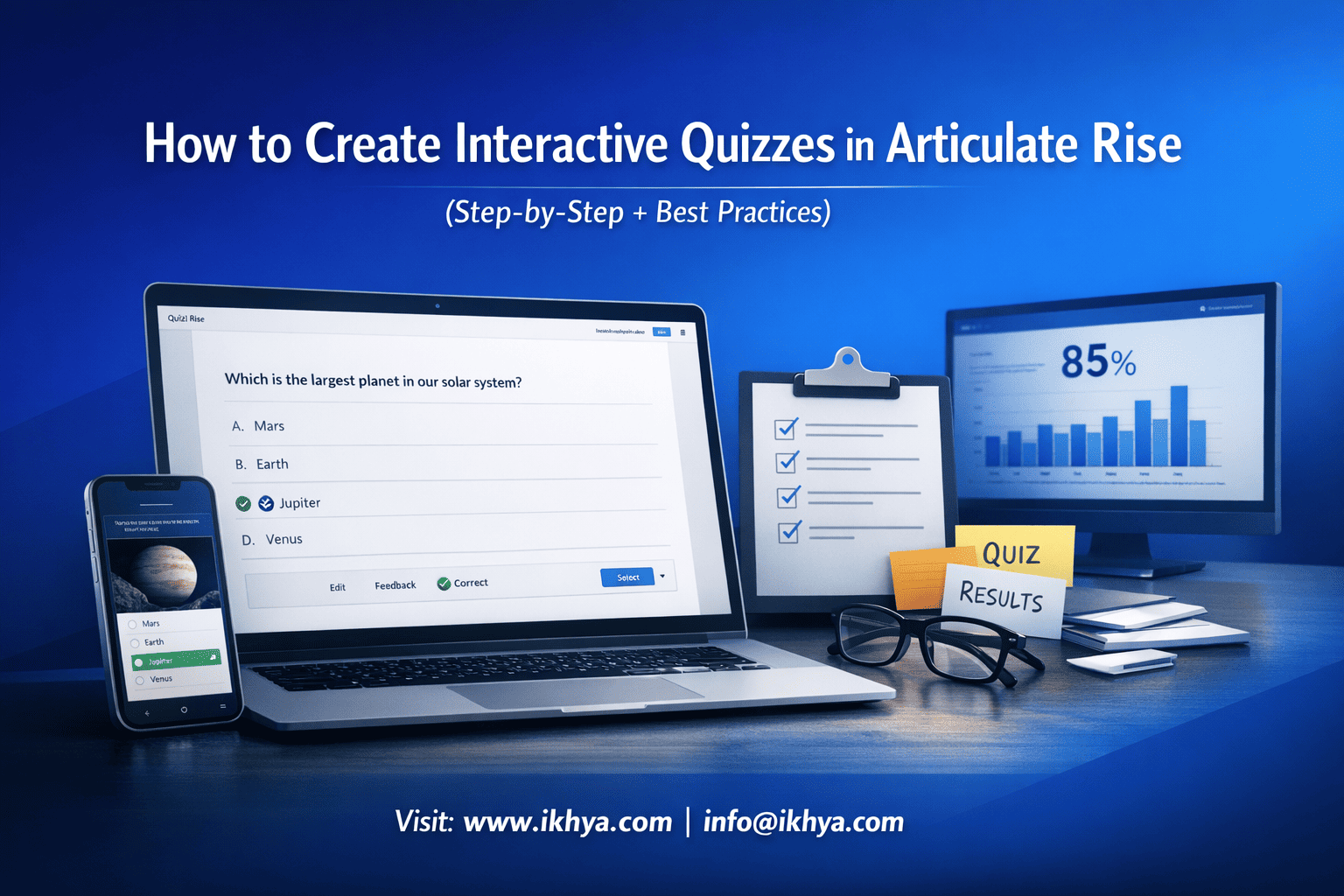
Creating interactive quizzes in Articulate Rise is one of the most effective ways to improve learner engagement and knowledge retention in corporate training. However, most organizations only use basic quiz formats, missing the opportunity to create meaningful, performance-driven learning experiences.
In this guide, you’ll learn how to create interactive quizzes in Articulate Rise step by step, along with best practices, real-world use cases, and strategic insights to make your quizzes more impactful.
If you’re exploring how interactive learning can transform your training programs, you can book a free eLearning demo to see how enterprise-grade quizzes are implemented in real scenarios.
What Are Interactive Quizzes in Articulate Rise?
Interactive quizzes in Articulate Rise are built-in assessment components that allow learners to test their knowledge using structured question formats, instant feedback, and LMS-based tracking.
They are commonly used for:
- Knowledge checks during training
- Final assessments
- Compliance validation
- Skill-based evaluations
Unlike traditional quizzes, interactive quizzes in Rise:
- Provide immediate feedback
- Support mobile-first learning
- Enable SCORM and xAPI tracking
- Integrate seamlessly with LMS platforms
To understand the platform better, explore this guide on what Articulate Rise 360 is and how it supports modern eLearning development.
Key Features of Articulate Rise Quizzes
- Pre-built quiz blocks
- Multiple question types
- Automatic scoring
- Responsive design
- LMS compatibility
These features make Rise ideal for rapid deployment. Many organizations leverage this capability through rapid eLearning development using Articulate Rise to scale training quickly.
When Should You Use Quizzes in Articulate Rise?
Use Rise quizzes when:
- You need fast course development
- Content is straightforward and linear
- You want mobile-friendly learning
- You require basic assessment tracking
However, for advanced requirements like:
- Branching scenarios
- Simulations
- Complex logic
You may need support from Articulate Storyline development services or a blended approach.
Strategic Role of Quizzes in Learning Design
Interactive quizzes are not just assessments—they are part of a broader instructional strategy.
They help:
- Reinforce learning
- Identify knowledge gaps
- Improve retention
- Drive learner engagement
To design quizzes effectively, it’s important to follow structured methodologies like instructional design best practices for Articulate Rise.
Why Interactive Quizzes Matter in Corporate Training
Interactive quizzes in Articulate Rise play a critical role in ensuring that training is not just completed—but actually understood, retained, and applied. They bridge the gap between content delivery and measurable learning outcomes.
1. Improve Knowledge Retention
Quizzes force learners to actively recall information instead of passively consuming content.
- Reinforces memory through repetition
- Strengthens understanding with feedback
- Reduces forgetting curve
For example, organizations implementing quiz-driven microlearning through microlearning development services often see a 30–50% improvement in retention rates.
2. Increase Learner Engagement
Modern learners expect interaction, not just content.
Interactive quizzes:
- Break monotony
- Introduce challenge and curiosity
- Keep learners mentally active
This is especially important in distributed teams across the USA, UK, UAE, and Australia where engagement is harder to maintain in remote learning environments.
3. Validate Learning Outcomes
One of the biggest challenges in corporate training is proving effectiveness.
Quizzes help answer:
“Did the learner actually understand the content?”
They enable:
- Performance measurement
- Skill validation
- Certification readiness
This aligns with structured enterprise approaches outlined in the enterprise elearning development process step-by-step guide.
4. Enable LMS Tracking and Analytics
Interactive quizzes in Rise can be published using SCORM or xAPI, allowing organizations to track:
- Completion rates
- Scores and pass percentages
- Time spent
- Attempt history
These insights are essential for compliance-heavy industries. Many companies implement this through LMS-compatible eLearning course development services to ensure seamless reporting.
5. Support Compliance and Risk Reduction
Industries like healthcare, finance, and oil & gas rely heavily on quizzes for compliance validation.
Use cases include:
- Safety certifications
- Regulatory training
- Audit documentation
For example, organizations using compliance training elearning solutions often integrate mandatory quizzes to ensure audit readiness and reduce legal risks.
6. Accelerate Onboarding and Skill Development
Interactive quizzes help new employees:
- Understand processes faster
- Apply knowledge immediately
- Identify gaps early
Retail and IT companies frequently use quiz-driven onboarding via custom eLearning development services to reduce ramp-up time.
Real-World Impact (Practical Scenarios)
| Industry | Use Case | Impact |
|---|---|---|
| Healthcare | Compliance quizzes | 40% better retention |
| Manufacturing | Safety assessments | 30% reduction in incidents |
| Finance | Regulatory exams | Improved audit scores |
| Retail | Customer service training | Faster onboarding |
Where Most Organizations Go Wrong
Despite the benefits, many companies fail to get results because they:
- Use only basic multiple-choice questions
- Ignore feedback design
- Don’t align quizzes with business goals
- Treat quizzes as a formality
This leads to:
- Low engagement
- Poor retention
- Ineffective training ROI
To overcome this, many enterprises adopt structured strategies through rapid eLearning development services to design more engaging and scalable assessments.
Turning Quizzes into a Strategic Advantage
Interactive quizzes become powerful when they are:
- Scenario-based instead of theory-based
- Integrated within learning (not just at the end)
- Designed with instructional intent
- Aligned with business KPIs
If you’re planning to implement or scale quiz-based learning across your organization, you can request an RFP to get a structured solution aligned with your training goals.
Types of Quiz Questions in Articulate Rise
Articulate Rise offers a set of built-in quiz question types that allow you to create structured, interactive assessments quickly. While the options are not as advanced as Storyline, they are powerful enough for most corporate training use cases.
Understanding each type helps you design quizzes that are not just functional—but effective.
1. Multiple Choice Questions
This is the most commonly used question type in Rise.
- Learners select one correct answer
- Ideal for knowledge checks
- Easy to create and scale
Best used for:
- Compliance training
- Product knowledge
- Policy understanding
Limitation:
Overuse can reduce engagement if not combined with other formats.
2. Multiple Response Questions
Learners select more than one correct answer.
- Encourages deeper thinking
- Tests understanding instead of memorization
Best used for:
- Scenario-based decision-making
- Risk identification
- Process validation
3. Fill-in-the-Blank Questions
Learners type the correct answer into a blank field.
- Tests recall accuracy
- Reduces guessing
Best used for:
- Terminology
- Definitions
- Key concepts
4. Matching Questions
Learners match items from two columns.
- Improves association skills
- Works well for relationships
Best used for:
- Process steps
- Cause-effect relationships
- Product-feature mapping
5. True/False Questions
Simple binary choice questions.
- Quick validation
- Easy to build
Best used for:
- Rapid checks
- Reinforcement points
Caution:
Should not be overused due to high guessing probability.
6. Sequence Questions
Learners arrange items in the correct order.
- Tests procedural understanding
- Validates workflows
Best used for:
- Manufacturing processes
- Safety steps
- System workflows
For structured implementation of such training flows, many companies rely on manufacturing training elearning solutions.
7. Knowledge Check Blocks vs Quiz Lessons
Articulate Rise provides two ways to add questions:
Knowledge Check Blocks
- Embedded within lessons
- No scoring required
- Used for reinforcement
Quiz Lessons
- Dedicated assessment module
- Scored results
- LMS tracking enabled
This flexibility is one reason organizations prefer Rise for rapid deployments, especially when combined with articulate rise development services.
Choosing the Right Question Type (Quick Framework)
Use this simple framework:
- Recall-based learning → Multiple choice, fill-in-the-blank
- Application-based learning → Multiple response, sequence
- Concept relationships → Matching
- Quick validation → True/False
Real-World Example
Finance Training Scenario:
Instead of asking:
“What is AML policy?”
Use:
- Multiple response → Identify suspicious activities
- Scenario-based MCQ → Choose correct action
- Sequence → Steps to report compliance issue
This approach aligns with programs like financial services training elearning solutions where accuracy and decision-making are critical.
Key Limitation to Understand
Articulate Rise question types are linear and non-branching.
This means:
- No adaptive paths
- No complex decision trees
- No simulation-based assessment
For advanced requirements like scenario branching, many organizations combine Rise with scenario-based learning in Articulate Rise or extend capabilities using Storyline.
Strategic Insight
The effectiveness of quizzes is not about the number of questions—but about:
- Question design quality
- Relevance to real-world tasks
- Feedback clarity
Organizations that invest in structured quiz design often integrate it into broader ecosystems like instructional design services to maximize learning impact.
Step-by-Step: How to Create Quizzes in Articulate Rise
Creating interactive quizzes in Articulate Rise is a straightforward process, but the real value comes from structuring them correctly for learning impact. Below is a practical, step-by-step workflow used by enterprise teams to build effective assessments.
Step 1: Create or Open Your Course
Start by logging into Rise 360 and either:
- Create a new course
- Open an existing course where you want to add quizzes
Quizzes can be placed:
- At the end of lessons
- Between sections
- As a final assessment
If you’re building from scratch, many organizations begin with structured workflows like how to build microlearning courses using Articulate Rise to align quizzes with short learning modules.
Step 2: Add a Quiz Lesson
To create a scored quiz:
- Click “Add Lesson”
- Select “Quiz”
- Choose a quiz type (graded assessment)
This creates a dedicated quiz module where:
- Scores are tracked
- Results can be passed to LMS
- Pass/fail criteria can be set
Step 3: Add Questions
Inside the quiz lesson:
- Click “Add Question”
- Select the question type:
- Multiple choice
- Multiple response
- Fill-in-the-blank
- Matching
- Sequence
Then:
- Enter the question
- Add answer options
- Mark correct answers
Step 4: Configure Feedback
Feedback is where most quizzes fail or succeed.
In Rise, you can:
- Add correct/incorrect feedback
- Provide explanations
- Guide learners toward the right understanding
Best Practice:
Instead of saying:
“Incorrect answer”
Say:
“Incorrect. The correct procedure requires reporting the issue within 24 hours due to compliance standards.”
For deeper implementation strategies, many teams rely on custom eLearning development services to design feedback that improves retention.
Step 5: Set Passing Score and Attempts
You can configure:
- Passing percentage (e.g., 80%)
- Number of attempts
- Retry behavior
This is especially important for:
- Compliance training
- Certification programs
- Regulatory environments
Step 6: Customize Quiz Settings
Articulate Rise allows you to control:
- Navigation (free vs restricted)
- Answer shuffling
- Review options
- Feedback visibility
For global deployment across LMS platforms, organizations often align these settings with lms-compatible elearning course development services to ensure accurate reporting.
Step 7: Publish and Track Results
Once your quiz is ready:
- Export as SCORM, xAPI, or AICC
- Upload to your LMS
- Track learner performance
You can monitor:
- Scores
- Completion rates
- Attempts
- Pass/fail status
This is critical for enterprise environments where training effectiveness must be measurable, often supported by strategies outlined in the elearning consultancy services.
Example Workflow (Real Scenario)
Use Case: Retail Employee Training
- Week 1: Product knowledge module
- Embedded knowledge checks after each section
- Final quiz with:
- 10 questions
- 80% pass score
- 2 attempts
Result:
- 25% faster onboarding
- Improved customer interaction scores
This approach is widely used in retail training elearning solutions.
Timeline Example
| Project Type | Duration |
|---|---|
| Basic quiz (10–15 questions) | 2–3 days |
| Structured module with quizzes | 1–2 weeks |
| Scenario-based advanced quiz system | 3–4 weeks |
Cost Estimate (Practical Range)
| Complexity | Cost Range |
|---|---|
| Basic quiz | $500 – $1,500 |
| Intermediate (feedback + structure) | $1,500 – $4,000 |
| Advanced (scenarios + integration) | $4,000 – $10,000 |
Common Mistakes to Avoid
- Adding quizzes only at the end
- Using generic feedback
- Overloading with too many questions
- Ignoring real-world application
Pro Tip
The best quizzes are not created after content—they are designed alongside it.
If you’re planning large-scale quiz development or multi-course deployment, you can explore structured execution by choosing to request an RFP and align quizzes with business objectives.
How to Make Quizzes More Engaging in Rise 360
Creating quizzes in Articulate Rise is easy—but making them engaging is where real impact happens. Engagement determines whether learners simply complete a quiz or actually learn from it.
To improve engagement, quizzes must move beyond basic questions and become interactive learning experiences tied to real-world decisions.
1. Use Scenario-Based Questions Instead of Theory
Instead of asking direct questions, place learners in realistic situations.
Example:
Instead of:
“What is the correct safety procedure?”
Ask:
“You notice a machine overheating during operation. What should you do first?”
This approach:
- Improves decision-making skills
- Mimics real job scenarios
- Increases retention
For deeper implementation, many organizations adopt scenario-based learning in Articulate Rise to simulate real environments.
2. Add Meaningful Feedback (Not Just Right/Wrong)
Feedback is one of the most powerful engagement drivers.
Avoid:
- “Correct”
- “Incorrect”
Use:
- Explanation of why the answer is right
- What happens in real-world scenarios
- Consequences of wrong choices
Organizations that prioritize this often use instructional design services to craft feedback that improves learning outcomes.
3. Break Long Quizzes into Micro Assessments
Instead of one long quiz:
- Add small quizzes after each section
- Use knowledge checks during lessons
This:
- Reduces cognitive overload
- Keeps learners engaged
- Reinforces learning continuously
This strategy aligns with microlearning development services used in modern training programs.
4. Use Real-World Context in Questions
Make every question relevant to the learner’s role.
Examples by industry:
- Healthcare: Patient safety scenarios
- Manufacturing: Equipment handling steps
- Finance: Fraud detection decisions
- Retail: Customer interaction situations
- IT: System troubleshooting
For industry-specific implementations, many organizations rely on solutions like healthcare training elearning solutions to contextualize learning.
5. Apply Gamification Elements (Within Rise Limits)
While Rise has limited gamification features, you can still:
- Use scoring benchmarks
- Add challenge-based progression
- Create “pass thresholds”
- Introduce competitive elements (via LMS)
For more advanced gamification strategies, explore gamification strategies for Articulate Rise courses.
6. Design for Mobile-First Learning
Most learners today access training on mobile devices.
Ensure:
- Short questions
- Easy readability
- Minimal scrolling
- Clear options
Rise is inherently responsive, but designing specifically for mobile enhances usability. Many companies optimize this through mobile learning development solutions.
7. Mix Question Types Strategically
Avoid repeating the same format.
Use a combination of:
- Multiple choice
- Matching
- Sequence
- Scenario-based questions
This keeps learners mentally active and prevents fatigue.
8. Use Progressive Difficulty
Structure quizzes like this:
- Start with easy questions
- Move to moderate difficulty
- End with application-based questions
This builds confidence and improves completion rates.
Real-World Example
Manufacturing Safety Training
Instead of:
- 15 MCQs at the end
Use:
- 3 knowledge checks per module
- 1 scenario-based sequence question
- Final quiz with mixed formats
Result:
- 35% improvement in engagement
- Reduced training errors
Common Engagement Mistakes
- Overusing multiple-choice questions
- No real-world context
- Weak or no feedback
- Long, exhausting quizzes
- No progression logic
Engagement is not about visuals—it’s about interaction quality.
Organizations that take quiz design seriously often integrate it into broader ecosystems like custom elearning development services to ensure consistency, scalability, and measurable outcomes.
If you’re looking to transform basic quizzes into high-impact learning tools, you can explore tailored solutions by reaching out via contact us to discuss your requirements.
Instructional Design Framework for Effective Quizzes
Creating quizzes in Articulate Rise is not just about adding questions—it’s about designing assessments that drive real learning outcomes. A structured instructional design approach ensures quizzes are aligned with business goals, learner needs, and measurable performance.
The 4-Step Quiz Design Framework
To create effective quizzes, follow this proven framework used by enterprise L&D teams:
1. Define Learning Objectives First
Before creating any question, clearly define:
- What should the learner know?
- What should the learner be able to do?
- What mistakes should they avoid?
Every quiz question must map directly to a learning objective.
Example:
- Objective → “Identify safety hazards in a factory”
- Quiz → Scenario-based hazard identification question
This structured approach is commonly applied in instructional design best practices for Articulate Rise to ensure alignment between content and assessment.
2. Choose the Right Assessment Type
Not all quizzes serve the same purpose.
Use this model:
- Knowledge Check (Formative) → During learning
- Final Assessment (Summative) → End of course
- Application-Based Quiz → Real-world scenarios
This helps balance learning reinforcement and evaluation.
3. Design Questions for Real-World Application
Avoid theoretical questions. Focus on decision-making.
Instead of:
“What is the correct compliance rule?”
Ask:
“A customer requests confidential data. What should you do?”
This approach:
- Improves job readiness
- Reduces real-world errors
- Enhances critical thinking
Organizations implementing such strategies often leverage scenario-based learning in Articulate Rise to simulate workplace situations.
4. Add Feedback That Teaches
Feedback should act as a micro-learning moment.
Effective feedback includes:
- Why the answer is correct
- Why other options are incorrect
- Real-world implications
For large-scale training programs, companies enhance this using elearning consultancy services to align feedback with learning strategy.
Quiz Design Checklist (Use Before Publishing)
- Are questions aligned with objectives?
- Do they reflect real-world tasks?
- Is feedback meaningful?
- Is difficulty level balanced?
- Are question types varied?
Real-World Application Across Industries
Healthcare
- Scenario: Patient safety decision-making
- Quiz Type: Multiple response + scenario MCQs
- Outcome: Reduced compliance errors
Manufacturing
- Scenario: Equipment handling sequence
- Quiz Type: Sequence + matching
- Outcome: Fewer workplace incidents
Finance
- Scenario: Fraud detection
- Quiz Type: Scenario-based MCQs
- Outcome: Improved audit readiness
Retail
- Scenario: Customer interaction
- Quiz Type: Role-based questions
- Outcome: Better customer satisfaction
IT / Software
- Scenario: Troubleshooting workflows
- Quiz Type: Sequence + decision-based
- Outcome: Faster issue resolution
These industry-specific implementations are often delivered through custom elearning development services to ensure contextual relevance.
Common Instructional Design Mistakes
- Writing questions before defining objectives
- Testing memory instead of application
- Ignoring feedback design
- Overloading quizzes with unnecessary questions
A well-designed quiz is not an evaluation tool—it’s a learning experience in itself.
Organizations that adopt this mindset often scale faster and achieve better outcomes through structured approaches like rapid elearning development services, especially when deploying training across global teams.
If you’re planning to design high-impact quizzes aligned with business goals, you can explore structured solutions by submitting a request RFP (/request-rfp/) to get a tailored approach.
SCORM, LMS Tracking, and Quiz Analytics
Interactive quizzes in Articulate Rise are not just for engagement—they are powerful tools for tracking learner performance, measuring training effectiveness, and ensuring compliance. When properly configured, they provide actionable data through LMS integration.
How Quiz Tracking Works in Articulate Rise
Articulate Rise allows you to export courses in formats like:
- SCORM 1.2
- SCORM 2004
- xAPI (Tin Can)
- AICC
Once uploaded to an LMS, quizzes can track:
- Learner scores
- Completion status
- Pass/fail results
- Number of attempts
- Time spent on assessments
Organizations often implement this through LMS-compatible eLearning course development services to ensure seamless tracking across platforms.
What Data Can You Track?
Here’s a breakdown of key quiz analytics:
| Metric | What It Tells You |
|---|---|
| Score | Learner understanding |
| Completion Rate | Course effectiveness |
| Attempts | Difficulty level |
| Time Spent | Engagement level |
| Pass/Fail | Compliance readiness |
This data is critical for enterprise training environments where decisions must be backed by measurable insights.
Why SCORM and xAPI Matter
SCORM is widely used for:
- Basic tracking (completion, scores)
- LMS compatibility
- Compliance reporting
xAPI goes further by tracking:
- Detailed learner interactions
- Learning behavior beyond LMS
- Real-world activity tracking
For global organizations operating across the USA, UK, UAE, and Australia, using the right tracking standard ensures consistency in reporting and compliance.
Real-World Use Cases
Healthcare Compliance Training
- Track pass/fail rates for certifications
- Ensure audit readiness
- Maintain training records
Manufacturing Safety Training
- Monitor assessment scores
- Identify high-risk knowledge gaps
- Reduce workplace incidents
Finance & Banking
- Validate regulatory training completion
- Track multiple attempts
- Ensure adherence to policies
These implementations are commonly delivered through compliance training elearning solutions where tracking is mandatory.
Common Tracking Mistakes
Many organizations fail to get accurate data because they:
- Use incorrect SCORM settings
- Don’t define completion criteria properly
- Ignore LMS configuration
- Fail to test reporting before deployment
To avoid these issues, companies often rely on elearning consultancy services to align LMS setup with business requirements.
Advanced Analytics Strategy
To maximize the value of quiz data:
- Analyze low-scoring questions → Identify content gaps
- Track repeated failures → Improve question clarity
- Monitor completion trends → Optimize course structure
- Compare department-level performance → Identify skill gaps
Example Scenario
Global IT Training Deployment
- 1,000+ learners across regions
- SCORM-based tracking enabled
- Weekly analytics reports generated
Outcome:
- Identified 3 weak areas in training
- Updated quiz content
- Improved pass rates by 28%
Such scalable implementations are often supported by custom eLearning development services for enterprise-level training programs.
Quizzes without tracking are just activities.
Quizzes with tracking become decision-making tools.
If you’re planning to implement LMS-based quiz tracking or optimize your existing system, you can contact the team to explore how to align analytics with your training goals.
Real-World Use Cases Across Industries
Interactive quizzes in Articulate Rise are used across industries to solve real business problems—from compliance and safety to onboarding and performance improvement. When designed strategically, quizzes become a key driver of measurable outcomes.
Healthcare: Compliance and Patient Safety Training
In healthcare, accuracy and compliance are critical.
How quizzes are used:
- Validate understanding of protocols
- Test decision-making in critical situations
- Ensure regulatory compliance
Example:
A hospital training program used scenario-based quizzes for infection control.
Result:
- 40% improvement in retention
- Reduced compliance violations
Organizations typically implement such programs through healthcare training elearning solutions to ensure accuracy and audit readiness.
Manufacturing: Safety and Process Training
Manufacturing environments require strict adherence to procedures.
How quizzes are used:
- Sequence-based assessments for workflows
- Hazard identification scenarios
- Equipment handling validation
Example:
A manufacturing company introduced quiz-based reinforcement in safety training.
Result:
- 30% reduction in workplace incidents
- Faster onboarding for new employees
These programs are often developed using manufacturing training elearning solutions for scalability across plants.
Finance: Regulatory and Compliance Training
Financial institutions must ensure employees understand complex regulations.
How quizzes are used:
- AML and fraud detection scenarios
- Policy validation
- Certification assessments
Example:
A bank implemented scenario-based quizzes for AML training.
Result:
- Improved audit scores
- Reduced compliance risks
Such implementations are supported by financial services training elearning solutions to maintain regulatory standards.
Retail: Customer Service and Sales Training
Retail training focuses on real-time decision-making and customer interaction.
How quizzes are used:
- Role-based scenarios
- Product knowledge checks
- Customer handling situations
Example:
A retail chain used interactive quizzes in onboarding.
Result:
- 25% faster employee ramp-up
- Improved customer satisfaction scores
These outcomes are typically achieved using retail training elearning solutions tailored for frontline staff.
IT & Software: Technical and Onboarding Training
IT teams require structured learning for systems, tools, and workflows.
How quizzes are used:
- Troubleshooting scenarios
- Process validation
- Product training assessments
Example:
A SaaS company implemented quizzes in onboarding modules.
Result:
- Faster product understanding
- Reduced support tickets
These programs are often built through IT software training elearning solutions for technical teams.
Oil & Gas: High-Risk Safety Training
In high-risk industries, quizzes play a critical role in preventing accidents.
How quizzes are used:
- Emergency response scenarios
- Safety protocol validation
- Risk assessment
Example:
An oil & gas company introduced mandatory quizzes after each module.
Result:
- Improved safety compliance
- Reduced operational risks
Such implementations are supported by oil & gas training elearning solutions.
Key Takeaways Across Industries
Across all industries, effective quiz implementation follows a pattern:
- Scenario-based questions outperform theoretical ones
- Frequent knowledge checks improve retention
- LMS tracking ensures accountability
- Feedback-driven quizzes enhance learning
Interactive quizzes are not just tools—they are performance enablers.
Organizations that align quizzes with real-world tasks and business KPIs see:
- Better training ROI
- Higher engagement
- Improved job performance
If you’re planning industry-specific training programs with measurable outcomes, you can explore tailored solutions through custom eLearning development services.
Limitations of Articulate Rise Quizzes (And Solutions)
Articulate Rise is excellent for rapid quiz creation, but it has limitations that can impact learning effectiveness—especially for complex training needs. Understanding these limitations helps you decide when Rise is enough and when you need advanced solutions.
1. No Advanced Branching or Adaptive Learning
Rise quizzes follow a linear structure.
Limitation:
- No dynamic paths based on learner choices
- No personalized learning journeys
Impact:
- Not ideal for decision-based or scenario-heavy training
Solution:
For branching and adaptive learning, organizations often combine Rise with Articulate Storyline development services to build advanced interactions.
2. Limited Question Customization
Rise offers predefined question formats with minimal customization.
Limitation:
- Fixed layouts
- Limited control over UI/UX
- No advanced interactions
Impact:
- Quizzes may feel repetitive
- Reduced engagement in long courses
Solution:
Use a mix of question types and enhance design with strategies from interactive eLearning development using Lectora Inspire or other tools when needed.
3. No Complex Simulations
Rise cannot simulate real-world environments or systems.
Limitation:
- No software simulations
- No role-based branching scenarios
Impact:
- Not suitable for technical or high-risk training
Solution:
Use simulation-based approaches through elearning simulation-based training services for immersive learning experiences.
4. Basic Feedback Capabilities
Feedback options in Rise are limited to simple responses.
Limitation:
- No layered feedback
- No adaptive hints
- No progressive guidance
Impact:
- Missed opportunity for deeper learning
Solution:
Enhance feedback design using structured approaches from instructional design services to make feedback more meaningful.
5. Limited Analytics Depth (Without xAPI)
While Rise supports SCORM and xAPI, default analytics can be basic depending on LMS.
Limitation:
- Limited behavioral insights
- No deep learner interaction tracking
Impact:
- Harder to optimize training based on data
Solution:
Adopt advanced tracking strategies through elearning consultancy services to leverage xAPI and analytics tools.
6. Not Ideal for High-Stakes Assessments
Rise quizzes are suitable for basic to moderate assessments but not for:
- Certification-level exams
- Complex evaluation frameworks
- Adaptive testing systems
Solution:
For high-stakes assessments, organizations often design hybrid solutions using Rise + Storyline or fully custom builds via custom elearning development services.
Quick Comparison: Rise Limitations vs Solutions
| Limitation | Impact | Recommended Solution |
|---|---|---|
| No branching | Limited interactivity | Storyline integration |
| Basic UI | Low engagement | Custom design approach |
| No simulations | Limited realism | Simulation-based training |
| Basic feedback | Weak learning reinforcement | Instructional design enhancement |
| Limited analytics | Poor insights | xAPI + consultancy |
Real-World Scenario
Compliance Training (Finance Industry)
- Initial approach: Basic Rise quizzes
- Issue: Learners passed but failed in real scenarios
Improvement:
- Added scenario-based branching using Storyline
- Enhanced feedback explanations
Result:
- 35% improvement in real-world decision accuracy
Strategic Insight
Articulate Rise is powerful—but only within its scope.
Use Rise for:
- Rapid development
- Microlearning
- Standard assessments
Use advanced tools or services when:
- Interactivity becomes complex
- Learning outcomes require deeper evaluation
- Business risks are high
If you’re unsure whether Rise is sufficient for your training needs, you can explore expert guidance through articulate rise development services to identify the right approach.
Rise vs Storyline for Quiz Development
Choosing between Articulate Rise and Storyline for quiz development depends on your training complexity, interactivity needs, and business goals. Both tools are powerful—but they serve different purposes.
Quick Answer
- Use Articulate Rise for fast, responsive, and simple quizzes
- Use Storyline for complex, interactive, and scenario-based assessments
Many organizations combine both to balance speed and depth, often through rapid eLearning development using Storyline and Rise 360.
Key Differences Between Rise and Storyline
| Feature | Articulate Rise | Articulate Storyline |
|---|---|---|
| Development Speed | Very fast | Moderate |
| Interactivity | Basic | Advanced |
| Branching | Not supported | Fully supported |
| Simulations | Not available | Fully supported |
| Mobile Responsiveness | Built-in | Requires design |
| Customization | Limited | Highly flexible |
| Use Case | Microlearning, compliance | Scenario-based, simulations |
When to Use Articulate Rise for Quizzes
Choose Rise when:
- You need quick deployment
- Training content is linear
- Assessments are straightforward
- Mobile-first experience is required
Typical use cases:
- Compliance training
- Onboarding modules
- Product knowledge checks
Many organizations scale such training using articulate rise course development services for corporate training teams.
When to Use Storyline for Quizzes
Choose Storyline when:
- You need branching scenarios
- Training requires decision-making simulations
- You want custom UI/UX
- Assessments are high-stakes
Typical use cases:
- Safety training simulations
- Healthcare decision-making
- Complex compliance scenarios
For such advanced needs, companies often rely on articulate storyline course development services complete guide to build interactive learning experiences.
Hybrid Approach: Best of Both Worlds
Many enterprises adopt a hybrid strategy:
- Use Rise for content delivery
- Use Storyline for advanced quizzes
- Embed Storyline blocks inside Rise courses
This approach:
- Reduces development time
- Maintains engagement
- Balances cost and complexity
Real-World Example
Global Compliance Training (Finance Sector)
- Rise used for course content
- Storyline used for scenario-based assessments
- LMS tracking via SCORM
Result:
- 30% improvement in assessment performance
- Better decision-making accuracy
Cost Comparison
| Type | Cost Range |
|---|---|
| Rise-only quiz development | $500 – $3,000 |
| Storyline-based advanced quizzes | $3,000 – $10,000+ |
| Hybrid solution | $4,000 – $12,000 |
Timeline Comparison
| Approach | Timeline |
|---|---|
| Rise-only | 1–2 weeks |
| Storyline-only | 3–5 weeks |
| Hybrid | 2–4 weeks |
Decision Framework
Ask these questions:
- Do learners need to make decisions? → Storyline
- Is speed more important than complexity? → Rise
- Is mobile learning critical? → Rise
- Do you need simulations? → Storyline
There is no “better tool”—only the right tool for the job.
Organizations that choose wisely:
- Reduce development costs
- Improve learning outcomes
- Scale training effectively
If you’re evaluating the right approach for your training programs, you can explore options through articulate rise vs storyline which tool should you choose for a deeper comparison.
Cost & Timeline for Quiz Development
The cost and timeline for creating interactive quizzes in Articulate Rise vary based on complexity, instructional design depth, and business requirements. Understanding this helps you plan budgets, resources, and delivery expectations more accurately.
Quick Overview
- Basic quizzes → Fast and low cost
- Structured quizzes with feedback → Moderate investment
- Advanced scenario-based quizzes → Higher cost and longer timelines
Cost Breakdown (Realistic Ranges)
| Quiz Type | Description | Cost Range |
|---|---|---|
| Basic Quiz | 5–10 questions, simple MCQs | $500 – $1,500 |
| Intermediate Quiz | Mixed question types + feedback | $1,500 – $4,000 |
| Advanced Quiz | Scenario-based + strategy | $4,000 – $10,000+ |
What Impacts Cost?
Several factors influence pricing:
1. Instructional Design Depth
- Basic questions vs scenario-based design
- Feedback complexity
2. Number of Questions
- More questions = higher effort
- More review cycles
3. Media and Content
- Images, icons, multimedia
- Real-world scenarios
4. LMS Integration
- SCORM/xAPI configuration
- Testing and validation
5. Revisions and Stakeholder Input
- Multiple review rounds increase cost
Organizations looking to scale efficiently often rely on rapid eLearning development services to reduce time and cost without compromising quality.
Timeline Breakdown
| Project Type | Timeline |
|---|---|
| Basic quiz module | 2–3 days |
| Structured quiz with feedback | 1–2 weeks |
| Advanced scenario-based quiz | 3–4 weeks |
Example Project Timelines
Scenario 1: Compliance Training (Fast Deployment)
- 10-question quiz
- Standard feedback
- SCORM export
Timeline: 1 week
Cost: ~$1,500
Scenario 2: Global Onboarding Program
- Multiple modules
- Embedded quizzes + final assessment
- LMS tracking + analytics
Timeline: 3–4 weeks
Cost: $5,000 – $8,000
Cost Optimization Strategies
To reduce cost while maintaining quality:
- Use standardized templates
- Limit unnecessary question volume
- Focus on high-impact scenarios
- Use pre-built assets
Many organizations achieve this balance by leveraging ppt to elearning conversion services to quickly transform existing content into quiz-based modules.
Hidden Costs to Consider
- LMS testing and debugging
- Content updates and maintenance
- Localization for global teams
- Compliance re-certification updates
For global deployments, companies often include localization planning through elearning translation localization services.
ROI Perspective
While quizzes may seem like a small component, their impact is significant:
- Improved retention → Better performance
- Reduced errors → Lower operational risk
- Faster onboarding → Cost savings
Organizations that invest strategically often see measurable ROI when quizzes are integrated into broader solutions like custom elearning development services.
The goal is not to minimize cost—but to maximize learning impact per dollar spent.
A well-designed quiz can:
- Replace hours of retraining
- Reduce compliance risks
- Improve employee performance
If you’re planning a quiz development project and need a clear cost and execution roadmap, you can request a structured proposal tailored to your requirements.
When to Outsource Quiz Development
Outsourcing quiz development becomes the right choice when internal teams lack the time, expertise, or resources to design effective, scalable assessments. While Articulate Rise is easy to use, creating high-impact quizzes still requires instructional design, strategy, and technical alignment.
Quick Answer
Outsource quiz development when:
- You need faster delivery at scale
- Your team lacks instructional design expertise
- Training requires advanced scenarios or compliance alignment
- You want consistent quality across courses
Signs You Should Outsource
1. Low Engagement in Current Training
If learners are:
- Skipping quizzes
- Guessing answers
- Not retaining knowledge
It indicates poor quiz design—not tool limitations.
2. Limited Internal Expertise
Many teams know how to use Rise—but struggle with:
- Writing effective questions
- Designing feedback
- Aligning quizzes with objectives
This is where instructional design services add significant value.
3. Scaling Training Across Regions
If you’re deploying training across:
- USA
- UK
- UAE
- Australia
You’ll need:
- Localization
- LMS compatibility
- Standardized structure
Organizations often handle this through global training deployment using Articulate Rise development and localization.
4. Complex Training Requirements
Outsource when training includes:
- Scenario-based assessments
- Compliance-heavy modules
- Multi-course programs
These require structured execution typically delivered via custom elearning development services.
In-House vs Outsourced Quiz Development
| Factor | In-House | Outsourced |
|---|---|---|
| Cost | Lower upfront | Higher upfront |
| Speed | Slower | Faster |
| Expertise | Limited | Specialized |
| Scalability | Difficult | Easy |
| Quality | Inconsistent | Standardized |
Cost Comparison (Practical View)
| Approach | Cost Range |
|---|---|
| In-house basic quiz | Low (internal effort) |
| Outsourced basic quiz | $500 – $1,500 |
| Outsourced advanced quiz | $3,000 – $10,000+ |
Real-World Scenario
Manufacturing Company (Safety Training)
- Initial approach: In-house quiz creation
- Problem: Low engagement, high incident rates
Solution:
- Outsourced quiz redesign
- Added scenario-based questions
- Improved feedback
Result:
- 30% reduction in safety incidents
- Higher training completion rates
Vendor Selection Framework
Before outsourcing, evaluate vendors based on:
- Instructional design capability
- Experience with Articulate Rise
- Industry expertise
- LMS and SCORM knowledge
- Ability to scale
For a structured evaluation approach, refer to how to choose the elearning vendor.
Outsourcing Models
1. Project-Based
- Fixed scope
- Defined timeline
- Ideal for one-time training
2. Dedicated Team
- Ongoing support
- Scalable resources
- Suitable for enterprises
For organizations planning long-term partnerships, models like reliable Articulate Rise development partner for long-term projects are often preferred.
Risks of Outsourcing (And How to Avoid Them)
Risk: Poor understanding of your business
→ Solution: Share clear objectives and use-case scenarios
Risk: Delays in delivery
→ Solution: Define timelines and milestones
Risk: Generic content
→ Solution: Choose vendors with domain expertise
Outsourcing is not about replacing your team—it’s about enhancing capability and accelerating results.
Organizations that outsource effectively:
- Reduce development time
- Improve learning quality
- Scale training globally
If you’re evaluating outsourcing for your quiz development or broader training needs, you can connect with experts to explore the right approach for your organization.
How to Choose the Right eLearning Vendor
Choosing the right eLearning vendor is critical when you want to create interactive quizzes in Articulate Rise that actually deliver business results—not just completed courses. The right partner ensures your quizzes are engaging, scalable, and aligned with real-world performance.
Quick Answer
Choose an eLearning vendor who:
- Understands instructional design, not just tools
- Has experience with Articulate Rise and Storyline
- Can deliver LMS-ready, SCORM/xAPI compliant courses
- Aligns training with business outcomes
1. Evaluate Instructional Design Expertise
The biggest difference between average and high-impact quizzes is instructional design quality.
Ask:
- Do they design scenario-based questions?
- Do they create meaningful feedback?
- Do they align quizzes with learning objectives?
Vendors offering strong instructional design services typically deliver better learning outcomes than tool-focused providers.
2. Check Experience with Articulate Tools
Your vendor should have hands-on expertise in:
- Articulate Rise (rapid development)
- Storyline (advanced interactions)
This ensures they can recommend the right tool for your needs. For deeper evaluation, refer to articulate rise vs storyline which should you use for corporate training .
3. Assess LMS and Technical Capabilities
Ensure the vendor understands:
- SCORM, xAPI, AICC standards
- LMS integration and reporting
- Cross-platform compatibility
This is essential for tracking quiz performance and compliance.
4. Review Industry Experience
Choose vendors who have worked in your domain:
- Healthcare → Compliance training
- Manufacturing → Safety training
- Finance → Regulatory programs
- Retail → Customer experience
- IT → Technical onboarding
Industry experience ensures quizzes are realistic and relevant.
5. Evaluate Content Quality and Samples
Always review:
- Previous projects
- Sample quizzes
- Case studies
Look for:
- Scenario-based questions
- Engaging design
- Clear feedback
You can also explore real implementations through custom elearning development case study to assess quality benchmarks.
6. Understand Their Development Process
A good vendor follows a structured workflow:
- Requirement analysis
- Instructional design
- Development
- Review and feedback
- LMS testing
- Deployment
For a detailed view, refer to the enterprise elearning development process step-by-step guide .
7. Compare Cost vs Value (Not Just Price)
Low-cost vendors may:
- Use generic questions
- Skip instructional design
- Deliver poor engagement
Instead, focus on:
- ROI
- Learning effectiveness
- Scalability
To understand cost dynamics, explore in-house vs outsourced elearning development cost comparison.
8. Check Scalability and Long-Term Support
If you plan to scale training:
- Can the vendor handle multiple courses?
- Do they offer ongoing support?
- Can they manage updates and localization?
For long-term strategies, refer to elearning outsourcing guide for enterprises.
Vendor Evaluation Checklist
Use this before finalizing:
- Do they understand your business goals?
- Do they offer instructional design expertise?
- Are they experienced with Rise and Storyline?
- Can they handle LMS integration?
- Do they provide scalable solutions?
Real-World Scenario
Retail Organization (Global Training Rollout)
- Challenge: Inconsistent training quality across regions
- Solution: Selected vendor with strong instructional design + localization capability
Result:
- Standardized quiz structure
- Improved learner engagement
- Faster deployment across regions
Strategic Insight
The right vendor doesn’t just build quizzes—they build learning experiences that drive performance.
Choosing the wrong vendor can lead to:
- Poor engagement
- Ineffective training
- Wasted investment
If you’re evaluating vendors and want a structured approach, you can request an RFP to compare solutions and find the best fit for your training needs.
Future Trends in Interactive Quizzes (AI, Adaptive Learning)
Interactive quizzes in Articulate Rise are evolving rapidly. With advancements in AI, analytics, and adaptive learning, quizzes are no longer static assessments—they are becoming intelligent learning systems that personalize experiences and improve outcomes.
1. AI-Powered Quiz Generation
AI is transforming how quizzes are created.
What’s changing:
- Automatic question generation from content
- Smart distractors (wrong answers)
- Personalized feedback
Impact:
- Faster development
- Reduced manual effort
- Consistent quality
Organizations are increasingly integrating AI into workflows supported by rapid elearning development services to scale content creation.
2. Adaptive Learning Paths
Traditional quizzes are linear. Adaptive quizzes adjust based on learner performance.
How it works:
- Correct answers → Move to advanced questions
- Incorrect answers → Provide remediation
Impact:
- Personalized learning experience
- Better retention
- Efficient learning paths
While Rise has limited native support, adaptive strategies are often implemented through custom elearning development services.
3. Data-Driven Learning Analytics
Modern quizzes are becoming analytics engines.
Advanced tracking includes:
- Behavior analysis
- Learning patterns
- Predictive performance insights
Using xAPI, organizations can:
- Track beyond LMS
- Analyze real-world application
These capabilities are often implemented via elearning consultancy services to align analytics with business KPIs.
4. Scenario-Based and Simulation-Driven Assessments
Future quizzes will focus more on:
- Real-world decision-making
- Role-based simulations
- Interactive scenarios
This shift is already visible in industries like healthcare and aviation, where training must reflect real-life risks.
For immersive experiences, companies rely on elearning simulation-based training services.
5. Gamification and Engagement Models
Quizzes are becoming more engaging through:
- Points and leaderboards
- Progress tracking
- Rewards and badges
Even within Rise limitations, organizations enhance engagement using strategies from gamification strategies for Articulate Rise courses.
6. Mobile-First and On-Demand Learning
With the rise of remote work, quizzes are increasingly:
- Mobile-friendly
- Short and modular
- Available on-demand
This aligns with modern learning strategies supported by mobile learning development solutions.
7. Continuous Learning and Micro-Assessments
Instead of one-time quizzes, organizations are moving toward:
- Continuous assessments
- Microlearning quizzes
- Just-in-time learning
This approach improves long-term retention and performance.
Real-World Example
Global IT Company
- Implemented AI-generated quizzes
- Used adaptive learning paths
- Integrated analytics dashboards
Result:
- 35% improvement in learning efficiency
- Reduced training time
- Higher engagement rates
Strategic Insight
The future of quizzes is not about testing knowledge—it’s about guiding learning journeys.
Organizations that adopt these trends:
- Deliver personalized training
- Improve performance outcomes
- Stay competitive in global markets
If you’re planning to modernize your training with AI-driven or adaptive quiz strategies, you can explore advanced eLearning solutions to align your programs with future-ready learning models.
Conclusion: Turning Quizzes into Business-Driven Learning Tools
Creating interactive quizzes in Articulate Rise is not just about adding questions—it’s about designing learning experiences that drive real performance.
When done right, quizzes help you:
- Improve knowledge retention
- Increase learner engagement
- Validate training effectiveness
- Reduce compliance risks
- Accelerate employee performance
But the real impact comes when quizzes are:
- Scenario-based
- Aligned with business goals
- Supported by LMS tracking
- Designed using instructional strategy
Organizations that treat quizzes as a strategic tool—not a checkbox—see measurable improvements in training ROI across industries like healthcare, manufacturing, finance, retail, and IT.
If you’re planning to scale interactive, high-impact training programs, you can explore how a structured approach works with custom elearning development services tailored to your business needs.
For direct consultation or project discussion, reach out to:
IKHYA – eLearning Solutions Company
Email: info@ikhya.com
Or take the next step and contact the team to discuss your requirements.
FAQs
1. How do you create interactive quizzes in Articulate Rise?
You can create quizzes by adding a quiz lesson, selecting question types, configuring feedback, and publishing the course with LMS tracking.
2. What question types are available in Articulate Rise?
Rise supports multiple choice, multiple response, fill-in-the-blank, matching, sequence, and true/false questions.
3. Can Articulate Rise quizzes track learner performance?
Yes, quizzes can track scores, completion, and attempts through SCORM or xAPI in an LMS.
4. Are Rise quizzes suitable for compliance training?
Yes, they are widely used for compliance training with pass/fail tracking and reporting.
5. What are the limitations of Articulate Rise quizzes?
They lack advanced branching, simulations, and deep customization compared to tools like Storyline.
6. Can you create scenario-based quizzes in Articulate Rise?
Basic scenario-based questions are possible, but advanced branching requires additional tools.
7. How many questions should a quiz have?
Typically 5–15 questions for short modules and 10–20 for full assessments, depending on complexity.
8. What is the ideal passing score for quizzes?
Most organizations use 70–80%, but compliance training may require higher thresholds.
9. Can quizzes be used in microlearning?
Yes, quizzes are highly effective in microlearning for quick reinforcement.
10. How long does it take to create a quiz in Rise?
Basic quizzes take 2–3 days, while advanced ones may take 2–4 weeks.
11. Can Articulate Rise quizzes be customized?
Customization is limited to available templates and settings.
12. What is the difference between knowledge checks and quizzes?
Knowledge checks are ungraded, while quizzes are scored and tracked in LMS.
13. Can quizzes improve learner engagement?
Yes, especially when designed with scenarios, feedback, and varied question types.
14. Do quizzes support mobile learning?
Yes, Articulate Rise quizzes are fully responsive and mobile-friendly.
15. Can you integrate quizzes with LMS platforms?
Yes, using SCORM, xAPI, or AICC formats.
16. What industries benefit most from quiz-based training?
Healthcare, manufacturing, finance, retail, IT, and oil & gas.
17. Should quizzes be placed at the end or throughout the course?
Best practice is to use both—knowledge checks throughout and a final assessment.
18. Can quizzes reduce training costs?
Yes, by improving retention and reducing retraining needs.
19. When should you use Storyline instead of Rise?
When you need advanced interactions, branching, or simulations.
20. Is outsourcing quiz development a good idea?
Yes, especially for large-scale or complex training programs requiring expertise.
Related Resources
Looking to take the next step? These resources will help you plan, execute, and scale your healthcare eLearning initiatives more effectively.
- healthcare training elearning solutions
- instructional design services
- articulate rise development services
- custom elearning development services
- request rfp