Healthcare eLearning Solutions for Hospitals, Health Systems and Pharma
For L&D, clinical education and compliance teams in hospitals, health systems, pharma and life sciences.
Custom courses built on your own policies, protocols and product data, short enough for shift work and tracked in your LMS.
Large program or formal tender? Submit an RFP →
- Since 2010Delivering eLearning
- 500+Projects
- 40+Countries with clients
- 120+Specialists
Healthcare eLearning solutions from IKHYA
IKHYA builds custom healthcare eLearning solutions for L&D, clinical education and compliance teams in hospitals, health systems, pharma and life sciences. We turn your policies, protocols and product data into short, trackable courses: compliance modules, branching clinical scenarios, software simulations and sales training, delivered as SCORM or xAPI for your LMS and checked by your own experts.
Healthcare and life sciences is one of the industries we build for. See all sectors on our eLearning by industry page.

Why healthcare teams work with IKHYA
Your protocols, not a generic library
We build from your policies, SOPs and product information, so staff learn the way your organization actually works. Your clinical or compliance experts approve the storyboard and the final course before anything goes live.
Hospital staff training that fits around shifts
Microlearning modules and mobile learning that a nurse, pharmacist or field rep can finish in a short break, on a phone or a ward computer.
Records your auditors can use
Courses output to SCORM 1.2, SCORM 2004 or xAPI, so your LMS records who completed what, when and with which score. We test every course in your LMS before launch.
One course, many sites and languages
We localize courses into 40+ languages with human or AI voiceover, so every site and country gets the same content.
What healthcare and pharma teams train with eLearning
Most healthcare training is driven by a rule, a policy or a product launch. The table below shows what some common US rules ask of training, in the regulator's own words, and the eLearning format that usually fits. Your compliance or quality team decides which rules apply to you; we build the training around the requirements and policies you give us.
| Training need | Who it's for | What the rule asks of training | eLearning format that fits |
|---|---|---|---|
| Patient privacy (HIPAA Privacy Rule, 45 CFR 164.530(b)) | All workforce members | Train every workforce member on your privacy policies, new staff within a reasonable period, and again after a material change; document the training. HIPAA sets no fixed yearly interval. | Short scenario modules on real privacy situations (hallway talk, misdirected fax, social media), with a quiz your LMS records |
| Security awareness (HIPAA Security Rule, 45 CFR 164.308(a)(5)) | All workforce, including management | A security awareness and training program for all members of the workforce, including management | Microlearning on phishing, passwords and device use, refreshed as threats change |
| Bloodborne pathogens (OSHA 29 CFR 1910.1030(g)(2)) | Staff with occupational exposure | Training at initial assignment and at least annually, during working hours, at no cost; an opportunity for interactive questions and answers with the trainer; records kept 3 years | eLearning for the knowledge part, plus a named trainer or hotline for questions and your site-specific details (see the note below) |
| Drug manufacturing (FDA CGMP, 21 CFR 211.25(a)) | Manufacturing, packaging and QA staff | Training in the operations each person performs and in CGMP, given by qualified individuals on a continuing basis and often enough that staff stay familiar with the rules | SOP-based modules, step-by-step process simulations, short refreshers when an SOP changes |
| Clinical trials (ICH E6(R3) GCP, adopted January 6, 2025) | Investigators, coordinators, monitors, sponsor staff | Everyone involved in a trial should be qualified by education, training and experience for their tasks | Protocol and role training, scenario practice on consent and deviations |
| Pharma sales reps (PhRMA Code, section 14, effective January 1, 2022) | Reps who visit health care professionals | Training on the laws, regulations and codes (including the Code) that govern rep interactions, plus science and product knowledge consistent with FDA requirements; updated training as needed; periodic assessment | Product and disease modules, compliant-conversation scenarios, test-me assessments |
| Medical devices (FDA QMSR, 21 CFR Part 820, effective February 2, 2026) | Device makers' manufacturing and quality teams | The QMSR incorporates ISO 13485:2016 by reference; ask your quality team which training records your quality system requires | Procedure and product training mapped to your quality system |
| Onboarding and everyday skills | New hires, support staff, patient-facing teams | Set by your own policies | Onboarding paths, customer service in healthcare training, software simulations of the systems staff use |
Note on bloodborne pathogens training online: OSHA has said (letter of June 11, 1997) that computer-based training "by itself" would not meet the intent of most of its training rules, and that in a computer-based program the live questions-and-answers requirement may be met with a telephone hotline to a qualified trainer. The same letter points out that the training includes site-specific elements. So plan the course with a named trainer, a way to reach them, and a section on your own exposure control plan.
For how to plan and run regulated training in general, see our compliance training best practices, and for regulated training across industries, our compliance eLearning page.
Not sure which option is right for you?
Medical simulation training on screen: what it can and can't do
In healthcare, "simulation" often means a sim lab with manikins and a facilitator. Screen-based simulation is different: learners make decisions in a realistic case and see the consequences, at their own pace, as many times as they need.
Branching clinical scenarios
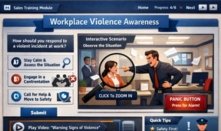
Scenario-based training where learners choose what to do next (escalate, document, speak up, reassure a patient) and get feedback on each choice. Good for patient safety, handoffs, privacy decisions and communication.
Software simulations
Show-me, try-me and test-me simulations of the systems staff use every day, so people practice a workflow before they touch live records.
360-degree scenarios in Adobe Captivate
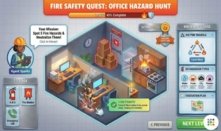
360-degree photo and video scenarios built in Adobe Captivate let learners look around a real space, such as a ward, a pharmacy or a cleanroom, and spot hazards or next steps.
What it can't do: screen-based simulation builds knowledge and decision-making. It does not replace supervised hands-on practice for clinical skills, so plan it as preparation, not as the skills sign-off. eLearning can come before a sim-lab session, so learners arrive knowing the steps and the lab time goes on practice.
Pharmaceutical training: sales, manufacturing, quality and clinical trial teams
Pharmaceutical training has to be accurate, current and recorded, because regulators and industry codes expect it. We build pharmaceutical training solutions, delivered as online courses your LMS tracks, for four groups.

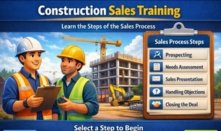
Pharmaceutical sales training
Product and disease-state modules, compliant-conversation scenarios and test-me assessments for reps. The PhRMA Code (section 14) asks companies to train reps on the laws, regulations and codes that govern their interactions with health care professionals, give them enough science and product knowledge to share accurate information consistent with FDA requirements, and assess them periodically. An online pharmaceutical sales training program lets you update every rep at once when a label or policy changes.
Manufacturing and packaging
SOP-based modules and process simulations for manufacturing, packaging and warehouse staff, with short refreshers when an SOP changes. 21 CFR 211.25(a) asks for training in each person's operations and in CGMP on a continuing basis.
Quality and audit teams
Courses on deviations, CAPA, documentation and audit readiness, built from your quality procedures and reviewed by your QA team.
Clinical trial teams
Protocol and role-based training for site and sponsor staff. ICH E6(R3) GCP says everyone involved in a trial should be qualified by education, training and experience for their tasks.
What we deliver
When you compare healthcare eLearning companies, check four things: the course types they build, the tools they work in, the output standards and how they test in your LMS. Here is ours.
Course types
- Custom eLearning, rapid eLearning, microlearning and mobile learning
- Scenario-based and simulation-based training, software simulations
- 360-degree photo and video scenarios built in Adobe Captivate
- Interactive and animated video, gamified learning
- PowerPoint and ILT (instructor-led training) to eLearning conversion
- Course redesign and legacy (Flash or old SCORM) conversion to HTML5 or Rise
- Blended learning packages that combine eLearning with your live sessions
Tools and outputs
- Articulate Storyline 360, Articulate Rise 360, Adobe Captivate, Lectora, iSpring Suite, dominKnow ONE and Elucidat
- SCORM 1.2, SCORM 2004, xAPI and HTML5 (SCORM is the standard that lets a course run and report in most LMSs; xAPI records more detailed learning activity)
- Accessible eLearning built to WCAG 2.1 AA and Section 508
- Translation and localization into 40+ languages, with human or AI voiceover
LMS testing and setup
LMS platforms we have delivered courses to include Moodle, TalentLMS, Docebo and Cornerstone. We set up, configure and support these platforms and build courses that track in any SCORM 1.2, SCORM 2004 or xAPI LMS. We also offer LMS selection, setup, implementation and migration, and learning analytics using xAPI and the Kirkpatrick model (reaction, learning, behavior, results).
We also test courses in other LMSs your organization may use, for example Absorb, SAP SuccessFactors, Workday Learning, Canvas and Litmos.
How a healthcare eLearning project works
The most important step in healthcare eLearning is the review: your experts confirm every clinical, legal and product detail before anything is built.
- 01
Discovery call
IKHYA and YouWe agree the audience, goals, rules that apply, LMS and deadline.
- 02
Source content and SMEs
YouYou share policies, SOPs, product data and name your clinical or compliance reviewers.
- 03
Design and storyboard
IKHYA drafts, you reviewWe write the storyboard: every screen, scenario, question and piece of narration.
- 04
Clinical and compliance sign-off
YouYour experts check accuracy and approve the storyboard before development starts.
- 05
Build and prototype
IKHYA drafts, you reviewWe build in the agreed tool and share a working version for review.
- 06
Review rounds
IKHYA and YouYour reviewers comment in one shared place; we fix and confirm each change.
- 07
QA and LMS testing
IKHYAWe test function, devices, accessibility and tracking in your LMS.
- 08
Launch and measure
IKHYA and YouYou launch; we help you read completion, scores and, where set up, xAPI data.
What drives the cost of healthcare eLearning?
IKHYA works on a quote basis. The price depends on:
What you send us, what we prepare
You send You
- Policies, SOPs, protocols, product information or slide decks
- Named clinical, compliance or medical reviewers
- Brand guide and any approved images or video
- LMS name and a test account
- Languages and regions
- The rules your compliance team says apply
We prepare IKHYA
- Learning objectives and course outline
- Storyboard with every screen, scenario and question
- Visual design and prototype
- SCORM or xAPI package, tested in your LMS
- Translated and localized versions with voiceover
- Assessments and completion settings that match them
Proof
 Healthcare
Mobile-first privacy and infection-control training for 4,000 hospital staff
A US regional hospital network with 5 hospitals had a 2-hour annual PDF and slide course that staff on shifts could not finish.
- What we built
- 8 microlearning modules of 6 to 8 minutes in Articulate Rise 360
- Patient-privacy scenarios reviewed by the network's compliance officer
- Built to WCAG 2.1 AA and delivered as SCORM 1.2 in 7 weeks
- Results
- Measured with LMS completion and quiz data (first cycle vs the previous year), on-time completion rose from 71% to 94%.
- The average quiz score was 88%.
"Nurses can finish a module on their phones between patients now. Completion stopped being a monthly chase for our managers, and the compliance officer signed off on every scenario before launch, so we had no surprises."
Across industries, IKHYA has delivered 500+ projects since 2010 for clients in 40+ countries, including a compliance overhaul that raised completion and pass rates from 61% to 82% across 1,200 employees.
Healthcare eLearning FAQs
Healthcare eLearning solutions are online courses, simulations and assessments that train hospital, health system, pharma and life sciences staff on clinical, compliance, product and system skills. They run in a learning management system (LMS), which records completions and scores for audits.
Partly. OSHA requires an opportunity for interactive questions and answers with the person conducting the training, and has said computer-based training alone is not enough, though a hotline to a qualified trainer can meet the Q&A part.
HIPAA does not set a fixed interval. The Privacy Rule requires training for new workforce members within a reasonable period, again when a material change affects their functions, and documentation of the training. Your own policy can add a yearly refresher.
No. Screen-based simulation builds knowledge and decision-making, but clinical skills still need supervised practice. eLearning works best before a sim-lab or bedside session.
Credit is given by an accredited provider, not by the course builder. ACCME accredits organizations that offer continuing medical education, not individual activities. If your organization is an accredited provider, or works with one, the course we build can be the activity that goes through its process.
It depends on course length, interactivity, the number of review rounds and how quickly your clinical reviewers can respond. We agree a schedule with review dates at the start.
Your own experts. We design and build the course; your clinical, compliance or medical reviewers approve the storyboard before development and sign off the final version.
Yes. We deliver SCORM 1.2, SCORM 2004, xAPI or HTML5, test every course in your LMS before launch and localize into 40+ languages with human or AI voiceover.
Build healthcare training your staff will finish
Tell us about your audience, your rules and your deadline. We will scope it and send a quote.