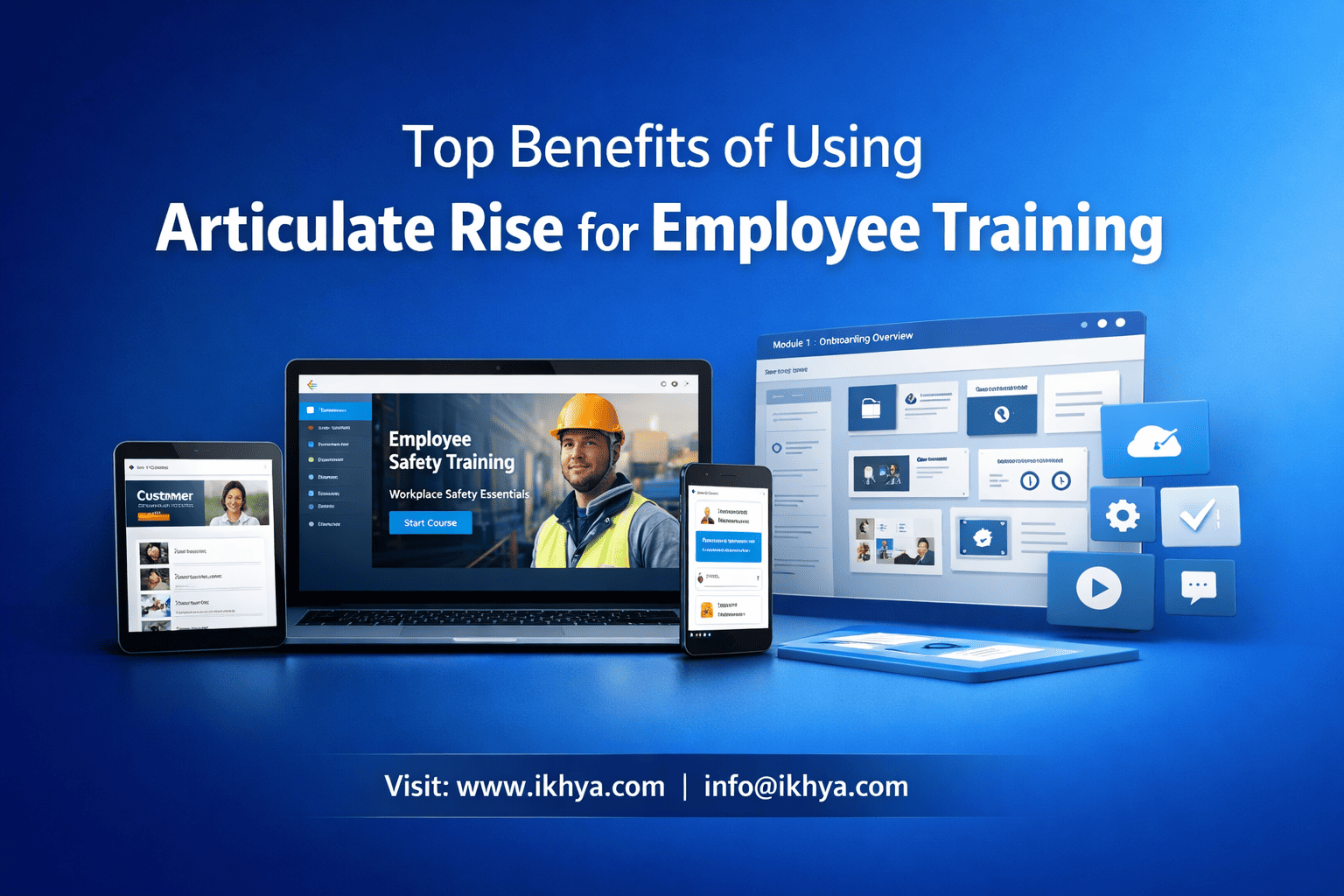
Top Benefits of Using Articulate Rise for Employee Training

Employee training is no longer about long classroom sessions or static slides. Organizations today need fast, scalable, and mobile-friendly learning solutions—and that’s where Articulate Rise for employee training stands out. It helps companies create engaging courses quickly while ensuring compatibility across devices and LMS platforms.
If you’re planning to modernize training or convert legacy content, exploring a free eLearning demo can help you understand how Rise fits your needs before investing heavily.
What is Articulate Rise and How It Works
Articulate Rise is a cloud-based eLearning authoring tool that allows organizations to create responsive, interactive courses without complex programming. It uses a block-based system where content is structured into lessons, making it easy to design and update training modules.
If you’re new to the platform, this detailed guide on what Articulate Rise 360 is explains its core functionality and use cases.
How Articulate Rise Works in Simple Terms
- You build courses using pre-designed content blocks
- Content automatically adapts to mobile, tablet, and desktop
- Courses can be exported as SCORM or xAPI packages
- Easily integrate with any LMS (Learning Management System)
Key Functional Capabilities
- Responsive design (no extra effort needed)
- Built-in templates for faster course creation
- Interactive elements like quizzes, timelines, and tabs
- Real-time collaboration for distributed teams
To understand how Rise ensures seamless multi-device learning, this resource on how Articulate Rise creates responsive eLearning courses provides deeper insights.
Why This Matters for Employee Training
Traditional eLearning tools often require:
- Separate mobile optimization
- Long development cycles
- High development costs
Articulate Rise eliminates these challenges by enabling:
- Faster deployment
- Lower development effort
- Consistent learning experience across global teams
Organizations across the USA, UK, UAE, and Australia are increasingly adopting Rise as part of their digital learning transformation strategies, especially for compliance, onboarding, and product training.
Where Rise Fits in Modern Training Ecosystems
Articulate Rise is best suited for:
- Microlearning modules
- Compliance training programs
- Employee onboarding courses
- Global workforce training with localization
When combined with custom eLearning development services, Rise becomes even more powerful by aligning content with business goals and learner behavior.
Rise vs Traditional Authoring Tools (Quick View)
| Feature | Articulate Rise | Traditional Tools |
|---|---|---|
| Development Speed | Very Fast | Slow |
| Mobile Optimization | Automatic | Manual |
| Technical Skills Needed | Low | High |
| Scalability | High | Moderate |
| Cost Efficiency | High | Low–Moderate |
Real Example Scenario
A retail company in the UK needed to train 5,000 employees across multiple locations.
Traditional Approach:
- Development time: 10–12 weeks
- Cost: $25,000+
- Mobile issues reported
Using Articulate Rise:
- Development time: 3–4 weeks
- Cost: $8,000–$12,000
- Fully mobile-compatible
This demonstrates how Rise significantly improves speed, cost, and learner experience.
When Organizations Typically Adopt Rise
Companies usually shift to Rise when they:
- Need rapid eLearning development
- Want to convert PowerPoint or ILT training
- Require global training deployment
- Aim to improve learning engagement
For a deeper understanding of capabilities, reviewing the top features of Articulate Rise for eLearning development helps clarify its strengths.
Key Benefits of Articulate Rise for Employee Training
Articulate Rise offers a combination of speed, scalability, and simplicity that makes it ideal for corporate training. It helps organizations deliver high-quality learning experiences while reducing development time and cost.
1. Faster Course Development (Rapid eLearning)
One of the biggest advantages of Rise is its ability to accelerate course creation.
- Pre-built templates reduce design effort
- Drag-and-drop content blocks simplify development
- No coding required
Impact:
- Courses can be built 3–5x faster than traditional tools
- Ideal for urgent training needs like compliance updates
Organizations using rapid eLearning development services often rely on Rise to meet tight deadlines without compromising quality.
2. Cost-Effective Training Development
For organizations evaluating budget vs quality, understanding custom eLearning development cost vs ready-made courses helps make informed decisions.
3. Scalable for Global Training
For global rollout strategies, companies often combine Rise with eLearning translation and localization services.
4. Ideal for Rapid Content Conversion
Organizations looking to digitize training often use ILT to eLearning course conversion services along with Rise.
Why Articulate Rise is Ideal for Corporate Training Programs
Articulate Rise is ideal for corporate training because it enables organizations to deliver fast, scalable, and consistent learning experiences across global teams. Its ease of use, responsiveness, and LMS compatibility make it a practical choice for modern enterprise training environments.
Key Reasons Organizations Choose Rise for Corporate Training
- Rapid deployment for urgent training needs
- Consistent learning experience across devices and regions
- Reduced dependency on technical teams
- Seamless LMS integration (SCORM/xAPI)
- Easy updates for compliance and policy changes
If you’re evaluating whether Rise fits your training strategy, this guide on why organizations use Articulate Rise for corporate training provides deeper clarity.
Where Rise Delivers Maximum Impact
Rise is particularly effective in:
Employee Onboarding
- Standardized onboarding across locations
- Faster time-to-productivity
- Easy updates for evolving company policies
Compliance Training
- Frequent regulatory updates handled easily
- Trackable completion via LMS
- Ideal for industries like healthcare, finance, and oil & gas
Product and Sales Training
- Quick rollout of new product information
- Mobile-friendly access for field teams
- Scenario-based learning for better retention
Remote Workforce Training
- Supports distributed teams
- Accessible anytime, anywhere
- No dependency on classroom sessions
Organizations implementing mobile learning development solutions often combine them with Rise to support hybrid and remote teams effectively.
Business Impact of Using Rise
| Metric | Traditional Training | Using Rise |
|---|---|---|
| Time to Launch | 8–12 weeks | 2–4 weeks |
| Update Time | Days/Weeks | Hours |
| Device Compatibility | Limited | Full |
| Learner Engagement | Moderate | High |
Real Corporate Scenario
A financial services company in the UAE needed compliance training for 2,000 employees.
Challenges:
- Frequent regulatory updates
- Distributed workforce
- Low completion rates
Solution Using Rise:
- Converted training into microlearning modules
- Integrated with LMS using SCORM
- Enabled mobile access
Results:
- Completion rate increased from 62% to 91%
- Development time reduced by 60%
- Update cycles reduced from 2 weeks to 2 days
When Rise Becomes a Strategic Advantage
Rise is not just a tool—it becomes a strategic asset when:
- Training needs to scale across multiple regions
- Organizations want to standardize learning experiences
- Speed and cost are critical decision factors
For companies planning large-scale training initiatives, working with Articulate Rise development services ensures better alignment with business goals and faster execution.
Real-World Use Cases Across Industries
Articulate Rise adapts well across industries because of its flexibility, scalability, and ease of deployment. It supports different training needs—from compliance to operational training—without increasing complexity.
Healthcare Training
Healthcare organizations require:
- Strict compliance training
- Frequent updates
- High accuracy
Use Case:
- Infection control training
- Patient safety modules
- HIPAA compliance
How Rise Helps:
- Quick updates for changing regulations
- Scenario-based learning for real-world situations
- Mobile access for frontline staff
For structured learning programs, companies often use healthcare training eLearning solutions alongside Rise.
Manufacturing Training
Manufacturing training focuses on:
- Safety protocols
- Equipment handling
- Process training
Use Case:
- Machine operation training
- Safety compliance modules
- SOP-based training
How Rise Helps:
- Microlearning modules for quick reference
- Visual content for better understanding
- Easy updates for process changes
Many organizations enhance this using manufacturing training eLearning solutions.
Finance and Compliance Training
Finance industries deal with:
- Regulatory compliance
- Risk management
- Anti-money laundering (AML) training
Use Case:
- Compliance certification programs
- Risk awareness training
- AML modules
How Rise Helps:
- Frequent content updates
- LMS tracking for audits
- Structured learning paths
These programs are often supported by compliance training eLearning solutions.
Retail Training
Retail requires:
- Fast onboarding
- Product knowledge training
- Customer service training
Use Case:
- Store employee onboarding
- Seasonal product training
- Customer interaction modules
How Rise Helps:
- Mobile-friendly courses for frontline staff
- Quick updates for promotions and products
- Engaging content for better retention
Retail brands often integrate this with retail training eLearning solutions.
IT and Software Training
IT organizations need:
- Continuous skill updates
- Product training
- Technical onboarding
Use Case:
- Software training modules
- Developer onboarding
- Cybersecurity awareness
How Rise Helps:
- Modular learning structure
- Scalable training programs
- Easy updates for new technologies
These initiatives are commonly supported by IT and software training eLearning solutions.
Key Takeaway Across Industries
Regardless of industry, Rise consistently delivers:
- Faster development
- Better learner engagement
- Lower training costs
- Scalable global deployment
Articulate Rise vs Traditional eLearning Tools
Articulate Rise differs from traditional eLearning tools by prioritizing speed, simplicity, and responsiveness, while older tools focus on customization and complex interactivity. The right choice depends on your training goals, timelines, and level of interactivity required.
Key Differences at a Glance
| Criteria | Articulate Rise | Traditional Tools (Storyline, Captivate, etc.) |
|---|---|---|
| Development Speed | Very Fast | Moderate to Slow |
| Mobile Responsiveness | Built-in | Requires manual design |
| Technical Skill Required | Low | High |
| Interactivity Level | Moderate | Advanced |
| Cost | Lower | Higher |
| Scalability | High | Moderate |
If you’re evaluating tool selection, this detailed comparison of Articulate Rise vs Storyline for corporate training helps clarify which tool fits your needs.
When Articulate Rise is the Better Choice
Choose Rise when you need:
- Rapid eLearning development
- Mobile-first learning experiences
- Standardized training across teams
- Frequent updates (compliance, onboarding)
- Cost-efficient course production
Example Scenario:
A global IT company rolling out onboarding for 3,000 employees across the USA and Australia would benefit from Rise due to:
- Faster rollout
- Device compatibility
- Easy updates
When Traditional Tools Are Better
Traditional tools like Storyline or Captivate are better when you need:
- Complex simulations
- Advanced branching scenarios
- Custom animations and interactions
- Game-based learning
For such requirements, combining Rise with Articulate Storyline development services is a common strategy.
Hybrid Approach: Best of Both Worlds
Many enterprises use a blended strategy:
- Rise for:
- Compliance training
- Microlearning
- Onboarding
- Storyline/Captivate for:
- Simulations
- High-interaction modules
This approach allows organizations to balance:
- Speed
- Cost
- Learning effectiveness
Decision Framework
Use this quick decision model:
| Requirement | Recommended Tool |
|---|---|
| Fast deployment | Rise |
| Mobile-first training | Rise |
| Complex simulations | Storyline |
| Budget constraints | Rise |
| High interactivity | Storyline |
Cost of Developing Training Using Articulate Rise
Articulate Rise significantly reduces eLearning development costs by minimizing design complexity and development time. It is one of the most cost-efficient solutions for corporate training.
Typical Cost Breakdown
| Course Type | Duration | Cost Range (USD) |
|---|---|---|
| Basic Compliance Course | 30–45 mins | $3,000 – $6,000 |
| Employee Onboarding | 60–90 mins | $5,000 – $10,000 |
| Multi-module Training Program | 2–3 hours | $8,000 – $15,000 |
What Affects Cost?
- Content complexity
- Level of interactivity
- Multimedia usage (videos, animations)
- Localization requirements
- Number of modules
Organizations looking to scale efficiently often rely on rapid eLearning development using Storyline and Rise 360 to optimize cost and timelines.
Cost Comparison: In-House vs Outsourcing
| Approach | Cost | Pros | Cons |
|---|---|---|---|
| In-House | High | Full control | Slow, resource-heavy |
| Outsourcing | Moderate | Faster, scalable | Vendor dependency |
To make a strategic decision, reviewing in-house vs outsourced eLearning development cost comparison helps identify the most cost-effective approach.
Real Cost Scenario
A manufacturing company in Australia needed safety training for 1,500 employees.
In-House Approach:
- Cost: $20,000+
- Timeline: 10 weeks
Using Rise with Outsourcing:
- Cost: $9,000
- Timeline: 4 weeks
Savings:
- 55% cost reduction
- 60% faster delivery
Project Timelines for Rise-Based Training
Articulate Rise enables faster project execution compared to traditional eLearning tools. Timelines vary based on complexity, but most projects follow structured delivery models.
2-Week Rapid Deployment Model
Best for:
- Compliance training
- Short onboarding modules
- Microlearning
Timeline Breakdown:
| Phase | Duration |
|---|---|
| Content analysis | 2 days |
| Storyboarding | 3 days |
| Development | 5 days |
| Review & revisions | 3 days |
| Deployment | 1–2 days |
4-Week Standard Development Model
Best for:
- Multi-module training
- Product training
- Certification programs
Timeline Breakdown:
| Phase | Duration |
|---|---|
| Requirement analysis | 4–5 days |
| Instructional design | 5–6 days |
| Development | 10–12 days |
| QA & testing | 4–5 days |
| Final deployment | 2–3 days |
Factors That Impact Timeline
- Content readiness
- Stakeholder availability
- Number of review cycles
- Complexity of interactions
Organizations aiming for faster turnaround often use rapid eLearning development services to streamline execution.
Key Timeline Advantage
Compared to traditional tools:
- Development time reduced by 40–70%
- Faster feedback cycles
- Quicker deployment to LMS
When to Use Articulate Rise (and When Not To)
Articulate Rise is best used for fast, scalable, and mobile-friendly training, but it is not ideal for highly complex or simulation-heavy learning. Knowing when to use it—and when to avoid it—ensures better ROI and learning effectiveness.
When You Should Use Articulate Rise
Use Rise when your training requires:
- Rapid development and deployment
- Mobile-first learning experiences
- Standardized training across locations
- Frequent updates (compliance, onboarding)
- Scalable global rollout
Best Use Cases
1. Compliance Training Programs
- Regulatory updates can be deployed quickly
- LMS tracking ensures audit readiness
- Easy version control
Organizations delivering compliance training at scale often rely on compliance training development using Articulate Storyline or Rise to maintain consistency.
2. Employee Onboarding
- Structured onboarding journeys
- Faster employee readiness
- Consistent experience across regions
Rise works especially well when paired with microlearning development services to break onboarding into digestible modules.
3. Microlearning-Based Training
- Short, focused lessons
- Better engagement and retention
- Ideal for modern learners
For organizations shifting to modern formats, microlearning development services complement Rise effectively.
4. Global Training Programs
- Multi-language support
- Consistent content delivery
- Easy localization
Companies expanding globally often combine Rise with global training deployment using Articulate Rise development and localization.
When You Should NOT Use Articulate Rise
Avoid Rise when your training requires:
- Advanced simulations
- Complex branching scenarios
- Game-based learning
- Highly customized UI/UX
Better Alternatives in These Cases
For advanced requirements, consider:
- Storyline for simulations
- Captivate for software training
- Hybrid solutions
Organizations dealing with complex learning scenarios often use eLearning simulation-based training services alongside other tools.
Decision Checklist
Use this quick checklist:
| Question | If Yes → Use Rise? |
|---|---|
| Need fast deployment? | Yes |
| Need mobile-first training? | Yes |
| Need complex simulations? | No |
| Budget constraints? | Yes |
| Frequent updates required? | Yes |
When Articulate Rise Becomes a Strategic Choice for Corporate Training
Many enterprises do not rely on a single tool. Instead, they:
- Use Rise for speed and scalability
- Use Storyline/Captivate for depth and interactivity
This hybrid approach ensures optimal training outcomes without increasing costs unnecessarily.
How to Implement Articulate Rise in Your Organization
Implementing Articulate Rise effectively requires a structured approach that aligns training goals with business objectives. A clear process ensures faster deployment and better learning outcomes.
Step-by-Step Implementation Process
Step 1: Define Training Objectives
- Identify business goals
- Define target audience
- Set measurable outcomes
Example:
- Reduce onboarding time by 30%
- Improve compliance completion rates
Step 2: Audit Existing Content
- Review current training materials
- Identify reusable content (PPTs, PDFs, ILT)
- Eliminate outdated information
Organizations often streamline this process using PPT to eLearning conversion services.
Step 3: Choose the Right Development Approach
Options include:
- In-house development
- Outsourcing
- Hybrid model
For faster execution and scalability, many companies opt for eLearning consultancy services to define the right strategy.
Step 4: Design Instructional Strategy
- Break content into modules
- Use microlearning where possible
- Add assessments and interactions
Strong learning design is critical, which is why organizations invest in instructional design services.
Step 5: Develop Courses in Rise
- Use pre-built templates
- Add multimedia elements
- Ensure mobile optimization
At this stage, working with Articulate Rise course development services for corporate training teams can significantly speed up delivery.
Step 6: LMS Integration and Testing
- Export courses as SCORM/xAPI
- Upload to LMS
- Test tracking and reporting
Step 7: Deployment and Continuous Improvement
- Launch training programs
- Monitor learner performance
- Update content regularly
Organizations modernizing legacy training often combine this with upgrade existing eLearning courses using Articulate Storyline and Rise.
Implementation Timeline Example
| Phase | Duration |
|---|---|
| Planning & analysis | 1 week |
| Design & development | 2–3 weeks |
| Testing & deployment | 1 week |
Common Implementation Challenges
- Lack of clear objectives
- Poor content quality
- Delayed stakeholder feedback
- Inadequate LMS setup
These can be avoided with proper planning and expert support.
Key Success Factors
- Clear training goals
- Strong instructional design
- Efficient collaboration
- Continuous optimization
Should You Outsource Articulate Rise Development?
Outsourcing Articulate Rise development is often the fastest and most cost-effective way to deliver high-quality training, especially when internal teams lack bandwidth, expertise, or scalability. It allows organizations to focus on business goals while experts handle design, development, and deployment.
When Outsourcing Makes Sense
Outsourcing is the right choice when:
- You need fast turnaround (2–4 weeks)
- Internal teams are overloaded
- Training requires professional instructional design
- You need multi-language or global deployment
- Projects require scalability across departments
Organizations planning large-scale initiatives often explore outsource eLearning development benefits, costs, and best practices to make informed decisions.
In-House vs Outsourced: Strategic Comparison
| Factor | In-House Development | Outsourced Development |
|---|---|---|
| Cost | High (fixed overhead) | Flexible (project-based) |
| Speed | Slower | Faster |
| Expertise | Limited | Specialized experts |
| Scalability | Low | High |
| Quality | Varies | Consistent |
Real Business Scenario
A healthcare organization in the USA needed compliance training for 3,000 employees.
In-House Approach:
- Timeline: 12 weeks
- Cost: $30,000+
- Limited instructional design expertise
Outsourced Approach (Rise-based):
- Timeline: 5 weeks
- Cost: $14,000
- High-quality, interactive modules
Outcome:
- 50% faster delivery
- 50% cost savings
- Improved learner engagement
Outsourcing Models
1. Project-Based Outsourcing
- Fixed scope
- Fixed timeline
- Best for one-time projects
2. Dedicated Team Model
- Long-term engagement
- Scalable resources
- Ideal for continuous training needs
Organizations building long-term strategies often refer to dedicated Articulate Storyline and Rise development team hiring guide.
Risks of Outsourcing (and How to Avoid Them)
| Risk | Solution |
|---|---|
| Poor communication | Set clear expectations and timelines |
| Quality issues | Review portfolios and case studies |
| Delays | Define milestones and checkpoints |
| Vendor dependency | Maintain documentation and ownership |
When NOT to Outsource
Avoid outsourcing if:
- You have a strong in-house L&D team
- Training needs are minimal
- Budget constraints are extremely tight
Key Takeaway
Outsourcing is not just about cost—it’s about:
- Speed
- Expertise
- Scalability
When done correctly, it significantly improves training quality and business outcomes.
How to Choose the Right eLearning Vendor
Choosing the right vendor is critical to the success of your Articulate Rise training initiatives. The right partner ensures quality, speed, and alignment with your business goals.
Step-by-Step Vendor Selection Framework
Step 1: Define Your Requirements
- Training type (compliance, onboarding, product)
- Target audience
- Timeline and budget
- LMS compatibility
If you’re unsure how to structure requirements, this eLearning RFP template guide can help you get started.
Step 2: Evaluate Vendor Expertise
Check for:
- Experience with Articulate Rise
- Industry-specific projects
- Instructional design capabilities
Step 3: Review Portfolio and Case Studies
Look for:
- Similar project experience
- Measurable results (engagement, completion rates)
- Quality of design and interactivity
Organizations comparing vendors often review custom eLearning development case study examples.
Step 4: Assess Development Process
A reliable vendor should have:
- Clear workflow
- Defined milestones
- Review cycles
- Quality assurance processes
Step 5: Evaluate Communication and Collaboration
- Regular updates
- Transparent timelines
- Easy collaboration tools
Step 6: Compare Cost vs Value
Do not choose based on cost alone.
Instead evaluate:
- ROI
- Quality
- Scalability
- Long-term support
Vendor Evaluation Checklist
| Criteria | What to Look For |
|---|---|
| Experience | Proven Rise projects |
| Team | Instructional designers + developers |
| Process | Structured and transparent |
| Communication | Clear and consistent |
| Cost | Value-driven, not cheapest |
Real Vendor Selection Scenario
A manufacturing company in Germany evaluated 3 vendors.
| Vendor | Cost | Timeline | Quality |
|---|---|---|---|
| Vendor A | Low | Slow | Medium |
| Vendor B | Medium | Fast | High |
| Vendor C | High | Fast | Very High |
Decision:
Chose Vendor B for best balance of cost, speed, and quality
Final Selection Tip
Always:
- Start with a pilot project
- Evaluate performance
- Scale based on results
If you’re exploring a reliable partner for your training needs, you can contact the eLearning experts to discuss your requirements and get clarity on timelines, cost, and approach.
Should You Outsource Articulate Rise Development?
Outsourcing Articulate Rise development is often the fastest and most cost-effective way to deliver high-quality training, especially when internal teams lack bandwidth, expertise, or scalability. It allows organizations to focus on business goals while experts handle design, development, and deployment.
When Outsourcing Makes Sense
Outsourcing is the right choice when:
- You need fast turnaround (2–4 weeks)
- Internal teams are overloaded
- Training requires professional instructional design
- You need multi-language or global deployment
- Projects require scalability across departments
Organizations planning large-scale initiatives often explore outsource eLearning development benefits, costs, and best practices to make informed decisions.
In-House vs Outsourced: Strategic Comparison
| Factor | In-House Development | Outsourced Development |
|---|---|---|
| Cost | High (fixed overhead) | Flexible (project-based) |
| Speed | Slower | Faster |
| Expertise | Limited | Specialized experts |
| Scalability | Low | High |
| Quality | Varies | Consistent |
Real Business Scenario
A healthcare organization in the USA needed compliance training for 3,000 employees.
In-House Approach:
- Timeline: 12 weeks
- Cost: $30,000+
- Limited instructional design expertise
Outsourced Approach (Rise-based):
- Timeline: 5 weeks
- Cost: $14,000
- High-quality, interactive modules
Outcome:
- 50% faster delivery
- 50% cost savings
- Improved learner engagement
Outsourcing Models
1. Project-Based Outsourcing
- Fixed scope
- Fixed timeline
- Best for one-time projects
2. Dedicated Team Model
- Long-term engagement
- Scalable resources
- Ideal for continuous training needs
Organizations building long-term strategies often refer to dedicated Articulate Storyline and Rise development team hiring guide.
Risks of Outsourcing (and How to Avoid Them)
| Risk | Solution |
|---|---|
| Poor communication | Set clear expectations and timelines |
| Quality issues | Review portfolios and case studies |
| Delays | Define milestones and checkpoints |
| Vendor dependency | Maintain documentation and ownership |
When NOT to Outsource
Avoid outsourcing if:
- You have a strong in-house L&D team
- Training needs are minimal
- Budget constraints are extremely tight
Key Takeaway
Outsourcing is not just about cost—it’s about:
- Speed
- Expertise
- Scalability
When done correctly, it significantly improves training quality and business outcomes.
Future Trends: Articulate Rise, AI, and Modern Learning
Articulate Rise is evolving alongside modern learning trends such as AI-driven personalization, automation, and data analytics. Organizations adopting Rise today are not just solving current training challenges—they are preparing for the future of digital learning.
1. AI-Driven Content Creation and Personalization
AI is transforming how training content is created and delivered.
How it applies to Rise:
- AI-assisted content generation (quizzes, summaries, scripts)
- Personalized learning paths based on learner behavior
- Automated content recommendations
Business Impact:
- Reduced development time
- Improved learner engagement
- Better knowledge retention
2. Data-Driven Learning with xAPI and Analytics
Modern training is no longer just about completion—it’s about performance insights.
Rise supports:
- SCORM and xAPI tracking
- Integration with advanced LMS platforms
- Real-time analytics dashboards
Organizations can track:
- Learner progress
- Completion rates
- Knowledge gaps
- Behavioral patterns
This is especially valuable for compliance-heavy industries like finance, healthcare, and aviation.
3. Microlearning and Just-in-Time Training
The shift toward short, focused learning modules continues to grow.
Rise is naturally suited for:
- Bite-sized learning content
- On-demand training
- Performance support tools
Organizations implementing microlearning development services are seeing:
- Higher engagement
- Faster learning
- Better retention
4. Mobile-First and Remote Learning
With global teams and hybrid work environments, mobile learning is essential.
Rise enables:
- Learning anytime, anywhere
- Consistent experience across devices
- Support for frontline and remote workers
This is critical for industries like:
- Retail
- Manufacturing
- Logistics
5. Continuous Learning Ecosystems
Modern organizations are moving from one-time training → continuous learning models.
Rise supports this by:
- Allowing quick updates
- Enabling modular learning paths
- Supporting ongoing skill development
6. Integration with Blended Learning Strategies
Rise is increasingly used as part of:
- Blended learning (ILT + eLearning)
- Virtual instructor-led training (VILT)
- Performance support systems
Organizations transitioning from classroom training often leverage transform instructor-led training into Articulate Storyline and Rise eLearning to modernize their approach.
Why Articulate Rise is Future-Ready for Employee Training
The future of training is:
- Faster
- Data-driven
- Personalized
- Scalable
Articulate Rise aligns perfectly with these trends, making it a future-ready investment for organizations.
Final Thoughts: Is Articulate Rise the Right Choice for Your Training?
Articulate Rise stands out as one of the most effective tools for modern employee training because it combines speed, scalability, and simplicity. It is particularly powerful for organizations that need to deliver high-quality training quickly without increasing costs.
Key Takeaways
- Faster development reduces time-to-market
- Mobile-first design supports modern learners
- Cost efficiency makes it scalable
- Easy updates ensure training stays relevant
- Global deployment supports distributed teams
Decision Summary
Articulate Rise is the right choice if you need:
- Rapid training deployment
- Scalable learning solutions
- Cost-effective course development
- Mobile-friendly learning experiences
However, for advanced simulations or complex interactivity, a hybrid approach with Storyline or other tools may be more effective.
Real Business Value
Organizations across the USA, UK, UAE, Australia, and beyond are using Rise to:
- Reduce training costs by 40–60%
- Improve completion rates by 20–40%
- Accelerate deployment timelines by 50%+
Moving Forward
If you’re planning to implement Articulate Rise for employee training, the next step is to evaluate your requirements and choose the right approach—whether in-house, outsourced, or hybrid.
To get clarity on your project scope, timelines, and cost, you can request an eLearning project proposal tailored to your training needs.
FAQs
1. What is Articulate Rise used for?
Articulate Rise is used to create responsive eLearning courses for employee training, onboarding, compliance, and microlearning.
2. Is Articulate Rise good for employee training?
Yes, it is highly effective for employee training due to its speed, scalability, and mobile compatibility.
3. How is Rise different from Storyline?
Rise is faster and easier to use, while Storyline offers more advanced interactivity and customization.
4. Can Rise courses be used on mobile devices?
Yes, Rise courses are fully responsive and work seamlessly on mobile, tablet, and desktop.
5. Does Rise support LMS integration?
Yes, it supports SCORM and xAPI, making it compatible with most LMS platforms.
6. Is Articulate Rise suitable for compliance training?
Yes, it is widely used for compliance training due to easy updates and tracking capabilities.
7. How much does it cost to develop a Rise course?
Costs typically range from $3,000 to $15,000 depending on complexity and length.
8. Can I convert PowerPoint into Rise courses?
Yes, existing PPT content can be converted into interactive Rise courses.
9. Is coding required to use Rise?
No, Rise is a no-code authoring tool.
10. How long does it take to create a course in Rise?
It can take 2–4 weeks depending on project complexity.
11. Can Rise handle multi-language training?
Yes, it supports localization for global training programs.
12. Is Rise suitable for microlearning?
Yes, it is ideal for creating short, engaging microlearning modules.
13. Can Rise courses be updated easily?
Yes, updates can be made quickly without rebuilding the entire course.
14. Does Rise support analytics?
Yes, through LMS integration and xAPI tracking.
15. Is Rise good for onboarding training?
Yes, it is widely used for employee onboarding programs.
16. Can Rise be used for product training?
Yes, it is effective for product and sales training.
17. What industries use Articulate Rise?
Healthcare, manufacturing, finance, retail, IT, and more.
18. Should I outsource Rise development?
Outsourcing is recommended for large or complex projects requiring speed and expertise.
19. Is Rise future-proof?
Yes, it aligns with trends like AI, mobile learning, and data-driven training.
20. What is the biggest advantage of Rise?
Its ability to deliver high-quality training quickly and cost-effectively.
Related Resources
Explore more insights and resources to strengthen your eLearning strategy and make informed decisions: