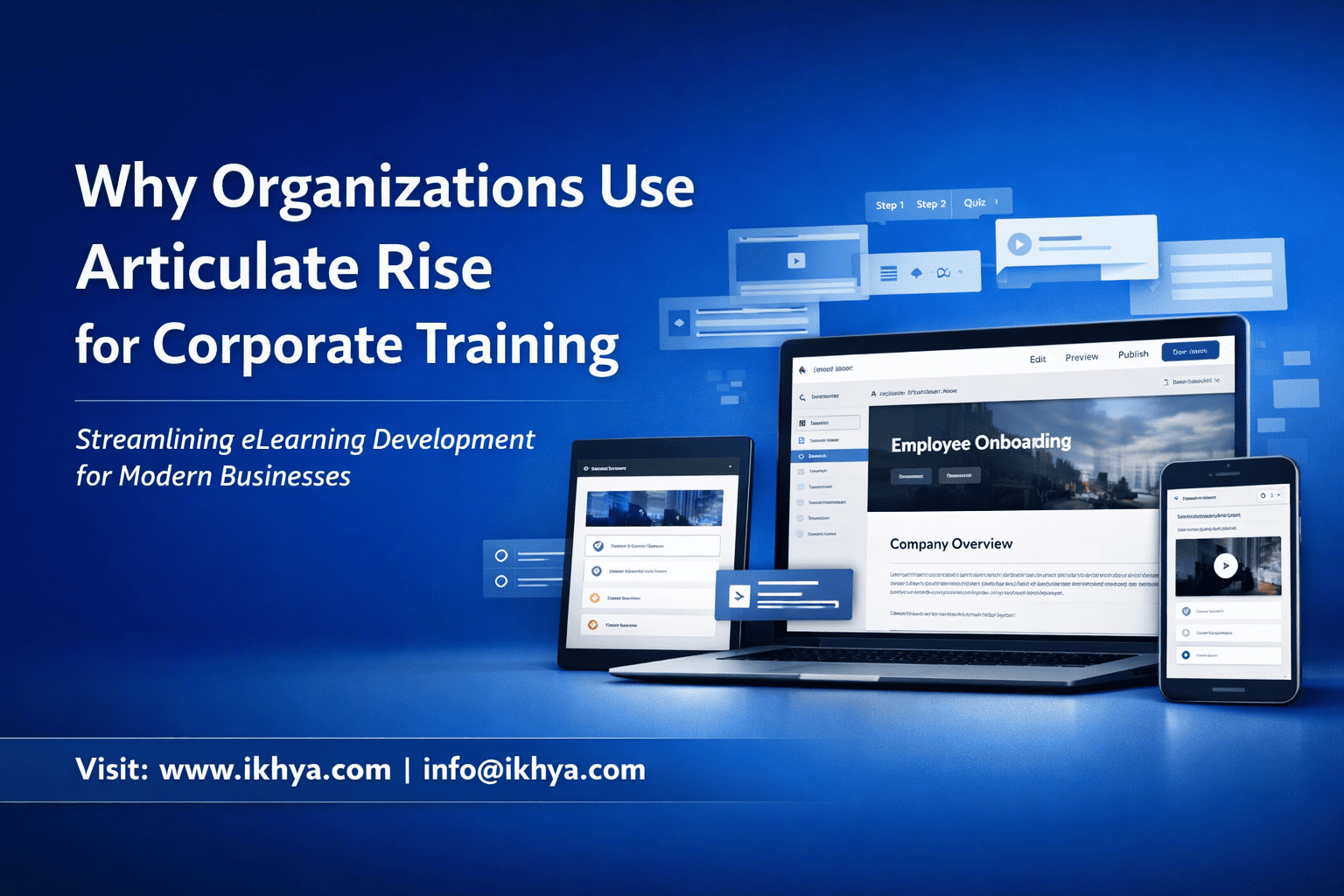
Why Organizations Use Articulate Rise for Corporate Training

Modern organizations are under constant pressure to deliver training faster, reach global employees, and keep learning engaging. Traditional training methods and slow eLearning development cycles often struggle to meet these demands. This is why many enterprises now rely on Articulate Rise to build scalable, mobile-ready corporate training programs.
Articulate Rise allows organizations to create responsive, interactive eLearning courses quickly without compromising instructional quality. Its block-based design, cloud collaboration features, and seamless LMS compatibility make it ideal for global corporate training deployments.
For companies planning enterprise eLearning initiatives, working with experienced development partners is often essential. Organizations looking for scalable course development can explore IKHYA – eLearning Solutions Company to understand how enterprise teams design, deploy, and scale Articulate Rise training programs globally.
If you want to see how Rise-based courses work in real enterprise environments, you can also Book a Free eLearning Demo with IKHYA’s experts.
What Is Articulate Rise and Why Enterprises Use It for Corporate Training
Articulate Rise is a cloud-based eLearning authoring tool that enables organizations to build responsive, mobile-friendly training courses quickly. Enterprises prefer Rise because it allows fast development, consistent design, LMS compatibility, and scalable training deployment across global teams without requiring complex development skills.
Articulate Rise is part of the Articulate 360 ecosystem, widely used by corporate learning teams across the US, UK, Australia, and UAE.
Unlike traditional authoring tools that require heavy design work, Rise uses a block-based course creation model that allows instructional designers to build courses quickly while maintaining professional structure and consistency.
Key Characteristics of Articulate Rise
Rise is designed for rapid corporate training development, especially when organizations need to deploy training to large distributed workforces.
Key features include:
- Fully responsive design for mobile, tablet, and desktop
- Cloud-based collaborative development
- Pre-built interactive content blocks
- SCORM and xAPI compatibility
- Seamless LMS integration
- Rapid course publishing for enterprise training
Because of these capabilities, many organizations adopt Rise when they need to scale training quickly without complex development cycles.
Companies planning enterprise learning ecosystems often combine Rise with broader eLearning strategies such as corporate eLearning development frameworks to ensure training aligns with business goals.
Why Corporate Training Teams Prefer Rise Over Traditional Development
Traditional eLearning development often requires:
- graphic design
- programming knowledge
- long development timelines
- heavy QA cycles
Rise simplifies this process dramatically.
Instead of designing every screen from scratch, instructional designers can assemble courses using pre-built components such as:
- interactive tabs
- knowledge checks
- timelines
- scenario blocks
- process diagrams
- labeled graphics
This allows corporate teams to create structured courses quickly while still applying instructional design principles.
Organizations that need rapid course rollout often combine Rise with services such as rapid eLearning development to convert training content into scalable digital learning programs.
Enterprise Training Use Cases for Articulate Rise
Rise is particularly useful for organizations that need high-volume training deployment across departments or regions.
Common enterprise use cases include:
Compliance training
- workplace safety
- financial compliance
- regulatory learning
Employee onboarding
- HR policies
- workplace culture
- internal processes
Operational training
- manufacturing procedures
- retail systems
- customer service workflows
Product training
- product knowledge
- sales enablement
- partner training
For example:
- US enterprises use Rise to deploy workplace compliance training across large employee bases.
- UK companies often use Rise for regulatory learning aligned with compliance frameworks.
- Australian organizations apply Rise in vocational training and workplace skill development.
- UAE companies use Rise to deliver multilingual training programs to diverse workforces.
These global deployments require LMS compatibility, localization capabilities, and scalable course development workflows.
Organizations that require large-scale training deployment often rely on specialized development partners offering Articulate Rise development services to ensure training quality, speed, and scalability.
Why Rise Fits Modern Enterprise Learning Ecosystems
Modern corporate training environments are complex.
Organizations must manage:
- multiple LMS platforms
- distributed global teams
- compliance training requirements
- multilingual learning programs
- rapid content updates
Rise integrates easily into these ecosystems because it supports SCORM and xAPI standards, allowing courses to connect seamlessly with enterprise LMS platforms such as:
- Cornerstone
- Docebo
- Moodle
- SAP SuccessFactors
- Absorb LMS
Rise also supports rapid course updates, allowing organizations to revise training content quickly when regulations, policies, or products change.
This agility makes Rise particularly valuable for industries where training must evolve frequently, including:
- healthcare
- aviation
- finance
- manufacturing
- retail
For example, organizations running large compliance initiatives often combine Rise with broader programs like compliance training eLearning solutions to ensure regulatory requirements are consistently met across regions.
Key Features of Articulate Rise That Make It Ideal for Corporate Training
Articulate Rise is widely adopted in corporate learning environments because it enables organizations to create responsive, structured, and interactive training quickly. Its cloud-based architecture, modular content blocks, and LMS compatibility allow enterprises to develop scalable training programs while maintaining consistent design and instructional quality.
Modern L&D teams are under pressure to deliver faster training deployment without sacrificing learning effectiveness. Rise solves this challenge by providing ready-to-use learning components that reduce development complexity.
Below are the most important features that make Rise valuable for enterprise training programs.
Fully Responsive Learning for Mobile Workforces
Corporate training today must reach employees working on:
- desktops
- tablets
- smartphones
- remote work environments
Articulate Rise automatically creates responsive courses that adapt to different screen sizes.
This eliminates the need for separate mobile course development and ensures employees can complete training anytime and anywhere.
Mobile-friendly learning is especially critical for industries such as:
- manufacturing
- retail
- healthcare
- aviation
- logistics
For example:
- US retail companies often deploy mobile training for store staff.
- Australian mining organizations provide mobile safety training for field workers.
- UAE aviation companies deliver mobile compliance courses for airport staff.
Organizations looking to implement scalable mobile-first training often combine Rise with mobile learning development solutions to ensure learning programs work effectively across devices.
Rapid Course Development with Pre-Built Interactive Blocks
One of the biggest reasons enterprises adopt Rise is its block-based course development model, which allows instructional designers to create courses quickly.
Instead of building every interaction manually, Rise provides ready-to-use blocks such as:
- interactive timelines
- knowledge check quizzes
- scenario-based interactions
- process diagrams
- labeled graphics
- accordion content blocks
These components allow course developers to build engaging learning experiences while significantly reducing development time.
For example, organizations converting existing training materials often use Rise to transform:
- PowerPoint presentations
- instructor-led training
- policy documentation
- onboarding manuals
Companies frequently use services like PPT to eLearning conversion services to rapidly convert traditional content into interactive Rise courses.
Cloud-Based Collaboration for Distributed Learning Teams
Unlike many traditional authoring tools, Articulate Rise is fully cloud-based.
This allows multiple stakeholders to collaborate on course development simultaneously.
Typical contributors in enterprise projects include:
- instructional designers
- subject matter experts
- compliance teams
- L&D managers
- training consultants
With cloud collaboration, teams can:
- review courses instantly
- provide feedback faster
- reduce development delays
- manage version control effectively
This capability is especially valuable for global organizations with distributed training teams.
Companies managing large training programs often combine Rise development with instructional design services to ensure content remains pedagogically effective while scaling across teams.
Seamless LMS Integration with SCORM and xAPI
Enterprise training systems rely heavily on Learning Management Systems (LMS) for tracking and reporting.
Articulate Rise supports standard learning protocols including:
- SCORM 1.2
- SCORM 2004
- xAPI (Tin Can API)
This ensures courses can be deployed on most enterprise LMS platforms.
Common LMS platforms used by global organizations include:
- Cornerstone OnDemand
- SAP SuccessFactors
- Moodle
- Docebo
- Blackboard Learn
With LMS integration, organizations can track:
- course completion rates
- learner progress
- assessment scores
- compliance certifications
- learning analytics
Many enterprises deploy Rise courses using LMS-compatible eLearning course development services to ensure smooth integration and reporting capabilities.
Why Articulate Rise Enables Faster Enterprise Training Development
Organizations choose Articulate Rise primarily because it allows rapid development and deployment of corporate training programs. The platform reduces design complexity, shortens production cycles, and allows L&D teams to update courses quickly when business requirements change.
Speed has become a major factor in corporate learning strategy. Companies must frequently launch new training programs due to:
- regulatory changes
- product updates
- onboarding growth
- digital transformation initiatives
- compliance requirements
Rise allows organizations to respond quickly to these demands.
Rapid Conversion of Instructor-Led Training into eLearning
Many organizations still rely heavily on classroom training.
However, scaling instructor-led training across global teams is expensive and time-consuming.
Articulate Rise enables organizations to convert traditional training programs into digital learning experiences.
Typical ILT conversion projects include:
- classroom training programs
- workshop materials
- facilitator guides
- training manuals
- PowerPoint presentations
Enterprises undergoing digital learning transformation often convert classroom training using ILT to eLearning course conversion services.
This allows organizations to scale training globally while maintaining consistent learning quality.
Faster Content Updates for Compliance Training
Compliance training is one of the most common enterprise learning requirements.
Industries such as healthcare, finance, and aviation must regularly update training due to regulatory changes.
Articulate Rise simplifies this process because courses can be edited quickly without rebuilding the entire course.
For example:
- US healthcare organizations update HIPAA compliance training regularly.
- UK financial institutions revise anti-money laundering training programs.
- UAE energy companies update workplace safety regulations.
Because Rise courses are cloud-based, training teams can update content and republish courses quickly.
Organizations managing compliance initiatives often develop training using compliance training eLearning solutions to maintain regulatory alignment.
Scalable Global Training Deployment
Large organizations must deliver training to employees across multiple countries.
Rise supports global training deployment through:
- multilingual course localization
- centralized content management
- LMS distribution
- responsive design for different devices
This allows enterprises to create one core course and deploy it across multiple regions.
Global organizations often support this strategy with eLearning translation and localization services to ensure courses remain culturally and linguistically appropriate.
When Organizations Need External eLearning Development Support
Although Rise simplifies course development, many enterprises still choose to outsource development projects.
This typically happens when organizations need:
- large-scale course production
- instructional design expertise
- multimedia enhancements
- LMS integration support
- global localization
In these situations, companies often partner with experienced providers.
Organizations evaluating outsourcing options can Request an eLearning RFP to discuss enterprise training requirements with IKHYA’s development specialists.
Articulate Rise vs Storyline: Choosing the Right Tool for Corporate Training
Organizations often compare Articulate Rise with other authoring tools when planning corporate training programs. Rise is typically chosen for rapid, scalable, and mobile-friendly training, while Storyline is better suited for complex simulations and highly interactive learning experiences.
Both tools are part of the Articulate 360 ecosystem, and many enterprises use them together depending on training requirements.
Training leaders must evaluate factors such as:
- development speed
- interaction complexity
- device compatibility
- LMS integration
- long-term scalability
Organizations exploring authoring tools can review the broader ecosystem through best eLearning authoring tools for corporate training to understand where Rise fits within enterprise learning technology stacks.
When Articulate Rise Is the Best Choice
Articulate Rise works best for organizations that need fast training development and large-scale course deployment.
Corporate training teams typically choose Rise when they need to build:
- onboarding programs
- compliance training
- policy training
- product knowledge courses
- process training modules
- microlearning programs
Rise enables instructional designers to structure courses quickly using pre-built content blocks, which dramatically reduces development time.
It is particularly valuable when companies must deliver training to thousands of employees across multiple locations.
For example:
- US retail companies often deploy Rise courses for employee onboarding.
- UK financial firms use Rise for regulatory compliance training.
- Australian logistics companies deliver safety training through mobile Rise courses.
- UAE enterprises deploy multilingual Rise training for international workforces.
Organizations implementing scalable corporate learning ecosystems often combine Rise with Articulate Rise course development services for corporate training teams to accelerate production while maintaining instructional quality.
When Storyline Is a Better Option
While Rise is ideal for rapid development, some training scenarios require advanced interactivity and custom simulations.
In these cases, organizations may choose Articulate Storyline.
Storyline is typically used when training requires:
- complex branching scenarios
- software simulations
- interactive problem-solving exercises
- gamified learning experiences
- advanced assessments
For example:
- IT companies often build system simulations using Storyline.
- Manufacturing firms use it for machine operation training.
- Healthcare organizations create interactive clinical decision simulations.
Organizations that require complex learning experiences often explore Articulate Storyline development services alongside Rise-based course development.
Comparison: Articulate Rise vs Storyline
| Feature | Articulate Rise | Articulate Storyline |
|---|---|---|
| Development speed | Very fast | Moderate |
| Mobile responsiveness | Automatic | Requires design adjustments |
| Interaction complexity | Moderate | Very high |
| Simulations | Limited | Advanced |
| Course customization | Moderate | Extensive |
| Ideal use cases | Compliance, onboarding, microlearning | Simulations, complex scenarios |
Many enterprises adopt a hybrid development strategy where Rise is used for scalable training programs and Storyline for highly interactive modules.
A detailed comparison of both tools can be explored in Articulate Rise vs Storyline – Which Should You Choose.
Enterprise Use Cases Where Articulate Rise Delivers Maximum Value
Articulate Rise is particularly effective when organizations need to deliver large volumes of training quickly while maintaining consistency across departments and regions.
Its responsive design and rapid development capabilities make it suitable for a wide range of corporate learning programs.
Employee Onboarding Programs
Employee onboarding is one of the most common uses of Articulate Rise.
Organizations must onboard new employees quickly while ensuring they understand:
- company policies
- workplace procedures
- compliance requirements
- organizational culture
Rise allows HR and L&D teams to build structured onboarding journeys using:
- welcome modules
- policy training
- knowledge checks
- role-specific learning paths
Because Rise courses are responsive, employees can complete onboarding training from any device.
Organizations building large-scale onboarding programs often integrate Rise courses into broader learning ecosystems such as IT and software training eLearning solutions to support workforce upskilling.
Compliance and Regulatory Training
Compliance training is one of the most critical corporate learning requirements.
Industries such as finance, healthcare, and aviation must regularly train employees on regulatory standards.
Rise is commonly used to develop training for:
- workplace safety
- anti-money laundering regulations
- healthcare compliance
- aviation safety procedures
- data privacy policies
For example:
- US healthcare organizations deliver HIPAA compliance training using eLearning.
- UK financial institutions deploy AML training programs.
- Australian construction companies provide workplace safety training.
- UAE energy companies run operational safety courses.
Many organizations build these programs using compliance training development using Articulate Storyline or Rise.
Microlearning for Continuous Employee Development
Modern organizations increasingly adopt microlearning strategies to support continuous employee development.
Microlearning modules are typically:
- short
- focused
- accessible on mobile devices
- easy to update
Rise is particularly effective for microlearning because its block-based design allows developers to create short modular lessons.
These modules can be used for:
- quick skill refreshers
- product updates
- policy reminders
- performance support
Organizations implementing microlearning strategies often combine Rise with microlearning development services to build scalable learning libraries.
Global Training Programs Across Multiple Regions
Large enterprises often operate across multiple countries.
Training programs must therefore support:
- multilingual content
- cultural adaptation
- regulatory compliance
- centralized reporting
Rise allows organizations to build a core course structure that can then be localized for different regions.
This approach ensures training consistency while adapting to regional requirements.
For example:
- US multinational companies deploy standardized corporate training globally.
- UK enterprises localize compliance training for EU regulations.
- Australian organizations adapt training to national vocational frameworks.
- UAE corporations localize content for diverse workforces.
Organizations implementing global learning strategies often rely on global training deployment using Articulate Rise development and localization to manage multilingual training effectively.
When Organizations Need a Dedicated Rise Development Partner
Although Rise simplifies course development, enterprise training programs often require specialized expertise and large-scale production capacity.
Companies frequently partner with external eLearning providers when they need:
- high-volume course development
- rapid training rollout
- instructional design consulting
- multimedia production
- LMS integration support
Enterprises evaluating outsourcing options should carefully assess development partners based on:
- enterprise training experience
- instructional design expertise
- scalability of development teams
- global deployment capabilities
Organizations planning large training initiatives can Contact IKHYA Experts to discuss enterprise Rise development strategies and implementation frameworks.
How Enterprises Evaluate Articulate Rise for Corporate Training Programs
Organizations evaluating Articulate Rise typically assess its ability to support scalable, mobile-friendly, and rapidly deployable training programs. Enterprise decision makers analyze factors such as LMS compatibility, development speed, instructional design flexibility, and long-term content maintenance before selecting Rise as their corporate training platform.
For most L&D leaders, the evaluation process focuses on how efficiently Rise can support large-scale training initiatives while maintaining consistent learning experiences across departments and regions.
Many organizations also seek external consulting support during the evaluation phase through eLearning consultancy services to determine whether Rise aligns with their enterprise learning strategy.
Key Technical Factors Enterprises Evaluate
Before adopting any authoring tool, organizations carefully assess whether it integrates well with their existing learning technology ecosystem.
Common technical considerations include:
1. LMS Compatibility
Corporate training programs depend heavily on LMS platforms to manage learning delivery and reporting.
Articulate Rise supports:
- SCORM 1.2
- SCORM 2004
- xAPI (Tin Can API)
This ensures seamless integration with enterprise LMS platforms such as:
- Cornerstone
- SAP SuccessFactors
- Docebo
- Moodle
- Absorb LMS
These integrations allow organizations to track:
- learner progress
- certification completion
- compliance records
- learning analytics
2. Learning Analytics and Reporting
Enterprise training leaders rely on learning data to evaluate program effectiveness.
Rise courses deployed through LMS systems allow organizations to analyze:
- course completion rates
- learner engagement
- assessment results
- compliance tracking
Many global organizations use these insights to continuously improve training strategies.
For example:
- US corporations use analytics to evaluate employee performance training.
- UK financial institutions track regulatory compliance learning.
- Australian enterprises measure workforce skills development.
- UAE organizations analyze safety training completion.
3. Course Update Flexibility
One of the major advantages of Rise is easy course updates.
Enterprises often need to revise training content when:
- policies change
- regulations evolve
- product updates occur
- operational procedures improve
Because Rise is cloud-based, training teams can update course content quickly without rebuilding the entire learning experience.
Organizations modernizing legacy learning content often use services like upgrade existing eLearning courses using Articulate Storyline and Rise to refresh outdated training libraries.
Instructional Design Considerations
While technology plays an important role, learning effectiveness is equally critical.
Corporate training leaders evaluate whether Rise supports modern instructional design methodologies.
Rise works well with frameworks such as:
- ADDIE (Analysis, Design, Development, Implementation, Evaluation)
- SAM (Successive Approximation Model)
- Microlearning-based learning architecture
- Scenario-based learning
Instructional designers often use Rise blocks to create structured learning journeys that include:
- concept explanations
- visual learning aids
- interactive activities
- knowledge checks
- scenario-based reflection
Organizations implementing structured course design often work with specialized teams offering custom eLearning development services to ensure instructional quality and learner engagement.
Content Development Workflow Evaluation
Enterprises also evaluate whether Rise supports efficient content development workflows.
A typical enterprise Rise development workflow includes:
- Training needs analysis
- Learning objective definition
- Instructional design planning
- Content development in Rise
- SME review and feedback
- LMS deployment
- Performance tracking
This structured process ensures that training aligns with business outcomes and workforce performance goals.
Organizations building large-scale training ecosystems often follow frameworks described in enterprise eLearning development process – step by step guide.
Cost and Scalability Evaluation
Cost is another critical factor in enterprise decision making.
Training leaders must balance:
- development cost
- production speed
- training scalability
- long-term maintenance
Rise is often considered cost-effective because:
- development time is shorter
- fewer specialized developers are required
- courses can be reused and updated easily
- mobile compatibility reduces redesign costs
However, large organizations frequently face challenges such as:
- high content volume
- tight rollout timelines
- global localization needs
In these cases, many enterprises explore outsourced development models to accelerate production and maintain consistent quality.
Companies comparing internal vs outsourced development approaches often analyze insights from in-house vs outsourced eLearning development cost comparison before making strategic decisions.
Strategic Role of External Development Partners
Even though Rise simplifies course development, enterprise projects often require specialized expertise.
Organizations typically partner with experienced eLearning providers when they need:
- large-scale course production
- instructional design consulting
- multimedia development
- LMS integration support
- global course localization
Experienced development partners can help organizations:
- design scalable training architectures
- manage large training libraries
- accelerate course production timelines
- maintain instructional design quality
Companies evaluating external support models often review outsource eLearning development – benefits, costs, and best practices to understand how outsourcing can support enterprise learning initiatives.
Why Enterprises Partner with IKHYA for Articulate Rise Development
Large organizations often require dedicated development teams to build and maintain corporate training programs.
IKHYA – eLearning Solutions Company supports enterprises by providing:
- Articulate Rise development expertise
- instructional design consulting
- enterprise LMS integration
- multilingual course localization
- scalable development teams
By combining technical expertise with instructional design best practices, IKHYA helps organizations deploy high-impact training programs that scale globally.
Organizations planning enterprise training initiatives can Request an eLearning RFP to discuss project requirements, timelines, and development models with IKHYA’s specialists.
Outsourcing Articulate Rise Development for Enterprise Training
Many organizations outsource Articulate Rise development to accelerate course production, access instructional design expertise, and manage large-scale training programs efficiently. Outsourcing allows enterprises to deploy high-quality eLearning faster while reducing internal workload and ensuring global training consistency.
As corporate training programs grow, internal L&D teams often face challenges such as limited design capacity, tight deadlines, and the need for specialized eLearning expertise.
This is where external development partners become valuable.
Organizations planning outsourcing strategies often start by reviewing frameworks like the eLearning outsourcing guide for enterprises to understand how external development models support enterprise learning programs.
Why Enterprises Outsource Articulate Rise Development
Corporate training departments typically outsource Rise development when training initiatives become too large or complex for internal teams to handle alone.
Common situations include:
- global training rollout programs
- large compliance training libraries
- digital transformation initiatives
- onboarding training for fast-growing workforces
- rapid conversion of classroom training to eLearning
Outsourcing allows organizations to scale development capacity without hiring large internal teams.
For example:
- US corporations often outsource large compliance training programs.
- UK financial institutions partner with eLearning vendors for regulatory learning development.
- Australian manufacturing companies outsource safety training development.
- UAE enterprises rely on external partners for multilingual training deployment.
These outsourcing models help organizations launch enterprise training initiatives faster.
Key Benefits of Outsourcing Articulate Rise Development
Enterprises typically experience several advantages when outsourcing Rise development.
1. Faster Course Production
External vendors provide dedicated development teams, allowing organizations to produce multiple courses simultaneously.
This is particularly important when companies must deploy training across large workforces quickly.
2. Access to Instructional Design Expertise
Professional eLearning vendors bring experience in:
- learning psychology
- instructional design frameworks
- scenario-based learning
- microlearning architecture
- learner engagement strategies
This expertise helps transform static training content into effective digital learning experiences.
3. Multimedia and Interactive Enhancements
Enterprise training often requires more than basic content.
Professional development teams can enhance courses with:
- visual storytelling
- infographics
- simulations
- scenario-based learning activities
- multimedia elements
Organizations seeking advanced learning experiences often combine Rise development with eLearning simulation-based training services.
4. Scalable Development Capacity
Large enterprises may need to develop dozens or even hundreds of training courses.
Outsourcing allows companies to scale development quickly without expanding internal teams.
This is particularly useful for:
- mergers and acquisitions
- workforce expansion
- global compliance training initiatives
Enterprise Vendor Selection Framework
Choosing the right eLearning development partner is critical.
Enterprises should evaluate vendors based on several key criteria.
| Evaluation Factor | Why It Matters |
|---|---|
| Enterprise experience | Vendor must understand corporate training requirements |
| Instructional design capability | Ensures learning effectiveness |
| Rise expertise | Specialized knowledge of the platform |
| LMS integration experience | Ensures seamless deployment |
| Global delivery capability | Supports multinational organizations |
| Development scalability | Ability to produce large training libraries |
Organizations looking to structure their vendor evaluation process often use frameworks described in how to choose the eLearning vendor.
Governance Models for Outsourced eLearning Projects
Successful outsourcing requires clear governance structures.
Enterprises typically establish project governance models such as:
Centralized development model
- Single vendor responsible for all course development
- Standardized design templates
- Centralized project management
Hybrid development model
- Internal L&D team manages strategy
- External vendor handles course production
Dedicated development team model
- Vendor provides full-time Rise developers and instructional designers
- Long-term partnership for continuous course production
Organizations running long-term training programs often adopt dedicated development teams to ensure consistency across training libraries.
This approach is commonly used by companies building large learning ecosystems through reliable Articulate Rise development partners for long-term projects.
Global Enterprise Examples of Rise Development
Many global organizations successfully deploy Articulate Rise training programs.
Below are typical use cases across regions.
United States
Large corporations use Rise for:
- compliance training
- employee onboarding
- leadership development
Rise allows training teams to deploy courses quickly across large employee populations.
United Kingdom
UK enterprises frequently use Rise for:
- financial compliance training
- workplace regulation education
- corporate skills development
Regulated industries such as banking and insurance rely heavily on structured digital learning.
Australia
Australian companies often deploy Rise for:
- vocational workforce training
- safety training programs
- operational process learning
Mobile accessibility is especially important for remote workforce environments.
United Arab Emirates
UAE organizations commonly use Rise for:
- multilingual workforce training
- hospitality and aviation training programs
- operational compliance education
Rise enables organizations to maintain consistent training across diverse workforces.
Why Enterprises Choose IKHYA as a Rise Development Partner
Enterprises often require strategic development partners capable of supporting large training ecosystems.
IKHYA – eLearning Solutions Company provides enterprise organizations with:
- Articulate Rise development expertise
- scalable development teams
- instructional design consulting
- LMS integration support
- multilingual training localization
These capabilities allow organizations to build and scale corporate learning programs efficiently.
Organizations planning enterprise training initiatives can Contact IKHYA Experts to discuss outsourcing models, project timelines, and Rise development strategies.
Best Practices for Implementing Articulate Rise in Enterprise Training Programs
Successful implementation of Articulate Rise in corporate training requires more than simply building courses. Organizations must design a structured learning strategy, align courses with business goals, integrate them with LMS systems, and establish governance for content updates and global deployment.
Enterprises that implement Rise strategically can create scalable learning ecosystems that support employee development, compliance, and operational training across regions.
Companies planning large training initiatives often start with structured frameworks such as the enterprise eLearning development process – step-by-step guide to ensure a systematic approach to training program deployment.
Build a Structured Corporate Learning Architecture
Before developing courses in Rise, organizations should define a clear training architecture.
A structured learning framework helps ensure courses align with business outcomes and employee performance goals.
Typical enterprise learning architecture includes:
Core compliance training
- workplace safety
- regulatory policies
- corporate ethics
Role-based training
- job-specific skills
- operational processes
- technical knowledge
Leadership development
- management training
- communication skills
- strategic thinking
Continuous learning
- microlearning modules
- performance support resources
- refresher training
This structured approach helps organizations maintain consistent learning pathways across departments.
Apply Instructional Design Frameworks
Effective eLearning requires strong instructional design.
Even though Rise simplifies course creation, the learning structure must still follow proven design models.
Common instructional design approaches used in enterprise training include:
ADDIE model
- Analysis
- Design
- Development
- Implementation
- Evaluation
SAM model (Successive Approximation Model)
- iterative development
- rapid prototyping
- continuous improvement
Organizations building enterprise learning programs often combine Rise development with instructional design services to ensure training content remains engaging and pedagogically effective.
Standardize Course Templates
Large organizations often develop dozens or hundreds of training courses.
Without design standards, training libraries can become inconsistent.
Best practice is to create standardized Rise course templates that include:
- consistent branding
- structured lesson layout
- standard assessment types
- consistent navigation
Standardization ensures learners experience a uniform training interface across courses.
Integrate Rise Courses with Enterprise LMS Platforms
For enterprise training programs to succeed, Rise courses must integrate seamlessly with the organization’s LMS.
LMS integration allows training teams to:
- track learner progress
- monitor completion rates
- issue certifications
- analyze training effectiveness
Rise supports standard learning protocols such as:
- SCORM 1.2
- SCORM 2004
- xAPI
Organizations deploying courses across multiple LMS environments often use LMS-compatible eLearning course development services to ensure compatibility and performance tracking.
Design Training for Mobile-First Learning
Modern workforces increasingly access training through mobile devices.
Rise automatically generates responsive courses, but organizations should still design courses with mobile learning principles in mind.
Best practices include:
- short learning modules
- minimal text blocks
- visual learning elements
- quick knowledge checks
This approach improves learner engagement and supports microlearning strategies.
Companies implementing mobile-first learning strategies often adopt mobile learning development solutions to deliver flexible training experiences.
Plan for Global Training Deployment
Global organizations must ensure training programs can scale across different regions and languages.
Enterprise Rise deployments often include:
- multilingual course localization
- cultural adaptation of content
- region-specific compliance modules
For example:
- US companies deploy standardized corporate training across multiple offices.
- UK enterprises adapt compliance training for regulatory frameworks.
- Australian organizations use Rise for workforce skills development.
- UAE corporations localize training for multinational workforces.
Organizations deploying global training programs often rely on global training deployment using Articulate Rise development and localization to ensure consistent learning delivery across regions.
Establish Content Lifecycle Management
Training content must evolve as organizations change.
Enterprises should implement content lifecycle management frameworks that define how courses are updated and maintained.
Typical lifecycle stages include:
- Course development
- LMS deployment
- learner feedback collection
- performance analytics review
- course updates and revisions
This approach ensures training remains relevant, accurate, and aligned with business goals.
Partner with Experienced eLearning Development Teams
While Rise simplifies development, enterprise-scale training programs often require specialized expertise.
Organizations frequently collaborate with eLearning providers when they need:
- large training libraries developed quickly
- instructional design consulting
- multimedia development
- LMS integration support
- multilingual localization
IKHYA – eLearning Solutions Company supports enterprise organizations with scalable Rise development teams, instructional design expertise, and global training deployment support.
Companies planning corporate training programs can Book a Free eLearning Demo to explore how Rise-based learning solutions can be implemented across their organization.
Conclusion: Why Articulate Rise Is Transforming Corporate Training
Articulate Rise has become one of the most widely adopted authoring tools for corporate training because it enables organizations to build responsive, scalable, and engaging eLearning programs quickly. Its cloud-based development model, modular content blocks, and LMS compatibility make it especially valuable for modern enterprise learning environments.
Organizations across industries—from healthcare and finance to manufacturing and aviation—use Rise to deliver training programs such as onboarding, compliance education, operational training, and microlearning.
For corporate training leaders, the value of Rise lies in its ability to:
- accelerate course development
- simplify global training deployment
- support mobile learning
- integrate seamlessly with enterprise LMS platforms
- enable continuous training updates
However, successfully implementing Rise at enterprise scale requires more than just using the tool. Organizations must establish structured instructional design frameworks, standardized course templates, and scalable development workflows.
Many enterprises therefore partner with specialized development providers to ensure their training programs are instructionally effective, technically scalable, and aligned with business objectives.
IKHYA – eLearning Solutions Company supports organizations with enterprise eLearning strategy, Articulate Rise development, LMS integration, and global training deployment. Organizations planning corporate training programs can explore custom eLearning development services to build scalable learning solutions tailored to their workforce needs.
FAQs
1. What is Articulate Rise used for in corporate training?
Articulate Rise is used to create responsive eLearning courses for onboarding, compliance training, product education, and employee skill development.
2. Is Articulate Rise suitable for large enterprise training programs?
Yes. Rise supports scalable training deployment and integrates with enterprise LMS platforms through SCORM and xAPI.
3. Can Rise courses work on mobile devices?
Yes. Rise automatically creates responsive courses that adapt to smartphones, tablets, and desktops.
4. How does Rise integrate with Learning Management Systems?
Rise courses can be exported in SCORM or xAPI format and uploaded to most enterprise LMS platforms.
5. What industries commonly use Articulate Rise?
Industries such as healthcare, finance, aviation, retail, and manufacturing frequently use Rise for corporate training.
6. Can Rise be used for compliance training?
Yes. Many organizations use Rise to deliver compliance training such as workplace safety, regulatory policies, and data protection programs.
7. How fast can courses be developed using Rise?
Courses can often be developed much faster than traditional eLearning because Rise uses pre-built interactive blocks.
8. Is instructional design still important when using Rise?
Yes. Even with rapid development tools, instructional design frameworks are essential for effective learning experiences.
9. Can Rise courses include quizzes and assessments?
Yes. Rise supports knowledge checks, quizzes, and interactive assessments.
10. Is Rise suitable for microlearning?
Yes. Rise is ideal for microlearning because its block-based design allows developers to create short, focused learning modules.
11. Can existing training materials be converted into Rise courses?
Yes. Organizations often convert PowerPoint presentations, classroom training, and documentation into Rise courses.
12. Does Rise support multilingual training programs?
Yes. Rise courses can be localized into multiple languages for global workforce training.
13. Should companies build Rise courses in-house or outsource development?
It depends on internal capacity. Many enterprises outsource development to scale course production and ensure instructional quality.
14. What skills are required to develop Rise courses?
Course development typically requires instructional design knowledge, content structuring skills, and basic multimedia design.
15. How does Rise support global training programs?
Rise allows organizations to deploy standardized courses globally through LMS systems and localized language versions.
16. Can Rise courses include multimedia elements?
Yes. Courses can include images, videos, interactive blocks, and multimedia elements.
17. How often should corporate training courses be updated?
Organizations typically review and update training annually or whenever regulations or business processes change.
18. What are the advantages of outsourcing Rise development?
Outsourcing provides access to instructional design expertise, faster production timelines, and scalable development teams.
19. How do companies choose the right eLearning development partner?
Organizations should evaluate vendor experience, instructional design capabilities, LMS expertise, and development scalability.
20. How can organizations start implementing Articulate Rise training?
Companies can begin by analyzing training needs, designing learning objectives, selecting development partners, and deploying courses through their LMS platforms.
Related Resources
If you want to explore how Articulate Rise fits into broader enterprise learning strategies, the following resources provide deeper guidance on development, tool selection, and training implementation.
- Articulate Rise vs Storyline – Which Should You Use for Corporate Training
- Articulate Rise Development Services
- Rapid eLearning Development Using Storyline and Rise 360
- Rapid Conversion of Instructor-Led Training to Articulate Rise eLearning
- Modernizing Corporate Training Using Articulate Storyline and Rise Development