Gamification Strategies for Articulate Rise Courses: A Practical Guide for Corporate Training

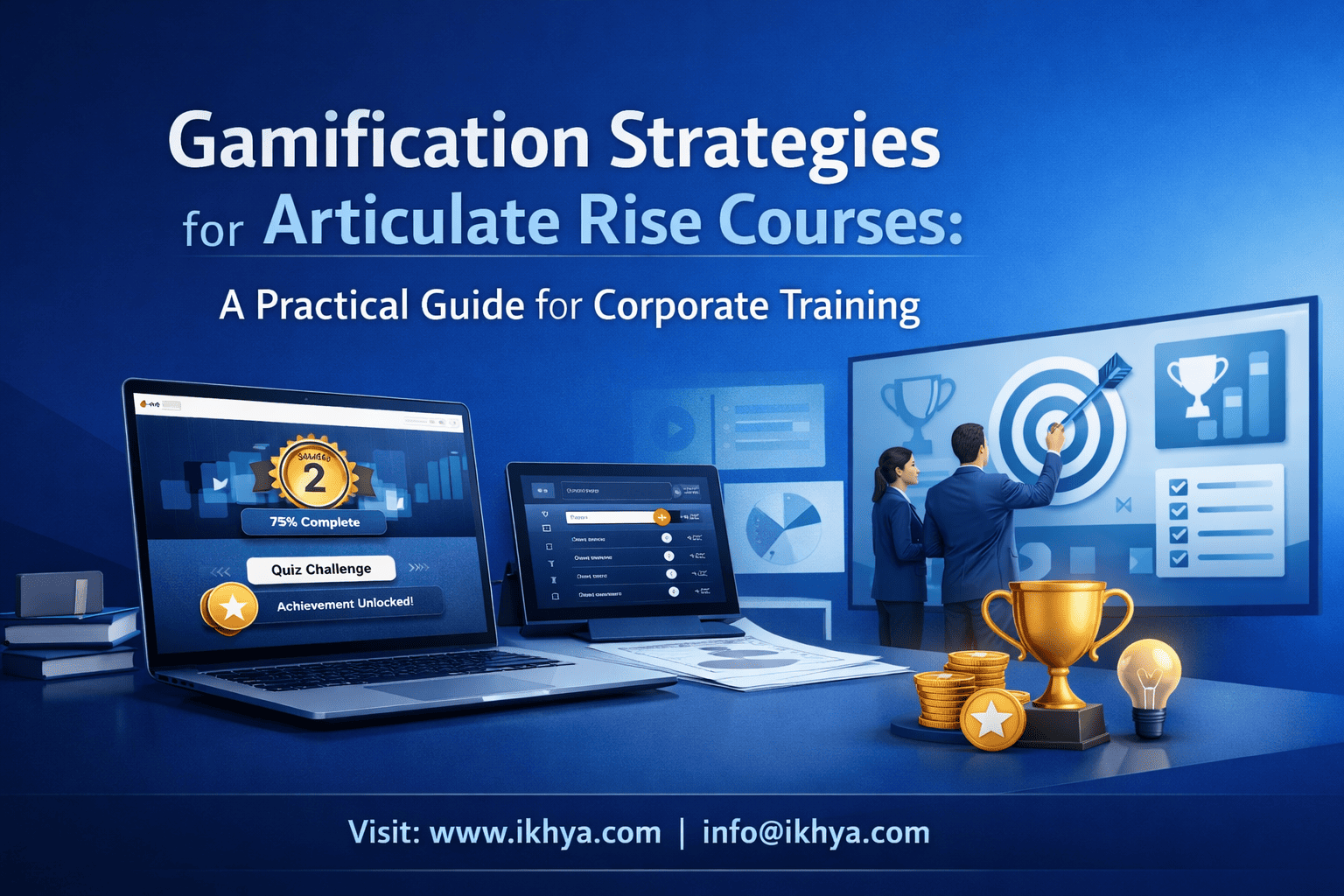
Corporate training often fails for one simple reason—learners disengage quickly. Static slides, long modules, and passive learning reduce completion rates. This is where gamification strategies for Articulate Rise courses become critical. By integrating game-like elements into Rise 360, you can transform dull content into engaging, results-driven learning experiences.
If you’re looking to improve learner engagement or modernize your training, exploring interactive eLearning approaches through a book a free eLearning demo can help you understand what works before implementation.
What Is Gamification in Articulate Rise?
Gamification in Articulate Rise means adding game-like mechanics—such as challenges, rewards, and progression—into learning content to boost engagement and retention. While Rise 360 doesn’t offer complex game engines like Storyline, it allows smart use of its blocks to simulate gamified experiences effectively.
In simple terms, it’s about making learning feel like progression, achievement, and interaction, not just content consumption.
Key Elements of Gamification in Rise
- Progress Tracking: Visual lesson completion indicators
- Knowledge Checks: Quizzes that reinforce learning
- Scenario Blocks: Decision-based learning paths
- Rewards Simulation: Badges, completion messages
- Microlearning Flow: Bite-sized challenges
If you want to understand how Rise structures courses for such strategies, reviewing the Articulate Rise 360 course structure is a great starting point.
How Rise Enables Gamification (Despite Limitations)
Articulate Rise is not a full-fledged game engine—but it supports lightweight gamification through design strategy:
- Use lesson sequencing to simulate levels
- Use quiz blocks as checkpoints
- Use scenarios for decision-based gameplay
- Use labels and completion triggers as rewards
For organizations scaling training programs, leveraging Articulate Rise development services helps implement structured gamification effectively.
Why This Matters
Without gamification:
- Completion rates drop below 40–60%
- Learners skim instead of engaging
- Knowledge retention declines
With gamification:
- Engagement increases significantly
- Learners interact more deeply
- Training outcomes improve measurably
Quick Example
| Traditional Approach | Gamified Approach |
|---|---|
| 30 slides of policy text | Scenario-based decisions |
| Final quiz only | Quizzes after each level |
| No interaction | Unlock next module after passing |
Where Most Teams Go Wrong
- Treating gamification as decoration, not strategy
- Overusing quizzes without engagement logic
- Ignoring learner motivation
To avoid these issues, aligning gamification with strong instructional design—like instructional design services—is essential.
When Should You Use Gamification in Rise?
Gamification works best when:
- You need behavior change (compliance, safety)
- Training is long or complex
- Learners show low engagement rates
- You want to improve completion metrics
For example, organizations converting classroom sessions into interactive formats often combine gamification with rapid conversion of instructor-led training to Articulate Rise eLearning to boost effectiveness.
Why Gamification Matters in Corporate Training
Gamification is not just a design trend—it directly impacts learner engagement, completion rates, and business outcomes. In corporate environments, where training is often mandatory, gamification helps convert passive learners into active participants.
When implemented correctly in Articulate Rise, gamification can improve both learning effectiveness and ROI.
The Real Business Impact of Gamification
Organizations that integrate gamification into eLearning typically see:
- 40–60% higher course completion rates
- Increased learner engagement time
- Better knowledge retention (up to 30–40%)
- Improved on-the-job performance
This is especially critical for compliance-heavy industries where engagement directly affects risk.
If your current training is not delivering these results, it may be time to explore custom eLearning development services that integrate gamification strategically.
Why Traditional Training Fails
Most corporate training programs struggle because they:
- Deliver information without interaction
- Lack motivation triggers
- Do not provide immediate feedback
- Fail to create a sense of progress or achievement
Gamification solves these issues by introducing:
- Clear goals
- Instant rewards
- Interactive decision-making
- Progress visibility
Psychological Drivers Behind Gamification
Gamification works because it taps into human behavior:
| Driver | How It Works in Rise |
|---|---|
| Achievement | Completion badges, milestones |
| Competition | Leaderboard simulation (via LMS) |
| Curiosity | Scenario-based branching |
| Reward | Feedback + unlock progression |
These elements create a dopamine-driven learning loop, encouraging learners to continue.
Example: Compliance Training Transformation
Before Gamification:
- 60-minute static module
- Single final assessment
- Low engagement
After Gamification:
- Broken into microlearning levels
- Scenario-based decision paths
- Quiz checkpoints after each section
- “Unlock next level” logic
Result:
- Completion rate increased from 52% → 85%
- Assessment scores improved significantly
To design such experiences effectively, combining gamification with structured microlearning design is often the most scalable approach.
Where Gamification Delivers Maximum ROI
Gamification is especially effective in:
1. Compliance Training
- Anti-money laundering
- Workplace safety
- Data protection
For these use cases, organizations often integrate gamification into compliance training eLearning solutions to ensure both engagement and audit readiness.
2. Employee Onboarding
- Culture training
- Process understanding
- Role-based learning
Gamification helps new hires progress step-by-step instead of being overwhelmed.
3. Product & Sales Training
- Product simulations
- Customer scenarios
- Decision-based selling
Gamified scenarios allow learners to practice without real-world risk.
4. Technical Training (IT / Software)
- System walkthroughs
- Tool simulations
- Troubleshooting paths
Interactive elements significantly improve hands-on learning retention.
When Gamification Might Not Be Necessary
It’s important to stay strategic. Gamification is not always required.
Avoid overusing it when:
- Content is very short (5–10 min)
- Training is purely informational
- Audience prefers quick reference material
In such cases, a better approach may be rapid eLearning development using Storyline and Rise 360, where interaction is minimal but effective.
Key Takeaway
Gamification is not about adding “fun”—it’s about driving measurable learning outcomes.
- It improves engagement
- It increases retention
- It supports behavior change
When aligned with business goals, it becomes a performance tool, not just a design feature.
Key Gamification Elements You Can Use in Articulate Rise 360
Gamification in Articulate Rise is built through smart use of existing blocks and learning flow design, not complex coding. By combining quizzes, scenarios, and progression logic, you can simulate a highly engaging learning experience.
The key is to map game mechanics to learning outcomes, not just add interaction randomly.
1. Progress-Based Learning (Level System)
This is the simplest and most effective gamification technique in Rise.
You can structure your course like:
- Level 1 → Basics
- Level 2 → Intermediate
- Level 3 → Advanced
Each lesson acts like a game level, where learners must complete one before unlocking the next.
How to implement in Rise:
- Use lesson sequencing
- Enable “complete lesson” triggers
- Use section dividers as level indicators
This approach works especially well in structured programs like Articulate Rise course development services for corporate training teams where scalability matters.
2. Knowledge Checks as Checkpoints
Instead of placing one final quiz, break it into multiple checkpoints.
- Add quizzes after each module
- Use immediate feedback
- Require passing score to continue
This creates a continuous engagement loop, similar to clearing stages in a game.
For advanced interactivity, some organizations combine Rise with eLearning simulation-based training services to enhance realism.
3. Scenario-Based Decision Making
Scenarios are one of the most powerful gamification tools in Rise.
They simulate:
- Real-life decisions
- Consequences
- Branching outcomes
Example:
A healthcare compliance course:
- Learner chooses how to respond to a patient
- Each decision leads to a different outcome
This creates learning through experience, not just reading.
You can explore deeper implementations through scenario-based learning in Articulate Rise.
4. Unlockable Content (Gated Learning)
This technique mimics game progression.
- Lock advanced modules
- Require quiz completion
- Use “continue” buttons strategically
Learners feel a sense of achievement and progression.
This is particularly useful in structured enterprise programs involving global training deployment and localization.
5. Rewards and Recognition (Simulated Badges)
Rise doesn’t have built-in badge systems, but you can simulate them using:
- Completion messages
- Visual graphics (badge images)
- “Congratulations” screens
Example:
- “You’ve completed Level 2 – Safety Champion”
For large-scale programs, integrating this with LMS tracking ensures learner achievements are properly recorded.
6. Microlearning Challenges
Break content into small, challenge-based lessons:
- 3–5 minute modules
- One objective per lesson
- One challenge per module
This creates a bite-sized progression system, similar to mobile games.
For implementation at scale, many organizations rely on microlearning development services to design structured learning paths.
7. Story-Based Learning (Narrative Gamification)
Instead of isolated modules, build a continuous story:
- A character guides the learner
- Each lesson advances the storyline
- Decisions affect outcomes
This increases emotional engagement, which improves retention.
8. Timer-Based Challenges (Optional)
Although Rise has limitations, you can simulate urgency by:
- Adding time-based instructions
- Using scenario pacing
- Creating quick decision prompts
This works well in:
- Sales training
- Customer support simulations
9. Leaderboard Simulation (Through LMS)
Rise itself doesn’t support leaderboards, but you can:
- Track scores via LMS
- Display rankings externally
- Encourage friendly competition
Organizations using advanced tracking often combine this with expert eLearning consultancy to align analytics with business goals.
10. Immediate Feedback Loops
One of the most underrated gamification elements.
- Provide feedback after every action
- Explain why answers are correct/incorrect
- Reinforce learning instantly
This keeps learners engaged and informed continuously.
11. Visual Progress Indicators
Use:
- Progress bars
- Section labels
- Milestone messages
These create a sense of forward movement, which is critical for motivation.
12. Interactive Blocks for Engagement
Rise offers several blocks that can be gamified:
- Accordion → reveal-based learning
- Tabs → exploration
- Flashcards → memory challenges
- Labeled graphics → discovery learning
When used correctly, these become mini-game interactions.
For modern responsive experiences, aligning this with mobile learning development solutions ensures accessibility across devices.
Gamification in Rise is not about adding “game features”—it’s about:
- Structuring content as a journey
- Creating decision-based learning
- Providing continuous feedback and rewards
When these elements are combined, even a simple Rise course can feel like a dynamic learning experience.
Step-by-Step Framework to Gamify Articulate Rise Courses
Gamifying an Articulate Rise course is not about adding random interactions—it requires a structured design approach that aligns learning objectives with engagement mechanics. A well-designed framework ensures that gamification drives real business outcomes, not just visual appeal.
Below is a practical, execution-ready framework used by corporate training teams.
Step 1: Define Clear Learning Objectives
Start by identifying what learners must do differently after training.
Avoid vague goals like:
- “Understand compliance policies”
Instead, define measurable outcomes:
- “Identify and respond correctly to compliance violations”
This ensures gamification is tied to behavior change, not just engagement.
For organizations building structured programs, aligning objectives with instructional design best practices for Articulate Rise ensures consistency.
Step 2: Identify Gamification Opportunities
Not all content needs gamification. Focus on:
- Complex decision-making areas
- High-risk topics (compliance, safety)
- Low-engagement training modules
Ask:
- Where do learners lose interest?
- Where can decisions be simulated?
This step helps prioritize high-impact gamification zones.
Step 3: Design the Learner Journey (Game Flow)
Think of your course as a game journey:
| Stage | Learning Equivalent |
|---|---|
| Level 1 | Introduction |
| Level 2 | Core concepts |
| Level 3 | Application |
| Final Level | Assessment |
Map:
- Entry point
- Progression path
- Completion milestone
This creates a clear learning progression system.
Step 4: Select the Right Rise Blocks
Now translate your strategy into Rise components:
- Scenario blocks → decision-making
- Quiz blocks → checkpoints
- Accordion/tabs → exploration
- Flashcards → reinforcement
The key is to match the right block to the right learning behavior.
For advanced implementations, teams often combine this with interactive eLearning development strategies using Articulate Rise.
Step 5: Add Progression & Unlock Logic
Gamification works best when learners feel they are moving forward.
Implement:
- Sequential lesson completion
- Mandatory quiz passing
- Section-based progression
This creates:
- Motivation
- Accountability
- Achievement
Step 6: Integrate Feedback & Rewards
Every learner action should trigger feedback.
- Correct answer → reinforcement
- Incorrect answer → explanation
- Module completion → recognition
You can simulate rewards using:
- Visual badges
- Completion messages
- Progress indicators
For enterprise-level tracking, integrating with LMS-compatible eLearning course development services ensures these actions are measurable.
Step 7: Test with Real Users
Before full rollout:
- Conduct pilot testing
- Track engagement metrics
- Collect learner feedback
Check:
- Are learners completing modules?
- Are they interacting or skipping?
- Are scores improving?
This step ensures your gamification is effective, not just attractive.
Step 8: Optimize Using LMS Analytics
Post-launch, use LMS data to refine:
- Completion rates
- Time spent per module
- Quiz performance
Standards like SCORM and xAPI help track:
- Learner behavior
- Interaction patterns
- Performance trends
Organizations aiming for deeper analytics often rely on eLearning consultancy services to optimize performance.
Example Implementation (Real-World Scenario)
Industry: Manufacturing Safety Training
Objective: Reduce workplace incidents
Gamification Strategy:
- Level-based modules (machine safety stages)
- Scenario-based hazard identification
- Quiz checkpoints after each section
- Final “Safety Certification” badge
Timeline Example
| Phase | Duration |
|---|---|
| Content structuring | 3–4 days |
| Gamification design | 4–5 days |
| Development in Rise | 5–7 days |
| Testing & deployment | 2–3 days |
Total: ~2–3 weeks
Cost Scenario
| Complexity Level | Estimated Cost |
|---|---|
| Basic gamification | $1,000 – $3,000 |
| Moderate | $3,000 – $6,000 |
| Advanced (scenarios + LMS integration) | $6,000 – $10,000 |
Costs vary depending on:
- Interactivity level
- Number of modules
- LMS integration requirements
Organizations often evaluate this alongside in-house vs outsourced eLearning development cost comparison to make informed decisions.
Common Mistake in Execution
- Starting with tools instead of strategy
- Overloading with interactions
- Ignoring learner journey
Key Takeaway
A successful gamified Rise course follows this logic:
Objective → Engagement Strategy → Learning Flow → Interaction → Feedback → Optimization
When this framework is applied correctly, gamification becomes a performance driver, not just a design layer.
12+ Proven Gamification Strategies for Articulate Rise Courses
Gamification becomes powerful when you apply specific, repeatable strategies—not just isolated interactions. Below are proven techniques that work effectively within Articulate Rise, especially in corporate training environments.
Each strategy is practical, scalable, and aligned with real business outcomes.
1. Scenario-Based Learning Paths
Instead of linear content, create decision-driven experiences.
- Present real-world situations
- Let learners choose actions
- Show consequences instantly
Example:
In finance training, learners decide how to handle suspicious transactions.
To implement deeper simulations, many teams extend this approach using eLearning simulation-based training services.
2. Level-Based Course Structure
Turn your course into progressive levels:
- Level 1 → Basics
- Level 2 → Application
- Level 3 → Mastery
Each level should:
- Introduce new complexity
- Require completion before moving forward
This works well in structured programs like Articulate Rise eLearning development for manufacturing training.
3. Unlock-Based Progression
Create a sense of achievement by locking content:
- Complete quiz → unlock next module
- Finish scenario → access advanced content
This mimics game progression mechanics and increases motivation.
4. Microlearning Challenge Series
Break content into small challenges:
- One topic = one challenge
- Short lessons (3–5 minutes)
- Immediate feedback
This is especially effective when aligned with how to build microlearning courses using Articulate Rise.
5. Points-Based Learning System (Simulated)
While Rise doesn’t natively support points, you can simulate it:
- Assign “points” per module
- Show cumulative score at milestones
- Use messaging like “You earned 50 points”
When integrated with LMS tracking, this becomes measurable via LMS-compatible eLearning course development services.
6. Badge-Based Recognition
Create a reward system using:
- Visual badges
- Completion certificates
- Milestone screens
Example:
- “Compliance Champion”
- “Safety Expert”
This is highly effective in compliance-driven environments like healthcare compliance training eLearning case study.
7. Story-Driven Learning (Narrative Gamification)
Build a continuous storyline:
- A character guides the learner
- Each module continues the story
- Decisions impact outcomes
This increases emotional engagement and retention.
8. Timed Decision Challenges
Introduce urgency:
- “You have 30 seconds to respond”
- Quick decision scenarios
Works well in:
- Customer service training
- Sales simulations
9. Interactive Exploration (Discovery Learning)
Use Rise blocks like:
- Labeled graphics
- Tabs
- Accordions
Turn them into exploration-based challenges:
- “Find the risk in this image”
- “Identify the correct process step”
10. Progressive Difficulty Model
Start simple, then increase complexity:
- Easy → Medium → Advanced
- Basic quiz → Scenario → Multi-step decision
This creates a learning curve similar to games.
11. Immediate Feedback Reinforcement
Every action should trigger:
- Instant feedback
- Explanation
- Reinforcement
This helps learners:
- Correct mistakes quickly
- Understand concepts deeply
12. Real-World Simulation Flow
Combine multiple strategies:
- Scenario → decision → feedback → next scenario
This creates a loop-based learning system.
Organizations often build such experiences using interactive eLearning development using Articulate Rise to ensure realism.
13. Leaderboard Integration (Advanced)
Although not native to Rise:
- Use LMS to track scores
- Display rankings externally
- Encourage competition
This is effective in:
- Sales teams
- Performance-driven roles
Industry-Wise Application Examples
Healthcare
- Patient handling scenarios
- Compliance decision paths
- Certification-based gamification
Manufacturing
- Safety hazard identification
- Equipment operation simulations
- Step-by-step risk challenges
Finance
- Fraud detection scenarios
- Regulatory compliance quizzes
- Decision-based workflows
Retail
- Customer interaction simulations
- Sales objection handling
- Product knowledge challenges
IT / Software
- Troubleshooting scenarios
- System navigation simulations
- Debugging challenges
Key Insight
The most effective gamification strategies:
- Focus on decision-making, not decoration
- Create progression and reward loops
- Align with real-world job tasks
When applied correctly, these strategies turn Rise courses into performance-driven learning systems.
Real-World Use Cases of Gamification in Articulate Rise (Across Industries)
Gamification delivers the highest impact when it is aligned with real business challenges and industry-specific learning needs. Below are practical, real-world scenarios showing how organizations apply gamification in Articulate Rise to solve actual problems—not just improve engagement.
Healthcare Training: Improving Compliance & Patient Safety
Gamification in healthcare focuses on decision accuracy and risk reduction.
Use Case:
A hospital needed to train staff on patient data privacy (HIPAA-like compliance).
Gamified Approach:
- Scenario-based patient interactions
- Decision checkpoints after each case
- “Correct vs Incorrect” consequence feedback
- Final certification badge
Outcome:
- Completion rates increased from 58% → 88%
- Error rates in assessments reduced significantly
Organizations often implement such programs using healthcare training eLearning solutions to ensure compliance alignment.
Manufacturing Training: Reducing Workplace Incidents
Manufacturing training benefits from simulation-driven gamification.
Use Case:
A factory wanted to reduce machine-related accidents.
Gamified Approach:
- Hazard identification challenges
- “Spot the risk” interactive images
- Step-by-step machine operation levels
- Unlock-based progression
Outcome:
- Incident reports reduced by ~25%
- Faster onboarding of new workers
This is commonly implemented through manufacturing training eLearning solutions for scalable deployment.
Financial Services: Fraud Detection & Compliance
Finance training requires accuracy and critical thinking.
Use Case:
A banking organization needed AML (Anti-Money Laundering) training.
Gamified Approach:
- Real transaction scenarios
- Decision-based branching paths
- Risk scoring system
- Timed decision challenges
Outcome:
- Improved detection accuracy in simulations
- Higher assessment scores
These programs are often aligned with financial services training eLearning solutions.
Retail Training: Enhancing Customer Experience
Retail training benefits from behavior-based gamification.
Use Case:
A retail chain wanted to improve customer interaction quality.
Gamified Approach:
- Role-play scenarios (customer objections)
- Points for correct responses
- Leaderboard via LMS
- Story-driven sales journey
Outcome:
- Increased sales conversion rates
- Better customer satisfaction scores
Many companies implement this through retail training eLearning solutions.
IT & Software Training: Improving Technical Skills
Technical training requires hands-on, decision-based learning.
Use Case:
An IT company needed to train employees on a new software system.
Gamified Approach:
- Step-by-step system simulations
- Troubleshooting challenges
- Progressive difficulty levels
- Scenario-based debugging
Outcome:
- Faster system adoption
- Reduced support tickets
Oil & Gas Training: Safety-Critical Learning
High-risk industries benefit from immersive gamification.
Use Case:
Training workers on safety protocols in hazardous environments.
Gamified Approach:
- Emergency response scenarios
- Time-based decision-making
- Risk consequence simulations
- Certification-based progression
These are typically implemented via oil & gas training eLearning solutions.
Example: End-to-End Gamified Course Flow
Here’s how a typical gamified Rise course looks in practice:
| Stage | Gamification Element | Purpose |
|---|---|---|
| Introduction | Story setup | Engagement |
| Level 1 | Basic quiz | Knowledge check |
| Level 2 | Scenario | Decision-making |
| Level 3 | Challenge | Skill application |
| Final | Assessment + badge | Validation |
Timeline Example (Enterprise Deployment)
Rapid Model (2 Weeks)
- Day 1–3 → Content structuring
- Day 4–6 → Gamification design
- Day 7–10 → Development in Rise
- Day 11–14 → Testing & LMS deployment
Advanced Model (4–6 Weeks)
- Week 1 → Strategy + storyboarding
- Week 2–3 → Scenario development
- Week 4 → Course build
- Week 5 → QA + revisions
- Week 6 → Deployment + analytics setup
For large-scale rollouts, organizations often rely on global training deployment using Articulate Rise development and localization.
Cost Scenarios (Realistic Estimates)
| Project Type | Cost Range |
|---|---|
| Basic gamification | $1,000 – $3,000 |
| Scenario-based course | $3,000 – $6,000 |
| Advanced gamified program | $6,000 – $10,000+ |
Factors affecting cost:
- Number of modules
- Level of interactivity
- LMS integration
- Localization needs
Key Insight
Gamification is not one-size-fits-all.
- Healthcare → Accuracy & compliance
- Manufacturing → Safety & risk awareness
- Finance → Decision precision
- Retail → Behavioral training
- IT → Skill-based learning
The most successful organizations customize gamification based on industry needs, not just trends.
Articulate Rise vs Storyline for Gamification: Which Should You Choose?
Choosing between Articulate Rise and Storyline for gamification depends on complexity, interactivity needs, and business goals. Rise is fast and scalable, while Storyline enables advanced, game-like experiences.
The right decision is not about the tool—it’s about what level of gamification your training actually requires.
Quick Comparison: Rise vs Storyline
| Feature | Articulate Rise | Articulate Storyline |
|---|---|---|
| Development Speed | Very fast | Moderate to slow |
| Gamification Level | Basic to moderate | Advanced |
| Interactivity | Pre-built blocks | Fully customizable |
| Scenarios | Limited branching | Complex branching |
| Mobile Responsiveness | Built-in | Requires design effort |
| Cost | Lower | Higher |
For organizations evaluating both tools, understanding the difference through Articulate Rise vs Storyline which should you use for corporate training helps clarify decision-making.
When Articulate Rise Is Enough
Rise works best when you need light to moderate gamification with speed and scalability.
Ideal Use Cases
- Compliance training
- Employee onboarding
- Product knowledge modules
- Microlearning programs
Why Choose Rise
- Faster development timelines (2–4 weeks)
- Easy updates and scalability
- Mobile-first design
- Lower cost
For rapid deployment scenarios, many organizations rely on rapid eLearning development using Articulate Rise.
Example Scenario
Compliance Training (Rise):
- Scenario-based questions
- Quiz checkpoints
- Level progression
- Completion badges
This delivers effective engagement without complex development.
When You Need Articulate Storyline
Storyline is required when gamification becomes highly interactive or simulation-heavy.
Ideal Use Cases
- Software simulations
- Game-based learning modules
- Complex branching scenarios
- Drag-and-drop challenges
- Leaderboards and scoring systems
Why Choose Storyline
- Full control over interactions
- Advanced animations
- Custom variables and logic
- True game-like experiences
Organizations building advanced gamified solutions often leverage Articulate Storyline development services for flexibility.
Example Scenario
Sales Training (Storyline):
- Multi-path decision tree
- Score-based outcomes
- Real-time feedback loops
- Competitive scoring
This creates a near-game environment, which Rise alone cannot fully replicate.
Hybrid Approach: Best of Both Worlds
Many enterprises combine both tools:
- Rise → Core content + structure
- Storyline → Advanced interactions embedded inside Rise
This approach provides:
- Speed + scalability (Rise)
- Deep engagement (Storyline)
For such blended strategies, teams often adopt modernizing corporate training using Articulate Storyline and Rise development.
Decision Framework
Use this quick framework:
Choose Rise if:
- You need fast delivery
- Gamification is moderate
- Budget is limited
- Content is mostly informational + interactive
Choose Storyline if:
- You need advanced game mechanics
- Training requires deep simulations
- You want custom interactions
- Budget and timeline allow
Cost Comparison Insight
| Tool | Typical Cost Range |
|---|---|
| Rise (Gamified Course) | $1,000 – $5,000 |
| Storyline (Advanced Gamification) | $5,000 – $15,000+ |
Common Mistake
Many organizations:
- Overuse Storyline for simple training
- Or underuse it when advanced gamification is required
The result:
- Either wasted budget
- Or poor learner engagement
Key Takeaway
- Use Rise for speed, scalability, and structured gamification
- Use Storyline for immersive, high-end gamified experiences
- Combine both for enterprise-level training programs
If you’re unsure which approach fits your training goals, getting expert input through a request for eLearning proposal can help you evaluate cost, timeline, and tool selection.
LMS Integration, SCORM, xAPI & Analytics for Gamified Rise Courses
Gamification is only effective if you can measure its impact. That’s where LMS integration, SCORM, and xAPI come in. They allow you to track learner behavior, engagement, and performance—turning gamified learning into data-driven training.
Without proper tracking, gamification becomes guesswork. With it, it becomes a performance optimization tool.
What You Can Track in Gamified Rise Courses
When your Rise course is integrated with an LMS, you can monitor:
- Course completion rates
- Time spent per module
- Quiz scores and attempts
- Interaction frequency
- Drop-off points
These insights help you understand:
- Where learners struggle
- Which gamification elements work
- How to improve course design
For organizations building scalable tracking systems, LMS-compatible eLearning course development services ensure smooth integration.
SCORM vs xAPI: What’s the Difference?
Both SCORM and xAPI are standards used to track learning data—but they differ in capability.
SCORM (Sharable Content Object Reference Model)
- Tracks:
- Completion status
- Scores
- Basic progress
- Best for:
- Compliance training
- Standard reporting
- Limitation:
- Cannot track detailed learner behavior
xAPI (Experience API)
- Tracks:
- Every learner action
- Scenario decisions
- Time spent on interactions
- Learning paths
- Best for:
- Advanced gamification
- Behavior analysis
- Personalized learning
Comparison Table
| Feature | SCORM | xAPI |
|---|---|---|
| Completion Tracking | Yes | Yes |
| Quiz Scores | Yes | Yes |
| Interaction Tracking | Limited | Advanced |
| Offline Learning Data | No | Yes |
| Behavior Analytics | No | Yes |
How Gamification Benefits from xAPI
Gamification relies heavily on behavior tracking, and xAPI enables:
- Tracking every decision in a scenario
- Measuring engagement with interactive elements
- Identifying learning patterns
- Personalizing future learning paths
Example:
- Which option learners choose in a compliance scenario
- How long they take to respond
- Whether they improve over time
This turns gamification into a continuous improvement system.
Organizations looking to implement this level of tracking often consult eLearning consultancy services for strategy and setup.
Key Metrics to Measure Gamification Success
To evaluate effectiveness, track:
1. Engagement Metrics
- Time spent per lesson
- Interaction rate
- Revisit frequency
2. Performance Metrics
- Quiz scores
- Attempt counts
- Pass/fail rates
3. Behavioral Metrics
- Scenario decision accuracy
- Learning path choices
- Drop-off points
Example: Analytics in Action
Scenario: Compliance Training
Before Gamification:
- Completion rate: 55%
- Average score: 65%
After Gamification + Analytics:
- Completion rate: 87%
- Average score: 82%
- Time spent increased (higher engagement)
Insights:
- Learners struggled in Module 2 → redesigned
- Scenario questions improved retention
How to Optimize Using LMS Data (Step-by-Step)
Step 1: Identify Drop-Off Points
- Where are learners leaving the course?
Step 2: Analyze Engagement
- Which sections have low interaction?
Step 3: Improve Weak Areas
- Add scenarios
- Break content into microlearning
Step 4: Test Again
- Relaunch updated version
- Compare metrics
Global Deployment Considerations
For organizations operating across regions (USA, UK, UAE, AUS):
- Ensure LMS supports SCORM/xAPI
- Localize gamification elements
- Track performance across regions
For large-scale implementation, global training deployment ensures consistency and scalability.
Common Mistakes to Avoid
- Tracking only completion rates
- Ignoring behavioral data
- Not updating courses based on analytics
- Using SCORM when xAPI is needed
Key Takeaway
- Gamification without analytics = guesswork
- Gamification with LMS tracking = measurable performance improvement
To truly benefit, organizations must:
- Track data
- Analyze behavior
- Continuously optimize
Common Mistakes in Gamified Articulate Rise Courses (and How to Avoid Them)
Gamification can significantly improve learning outcomes—but when implemented incorrectly, it can confuse learners, waste budget, and reduce effectiveness. Many organizations fail not because of the tool, but because of poor strategy.
Understanding these common mistakes helps you build high-impact, performance-driven courses.
1. Treating Gamification as Decoration
One of the biggest mistakes is adding gamification elements just for visual appeal.
Problem:
- Random quizzes
- Unnecessary interactions
- No link to learning objectives
Solution:
- Every gamified element must support a learning outcome
- Tie interactions directly to behavior change
To ensure alignment, following structured approaches like instructional design services is critical.
2. Overloading the Course with Interactions
More interaction does NOT mean better engagement.
Problem:
- Too many clicks
- Cognitive overload
- Learner fatigue
Solution:
- Use interaction only where it adds value
- Keep the experience smooth and intuitive
3. Ignoring the Learner Journey
Many courses lack a clear progression system.
Problem:
- No sense of levels or milestones
- Learners feel lost
- No motivation to continue
Solution:
- Design a clear progression path
- Use levels, checkpoints, and completion triggers
4. Poor Scenario Design
Scenarios are powerful—but only when realistic.
Problem:
- Unrealistic situations
- Obvious answers
- No real consequences
Solution:
- Use real-world cases
- Add meaningful consequences
- Reflect actual job challenges
For better execution, teams often follow proven scenario-based learning practices in Articulate Rise.
5. Lack of Feedback Mechanisms
Gamification without feedback fails quickly.
Problem:
- Learners don’t know why they’re wrong
- No reinforcement of correct behavior
Solution:
- Provide instant, meaningful feedback
- Explain both correct and incorrect answers
6. No Performance Tracking
Many organizations launch gamified courses without measuring success.
Problem:
- No data on engagement
- No improvement strategy
Solution:
- Integrate with LMS
- Track SCORM/xAPI data
- Optimize based on insights
If you’re unsure how to implement this, eLearning consultancy services can help define tracking strategies.
7. Using the Wrong Tool for the Job
Trying to build complex gamification in Rise can limit effectiveness.
Problem:
- Overcomplicated designs in Rise
- Poor user experience
Solution:
- Use Rise for moderate gamification
- Use Storyline for advanced simulations
8. Ignoring Mobile Learning Experience
Rise is mobile-friendly—but poor design can still break the experience.
Problem:
- Long text blocks
- Difficult interactions on small screens
Solution:
- Design for mobile-first learning
- Use short modules and simple interactions
For optimized experiences, aligning with mobile learning development solutions is important.
9. No Alignment with Business Goals
Gamification should solve business problems—not just improve engagement.
Problem:
- No link to performance metrics
- No measurable ROI
Solution:
- Define clear KPIs:
- Completion rates
- Performance improvement
- Behavior change
10. One-Size-Fits-All Approach
Different industries need different strategies.
Problem:
- Same gamification for all training types
Solution:
- Customize based on:
- Industry
- Learner profile
- Training objective
For example, compliance training requires different strategies than onboarding or sales training.
Quick Checklist for Success
Before launching your gamified Rise course, check:
- Are objectives clearly defined?
- Is there a structured learner journey?
- Are interactions meaningful?
- Is feedback provided instantly?
- Is performance being tracked?
If the answer is “no” to any of these, refinement is needed.
Key Takeaway
Gamification fails when it is:
- Random
- Overloaded
- Unmeasured
It succeeds when it is:
- Strategic
- Structured
- Data-driven
When to Outsource Gamified eLearning Development
Outsourcing gamified Articulate Rise development becomes the right move when internal bandwidth, expertise, or timelines are limited. It allows organizations to deliver high-quality, engaging training without slowing down business operations.
Instead of struggling with tools and strategy, outsourcing ensures faster delivery, better design, and measurable results.
Clear Signs You Should Outsource
You should consider outsourcing when:
- Your internal team lacks gamification expertise
- You need to deliver training within tight deadlines (2–4 weeks)
- Your courses require advanced scenarios or interactivity
- You are scaling training across multiple regions or teams
- Your current courses have low engagement or completion rates
In such cases, leveraging custom eLearning development services helps bridge both skill and execution gaps.
In-House vs Outsourcing: Quick Comparison
| Factor | In-House Team | Outsourcing |
|---|---|---|
| Cost | Fixed (salary, tools) | Variable (project-based) |
| Speed | Slower (resource constraints) | Faster (dedicated team) |
| Expertise | Limited | Specialized |
| Scalability | Low | High |
Organizations often evaluate this using in-house vs outsourced eLearning development cost comparison before making a decision.
What You Gain by Outsourcing
Outsourcing is not just about saving time—it’s about improving quality and outcomes.
1. Instructional Design Expertise
- Structured gamification frameworks
- Learning psychology integration
2. Faster Turnaround
- Parallel development workflows
- Pre-built templates and assets
3. Better Learner Experience
- Professional UI/UX
- Optimized interaction design
4. Scalability
- Multi-language deployment
- Multi-industry adaptation
For large-scale initiatives, companies often partner with teams offering reliable Articulate Rise development partner for long-term projects.
How to Choose the Right eLearning Vendor
Choosing the right vendor directly impacts project success, cost, and learner outcomes. A wrong choice can lead to delays, poor quality, and ineffective training.
Vendor Evaluation Framework
Use this structured approach:
1. Experience in Gamification
- Have they built gamified Rise courses before?
- Can they show real examples?
2. Industry Expertise
- Do they understand your industry (healthcare, finance, manufacturing)?
- Can they design relevant scenarios?
3. Technical Capability
- Expertise in Rise + Storyline
- LMS integration (SCORM, xAPI)
4. Instructional Design Strength
- Do they follow structured learning frameworks?
- Can they align with business goals?
5. Scalability & Support
- Can they handle large deployments?
- Do they offer post-launch support?
To streamline vendor selection, many organizations follow how to choose the eLearning vendor guidelines.
Questions You Should Ask Before Hiring
- How do you approach gamification in Rise?
- Can you share case studies with measurable results?
- What is your typical project timeline?
- How do you ensure LMS compatibility?
- What is your revision and feedback process?
Red Flags to Avoid
- No clear gamification strategy
- Overpromising timelines
- Lack of real project examples
- Poor communication process
Example: Outsourcing Scenario
Company: Retail Enterprise
Challenge:
Low engagement in product training
Solution:
Outsourced gamified Rise development
Implementation:
- Scenario-based sales training
- Level progression system
- LMS leaderboard integration
Result:
- 2x increase in engagement
- Improved sales conversion
Cost Perspective: Outsourcing vs In-House
| Scenario | Estimated Cost |
|---|---|
| In-house (team + tools) | $8,000–$15,000/month |
| Outsourced project | $3,000–$10,000 |
Key Takeaway
Outsourcing is ideal when you need:
- Speed
- Expertise
- Scalability
- Better learning outcomes
It allows your internal team to focus on strategy, while experts handle execution.
If you’re planning a gamified training project and want clarity on scope, timeline, and cost, you can contact eLearning experts to discuss your requirements.
Future Trends: AI-Driven Gamification and Adaptive Learning in Rise
Gamification in Articulate Rise is evolving beyond static interactions. With the rise of AI, automation, and data-driven learning, organizations are moving toward adaptive, personalized learning experiences that respond to each learner’s behavior.
The future of gamification is not just engagement—it’s intelligent learning optimization.
1. AI-Powered Personalized Learning Paths
Modern learning systems can adjust content based on:
- Learner performance
- Decision patterns
- Time spent on modules
How it works:
- High-performing learners skip basic levels
- Struggling learners receive additional support
- Content adapts dynamically
This creates a customized gamified journey for every learner.
2. Adaptive Gamification Models
Traditional gamification is linear. Adaptive gamification is dynamic.
Instead of:
- Fixed levels
You get: - Personalized progression paths
Example:
- Learner fails a compliance scenario → gets a simplified scenario
- Learner performs well → moves to advanced challenges
Organizations implementing such models often align them with adaptive learning with variables in Lectora Inspire concepts for deeper personalization.
3. Data-Driven Learning Optimization
With xAPI and analytics, gamification is becoming self-improving.
- Identify weak modules
- Track learner decisions
- Optimize content continuously
This shifts training from:
- Static → Dynamic
- One-time → Continuous improvement
4. AI-Generated Scenarios & Content
AI can now help:
- Generate realistic scenarios
- Create dynamic quizzes
- Personalize feedback
This reduces development time while increasing content relevance.
5. Integration with Performance Systems
Future gamified learning will connect with:
- HR systems
- Performance dashboards
- Skill tracking platforms
This allows organizations to:
- Link training to performance
- Measure real business impact
6. Microlearning + Gamification + AI
The most powerful combination emerging today:
- Microlearning → short, focused content
- Gamification → engagement
- AI → personalization
Together, they create:
- Highly efficient learning systems
- Better retention
- Faster skill development
This approach is already being adopted in programs built with microlearning development services.
7. Global Learning Personalization
For organizations operating across regions (USA, UK, UAE, AUS):
- AI can localize content automatically
- Gamification adapts culturally
- Learning paths vary by region
For large-scale rollouts, combining this with eLearning translation and localization services ensures consistency.
Final Thoughts
Gamification in Articulate Rise is no longer optional—it’s becoming a core strategy for modern corporate training.
When implemented correctly, it delivers:
- Higher engagement
- Better knowledge retention
- Measurable performance improvement
But success depends on:
- Strategy, not just tools
- Real-world application
- Continuous optimization
If you’re planning to build or upgrade gamified training programs, working with an experienced partner like IKHYA – eLearning Solutions Company can help you design scalable, high-impact learning experiences. You can also reach out directly at info@ikhya.com for expert guidance.
For organizations ready to move forward, you can explore your requirements and get structured guidance through a request RFP for eLearning solutions.
FAQs: Gamification in Articulate Rise
1. Can you fully gamify courses in Articulate Rise?
Yes, but only up to a moderate level. For advanced gamification, Storyline is often required.
2. What are the best gamification elements in Rise?
Scenarios, quizzes, progression systems, and feedback loops are the most effective.
3. Is gamification suitable for compliance training?
Yes, it significantly improves engagement and retention in compliance courses.
4. How long does it take to build a gamified Rise course?
Typically 2–6 weeks depending on complexity.
5. What is the cost of gamified eLearning?
Ranges from $1,000 to $10,000+ depending on scope.
6. Does Rise support leaderboards?
Not directly. It requires LMS integration.
7. What is better for gamification: Rise or Storyline?
Rise for basic to moderate, Storyline for advanced.
8. Can gamification improve ROI?
Yes, through better engagement and performance outcomes.
9. What industries benefit most from gamification?
Healthcare, manufacturing, finance, retail, and IT.
10. Is gamification suitable for mobile learning?
Yes, especially with Rise’s responsive design.
11. How do you measure gamification success?
Using LMS analytics, SCORM, and xAPI tracking.
12. What are common mistakes in gamification?
Overuse of interactions, lack of strategy, no tracking.
13. Can gamification be added to existing courses?
Yes, through course redesign and restructuring.
14. What is adaptive learning in gamification?
It personalizes learning paths based on user performance.
15. Do small companies need gamification?
Yes, especially for improving training effectiveness.
16. Is outsourcing gamified eLearning worth it?
Yes, for better quality and faster delivery.r
17. Can AI be used in gamified learning?
Yes, for personalization and content generation.
18. What is microlearning gamification?
Combining short modules with game elements.
19. Does gamification increase completion rates?
Yes, significantly when implemented correctly.
20. What is the first step to start gamification?
Define clear learning objectives and strategy.