

eLearning Localization Companies In Germany
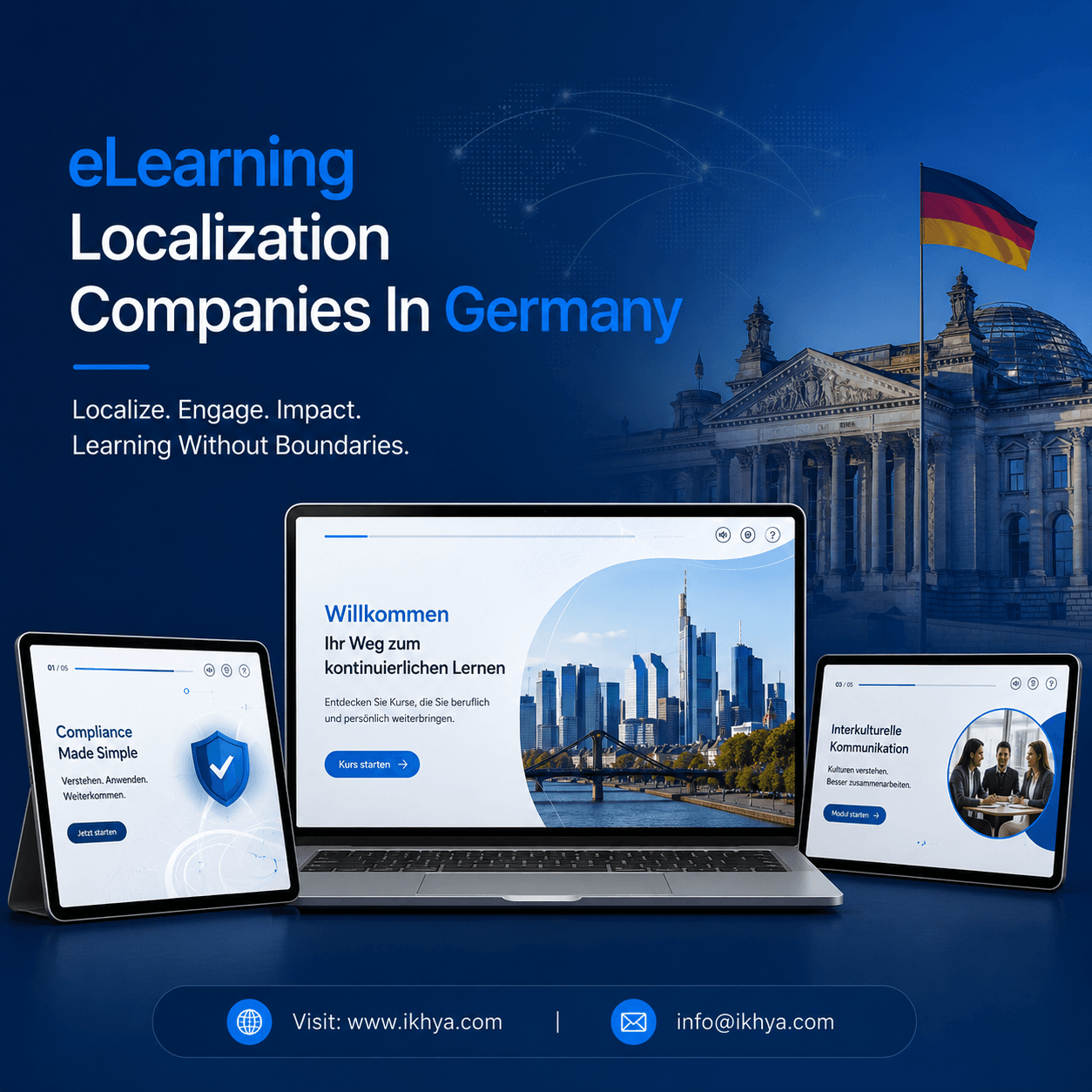
eLearning Localization Companies In Germany play a major role in helping organisations deliver training across multilingual teams, regional offices, and regulated industries. German businesses often need learning content adapted for different languages, legal standards, and workplace cultures. A poor localisation process can confuse learners, reduce completion rates, and create compliance risks across international operations.
Choosing the wrong provider can delay training rollouts, weaken learner engagement, and increase revision costs across distributed teams.
IKHYA helps organisations localise digital learning programmes with structured workflows and responsive support. Contact info@ikhya.com for guidance.
Why German Businesses Are Reworking Their eLearning Localization Strategy
eLearning Localization Companies In Germany are supporting organisations that need training content adapted for multilingual workforces and regional compliance requirements. German businesses operate across manufacturing, finance, healthcare, logistics, and technology sectors where training accuracy matters. A direct translation approach is no longer enough because learners expect content that matches local work culture, terminology, and operational standards.
Many organisations in Germany now deliver training to employees across Europe, the Middle East, and Asia. This creates pressure to maintain consistent learning outcomes in different languages. Companies must also ensure their learning platforms support subtitles, voiceovers, mobile access, and regional reporting requirements.
Training teams also face tight deadlines when onboarding new employees or rolling out compliance updates. Delays in localisation can slow operational readiness and create confusion across departments. Providers that combine instructional design with language adaptation help organisations reduce these risks.
The German market also places strong emphasis on technical accuracy. Manufacturing firms, engineering companies, and healthcare providers need training content reviewed by subject matter experts. This is why many organisations now prefer eLearning localization partners with sector-specific experience rather than general translation agencies.
A Practical Review of eLearning Localization Companies Operating in Germany
- IKHYA – eLearning Solutions Company provides localisation support for corporate learning programmes, multilingual LMS deployment, compliance training adaptation, and digital learning production. The company works with organisations that need structured localisation workflows and consistent learner experiences across international teams.
- Lingoda focuses on language learning and multilingual education support for corporate and individual learners. The company is recognised for digital language delivery models that help distributed teams improve communication skills.
- CareerFoundry develops online professional training content and supports localisation for international learners. The company works heavily within digital skills education and remote learning delivery.
- SoftDeCC supports corporate learning environments with digital content development and localisation capabilities. The company works with enterprise training projects that require multilingual adaptation.
- Babbel offers language-focused learning products that support multilingual workforce development. The company is known for digital learning experiences designed around learner engagement and accessibility.
- youknow GmbH develops digital learning programmes and supports customised employee training initiatives. The company also works on localised learning experiences for enterprise clients.
- Scheer IMC provides learning technology, LMS solutions, and multilingual training support for enterprise organisations. The company has experience managing large-scale learning environments.
- time4you supports digital learning infrastructure and training management systems for organisations in regulated industries. The company also delivers localisation support for workforce learning.
- simpleclub develops digital education content with a focus on learner engagement and accessible learning formats. The company uses interactive methods to support training delivery.
- eLeDia provides eLearning consulting, instructional design, and multilingual learning support for enterprise projects. The company also works on content adaptation and training process improvement.
Understanding the German eLearning Localization Market Before Vendor Selection
The Compliance Training Pressure German Employers Cannot Ignore
German organisations often operate under strict compliance frameworks that require accurate employee training records and standardised learning delivery. Industries such as healthcare, manufacturing, automotive, and finance must ensure employees understand policies in their working language. This makes localisation an operational requirement rather than a branding exercise.
Many training programmes fail because translated content does not reflect regional terminology or legal references. Employees may complete the course without fully understanding the instructions. eLearning localization providers in Germany now work closely with legal reviewers and subject matter experts to reduce these issues and improve training clarity.
Why International Workforces in Germany Need Better Learning Adaptation
Germany has a large international workforce across logistics, engineering, healthcare, and hospitality sectors. Companies must deliver training to employees with different language backgrounds and different levels of technical knowledge. Simple text translation rarely solves this challenge because examples, visuals, and assessments also need adaptation.
Modern eLearning Localization Companies In Germany now redesign scenarios, interface language, quizzes, and voiceovers for target learner groups. This approach improves engagement and reduces learner confusion. It also helps organisations maintain consistent performance standards across regional teams.
How Remote Work Has Changed Localization Priorities
Remote and hybrid work models increased demand for digital learning content that can be delivered globally without classroom dependency. German organisations now expect training materials to work across desktop devices, tablets, and smartphones. This creates extra localisation requirements related to responsive design and multimedia support.
Providers are also expected to support faster update cycles. Training modules may require localisation updates after policy changes or operational shifts. Companies therefore prefer vendors with structured review systems and scalable production processes that reduce turnaround time.
What Organisations Should Expect From eLearning Localization Providers in Germany
Multilingual Course Translation and Cultural Adaptation
Strong localisation providers do more than convert text into another language. They adapt scenarios, learner examples, imagery, and terminology to fit regional expectations. This helps employees understand the content faster and apply training correctly in workplace settings.
German organisations often require training content for employees across multiple European regions. Providers therefore manage translation memory systems, terminology databases, and review workflows to maintain consistency. This approach reduces duplication and improves quality across large training libraries.
LMS Integration and Technical Compatibility
Localised content must function correctly inside the organisation's learning management system. Providers in Germany often support SCORM, xAPI, and mobile-responsive formats to ensure compatibility. Technical testing is important because localisation changes can affect interface layouts and interactive elements.
Organisations also need localisation teams that understand reporting structures and learner analytics. A course that displays correctly but fails tracking requirements creates operational problems. Technical validation therefore forms a major part of professional localisation projects.
Voiceover, Subtitles, and Multimedia Localisation
Video-based training is common across manufacturing, healthcare, and customer service sectors in Germany. This means localisation providers must support subtitles, multilingual narration, and synchronised audio production. Multimedia localisation helps learners engage with the material more effectively.
Many organisations now request region-specific voice talent and local pronunciation standards. This improves learner trust and creates a more natural experience. Providers that handle script adaptation, timing adjustment, and media editing internally often reduce project delays.
What German Organisations Gain From Working With eLearning Localization Specialists
- Consistent learner understanding across multilingual teams helps organisations reduce confusion during onboarding, compliance training, and operational instruction. This matters in Germany because many employers manage international staff across different departments and locations.
- Faster training deployment allows businesses to launch multilingual learning programmes without rebuilding every module from the beginning. Organisations benefit because project timelines stay manageable even when training content changes frequently.
- Improved compliance accuracy reduces the risk of employees misunderstanding legal or safety instructions due to weak translation quality. German industries with strict regulations depend on accurate learning records and standardised employee understanding.
- Higher learner engagement comes from content adapted to local communication styles and workplace expectations. Employees are more likely to complete training when examples, language, and visuals feel relevant to their role.
- Better scalability for global operations helps organisations manage training across multiple countries without losing consistency. This is important for German exporters and multinational employers operating across Europe and beyond.
- Reduced content maintenance effort becomes possible when providers use structured localisation workflows and translation memory systems. Teams spend less time correcting duplicated terminology or outdated course materials.
eLearning Localization Companies in Germany — Detailed Provider Breakdown
IKHYA – eLearning Solutions Company
IKHYA is an eLearning solutions company that supports organisations needing multilingual training delivery, localisation management, and digital learning production. Our team works with businesses that operate across international markets and require consistent learner experiences. We support organisations in Germany that need scalable learning programmes adapted for multilingual employees and distributed operations.
We offer eLearning localisation services that include content translation management, LMS integration, multimedia adaptation, voiceover production, subtitle localisation, and instructional redesign. IKHYA provides structured workflows that help organisations maintain learning quality while reducing delivery delays. Our team also supports localisation testing to ensure technical compatibility across devices and platforms.
Our experience includes regulated industries such as healthcare, manufacturing, finance, logistics, and technology. German organisations in these sectors often require training aligned with operational standards and compliance obligations. We support localisation projects where accuracy, terminology control, and learner clarity are essential.
IKHYA provides support for SCORM, xAPI, mobile learning formats, and multilingual LMS environments. Our team works with learning technologies that help organisations track engagement and training completion across regions. We also support multimedia localisation workflows for video learning, software simulations, and interactive modules.
We work closely with client teams throughout planning, review, production, and rollout stages. Our project approach focuses on communication clarity, milestone tracking, and collaborative review cycles. This helps organisations manage localisation projects without unnecessary delays or duplicated revision work.
Companies looking for structured eLearning localization support in Germany can contact our team directly through info@ikhya.com to discuss project scope and delivery requirements.
Lingoda
Lingoda focuses on language learning and digital education delivery for global learners and corporate teams. The company supports multilingual communication development through online learning models and structured language instruction. Organisations using multilingual workforce training often consider Lingoda for language support initiatives tied to employee development.
The company operates within digital learning environments that support remote participation and international accessibility. Its experience in language-focused education gives it visibility within multilingual training discussions across Germany.
CareerFoundry
CareerFoundry develops digital education programmes focused on professional skills and online career training. The company supports learners across international markets and works with remote-first educational delivery structures. Its digital learning model creates opportunities for content adaptation and multilingual learning access.
The organisation is recognised within online learning environments that support distributed learners and flexible education pathways. Companies exploring digital training ecosystems may encounter CareerFoundry within broader eLearning discussions.
SoftDeCC
SoftDeCC provides enterprise learning support and digital training services for organisations managing workforce education programmes. The company supports multilingual training initiatives and content development projects tied to business learning goals. Its services are relevant for organisations that require scalable training environments.
The company also works with digital learning infrastructure and training adaptation processes. Businesses looking for enterprise-focused learning support may consider SoftDeCC within localisation planning discussions.
Babbel
Babbel is widely known for digital language learning products and multilingual education delivery. The company focuses on learner engagement and practical language development through online platforms. Businesses exploring workforce language improvement programmes may review Babbel alongside other learning providers.
The organisation also contributes to broader conversations around multilingual workforce readiness and accessible digital learning. Its technology-driven learning environment supports flexible participation models.
youknow GmbH
youknow GmbH develops digital learning programmes and employee training experiences for enterprise environments. The company supports customised content development and learning engagement strategies for workforce education. Its work includes interactive learning formats and enterprise training support.
German organisations evaluating employee learning providers may encounter youknow GmbH in digital learning and localisation conversations. The company operates within enterprise-focused learning delivery environments.
Scheer IMC
Scheer IMC provides learning technologies, LMS solutions, and enterprise training systems for organisations managing large learning environments. The company supports digital training infrastructure and multilingual learning management capabilities. Its services are often linked to enterprise-level learning transformation projects.
The organisation also works with analytics, content management, and scalable training operations. Businesses with large learner populations may review Scheer IMC when assessing long-term learning technology strategies.
time4you
time4you supports learning management systems and digital training delivery for organisations operating in structured training environments. The company works with regulated sectors and supports workforce learning administration. Its services include learning infrastructure and programme management support.
Companies requiring organised learning deployment and multilingual training coordination may evaluate time4you within broader digital learning projects. The provider has experience supporting enterprise learning operations.
simpleclub
simpleclub focuses on interactive digital education and learner engagement through accessible learning experiences. The company uses multimedia formats and digital learning methods to improve learner participation. Organisations interested in modern training engagement approaches may explore simpleclub within digital learning evaluations.
The provider also contributes to discussions around learner motivation and mobile-friendly education delivery. Its approach aligns with changing expectations around digital learning accessibility.
eLeDia
eLeDia provides consulting, instructional design, and digital learning support for organisations improving workforce training. The company supports learning process development and training adaptation initiatives. Its work includes guidance around content structure and digital education planning.
Businesses seeking support with instructional workflows and training improvement projects may consider eLeDia during provider evaluations. The company operates within enterprise learning and training development environments.
How German eLearning Localization Providers Compare Across Delivery Requirements
| Company | Primary Focus | Localization Support | Industries Served | Technology Capability | Best Fit |
|---|---|---|---|---|---|
| IKHYA | Enterprise eLearning localisation | Translation, multimedia, LMS adaptation | Healthcare, manufacturing, finance | SCORM, xAPI, mobile learning | Global workforce training |
| Lingoda | Language learning | Multilingual instruction | Corporate education | Online learning platforms | Language development |
| CareerFoundry | Digital skills education | Learning adaptation support | Professional training | Remote learning delivery | Online learners |
| SoftDeCC | Enterprise training support | Multilingual learning projects | Corporate learning | Digital training systems | Workforce learning |
| Babbel | Language education | Multilingual learning access | Corporate language training | Digital learning apps | Language improvement |
| youknow GmbH | Custom employee training | Interactive localisation support | Enterprise learning | Digital course development | Employee engagement |
eLearning Localization Pricing in Germany and What Affects Costs
Pricing depends on language count, technical complexity, multimedia requirements, review cycles, and LMS compatibility testing. Organisations should evaluate localisation quality and workflow support rather than comparing translation rates alone.
| Project Type | Typical Scope | Estimated Range | Main Cost Drivers |
|---|---|---|---|
| Course translation | Text-based module | Medium budget range | Language volume and terminology review |
| Video localisation | Voiceover and subtitles | Higher budget range | Audio production and editing |
| LMS localisation | Platform adaptation | Project-based pricing | Technical integration complexity |
| Compliance training adaptation | Regulated content review | Higher review costs | Legal and subject matter validation |
| Interactive simulations | Software or workflow training | Variable pricing | Technical testing and redesign |
Organisations planning multilingual training projects in Germany can discuss localisation requirements directly through info@ikhya.com.
Technology Platforms Used Across eLearning Localization Projects in Germany
| Tool or Platform | Primary Use | Best Fit | Adoption Level |
|---|---|---|---|
| Articulate Storyline | Interactive course development | Corporate learning | High |
| Adobe Captivate | Simulation-based learning | Software training | Medium |
| Moodle | LMS deployment | Education and enterprise | High |
| Cornerstone | Enterprise learning management | Large organisations | High |
| Smartcat | Translation workflow management | Localization coordination | Medium |
| Trados | Translation memory management | Large multilingual projects | High |
How an eLearning Localization Project Progresses From Planning to Rollout
| Phase | Key Activities | Client Involvement | Typical Duration |
|---|---|---|---|
| Discovery | Scope review and language planning | High | 1 to 2 weeks |
| Content Audit | File and terminology review | Medium | 1 week |
| Localization Planning | Workflow and resource setup | Medium | 1 week |
| Translation | Content adaptation | Low | 2 to 4 weeks |
| Multimedia Production | Voiceover and subtitle work | Medium | 1 to 3 weeks |
| Technical Testing | LMS and device validation | Medium | 1 week |
| Review and QA | Stakeholder feedback cycles | High | 1 to 2 weeks |
| Deployment | Launch and reporting setup | Medium | Several days |
How German Industries Use eLearning Localization to Support Workforce Training
| Industry | Common Training Topics | Localization Challenge | Delivery Format |
|---|---|---|---|
| Manufacturing | Safety and machinery training | Technical terminology | Interactive modules |
| Healthcare | Compliance and patient safety | Regulatory accuracy | Video learning |
| Finance | Policy and ethics training | Legal terminology | LMS-based learning |
| Logistics | Operational onboarding | Distributed workforce | Mobile learning |
| Technology | Software training | Fast update cycles | Simulations |
| Retail | Customer service training | Language consistency | Microlearning |
Where eLearning Localization in Germany Is Heading Next
AI Translation Support and Human Review Workflows
AI-assisted translation tools are becoming more common across eLearning localization projects in Germany. Organisations use these systems to speed up early translation stages and reduce repetitive work. Human reviewers still play a major role because technical accuracy and cultural clarity remain critical.
Most enterprise buyers now expect providers to combine automation with expert quality control. This approach helps reduce delivery time without lowering training standards. Providers that manage AI translation carefully are likely to remain competitive.
Why Mobile Learning Adaptation Is Becoming Standard Practice
German organisations increasingly deliver training through smartphones and tablets because employees often work remotely or across multiple locations. Localisation providers therefore need to test content across different screen sizes and operating systems. Poor mobile adaptation can reduce learner participation and completion rates.
Modern localisation projects now include responsive design review as part of standard delivery workflows. Organisations expect multilingual learning content to remain functional and readable across devices.
The Growth of Video-Based Employee Learning Across Germany
Video learning continues to expand because organisations want faster and more engaging ways to train employees. Localisation providers are therefore managing more subtitle creation, multilingual narration, and media editing requests. This trend is especially visible in onboarding and operational training.
German employers also expect localisation teams to handle visual adaptation and synchronisation. Training videos must feel natural for local learners rather than appearing directly translated from another market.
Why Analytics Visibility Is Becoming More Important in Localization Projects
Organisations want clearer insight into learner engagement, completion rates, and assessment performance across multilingual training environments. This creates demand for localisation providers that understand LMS reporting structures and learning analytics. Companies no longer evaluate localisation quality through translation accuracy alone.
Providers now support reporting alignment and learner tracking as part of broader training delivery goals. This helps organisations measure training effectiveness across regions and departments.
How to Assess eLearning Localization Companies in Germany Before Signing an Agreement
Choosing the right localisation partner requires more than reviewing translation samples. Organisations should assess delivery structure, technical capability, quality assurance methods, and industry experience before selecting a provider.
- Industry knowledge helps providers understand terminology, compliance obligations, and operational realities within your sector. This matters because inaccurate localisation can create confusion and increase training risk.
- Technical compatibility expertise ensures learning modules function correctly across LMS environments and devices. Organisations benefit because deployment problems are identified earlier in the project cycle.
- Structured review workflows reduce delays and improve communication between stakeholders, translators, and instructional designers. Clear review systems also help maintain version control across multilingual projects.
- Multimedia production support becomes important when projects include video learning, software simulations, or interactive modules. Providers with in-house media capability often manage revisions more efficiently.
- Scalable project management helps organisations handle multiple language rollouts without losing consistency. This matters for German businesses operating across several regions.
- Quality assurance procedures improve learner experience by identifying technical errors and language inconsistencies before launch. Effective testing also reduces post-deployment correction costs.
- Communication responsiveness affects project timelines and stakeholder confidence throughout delivery. Organisations should evaluate how providers manage updates and issue resolution.
- Long-term support capability becomes important when training content requires regular updates or policy revisions. Ongoing localisation support helps organisations maintain consistency over time.
Organisations should request workflow examples, testing methods, and communication structures before finalising a localisation agreement. This helps buyers compare providers more accurately.
Why German Organisations Choose IKHYA for eLearning Localization Support
IKHYA works with organisations that need multilingual learning experiences delivered with consistency and operational clarity. Our team supports businesses that manage distributed employees, regulated training environments, and international learning rollouts.
We approach localisation as part of the wider learning experience rather than treating it as a translation-only process. IKHYA provides support for instructional redesign, multimedia localisation, technical testing, and LMS compatibility review. This helps organisations maintain learning quality across different languages and regional teams.
Our team collaborates closely with stakeholders throughout planning, review, production, and deployment stages. We focus on communication transparency and structured milestone tracking to keep projects organised. This reduces delays and improves visibility during complex localisation programmes.
IKHYA also supports scalable training operations through technology-aligned workflows and multilingual learning delivery models. We help organisations manage localisation updates efficiently as learning content evolves.
Companies planning multilingual employee training projects in Germany can contact IKHYA directly through info@ikhya.com for project discussions and localisation planning support.
Start Your eLearning Localization Initiative With Experienced Project Support in Germany
Organisations investing in multilingual training need localisation partners that understand technical delivery, learner engagement, and regional adaptation requirements. Choosing the right provider affects employee understanding, compliance performance, and training scalability across international operations.
German businesses often operate in environments where accurate communication and efficient onboarding directly affect operational performance. A structured localisation approach helps organisations reduce learner confusion and improve training consistency across multilingual teams.
Businesses looking for guidance on eLearning localization projects, multilingual training rollout strategies, or LMS adaptation support can contact info@ikhya.com for further discussion.
FAQs
Related Top eLearning Companies & Solutions in Germany
Germany organizations are adopting digital learning to support hybrid workforces, compliance training, multilingual learning, and workforce development. Businesses increasingly rely on eLearning solutions to improve onboarding, employee engagement, and operational consistency.
Explore leading eLearning providers, LMS platforms, instructional design specialists, and compliance training solutions across Germany.
At IKHYA – eLearning Solutions Company, we design impactful, compliance-driven, and performance-focused digital learning solutions tailored to your business goals.
🎯 Custom eLearning Course Development
⚡ Rapid eLearning & PPT Conversion
📊 Workplace Compliance Training
🌍 Localization & LMS-Ready Modules