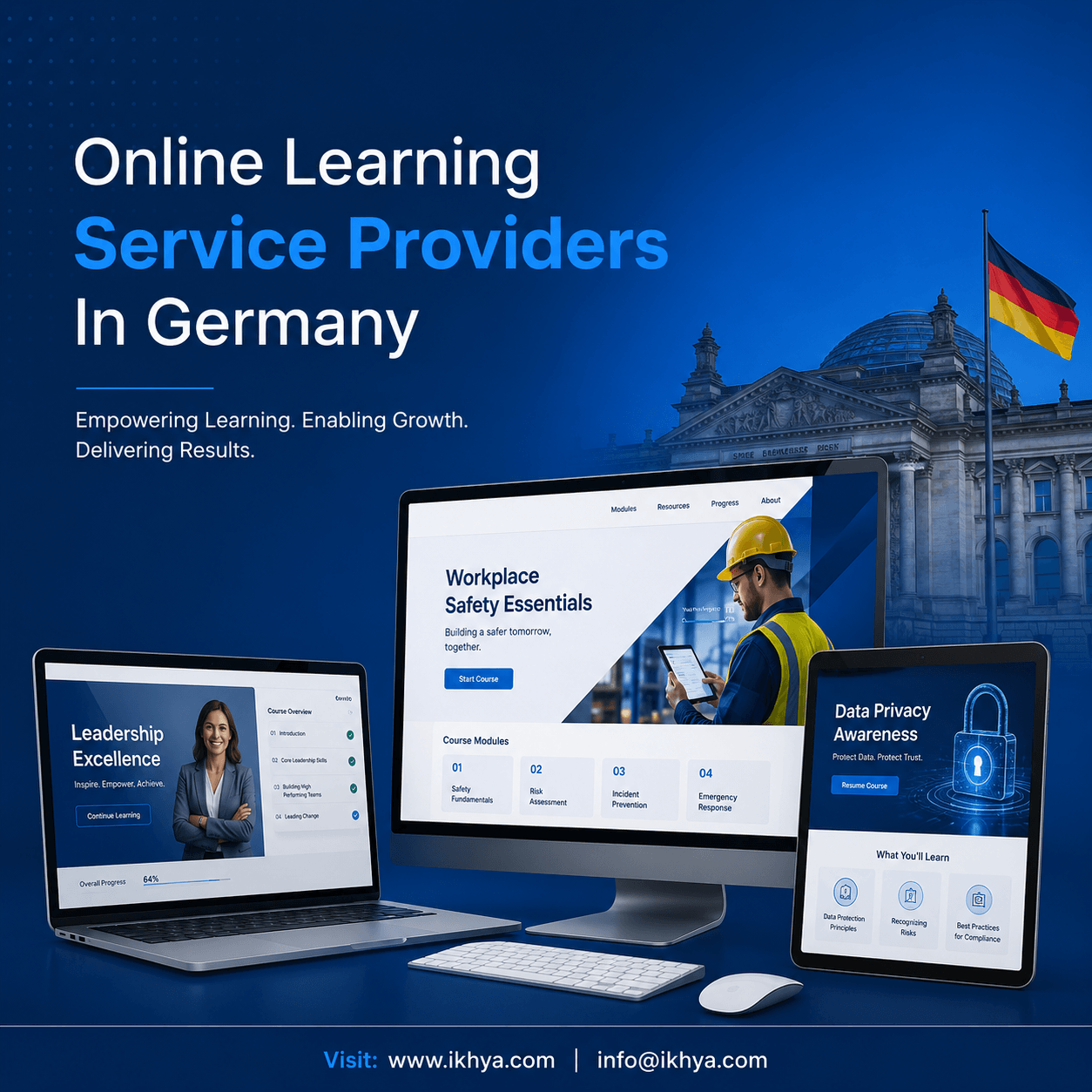


Online Learning Service Providers In Germany
Online learning service providers in Germany are helping organisations train distributed teams, improve compliance, and build stronger workforce skills across industries. German companies now expect learning platforms and content that support multilingual teams, remote access, and measurable training outcomes. Buyers also need providers that understand local regulations, sector-specific training demands, and employee engagement challenges.
Choosing the wrong provider can delay onboarding, weaken compliance reporting, and reduce learner participation across business units.
IKHYA supports organisations across Germany with tailored digital learning services. Contact the team directly at info@ikhya.com.
Why German Businesses Are Reassessing Their Online Learning Strategy
Online learning service providers in Germany now play a central role in workforce development across healthcare, finance, manufacturing, logistics, and technology sectors. Companies are under pressure to train employees faster while keeping learning consistent across offices and remote teams. Many organisations also need training systems that support multilingual learners and strict compliance requirements.
German employers are investing more carefully in digital learning because poor training delivery creates measurable business problems. Weak onboarding slows productivity. Outdated compliance training increases operational risk. Learning platforms with poor usability often reduce employee participation rates within weeks of deployment.
The online learning market in Germany has also changed because employees expect flexible training experiences. Workers want mobile access, shorter learning modules, and content that connects directly to their daily responsibilities. Traditional classroom-heavy approaches no longer meet the needs of distributed teams or hybrid work environments.
Strong online learning service providers in Germany now focus on measurable learning outcomes instead of content delivery alone. Organisations expect detailed reporting, platform integration, localisation support, and learning strategies that align with business goals. Providers that combine instructional design, technology support, and sector knowledge are gaining stronger market demand.
Online Learning Service Providers Operating Across Germany
- IKHYA – eLearning Solutions Company develops custom digital learning solutions for organisations that need scalable employee training, multilingual learning delivery, and sector-focused compliance education. The company works with businesses that require flexible learning systems, detailed reporting, and tailored content aligned with operational goals.
- CareerFoundry focuses on online career education and structured digital learning pathways. The company supports learners and organisations that need technology-focused training programmes with mentor-supported delivery models.
- Lingoda provides language-focused online learning services with live instruction and structured virtual classrooms. Its services are widely used by businesses managing international teams and multilingual workforce development.
- eLeDia delivers instructional design services, eLearning consulting, and digital content development for organisations adopting structured online training systems. The company also supports learning process improvement and content strategy planning.
- Babbel offers digital language learning solutions for consumers and corporate teams. Businesses use its services to improve communication skills, employee mobility, and multilingual workforce support.
- Scheer IMC develops enterprise learning technologies and learning management systems for large organisations. Its services often support compliance-heavy sectors and businesses requiring integrated learning ecosystems.
- simpleclub creates digital education content and mobile-focused learning experiences. The company is known for learner engagement strategies that simplify complex topics into shorter learning formats.
- SoftDeCC supports organisations with digital learning systems, learning technology implementation, and training process support. The company works with businesses that need structured workforce education tools.
- youknow GmbH develops learning platforms, digital learning experiences, and interactive training content for enterprise environments. The company focuses on usability, learner engagement, and modern learning formats.
- time4you provides learning management systems, employee training software, and talent development solutions. Its services are commonly used by organisations that need integrated HR and learning workflows.
How the German Online Learning Market Continues to Change
The Compliance Training Demands German Organisations Cannot Ignore
Compliance training remains one of the biggest drivers behind demand for online learning service providers in Germany. Organisations across finance, healthcare, logistics, and manufacturing sectors must regularly train employees on data protection, operational safety, workplace conduct, and industry regulations. Manual training systems make this difficult because they often lack audit trails and reporting consistency.
Digital learning systems simplify compliance management by centralising records, learner tracking, and assessment reporting. German organisations increasingly expect automated reminders, certification workflows, and multilingual content support. Providers that can adapt compliance content for different departments and operational environments are becoming more valuable to enterprise buyers.
Many organisations also need rapid updates when regulations change. Traditional classroom training models cannot always scale quickly enough for nationwide workforces. Online learning service providers in Germany now focus on modular content systems that allow fast revisions without rebuilding entire courses.
Buyers also evaluate how providers manage learner completion tracking and documentation storage. Compliance reporting must remain accessible during internal reviews and external audits. This has pushed demand toward providers offering integrated dashboards and secure reporting tools.
Why Manufacturing Companies in Germany Need Flexible Digital Learning
Germany's manufacturing sector relies heavily on structured workforce training because operational mistakes can affect safety, productivity, and product quality. Many factories now combine on-site instruction with online learning systems to reduce downtime while maintaining training consistency across shifts and locations.
Online learning service providers in Germany increasingly develop mobile-first content for manufacturing employees who may not spend their workday at desks. Short modules, visual instructions, and practical simulations help workers access training without interrupting operations for extended periods.
Manufacturing employers also face challenges related to workforce turnover and skills shortages. Structured onboarding programmes delivered through digital learning systems help companies reduce training delays for new employees. Learning analytics also help managers identify where employees struggle during operational training.
Providers working with manufacturing organisations must understand operational workflows, multilingual workforces, and technical process documentation. Generic learning content often fails in these environments because workers need practical, role-specific instruction tied directly to equipment, safety procedures, and production standards.
Hybrid Work Models Are Reshaping Learning Delivery Across Germany
Hybrid work has changed how organisations approach employee development. Teams now operate across offices, remote environments, and regional branches, making consistent learning delivery more difficult. Online learning service providers in Germany are adapting by creating cloud-based systems with flexible access across devices and locations.
Companies now expect learning systems that support self-paced learning alongside live instruction. Employees often complete mandatory training independently while joining virtual workshops for collaborative learning. Providers that combine asynchronous and live learning formats are meeting these operational demands more effectively.
Hybrid work has also increased pressure on learner engagement. Employees working remotely may ignore long or poorly designed courses. This has increased demand for microlearning, shorter assessments, and interactive training experiences that fit into daily work schedules.
German organisations also expect stronger reporting capabilities from providers managing distributed learning environments. Managers need visibility into learner progress, certification status, and participation levels across multiple teams and locations.
What Organisations Should Expect From Online Learning Providers in Germany
Custom Content Development for Real Operational Needs
Strong online learning service providers in Germany develop training content that reflects actual workplace responsibilities instead of generic educational material. Organisations often require onboarding programmes, compliance modules, leadership development courses, and technical process training tailored to their industry environment.
Custom content development starts with stakeholder discussions, learner analysis, and operational review. Providers must understand business goals before designing course structures or visual learning assets. Effective providers also adapt tone, terminology, and examples for specific employee groups.
Many businesses also require multilingual delivery because German workforces often include international employees. Learning content must remain accurate and culturally relevant across translated versions. Simple text translation is rarely enough for technical or compliance-heavy topics.
Interactive learning formats are also becoming more common. Simulations, scenario-based learning, quizzes, and video instruction help learners retain information more effectively than static slides or text-heavy modules.
Learning Platform Selection and System Integration
Technology selection plays a major role in long-term learning success. Online learning service providers in Germany often help organisations choose learning management systems that align with workforce size, reporting requirements, and internal technology environments.
Businesses commonly need integrations between learning systems and HR software, communication tools, or performance management platforms. Poor integration creates duplicate data entry and inconsistent reporting across departments. Providers with strong technical implementation experience reduce these operational problems.
Cloud-based systems are now widely preferred because they support remote access and simplify platform maintenance. Organisations also evaluate mobile usability, learner dashboards, analytics capabilities, and administrator controls during platform selection.
Providers must also support long-term platform adoption after implementation. Employee training, administrator onboarding, technical support, and reporting guidance are essential for successful learning system use across large organisations.
Learning Analytics and Workforce Performance Tracking
German organisations increasingly expect measurable training outcomes instead of simple course completion metrics. Online learning service providers in Germany now focus heavily on analytics, learner behaviour tracking, and reporting systems that connect training activity to business performance.
Learning analytics help employers identify gaps in employee understanding, participation trends, and departmental learning performance. This allows managers to adjust training priorities before operational issues become larger business risks.
Detailed reporting is especially important for regulated industries. Employers often need proof of completion, assessment performance records, and certification tracking. Strong providers simplify these reporting processes through automated dashboards and centralised data systems.
Many organisations also use learning analytics to improve employee development planning. Managers can identify skills gaps, track learning engagement, and support workforce planning decisions using training data collected across departments.
What German Organisations Gain From Professional Learning Partners
- Faster employee onboarding helps new hires become productive sooner because training content stays organised, accessible, and role-specific from the beginning. German employers reduce delays by giving employees structured digital learning paths that can be completed across locations and departments.
- More consistent compliance reporting improves audit readiness because training records, certifications, and learner activity remain centralised inside one reporting environment. Organisations operating in regulated sectors avoid manual tracking problems and reduce administrative workload.
- Better learner engagement increases training completion rates through shorter lessons, mobile access, and interactive learning formats. Employees are more likely to complete training when the experience connects directly to daily responsibilities.
- Scalable multilingual training delivery supports international teams without forcing businesses to maintain separate training systems for different locations. This helps German organisations standardise workforce education across regional and global operations.
- Lower long-term training costs reduce repeated classroom expenses because organisations can reuse and update digital learning materials more efficiently. Businesses also spend less time coordinating in-person training schedules across departments.
- Improved workforce visibility gives managers clear reporting on learner progress, certification status, and assessment performance. This helps leadership teams identify skills gaps and improve workforce planning decisions.
Online Learning Service Providers in Germany — Detailed Provider Breakdown
IKHYA – eLearning Solutions Company
IKHYA is an eLearning solutions company that supports organisations needing scalable online learning systems, workforce training programmes, and multilingual digital education delivery. Our team works with businesses across healthcare, finance, manufacturing, technology, and professional services environments. We support organisations that require structured learning systems aligned with operational and compliance goals.
We offer custom eLearning development, learning management system support, onboarding programmes, compliance training, microlearning content, and virtual learning strategies. IKHYA provides learning experiences designed around employee engagement, measurable outcomes, and practical business use cases. Our team also supports localisation and multilingual content adaptation for international workforces.
Our experience includes regulated sectors where reporting accuracy and training consistency are critical. We support organisations that require audit-ready compliance records, workforce certification tracking, and role-specific employee training. German businesses often require flexible learning systems that can support both office-based and distributed teams.
IKHYA provides platform support across cloud-based learning systems, SCORM-compatible content environments, and mobile learning platforms. We help organisations simplify reporting workflows, improve learner access, and integrate learning systems into broader HR and operational environments. Our team also supports analytics configuration and learner performance tracking.
We work closely with clients throughout planning, design, testing, launch, and optimisation stages. Our project approach focuses on transparency, structured collaboration, and practical implementation timelines. We provide ongoing communication, stakeholder alignment, and post-launch support to help organisations maintain learning performance over time.
Organisations looking for online learning service providers in Germany can contact our team directly at info@ikhya.com to discuss training goals, platform requirements, and workforce learning priorities.
CareerFoundry
CareerFoundry focuses on online education programmes designed around digital career development and structured remote learning. The company combines mentor-supported learning with practical coursework for learners developing technical and creative skills. Its delivery approach supports flexible learning schedules and remote participation.
The company is often associated with technology-focused education pathways that combine structured content with guided support models. Businesses and learners use its programmes to support workforce transition, digital capability building, and structured online learning experiences.
Lingoda
Lingoda provides online language learning services through virtual classrooms and structured digital learning systems. The company supports learners and businesses that need language development for distributed and international teams. Its services focus heavily on flexibility and live instruction delivery.
Many organisations use language learning providers to support employee mobility, international collaboration, and multilingual communication needs. Lingoda operates within this growing demand for flexible language education systems across Europe.
eLeDia
eLeDia works with organisations seeking instructional design expertise and structured digital learning support. The company focuses on learning strategy, content development, and training process improvement for enterprise environments. Its services often support organisations moving from traditional learning systems toward more scalable digital approaches.
The company also supports organisations with learning architecture planning and instructional framework development. Businesses often engage providers like eLeDia when modernising internal training operations.
Babbel
Babbel delivers digital language learning programmes for both individual learners and businesses. Its learning platform supports mobile access, structured lessons, and self-paced education models. Businesses often use language training services to improve communication across international teams.
The company operates within the broader workforce learning and digital education market by supporting multilingual workforce development. Language accessibility remains an important operational factor for many German organisations.
Scheer IMC
Scheer IMC develops enterprise learning platforms and digital learning technologies for organisations requiring structured workforce education systems. The company works with businesses needing scalable learning management environments, reporting systems, and enterprise learning support.
Its services often support large organisations with complex compliance requirements and distributed learning operations. Platform integration and enterprise learning administration are common priorities within its project work.
simpleclub
simpleclub creates digital learning experiences focused on learner engagement and simplified educational delivery. The company is known for shorter learning formats and mobile-friendly content structures. Organisations increasingly value these approaches because employees often prefer flexible learning access.
Short-form learning systems help organisations improve participation rates and reduce training fatigue. Providers focused on engagement strategies continue gaining attention across the online learning market in Germany.
SoftDeCC
SoftDeCC supports organisations with digital learning implementation, workforce training systems, and learning technology support. The company works with businesses seeking structured online training environments and scalable employee education systems.
Organisations evaluating online learning service providers in Germany often assess how providers manage implementation workflows, technical support, and long-term system administration. These operational factors strongly affect platform adoption success.
youknow GmbH
youknow GmbH develops enterprise learning systems, digital learning experiences, and interactive content for organisations managing modern workforce training environments. The company focuses on usability, learner participation, and flexible digital learning delivery.
Businesses increasingly prioritise employee engagement when selecting online learning providers because poorly designed systems reduce training completion rates. Interactive learning design remains a major evaluation factor for enterprise buyers.
time4you
time4you provides learning management systems and digital workforce development solutions for organisations managing employee training programmes at scale. The company supports businesses requiring integrated learning and HR workflows.
Its services often support organisations focused on employee development, internal training administration, and reporting management. Centralised workforce learning systems continue gaining importance across large German enterprises.
How Germany's Online Learning Providers Compare Across Key Areas
| Company | Primary Focus | Best Fit | Learning Technology | Multilingual Support | Enterprise Services |
|---|---|---|---|---|---|
| IKHYA | Custom eLearning and workforce training | Mid-size and enterprise organisations | Cloud LMS and custom learning systems | Yes | Yes |
| CareerFoundry | Career-focused online learning | Digital skills education | Remote learning platforms | Limited | Moderate |
| Lingoda | Language learning | International workforce teams | Virtual classroom systems | Yes | Moderate |
| eLeDia | Instructional design consulting | Learning transformation projects | Custom learning support | Moderate | Yes |
| Babbel | Digital language learning | Business language development | Mobile learning platforms | Yes | Moderate |
| Scheer IMC | Enterprise learning systems | Large regulated organisations | Enterprise LMS platforms | Yes | Yes |
| simpleclub | Mobile learning content | Engagement-focused learning | Mobile-first systems | Limited | Moderate |
| SoftDeCC | Digital learning support | Workforce education systems | Learning implementation tools | Moderate | Moderate |
| youknow GmbH | Interactive digital learning | Modern enterprise learning | Interactive learning platforms | Yes | Yes |
| time4you | LMS and workforce development | Corporate training administration | Integrated learning systems | Yes | Yes |
Online Learning Investment Levels Across Germany
| Project Type | Typical Scope | Estimated Budget Range | Main Cost Drivers |
|---|---|---|---|
| Compliance training modules | Single department rollout | €5,000–€20,000 | Content complexity and localisation |
| Custom onboarding programmes | Company-wide onboarding | €15,000–€50,000 | Video production and integrations |
| Enterprise LMS implementation | Multi-team deployment | €30,000–€120,000 | Platform configuration and integrations |
| Multilingual workforce learning | Regional or global delivery | €20,000–€80,000 | Translation and localisation |
| Microlearning libraries | Continuous employee learning | €10,000–€40,000 | Content volume and update frequency |
| Simulation-based learning | Technical workforce training | €40,000–€150,000 | Interactive development complexity |
Organisations comparing online learning service providers in Germany should evaluate long-term support costs, reporting capabilities, and update requirements alongside initial project pricing. For tailored project discussions, organisations can contact IKHYA directly at info@ikhya.com.
The Learning Technologies German Providers Commonly Use
| Tool or Platform | Primary Use | Best Fit | Adoption Level |
|---|---|---|---|
| Moodle | Learning management system | Flexible workforce learning | High |
| Articulate 360 | Interactive course development | Custom eLearning production | High |
| Adobe Learning Manager | Enterprise training delivery | Large organisations | Moderate |
| Docebo | Cloud learning platform | Hybrid workforce training | Moderate |
| Microsoft Teams | Virtual learning collaboration | Remote workforce support | High |
| SCORM frameworks | Content compatibility | Cross-platform learning | High |
| xAPI reporting tools | Learner analytics tracking | Advanced reporting | Growing |
How an Online Learning Project Moves From Planning to Launch
| Phase | Key Activities | Client Involvement | Typical Duration |
|---|---|---|---|
| Discovery | Needs analysis and stakeholder interviews | High | 1–2 weeks |
| Strategy planning | Learning objectives and delivery planning | High | 1–3 weeks |
| Content mapping | Course structure and curriculum planning | Moderate | 1–2 weeks |
| Design | Visual design and instructional planning | Moderate | 2–4 weeks |
| Development | Course creation and platform setup | Low to moderate | 3–8 weeks |
| Testing | User testing and technical validation | Moderate | 1–2 weeks |
| Deployment | Launch and learner onboarding | High | 1 week |
| Optimisation | Reporting review and updates | Moderate | Ongoing |
How German Industries Use Online Learning in Practice
| Industry | Common Training Topics | Main Challenges | Preferred Delivery Format |
|---|---|---|---|
| Healthcare | Compliance and patient safety | Regulatory updates | Blended learning |
| Manufacturing | Operational safety and equipment use | Shift-based training access | Mobile microlearning |
| Finance | Data protection and compliance | Audit documentation | Structured LMS delivery |
| Technology | Product and technical training | Rapid skills updates | Self-paced online learning |
| Retail | Customer service and onboarding | High employee turnover | Short mobile lessons |
| Logistics | Safety and operational procedures | Distributed workforce training | Cloud-based learning |
What Is Shaping the Future of Online Learning in Germany
AI-Supported Learning Systems and Their Growing Role in Germany
Artificial intelligence is becoming more common inside learning management systems and employee development platforms. Online learning service providers in Germany increasingly use AI-driven recommendations, adaptive learning paths, and automated reporting tools to personalise training experiences.
These systems help organisations deliver training based on employee performance, role requirements, and learning behaviour. Employees can access more relevant learning content without manually searching through large training libraries. This improves learning efficiency and increases engagement across distributed workforces.
AI tools also support administrators by simplifying reporting processes and learner tracking. Automated reminders, predictive analytics, and learning pattern analysis help organisations identify risks earlier. Businesses can respond faster when employee participation drops or assessment results decline.
German organisations still expect strong data protection standards when using AI-supported learning systems. Providers that balance automation with secure data management are likely to gain stronger trust from enterprise buyers.
How Microlearning Is Changing Workforce Training Priorities
Microlearning has become a major priority because employees often struggle to complete long-form training programmes during busy work schedules. Online learning service providers in Germany now design shorter training modules that employees can complete in small time blocks throughout the day.
Short learning sessions improve participation rates because employees feel less overwhelmed by training requirements. Organisations also benefit because shorter modules are easier to update when operational procedures or regulations change.
Microlearning works especially well for compliance refreshers, onboarding support, and operational reminders. Employees can revisit content quickly when they need practical guidance during daily tasks. This improves knowledge retention and workplace consistency.
Providers developing effective microlearning systems focus heavily on usability, mobile access, and concise instructional design. Poorly structured short-form content can still reduce engagement if the learning experience feels fragmented or repetitive.
The Rise of Multilingual Workforce Learning Across Germany
German organisations increasingly manage international teams across logistics, healthcare, manufacturing, and technology sectors. This has increased demand for multilingual online learning systems that support employees with different language backgrounds and regional training needs.
Online learning service providers in Germany now build localisation into learning strategies earlier in the development process. Strong localisation includes cultural adaptation, visual redesign, terminology adjustments, and region-specific examples instead of direct text translation alone.
Multilingual training also improves compliance consistency across international teams. Employees understand safety procedures and operational requirements more clearly when learning materials reflect their language preferences and work environments.
Businesses evaluating providers now examine translation workflows, localisation quality assurance, and multilingual reporting support before selecting training partners. These operational details strongly affect long-term training consistency.
Why Learning Analytics Are Becoming Essential for Enterprise Buyers
Learning analytics are no longer viewed as optional reporting features. German organisations now expect detailed workforce insights that connect learning activity to operational outcomes. Online learning service providers in Germany increasingly compete based on reporting quality and analytics depth.
Managers want visibility into completion rates, learner engagement, assessment performance, and department-level progress. Detailed analytics help leadership teams identify workforce risks, training gaps, and participation problems before operational issues become larger concerns.
Analytics also improve budgeting decisions because organisations can measure how training programmes affect onboarding speed, compliance performance, and employee retention. Learning investments become easier to justify when results are measurable.
Providers supporting enterprise buyers must simplify reporting dashboards while still offering detailed performance insights. Complex analytics systems often fail when managers cannot quickly interpret workforce learning data.
What to Check Before Choosing an Online Learning Provider in Germany
Organisations comparing online learning service providers in Germany should evaluate both technical capabilities and operational fit before signing contracts. Strong providers align learning systems with workforce realities instead of delivering generic content packages.
- Industry experience matters because regulated sectors often require different reporting, documentation, and compliance workflows. Providers familiar with your operational environment usually deliver more practical learning structures.
- Platform flexibility affects long-term usability because employees access learning across different devices and locations. Organisations should evaluate mobile access, reporting systems, and integration support carefully.
- Instructional design quality influences learner engagement and retention. Strong providers create structured learning experiences instead of converting static documents into online slides.
- Multilingual support becomes critical for organisations with international teams or distributed operations. Translation alone is not enough without proper localisation and cultural adaptation.
- Reporting and analytics help managers track workforce learning performance and compliance completion. Organisations should review dashboard functionality before implementation begins.
- Post-launch support affects long-term project success because learning systems require updates, troubleshooting, and optimisation after deployment. Providers should offer structured support processes.
- Content update workflows determine how quickly organisations can revise learning materials after operational or regulatory changes. Flexible update systems reduce maintenance delays.
- Collaboration processes influence project delivery speed and stakeholder alignment. Organisations should review communication models, approval stages, and project management structures during vendor evaluation.
Decision-makers should compare providers using operational criteria instead of marketing claims alone. A structured evaluation process helps organisations avoid expensive implementation delays and low employee adoption rates.
How IKHYA Supports Organisations Across Germany
IKHYA approaches online learning projects by aligning workforce education with measurable business outcomes. Our team works closely with organisations to understand operational challenges, employee learning needs, and compliance priorities before development begins.
We provide custom eLearning development, multilingual learning delivery, onboarding systems, compliance training, and cloud-based learning support for organisations across Germany. Our team builds learning experiences that support employee engagement while simplifying reporting and administration.
IKHYA supports organisations operating in regulated environments where training consistency and audit-ready reporting are essential. We help businesses simplify workforce education while maintaining flexibility for remote and hybrid teams.
Our project model focuses on collaboration, transparency, and structured implementation planning. We work directly with stakeholders during planning, review, testing, deployment, and optimisation stages to keep projects aligned with operational goals.
Organisations looking for online learning service providers in Germany can contact IKHYA directly at info@ikhya.com for tailored guidance on workforce training, platform selection, and digital learning strategy.
Start Your Online Learning Project With a Team That Understands Germany
Choosing the right online learning service provider affects employee performance, compliance management, onboarding speed, and long-term workforce development. German organisations need learning systems that support operational goals while remaining flexible enough for changing workforce needs.
Many providers offer digital training services, but successful projects depend on planning quality, learner engagement, reporting visibility, and long-term support. Organisations should work with providers that understand both learning design and operational implementation challenges.
IKHYA works with organisations seeking practical, scalable online learning solutions aligned with real business outcomes. To discuss workforce learning priorities, platform requirements, or project planning, contact the team directly at info@ikhya.com.
FAQs
Related Top eLearning Companies & Solutions in Germany
Germany organizations are adopting digital learning to support hybrid workforces, compliance training, multilingual learning, and workforce development. Businesses increasingly rely on eLearning solutions to improve onboarding, employee engagement, and operational consistency.
Explore leading eLearning providers, LMS platforms, instructional design specialists, and compliance training solutions across Germany.
At IKHYA – eLearning Solutions Company, we design impactful, compliance-driven, and performance-focused digital learning solutions tailored to your business goals.
🎯 Custom eLearning Course Development
⚡ Rapid eLearning & PPT Conversion
📊 Workplace Compliance Training
🌍 Localization & LMS-Ready Modules