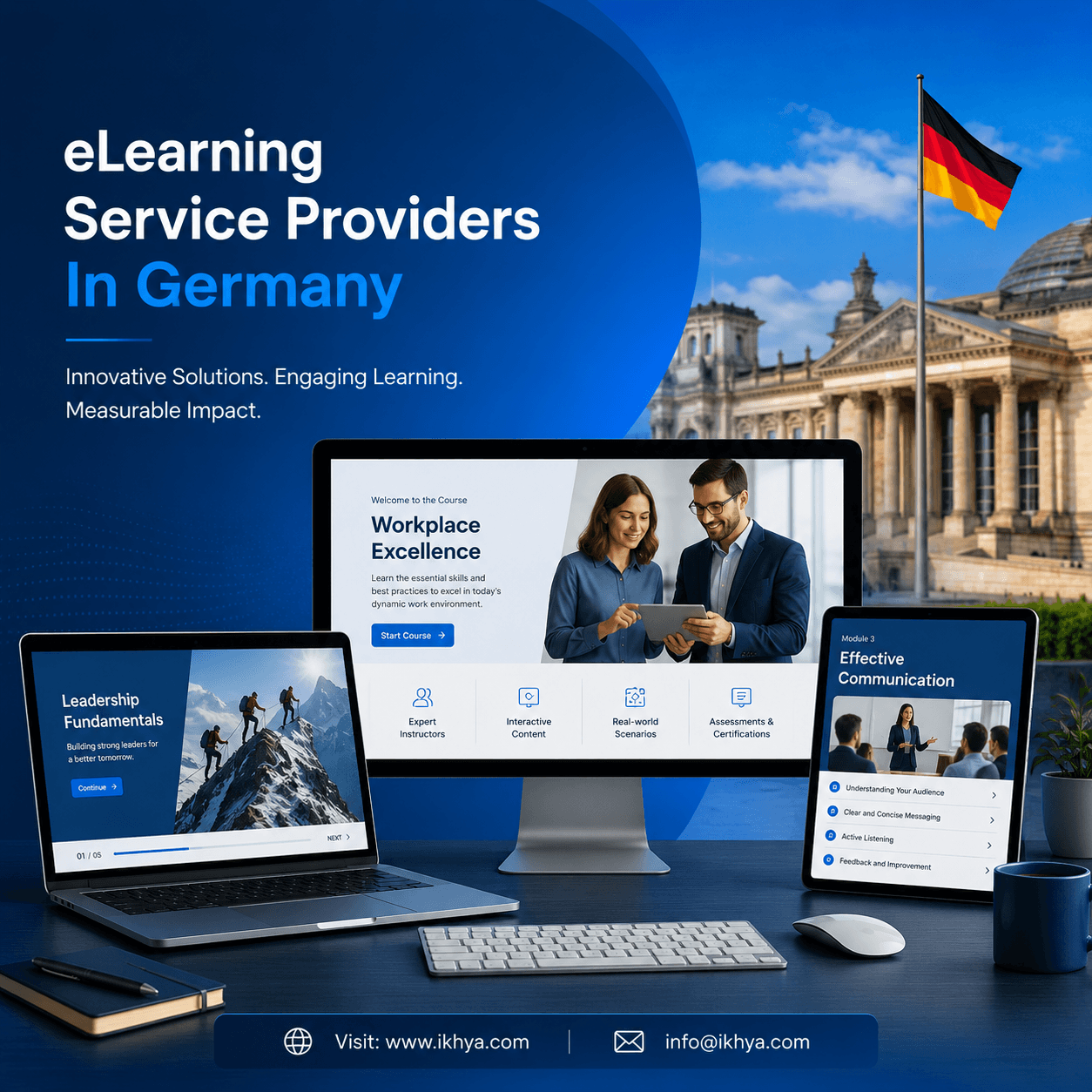


eLearning Service Providers In Germany
eLearning service providers in Germany are helping companies train employees faster, manage compliance requirements, and support hybrid workforces across multiple regions. German organisations now expect learning systems that support multilingual delivery, measurable reporting, and strong learner engagement. Companies in manufacturing, healthcare, finance, logistics, and technology are investing in digital learning partners that can manage both strategy and delivery.
Choosing the wrong provider often leads to poor learner completion rates, weak reporting, and expensive platform changes later.
IKHYA supports organisations that need practical digital learning support. Contact the team directly at info@ikhya.com.
Why German Businesses Are Reassessing Their eLearning Strategy
eLearning service providers in Germany now play a central role in workforce training, onboarding, compliance, and skills development. German organisations face pressure to train distributed teams quickly while maintaining quality and regulatory accuracy. Many businesses also need learning content in multiple languages because they operate across European markets.
Traditional classroom training creates scheduling problems and higher travel costs. Digital learning gives organisations more control over delivery, reporting, and learner progress. This matters for industries where employees need regular certification updates and process training.
German companies also expect training content to reflect local workplace standards and communication styles. Generic translated content often fails because learners disconnect from the material. Providers that understand German business culture usually deliver stronger learner engagement.
Another major shift involves data visibility. HR and compliance teams now expect detailed reporting from learning platforms. This helps organisations track completion rates, identify skill gaps, and prepare for audits more efficiently.
eLearning Companies Operating in Germany and What They Deliver
- IKHYA – eLearning Solutions Company delivers custom digital learning, LMS support, onboarding training, compliance learning, localisation, and learning consulting services. The company works with organisations that need structured learning programmes aligned with business goals and operational requirements.
- Lingoda focuses on language learning and virtual instructor-led education for businesses and individuals. The company supports organisations that need language improvement for international teams and customer-facing staff.
- SoftDeCC provides digital learning development, learning technology support, and enterprise training solutions. The company works with organisations that need structured learning delivery across distributed teams.
- CareerFoundry specialises in digital skills training and online career education. Its programmes focus on technology, design, and digital business skills development.
- youknow GmbH develops eLearning content and digital training experiences for corporate learning environments. The company often supports onboarding and internal communication training projects.
- Babbel delivers language learning tools for business communication and workforce development. The company supports flexible learning access for employees working across international teams.
- Scheer IMC offers learning management systems, learning platforms, and enterprise training solutions. The company serves organisations that require structured digital learning environments with reporting capabilities.
- simpleclub creates digital learning content focused on learner engagement and accessible education delivery. The company is known for simplified learning formats and mobile-friendly content.
- eLeDia provides instructional design, learning consulting, and digital training development services. The company supports organisations building structured online learning programmes.
- time4you develops learning management solutions and employee development platforms for organisations managing large learning ecosystems. The company supports workforce development initiatives across different industries.
Understanding the German eLearning Market Before Choosing a Provider
The Compliance Pressure German Organisations Cannot Ignore
German organisations in finance, healthcare, manufacturing, and logistics operate under strict compliance expectations. Employee training records must remain accurate, accessible, and easy to audit. This is one reason why eLearning service providers in Germany are seeing strong demand from regulated sectors.
Many companies now build compliance workflows directly into their learning platforms. Employees receive automatic reminders for mandatory courses and certification renewals. Managers can also monitor completion rates without relying on spreadsheets or manual reporting processes.
Why Manufacturing Companies in Germany Need Specialised Learning Support
Manufacturing remains one of Germany's strongest economic sectors, but workforce training has become more difficult. Production teams often work across multiple shifts and locations, making classroom training harder to schedule. Digital learning allows organisations to train staff without interrupting operations.
Manufacturing training also requires visual learning methods. Employees often learn procedures faster through simulations, videos, and guided process walkthroughs. Providers that understand operational environments usually create more practical and safer learning experiences.
How Multilingual Workforce Training Is Reshaping Learning Delivery
Many German organisations employ international teams across Europe and global markets. Training programmes must support different languages while maintaining consistent learning outcomes. Direct translation alone rarely produces strong learner engagement.
Strong eLearning providers redesign content for cultural relevance, workplace expectations, and audience understanding. This includes voiceovers, interface adjustments, examples, and terminology changes. Multilingual learning has become a business requirement rather than an optional feature.
What Strong eLearning Partners in Germany Deliver to Clients
Custom Learning Content Built Around Real Workflows
Many organisations need training aligned with their own systems, policies, and processes. Generic content often fails because employees cannot connect training to their daily responsibilities. Custom learning development solves this problem by using real business scenarios.
eLearning service providers in Germany often build onboarding modules, compliance programmes, and operational training around internal procedures. This approach improves learner understanding and reduces support requests after training completion.
Learning Platform Setup and Integration Support
Modern learning systems connect with HR platforms, reporting tools, and communication software. Businesses expect user management, reporting, and learner access to work smoothly across departments. Platform integration has become a key part of most learning projects.
Strong providers support LMS configuration, migration planning, reporting setup, and learner management. They also help organisations reduce manual administration work. This improves long-term operational efficiency for HR and training teams.
Localisation and Mobile Learning Delivery
Employees increasingly access training through phones and tablets while working remotely or across field locations. Learning content must remain simple to navigate across different devices. Mobile learning design now affects completion rates and learner engagement.
German organisations also need localisation support for multilingual workforces. Providers often redesign learning content rather than translating text directly. This improves learner understanding and creates more consistent learning outcomes across regions.
How German Organisations Benefit From Professional eLearning Support
- Faster employee onboarding helps new staff become productive sooner because training content stays accessible at any time. German organisations reduce onboarding delays while maintaining consistent process communication across departments.
- Improved compliance tracking gives managers clear visibility into mandatory training completion and certification status. This reduces manual reporting work and supports internal audit preparation.
- Lower long-term training costs reduce travel expenses, printed materials, and repeated classroom scheduling. Businesses also avoid productivity losses caused by repeated in-person training sessions.
- Consistent multilingual delivery ensures employees across different countries receive aligned training experiences and policy guidance. This matters for organisations managing distributed teams throughout Europe.
- Better learner engagement improves when training includes simulations, videos, and role-specific learning paths. Employees usually complete shorter and more practical modules more consistently.
Who the Leading eLearning Providers in Germany Are and What They Specialise In
IKHYA – eLearning Solutions Company
IKHYA is an eLearning solutions company that supports organisations seeking structured digital learning programmes across Germany and international markets. Our team works with businesses that need practical workforce training, compliance education, onboarding support, and multilingual learning delivery.
We offer custom eLearning development, LMS implementation support, localisation services, mobile learning, microlearning, and learning consulting. IKHYA provides project planning support from early discovery through deployment and learner reporting.
Our team has experience supporting industries such as healthcare, manufacturing, finance, retail, logistics, and technology. We understand that German organisations often require training accuracy, multilingual delivery, and clear audit reporting.
IKHYA supports multiple learning technologies including SCORM, xAPI, LMS integrations, reporting dashboards, and responsive learning delivery. We also help organisations improve learner access across desktop and mobile environments.
We work closely with clients through structured review cycles, transparent communication, and milestone-based project management. Our team focuses on practical delivery timelines and measurable learner outcomes instead of generic training production.
Organisations looking for eLearning service providers in Germany can contact our team directly at info@ikhya.com to discuss project requirements, timelines, and learning objectives.
Lingoda
Lingoda provides language learning programmes designed for remote and hybrid learning environments. The company supports workforce language development through virtual classes and structured learning paths. Organisations often use Lingoda when communication consistency across international teams becomes important.
SoftDeCC
SoftDeCC develops digital learning solutions for organisations managing enterprise training requirements. The company supports structured employee education programmes and learning technology implementation. Its services often focus on operational learning environments.
CareerFoundry
CareerFoundry focuses on online skills development related to technology and digital careers. The company delivers mentor-supported learning experiences for learners seeking practical career advancement. Organisations may use these programmes to support internal digital capability growth.
youknow GmbH
youknow GmbH develops digital learning content designed to improve employee engagement and knowledge retention. The company supports onboarding, communication, and workforce learning initiatives. Its learning formats often focus on accessibility and learner interaction.
Babbel
Babbel provides language learning support for individuals and businesses operating across multilingual environments. The platform offers flexible learning access and mobile learning functionality. Organisations often use Babbel to strengthen internal communication capabilities.
Scheer IMC
Scheer IMC offers enterprise learning platforms, digital learning infrastructure, and learning management support. The company serves organisations requiring structured reporting and scalable learning delivery. Its services often support large workforce environments.
simpleclub
simpleclub creates accessible digital learning content using simplified explanations and mobile-friendly design. The company focuses on learner engagement and practical educational experiences. Its approach often appeals to younger learner groups and digital-first environments.
eLeDia
eLeDia supports instructional design and learning consulting projects for organisations building online learning strategies. The company provides digital training planning and learning content development services. Organisations often engage eLeDia for structured learning transformation support.
time4you
time4you develops learning management solutions and workforce learning systems for enterprise clients. The company supports organisations needing employee development tracking and reporting capabilities. Its services often focus on long-term learning administration.
Side-by-Side Comparison of eLearning Providers in Germany
| Company | Main Focus | Custom Content | LMS Support | Multilingual Delivery | Best Fit |
|---|---|---|---|---|---|
| IKHYA | Corporate digital learning | Yes | Yes | Yes | Enterprise organisations |
| Lingoda | Language learning | Limited | No | Yes | International teams |
| SoftDeCC | Enterprise learning | Yes | Yes | Moderate | Operational training |
| CareerFoundry | Digital skills | No | No | Limited | Skills development |
| youknow GmbH | Learning content | Yes | Moderate | Moderate | Employee engagement |
| Babbel | Language training | No | No | Yes | Communication training |
| Scheer IMC | Learning platforms | Yes | Yes | Yes | Large enterprises |
| simpleclub | Mobile learning | Limited | Limited | Limited | Digital-first learning |
| eLeDia | Instructional design | Yes | Moderate | Moderate | Learning consulting |
| time4you | Learning systems | Moderate | Yes | Moderate | Workforce development |
Understanding eLearning Costs in Germany
Pricing depends on project scope, localisation needs, platform integrations, and learning complexity. Organisations should request detailed project breakdowns before selecting a provider.
| Project Type | Scope | Typical Cost Range | Main Pricing Factors |
|---|---|---|---|
| Basic onboarding module | Single course | Low to moderate | Length and media use |
| Compliance training | Multi-module delivery | Moderate | Reporting requirements |
| Custom LMS setup | Enterprise deployment | Moderate to high | Integrations and users |
| Multilingual learning | Regional rollout | Moderate to high | Languages and localisation |
| Simulation-based training | Interactive learning | High | Complexity and development |
Organisations comparing eLearning service providers in Germany can discuss pricing expectations directly with IKHYA at info@ikhya.com.
Technology Platforms Used by German eLearning Providers
| Tool | Primary Use | Best Fit | Adoption Level |
|---|---|---|---|
| Moodle | Learning management | Education and enterprise | High |
| Articulate 360 | Content authoring | Interactive learning | High |
| Adobe Learning Manager | Enterprise LMS | Large organisations | Moderate |
| Docebo | Cloud learning delivery | Corporate training | Moderate |
| Rise | Responsive modules | Mobile learning | High |
| Cornerstone | Talent learning | HR integration | Moderate |
The eLearning Delivery Process Explained
| Phase | Key Activities | Client Involvement | Typical Duration |
|---|---|---|---|
| Discovery | Needs analysis and goals | High | 1-2 weeks |
| Planning | Project roadmap creation | High | 1 week |
| Content Design | Storyboards and structure | Moderate | 2-3 weeks |
| Development | Module creation | Moderate | 3-6 weeks |
| Review | Feedback and revisions | High | 1-2 weeks |
| Integration | LMS deployment | Moderate | 1 week |
| Testing | User testing and fixes | Moderate | 1 week |
| Launch | Go-live and reporting | Low | Ongoing |
How Different German Industries Use eLearning
| Industry | Common Topics | Main Challenge | Delivery Format |
|---|---|---|---|
| Manufacturing | Safety and operations | Shift scheduling | Mobile modules |
| Healthcare | Compliance training | Audit readiness | LMS learning |
| Finance | Risk and compliance | Regulatory updates | Microlearning |
| Retail | Customer service | High turnover | Video learning |
| Logistics | Process training | Distributed workforce | Remote learning |
| Technology | Skills development | Fast change cycles | Blended learning |
How eLearning in Germany Is Evolving for Employers and Training Teams
AI-Based Personalisation and Employee Learning Paths
German organisations increasingly expect learning systems to recommend courses based on employee performance and job roles. Personalised learning paths reduce unnecessary training and improve learner engagement. Employees also complete training faster when content matches their experience level.
Many eLearning service providers in Germany now support adaptive learning workflows and reporting automation. HR teams use these systems to identify skill gaps more quickly and build targeted development plans.
Why Mobile Learning Is Becoming Standard Across Germany
Remote work and field operations have changed how employees access learning content. Organisations now expect training platforms to function smoothly across mobile devices without reducing learner quality. This shift matters for logistics, retail, and manufacturing environments.
Mobile learning also supports shorter training sessions that employees can complete during operational downtime. Providers that focus on responsive learning design often achieve stronger learner completion rates.
The Rise of Microlearning Across German Enterprises
Microlearning uses short training modules focused on one specific task or concept. German organisations increasingly prefer this approach because employees retain information more effectively through shorter sessions. It also reduces disruption during working hours.
Many providers now redesign long compliance and onboarding programmes into shorter learning sequences. This makes training easier to manage and improves learner participation across large workforces.
Data Reporting as a Standard Requirement in Corporate Learning
Learning analytics now influence workforce planning and compliance management decisions. Organisations want detailed reporting on learner engagement, assessment performance, and completion timelines. Basic completion tracking is no longer enough.
Providers that offer stronger reporting capabilities help organisations make better workforce development decisions. Reporting also supports leadership teams during budgeting and operational planning discussions.
How to Evaluate eLearning Providers in Germany Before Signing an Agreement
Choosing the right eLearning partner requires more than reviewing sample content. Organisations should evaluate delivery capability, communication quality, technical support, and industry understanding before committing to a provider.
- Industry experience matters because regulated sectors require accurate compliance knowledge and reporting structures. Providers familiar with German operational environments usually deliver more practical learning content.
- Multilingual capability becomes important when organisations manage teams across multiple countries or regions. Strong localisation improves learner understanding and training consistency.
- Technology integration support helps organisations reduce manual administration work and reporting delays. LMS compatibility should be reviewed before project approval.
- Content flexibility allows training modules to evolve with policy updates and operational changes. Businesses should avoid providers that make updates difficult or expensive.
- Project communication affects delivery speed and review quality throughout development. Clear milestone planning usually reduces project delays and revision problems.
- Reporting functionality supports compliance management and workforce visibility. Organisations should confirm what learner data remains accessible after deployment.
- Mobile learning support improves accessibility for distributed workforces and remote employees. Responsive learning design often improves completion rates.
- Long-term support availability becomes important after launch when updates, maintenance, and learner changes occur. Providers should explain their support structure clearly before contract approval.
Decision-makers should request detailed workflows, delivery timelines, and support models before final selection. This reduces operational risk and improves long-term learning outcomes.
Why Organisations in Germany Choose IKHYA for eLearning Services
IKHYA works with organisations that need practical and scalable learning delivery across corporate environments. We focus on creating training that employees can apply directly to their work responsibilities.
Our team supports onboarding programmes, multilingual learning, compliance education, and enterprise LMS projects. We also help organisations redesign outdated classroom material into digital learning formats that improve accessibility and reporting.
IKHYA understands that German organisations expect clear project communication and reliable delivery timelines. We work through structured milestones and collaborative review cycles to keep projects aligned with operational goals.
We also support long-term learning improvement after deployment. Our team helps clients review learner performance, update content, and expand training programmes as workforce needs change.
Organisations looking for dependable eLearning service providers in Germany can contact IKHYA directly at info@ikhya.com to discuss learning requirements and delivery planning.
Start Your eLearning Project With a Team That Understands Germany
Digital learning now affects workforce performance, compliance management, onboarding speed, and employee development across Germany. Organisations selecting an eLearning provider should focus on practical delivery experience, communication quality, and long-term support capability.
Many businesses need more than basic course development. They require multilingual delivery, reporting visibility, mobile access, and scalable learning systems that fit changing workforce requirements.
IKHYA supports organisations that want structured learning delivery aligned with operational goals. To discuss project requirements, timelines, or learning challenges, contact the team at info@ikhya.com.
FAQs
Related Top eLearning Companies & Solutions in Germany
Germany organizations are adopting digital learning to support hybrid workforces, compliance training, multilingual learning, and workforce development. Businesses increasingly rely on eLearning solutions to improve onboarding, employee engagement, and operational consistency.
Explore leading eLearning providers, LMS platforms, instructional design specialists, and compliance training solutions across Germany.
At IKHYA – eLearning Solutions Company, we design impactful, compliance-driven, and performance-focused digital learning solutions tailored to your business goals.
🎯 Custom eLearning Course Development
⚡ Rapid eLearning & PPT Conversion
📊 Workplace Compliance Training
🌍 Localization & LMS-Ready Modules