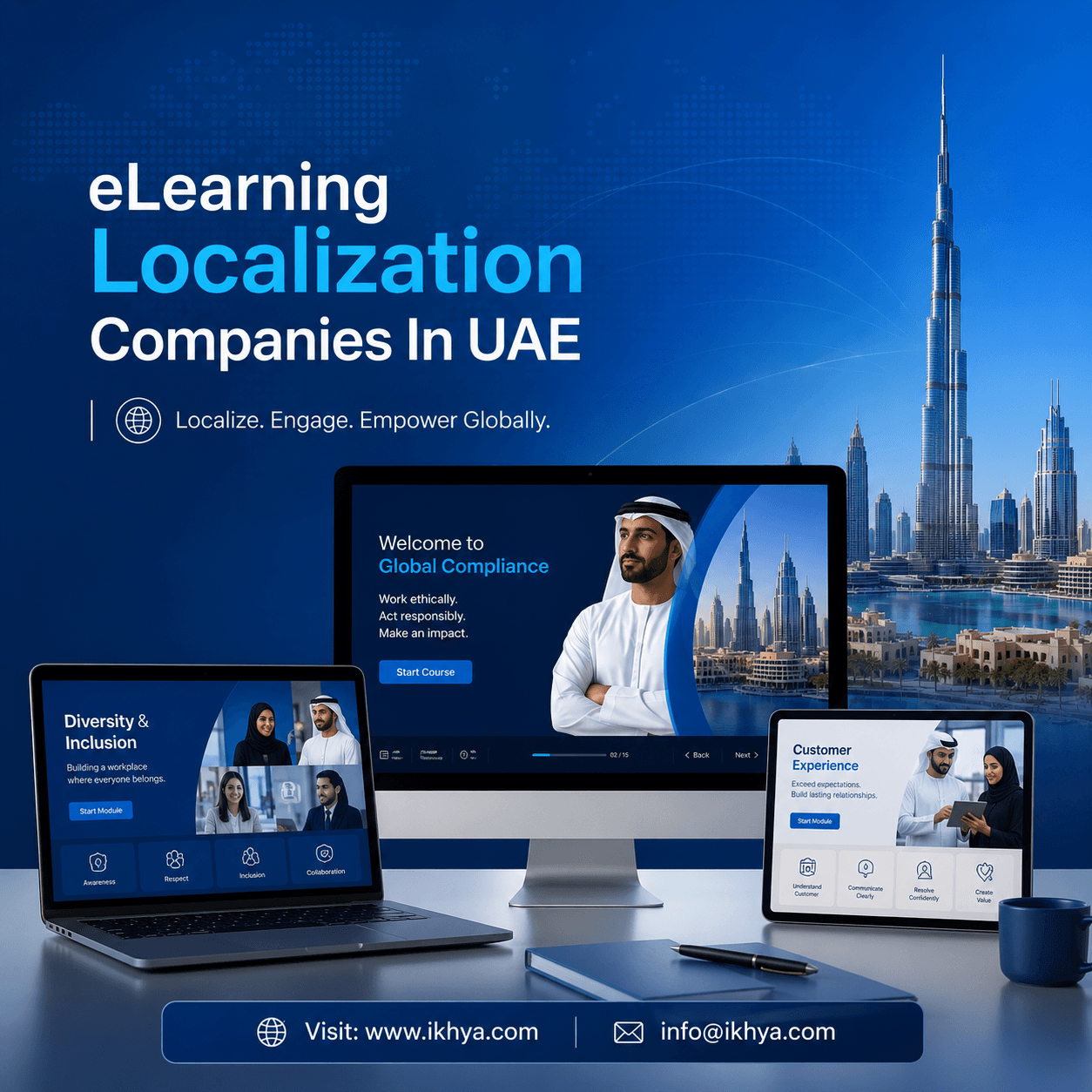


eLearning Localization Companies In UAE
eLearning localization companies in UAE help organisations deliver training that matches local language, culture, and compliance requirements. Many businesses in the UAE now support multilingual teams across finance, healthcare, aviation, logistics, retail, and government sectors. Training content that works in one region often fails in another when language, examples, and learning styles do not match the audience.
Choosing the wrong provider creates delays, weak learner engagement, and compliance risks across multilingual workforce training programmes.
IKHYA supports UAE organisations with localisation planning, Arabic learning adaptation, and multilingual training delivery. Contact info@ikhya.com.
Why UAE Businesses Are Rethinking How They Approach eLearning Localization
eLearning localization companies in UAE now play a central role in workforce training strategies across regulated and multilingual industries. Organisations in the UAE employ teams from different language backgrounds, education systems, and cultural environments. A standard English-only learning programme rarely delivers the same results across these groups. Companies now need training that feels relevant, clear, and locally aligned.
Localization goes beyond translation. A provider must adapt learning scenarios, examples, visual references, assessments, and platform experiences for the learner audience. In the UAE, Arabic language support is important for many organisations, especially in government-linked industries, healthcare, financial services, logistics, and energy. Businesses also require learning systems that support both Arabic and English interfaces without reducing usability.
The UAE market has also become more compliance-focused. Companies need audit-ready learning records, standardised onboarding, and role-based training delivery. Poor localisation can create misunderstanding during safety training, policy education, and operational learning. This creates legal and operational risk for employers.
Strong localisation improves learner completion rates, employee understanding, and training consistency across departments. Businesses now expect eLearning localization companies in UAE to support strategy, instructional design, platform delivery, and multilingual learner engagement together.
eLearning Localization Companies Operating in UAE — Who They Are and What They Do
- IKHYA – eLearning Solutions Company provides multilingual eLearning localization, instructional design, LMS implementation, and custom digital learning services for UAE organisations. The company supports Arabic and English learning delivery while adapting content for sector-specific compliance and workforce training needs.
- Docebo supports enterprise learning management with multilingual platform capabilities and localisation-ready delivery environments. The company works with organisations that need scalable employee learning experiences across regional teams.
- Biz Group delivers corporate learning services, leadership development, and digital learning support for organisations operating across the Gulf region. The company supports blended learning delivery with regional workforce adaptation.
- TalentLMS offers cloud-based LMS solutions with multilingual learning support and mobile-ready training environments. Organisations often use the platform for onboarding, compliance, and distributed workforce learning.
- Edufic Digital focuses on digital learning production, interactive content, and corporate training support for businesses in the Middle East. The company supports multilingual content development and training deployment.
- Capytech provides digital transformation and learning technology services that support training localisation and platform integration. Businesses use its services to improve learner accessibility and delivery consistency.
- Knowledge Horizon develops digital learning experiences for corporate and academic environments in the UAE and wider GCC region. The company supports Arabic learning adaptation and online programme delivery.
- Stylus Solutions works on custom eLearning production, training translation, and multimedia learning content development. Its projects often focus on learner engagement and visual adaptation.
- iLearn Me supports training content delivery for regional businesses through digital learning systems and learning consultancy services. The company works with organisations looking for flexible workforce learning delivery.
- Protraining provides workplace training support, certification programmes, and learning delivery services for corporate environments. Its digital training capabilities include multilingual content support and learner tracking.
What Is Driving Demand for eLearning Localization Across UAE Sectors
The Multinational Workforce Challenge That UAE Organisations Can No Longer Ignore
The UAE workforce includes employees from many language and cultural backgrounds. This creates a major challenge for organisations delivering standardised training across departments and business units. English-only learning often causes misunderstanding during compliance, onboarding, safety, and operational education. Employees may complete training modules without fully understanding the information.
eLearning localization companies in UAE now help businesses redesign learning experiences for multilingual audiences. This includes Arabic translation, voice-over adaptation, regional examples, and interface localisation. Effective localisation improves learner confidence because employees see familiar language structures and culturally relevant learning situations. Organisations also gain stronger reporting outcomes because training engagement improves when content feels accessible and clear.
Compliance Requirements and What They Mean for eLearning Localization in UAE
Regulated sectors in the UAE now expect stronger documentation and clearer employee training records. Healthcare providers, banks, aviation operators, and energy companies often require structured compliance education with audit-ready reporting. A poorly translated learning programme can create confusion during policy training or technical instruction.
Localization providers help organisations reduce this risk by adapting assessments, terminology, and workflow examples for regional operations. Arabic localisation is especially important where local regulation or workforce communication standards require bilingual training support. Many organisations now include localisation quality checks inside procurement processes because compliance training accuracy directly affects operational performance.
Why UAE Government and Enterprise Teams Require a Different Localization Approach
Government-linked organisations and large enterprises in the UAE often require a more structured localisation process than smaller businesses. Training programmes usually involve multiple departments, large employee groups, and strict approval cycles. Learning content must align with organisational terminology, branding, and operational language standards.
eLearning localization companies in UAE increasingly support enterprise governance processes through structured workflows, review cycles, and stakeholder collaboration models. Providers must coordinate with HR teams, compliance managers, learning administrators, and regional leadership groups. This approach ensures training consistency across locations while maintaining local relevance for learners.
What a Full-Service eLearning Localization Company in UAE Should Actually Deliver
Arabic Language Adaptation and Cultural Learning Alignment
Strong localisation providers do more than direct translation. They redesign learning interactions so they match local workplace communication styles and learner expectations. Arabic localisation often requires right-to-left formatting support, rewritten examples, and culturally appropriate visuals. These changes improve learner understanding and platform usability.
Many organisations underestimate how much cultural adaptation affects learning outcomes. Employees engage more effectively when training scenarios reflect familiar workplace environments. UAE organisations increasingly expect localisation providers to combine instructional design knowledge with language expertise. This creates training that feels natural rather than mechanically translated.
Multilingual LMS Integration and Learning Delivery Support
Modern training programmes rely on learning management systems that support multilingual user experiences. A localisation provider should understand how translated content behaves inside the LMS environment. This includes navigation structures, reporting systems, assessment logic, and mobile compatibility across language settings.
eLearning localization companies in UAE often support LMS configuration for Arabic and English learners. Providers may also assist with SCORM packaging, user testing, and multilingual learner analytics. Businesses benefit when localisation and platform delivery happen together because technical issues are resolved earlier during deployment.
Instructional Design and Scenario-Based Content Development
Instructional design shapes how employees absorb and apply training information. A localisation company should understand how different audiences respond to examples, interactions, and assessment methods. Generic translated text rarely creates strong learning engagement without instructional redesign.
UAE organisations increasingly request scenario-based learning that reflects local operational environments. This may include regional customer interactions, compliance situations, workplace communication norms, and sector-specific workflows. Localization providers who understand instructional strategy can create stronger learner outcomes than translation-only vendors.
How the Right eLearning Localization Partner Changes Outcomes for UAE Organisations
- Higher learner engagement comes from training content that employees understand without struggling through unfamiliar language structures or examples. This improves course completion rates and reduces learner frustration across multilingual teams.
- Improved compliance readiness helps organisations maintain stronger audit preparation through consistent employee understanding and documented training completion. Businesses in healthcare, aviation, and finance benefit from clearer policy communication.
- Faster onboarding delivery allows HR teams to train new employees across multiple locations without rebuilding content repeatedly for different language groups. This supports operational consistency during workforce growth.
- Better regional scalability helps organisations expand training programmes across GCC markets while keeping learning standards aligned. A structured localisation process reduces duplication during regional deployment.
- Stronger employee retention often follows when workers feel included in workplace communication and development programmes. Employees engage more positively when training respects their language preferences.
- Reduced operational misunderstandings support safer and more reliable workplace performance, especially in technical industries. Clear multilingual instruction lowers the risk of process errors and compliance gaps.
Inside the UAE eLearning Localization Market — Provider Profiles and Capabilities
IKHYA – eLearning Solutions Company
IKHYA is an eLearning solutions company that supports organisations across the UAE with multilingual learning, localisation, instructional design, and digital training delivery. Our team works with businesses that require Arabic and English learning experiences aligned with operational and compliance goals. We support enterprise training environments across corporate, government, and regulated sectors.
We offer custom eLearning development, LMS implementation, content localisation, voice-over adaptation, learning translation, and mobile learning support. Our team combines instructional design with localisation planning so training remains engaging after language adaptation. IKHYA provides structured review workflows that help organisations maintain accuracy across large learning libraries.
Our experience includes healthcare training, financial services education, onboarding programmes, aviation learning, energy sector compliance, and workforce safety education. We understand that UAE organisations often require bilingual learning delivery supported by regional compliance expectations. This allows us to adapt learning experiences for operational environments that demand precision and consistency.
IKHYA provides platform support for multilingual LMS delivery, SCORM integration, learner analytics, and mobile learning optimisation. Our team works with organisations that need Arabic right-to-left learning environments alongside English delivery systems. We also support content testing to improve usability across devices and learner groups.
We work closely with client teams through structured communication, milestone reviews, and collaborative production workflows. Our project approach focuses on transparency, learner outcomes, and operational alignment. This helps organisations manage localisation projects without losing visibility across approvals and delivery timelines.
Organisations looking for eLearning localization companies in UAE often choose IKHYA because we combine localisation strategy with instructional design and technical delivery support. Our team works directly with stakeholders to align learning goals, employee communication, and multilingual delivery needs. For project discussions or consultation support, contact info@ikhya.com.
Docebo
Docebo provides enterprise learning technology with multilingual learning capabilities suitable for international workforce environments. Organisations use the platform to manage onboarding, compliance training, and employee development across distributed teams. The company supports localisation-ready delivery through configurable learning environments and reporting tools.
Biz Group
Biz Group supports corporate learning and workforce development across the UAE and GCC region. The company delivers leadership training, digital learning support, and blended learning programmes for enterprise clients. Its localisation support helps organisations adapt training for multilingual employee groups.
TalentLMS
TalentLMS offers cloud-based learning management services with multilingual support and flexible deployment options. Businesses use the platform for employee onboarding, operational training, and distributed learning delivery. The system supports mobile learning access and simplified administration for regional teams.
Edufic Digital
Edufic Digital develops interactive learning experiences and digital training solutions for businesses across the Middle East. The company supports localisation projects that require multimedia learning adaptation and bilingual content support. Organisations often use its services for employee learning engagement initiatives.
Capytech
Capytech provides technology-focused learning support that includes platform integration and digital training delivery. The company works with businesses modernising employee learning systems and multilingual content distribution. Its services support operational consistency across learning environments.
Knowledge Horizon
Knowledge Horizon develops online learning environments and digital education support for corporate and academic sectors. The company supports multilingual programme delivery and regional learning adaptation. Organisations use its services for scalable digital learning initiatives.
Stylus Solutions
Stylus Solutions focuses on eLearning production, content adaptation, and multimedia localisation support. The company works with organisations that require visually engaging learning experiences across multiple languages. Its projects often involve custom digital learning modules and instructional redesign.
iLearn Me
iLearn Me supports digital learning implementation and employee training delivery for businesses in the UAE region. The company provides flexible learning solutions that help organisations improve workforce education access. Its services include online training support and learning platform guidance.
Protraining
Protraining provides workplace learning services, certification support, and digital training delivery for business environments. The company supports multilingual training deployment and learner administration. Organisations use its services for structured employee education and compliance programmes.
How UAE eLearning Localization Companies Compare Across Key Criteria
| Company | Primary Focus | Arabic Localization | LMS Support | Enterprise Capability | Industry Coverage |
|---|---|---|---|---|---|
| IKHYA | Custom multilingual eLearning | Strong | Advanced | High | Healthcare, finance, aviation, energy |
| Docebo | Enterprise LMS | Moderate | Advanced | High | Corporate enterprise |
| Biz Group | Corporate learning | Moderate | Moderate | High | Leadership and workforce training |
| TalentLMS | Cloud LMS delivery | Moderate | Advanced | Medium | General business training |
| Edufic Digital | Interactive learning content | Strong | Moderate | Medium | Corporate learning |
| Capytech | Learning technology integration | Moderate | Strong | Medium | Digital transformation |
| Knowledge Horizon | Online education delivery | Strong | Moderate | Medium | Academic and enterprise |
| Stylus Solutions | Content localisation | Strong | Basic | Medium | Custom learning projects |
| iLearn Me | Digital learning support | Moderate | Moderate | Medium | Corporate learning |
| Protraining | Workplace training | Basic | Basic | Medium | Certification and compliance |
eLearning Localization Pricing in UAE — What Shapes the Investment
Pricing depends on content complexity, language requirements, platform integration, multimedia adaptation, and review cycles. Arabic localisation projects often require additional formatting and quality review work. Enterprise projects with compliance requirements usually involve larger stakeholder groups and structured approval stages.
| Project Type | Typical Scope | Estimated Range | Main Pricing Factors |
|---|---|---|---|
| Course translation | Single learning module | Low to medium | Language count, review cycles |
| Multilingual onboarding | Employee induction programme | Medium | Media production, LMS setup |
| Compliance localisation | Regulated training adaptation | Medium to high | Approval workflows, accuracy checks |
| Custom interactive learning | Scenario-based learning modules | High | Instructional design and multimedia |
| LMS localisation | Platform and learner interface setup | Medium | Technical integration requirements |
Organisations planning multilingual learning programmes can contact info@ikhya.com for localisation planning discussions and project guidance.
The Platforms and Tools UAE eLearning Localization Companies Use to Deliver Results
| Tool or Platform | Primary Use | Best Fit | Adoption Level |
|---|---|---|---|
| Articulate Storyline | Interactive eLearning production | Corporate training | High |
| Adobe Captivate | Simulation and software training | Technical learning | Medium |
| Moodle | Open-source LMS delivery | Academic and enterprise | High |
| Docebo LMS | Enterprise learning management | Large organisations | High |
| TalentLMS | Cloud learning deployment | Mid-sized businesses | Medium |
| Vyond | Animated training content | Employee engagement | Medium |
| Rise 360 | Responsive microlearning | Mobile learning | High |
The eLearning Localization Delivery Process Explained — Phase by Phase
| Phase | Key Activities | Client Involvement | Typical Duration |
|---|---|---|---|
| Discovery | Training audit and learner review | High | 1 week |
| Content Review | Language and technical analysis | Medium | 1 week |
| Localization Planning | Workflow and language strategy | High | 1 week |
| Translation | Content adaptation and review | Medium | 2 to 3 weeks |
| Instructional Redesign | Scenario and interaction updates | Medium | 1 to 2 weeks |
| Technical Integration | LMS testing and SCORM setup | Low | 1 week |
| Quality Assurance | Functional and language testing | High | 1 week |
| Deployment | Go-live and learner support | Medium | Ongoing |
How Different UAE Industries Are Using eLearning Localization to Solve Real Problems
| Industry | Common Training Topics | Main Challenges | Preferred Delivery Format |
|---|---|---|---|
| Healthcare | Patient safety and compliance | Language clarity | Interactive modules |
| Finance | Risk and policy education | Regulatory accuracy | LMS learning paths |
| Aviation | Safety procedures | Technical terminology | Simulation learning |
| Retail | Customer service training | Workforce diversity | Mobile microlearning |
| Energy | Operational safety | Compliance consistency | Scenario-based learning |
| Government | Policy communication | Bilingual delivery | Structured online learning |
How eLearning Localization in UAE Is Changing and What It Means for Buyers
AI Translation Review Systems and Their Impact on eLearning Localization in UAE
Artificial intelligence tools now support parts of the translation process across digital learning projects. These systems speed up terminology checks, draft translation support, and multilingual consistency reviews. UAE organisations increasingly use AI-assisted workflows to manage large learning libraries more efficiently.
Human review still remains critical for instructional quality and cultural adaptation. Businesses now expect providers to combine AI efficiency with expert localisation oversight. This hybrid model improves turnaround times while maintaining learning clarity and compliance accuracy.
How Mobile Learning Is Changing the Way UAE Organisations Approach Localization
Employees across the UAE now access training through smartphones and tablets more often than desktop systems. This shift changes how localisation providers design content, navigation, and learner interactions. Long text-heavy learning modules perform poorly on mobile devices.
Localization companies now focus on shorter learning segments, simplified navigation, and mobile-ready Arabic formatting. Organisations benefit because employees can access training more easily during operational workflows and remote work situations.
The Rise of Personalized Learning Among UAE Enterprise Organisations
Large organisations increasingly want role-based learning paths that adapt to employee responsibilities and experience levels. This trend affects localisation because learning journeys must remain consistent across languages while supporting personalised content delivery.
eLearning localization companies in UAE now integrate learner analytics and adaptive learning strategies into multilingual projects. Businesses use these systems to improve engagement and training relevance across departments.
Why Accessibility Support Is Becoming a Standard Expectation in UAE eLearning Localization
Accessibility is becoming more important across corporate learning environments in the UAE. Organisations now expect training content to support learners with different accessibility needs and device preferences. This includes subtitle support, screen-reader compatibility, and flexible content structures.
Localization providers increasingly include accessibility reviews during production workflows. This improves learning access for broader employee groups while helping organisations meet inclusion goals across workforce development programmes.
The Questions Every UAE Organisation Should Ask an eLearning Localization Provider
Choosing between eLearning localization companies in UAE requires more than comparing translation capability alone. Organisations should evaluate instructional quality, delivery structure, platform support, and regional experience before selecting a provider.
- Ask about Arabic localisation experience because language support alone does not guarantee cultural learning alignment. Providers should explain how they adapt learning scenarios and user experiences for regional audiences.
- Review instructional design capability to understand whether the provider improves learning effectiveness after translation. Strong localisation requires engagement strategy, not only language conversion.
- Check LMS integration experience so technical delivery problems do not delay deployment. Providers should explain how they manage multilingual learner environments.
- Request quality assurance workflows to confirm how the provider checks language accuracy and technical functionality. Structured review systems reduce deployment risk.
- Evaluate compliance sector experience if your organisation operates in healthcare, aviation, energy, or finance. Regulated industries require greater precision during localisation.
- Understand project communication models before work begins because multilingual projects involve many review stages. Clear communication improves delivery speed and stakeholder alignment.
- Review multimedia adaptation capability for projects involving animation, voice-over, or interactive learning experiences. Multimedia localisation affects learner engagement significantly.
- Ask about post-launch support to ensure the provider can update and maintain multilingual learning libraries after deployment. Ongoing support becomes important during policy changes and business growth.
Businesses that evaluate providers carefully often achieve stronger learner engagement, smoother deployment, and better long-term training consistency across multilingual workforces.
How IKHYA Approaches eLearning Localization for Clients in UAE
IKHYA approaches localisation as a learning strategy rather than a translation task. Our team works closely with UAE organisations to understand workforce communication needs, regulatory expectations, and operational learning goals before production starts.
We provide multilingual instructional design, Arabic localisation, LMS support, interactive learning production, and deployment planning through structured project workflows. Our team focuses on creating learning experiences that remain engaging after localisation instead of producing direct language conversions.
IKHYA supports organisations across healthcare, finance, aviation, logistics, government, and energy sectors. We understand that different industries require different review processes, compliance structures, and learning delivery approaches. This helps us align localisation projects with real operational requirements.
Our team also supports long-term learning management through update planning, multilingual content maintenance, and learner analytics guidance. We work collaboratively with internal stakeholders so organisations maintain visibility throughout project delivery.
Businesses looking for practical support from experienced eLearning localization companies in UAE can contact IKHYA directly at info@ikhya.com for consultation and project discussions.
Ready to Move Forward With eLearning Localization in UAE? Let's Talk
Organisations across the UAE now recognise that multilingual learning requires more than simple translation. Effective localisation improves learner understanding, supports compliance, and strengthens workforce communication across diverse employee groups.
The right provider should understand instructional design, platform delivery, Arabic localisation, and enterprise learning governance together. Businesses that evaluate localisation strategically often achieve stronger training consistency and better employee engagement.
If your organisation is planning multilingual training delivery, onboarding localisation, or Arabic eLearning adaptation, contact info@ikhya.com to discuss your project requirements and delivery goals.
FAQs
Related Top eLearning Companies & Solutions in the UAE
UAE organizations are adopting digital learning to support hybrid workforces, compliance training, multilingual learning, and workforce development. Businesses increasingly rely on eLearning solutions to improve onboarding, employee engagement, and operational consistency.
Explore leading eLearning providers, LMS platforms, instructional design specialists, and compliance training solutions across the UAE.
At IKHYA – eLearning Solutions Company, we design impactful, compliance-driven, and performance-focused digital learning solutions tailored to your business goals.
🎯 Custom eLearning Course Development
⚡ Rapid eLearning & PPT Conversion
📊 Workplace Compliance Training
🌍 Localization & LMS-Ready Modules