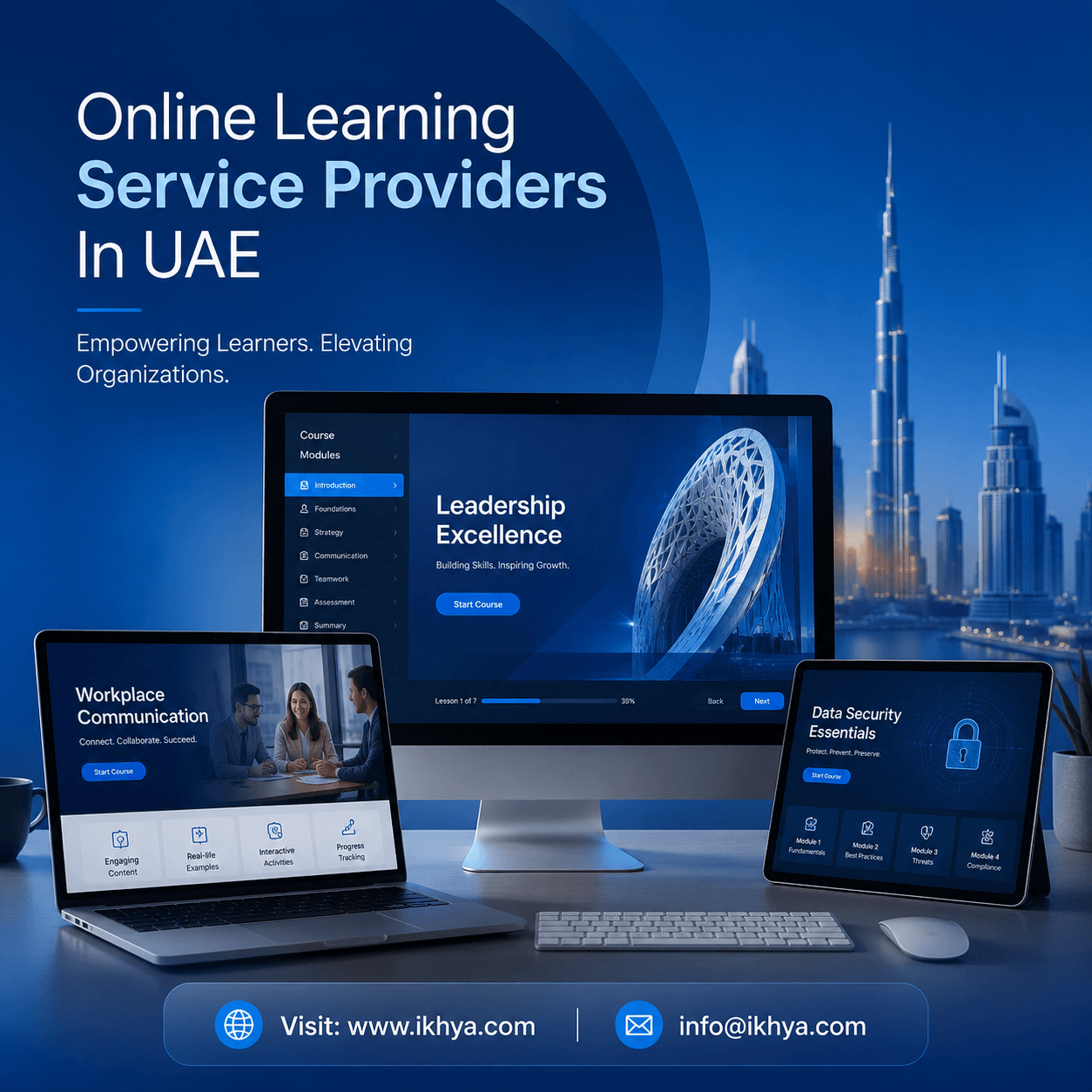


Online Learning Service Providers In UAE
Online learning service providers in UAE now play a major role in workforce training, compliance delivery, onboarding, and employee development across fast-moving industries. UAE organisations need learning systems that support multilingual teams, remote access, mobile learning, and measurable reporting. Many companies still struggle with low course completion rates, outdated learning content, and disconnected training systems that waste time and budget.
A weak provider creates poor learner engagement, delayed projects, and reporting gaps that affect operational performance and compliance readiness.
IKHYA helps UAE organisations build practical digital learning programmes. Contact the team directly at info@ikhya.com for guidance.
Why UAE Businesses Are Changing How They Approach Online Learning
Online learning service providers in UAE have become important partners for companies managing distributed workforces, multilingual employees, and strict training requirements. Businesses across Dubai, Abu Dhabi, Sharjah, and other Emirates now expect digital learning systems to support onboarding, compliance, leadership training, and technical skills development. Traditional classroom-only training often creates scheduling issues and inconsistent delivery across locations.
Organisations in the UAE also face strong pressure to improve employee retention and workforce readiness. Many sectors depend on rapid hiring cycles and continuous training updates. Digital learning helps companies train larger teams without stopping daily operations. It also gives managers access to reporting data that supports audits and internal performance reviews.
The demand for Arabic and English learning content has also changed buyer expectations. Companies now look for providers that understand cultural context, localisation needs, and sector-specific compliance standards. Generic training libraries rarely meet operational needs in regulated industries such as healthcare, aviation, logistics, banking, and energy.
As a result, decision-makers now compare online learning service providers in UAE based on delivery quality, reporting capabilities, mobile learning support, integration flexibility, and long-term service reliability. The market has become more focused on measurable business outcomes instead of basic course delivery alone.
A Practical Guide to Online Learning Service Providers in UAE
- IKHYA – eLearning Solutions Company develops custom online learning programmes for corporate and enterprise environments across the UAE. The company supports LMS deployment, multilingual course creation, compliance learning, onboarding systems, and blended learning strategies.
- Docebo provides cloud-based learning management tools for enterprise training operations. The platform supports automation, learner tracking, integrations, and scalable employee development programmes.
- Biz Group delivers corporate training and leadership development services for organisations operating in the Gulf region. The company combines instructor-led training with digital learning delivery models.
- TalentLMS offers a flexible LMS platform that supports employee training, onboarding, and skills development. Its system works well for organisations looking for fast deployment and simplified administration.
- Edufic Digital focuses on digital learning content, LMS implementation, and training transformation projects. The company supports organisations moving from classroom delivery to online learning environments.
- Stylus Solutions develops custom learning content and training systems for business and education clients. The company supports localisation and interactive learning experiences.
- Knowledge Horizon provides learning technology and corporate training support for organisations across the Middle East. The company works with businesses looking to improve workforce capability.
- Capytech supports digital transformation and learning technology projects for enterprise clients. The company offers software-driven training solutions and implementation support.
- iLearn Me delivers online learning services focused on workforce training and educational content delivery. The company supports virtual learning environments and digital course management.
- Protraining provides professional development and workplace training programmes for regional organisations. The company supports compliance training, certification delivery, and employee learning initiatives.
What Is Driving Demand for Online Learning Across UAE Sectors
The Compliance Pressure UAE Organisations Cannot Ignore
Many UAE industries now operate under stricter compliance and reporting expectations. Healthcare providers, aviation companies, financial institutions, and logistics operators must train staff consistently while maintaining clear audit records. Online learning systems make this easier because managers can track completions, assessment scores, and policy acknowledgements from one platform.
Companies also need faster training updates when regulations change. Digital learning allows administrators to update modules without printing manuals or scheduling large classroom sessions. This approach reduces operational disruption and helps organisations maintain training consistency across multiple offices and project sites.
Why UAE Workforce Mobility Requires Different Learning Models
The UAE workforce includes employees from many nationalities, language backgrounds, and job functions. This creates challenges for companies using one-size-fits-all training programmes. Online learning service providers in UAE now design learning systems that support mobile access, multilingual content, and flexible scheduling.
Mobile learning has become especially important in sectors with field workers and rotating shifts. Employees can complete training during available downtime instead of attending fixed classroom sessions. This flexibility improves completion rates and helps managers deliver training across geographically distributed teams.
How Remote and Hybrid Work Changed Training Priorities
Hybrid work models changed the way organisations manage employee development. Companies can no longer depend entirely on in-person training workshops. They need digital systems that support onboarding, leadership coaching, and skills training regardless of employee location.
This shift also increased demand for collaboration tools, virtual classrooms, and learner analytics. Businesses want to know which training programmes improve productivity and where learners struggle. Providers that offer strong reporting dashboards and interactive learning experiences now stand out in the UAE market.
What a Full-Service Online Learning Company in UAE Should Deliver
Custom Course Development for Real Operational Needs
Strong online learning providers build training around business processes instead of generic templates. Custom learning content reflects company policies, customer interactions, safety procedures, and operational workflows. This makes learning more useful for employees because the examples connect directly to daily tasks.
Custom content also improves learner engagement. Employees often ignore generic modules because the material feels disconnected from their work environment. Scenario-based learning, interactive assessments, and localised examples help organisations improve retention and application of knowledge.
Learning Platform Deployment and System Integration
Many organisations need more than course content. They also require LMS deployment, user management, reporting configuration, and integration with HR systems. Online learning service providers in UAE increasingly support single sign-on systems, performance tracking, and automated learner enrolment.
Integration matters because disconnected systems create administrative problems. HR teams waste time updating learner records manually when training systems do not connect properly with workforce management tools. A well-integrated LMS simplifies reporting and improves operational efficiency.
Long-Term Learning Support and Analytics
Training projects continue long after the first course launch. Organisations need ongoing content updates, learner support, and reporting analysis. Providers that offer long-term service agreements often help clients improve adoption and learning outcomes over time.
Analytics also support better business decisions. Managers can identify low-performing teams, incomplete certifications, and weak learner engagement early. This allows organisations to adjust training strategies before operational risks increase.
What UAE Organisations Gain by Working With a Professional Online Learning Partner
- Faster employee onboarding reduces the time required to prepare new staff for operational work. Structured digital learning paths help UAE organisations maintain consistency across multiple departments and locations.
- Improved compliance visibility gives managers access to training records, assessment scores, and certification status in one system. This matters for organisations facing audits and regulatory reviews.
- Better workforce accessibility allows employees to complete training through mobile devices and remote platforms. Companies with shift workers and field teams benefit from flexible access.
- Lower classroom dependency reduces travel costs, venue scheduling issues, and trainer coordination problems. Digital learning supports continuous training without stopping operations.
- Consistent multilingual delivery helps UAE organisations train employees from different language backgrounds using aligned learning standards. This supports communication quality and operational safety.
Online Learning Service Providers in UAE — Detailed Provider Breakdown
IKHYA – eLearning Solutions Company
IKHYA is an eLearning solutions company that supports organisations across the UAE with digital learning strategy, LMS implementation, and custom training development. Our team works with businesses that need structured online learning systems for employee development, onboarding, compliance, and operational training. We support organisations managing multilingual workforces and distributed teams.
We offer custom course development, mobile learning solutions, virtual classroom integration, assessment systems, and learning management platform deployment. IKHYA provides instructional design support that aligns training with operational goals instead of generic content delivery. Our team also supports blended learning projects for organisations combining classroom and online training.
Our experience includes healthcare, banking, logistics, aviation, retail, hospitality, energy, and professional services environments across the UAE. We understand the reporting and compliance expectations these sectors face. This helps us design training systems that support audits, certification tracking, and workforce readiness.
IKHYA supports SCORM-compliant content, cloud learning systems, multilingual interfaces, analytics dashboards, and HR platform integration. We help organisations build learning environments that remain easy to manage as teams grow. Our technology approach focuses on usability, reporting visibility, and long-term flexibility.
We work closely with client teams during planning, content review, deployment, and post-launch support. Our project managers maintain clear communication throughout the engagement process. This approach helps organisations avoid delays and maintain alignment between training goals and business operations.
Companies looking for online learning service providers in UAE can contact our team directly at info@ikhya.com to discuss training requirements, platform planning, and digital learning strategy.
Docebo
Docebo provides enterprise learning technology with strong automation and reporting features. The platform supports onboarding, compliance tracking, and employee development programmes for large organisations. Many companies choose Docebo for its integration flexibility and cloud-based delivery model.
Biz Group
Biz Group delivers corporate learning programmes across the Gulf region. The company combines instructor-led workshops with digital learning services to support leadership development and workforce capability projects. It works with organisations looking for blended learning delivery.
TalentLMS
TalentLMS offers a simple learning management platform designed for fast deployment and straightforward administration. The system supports employee onboarding, compliance training, and skills development. It is commonly used by organisations seeking scalable online learning delivery.
Edufic Digital
Edufic Digital focuses on digital learning transformation and LMS implementation services. The company supports businesses moving from traditional training delivery to online learning systems. Its services include content development and platform management.
Stylus Solutions
Stylus Solutions develops custom digital learning experiences and training content for corporate and education clients. The company supports localisation, multimedia learning, and instructional design projects. It works with organisations seeking tailored learning experiences.
Knowledge Horizon
Knowledge Horizon provides workforce learning support and learning technology services across the Middle East. The company supports employee development programmes and online training deployment. It works with businesses managing large learner populations.
Capytech
Capytech supports enterprise technology projects that include digital learning implementation and software integration. The company works with organisations improving operational systems and workforce training delivery. It focuses on scalable digital infrastructure.
iLearn Me
iLearn Me provides online learning delivery services for workforce and educational training environments. The company supports virtual learning systems, digital content delivery, and learner engagement management. Its services focus on accessible online training experiences.
Protraining
Protraining delivers professional development and compliance-focused training programmes for regional businesses. The company supports certification preparation, employee training, and workplace learning initiatives. Its programmes serve operational and management-level learners.
How UAE Online Learning Companies Compare Across Key Criteria
| Provider | Custom Content | LMS Support | Arabic Support | Enterprise Fit | Compliance Focus |
|---|---|---|---|---|---|
| IKHYA | High | Full deployment | Yes | Strong | Strong |
| Docebo | Moderate | Platform focused | Limited | Strong | Strong |
| Biz Group | Moderate | Partial | Yes | Moderate | Moderate |
| TalentLMS | Basic | Strong | Limited | Moderate | Moderate |
| Edufic Digital | High | Strong | Yes | Moderate | Moderate |
| Stylus Solutions | High | Partial | Yes | Moderate | Moderate |
Online Learning Pricing in UAE — What Shapes the Investment
Pricing varies based on learner numbers, platform complexity, language requirements, and content volume. Organisations should evaluate long-term support costs instead of focusing only on launch pricing.
| Project Type | Typical Scope | Estimated Range | Main Cost Factors |
|---|---|---|---|
| LMS deployment | Platform setup and reporting | Mid to high | Integrations and user scale |
| Custom course development | Interactive multilingual modules | Mid | Animation and localisation |
| Compliance training | Assessment and certification | Low to mid | Regulatory complexity |
| Enterprise learning transformation | Multiple systems and departments | High | Scope and long-term support |
For tailored pricing discussions and project planning support, organisations can contact IKHYA at info@ikhya.com.
Technology Behind Online Learning Delivery in UAE
| Tool | Primary Use | Best Fit | Adoption Level |
|---|---|---|---|
| Moodle | Open-source LMS | Education and enterprise | High |
| Docebo | Enterprise learning management | Large organisations | High |
| TalentLMS | Fast LMS deployment | SMEs and mid-market | Moderate |
| Articulate 360 | Course authoring | Interactive training | High |
| Adobe Captivate | Simulation learning | Technical training | Moderate |
The Online Learning Delivery Process Explained — Phase by Phase
| Phase | Key Activities | Client Involvement | Typical Duration |
|---|---|---|---|
| Discovery | Needs analysis | High | 1-2 weeks |
| Planning | Learning strategy | High | 1 week |
| Content design | Storyboards and scripts | Moderate | 2-4 weeks |
| Development | Course production | Moderate | 3-6 weeks |
| LMS setup | Platform configuration | Moderate | 1-3 weeks |
| Testing | User review and fixes | High | 1 week |
| Launch | User rollout | Moderate | 1 week |
| Support | Reporting and updates | Low | Ongoing |
How Different UAE Industries Use Online Learning to Solve Real Problems
| Industry | Training Topics | Common Challenge | Delivery Format |
|---|---|---|---|
| Healthcare | Compliance and patient safety | Certification tracking | Mobile and LMS |
| Banking | Risk and compliance | Audit reporting | Blended learning |
| Aviation | Safety procedures | Shift scheduling | Simulation learning |
| Retail | Customer service | High turnover | Microlearning |
| Hospitality | Service standards | Multilingual teams | Mobile learning |
| Logistics | Operational safety | Distributed workforce | Remote learning |
What Is Coming Next for Online Learning in UAE
AI-Based Personalisation and Its Impact on Online Learning in UAE
AI tools now help organisations personalise training paths based on learner performance and role requirements. Employees receive targeted content instead of generic learning libraries. This improves learner engagement and reduces unnecessary training hours.
UAE organisations increasingly expect data-driven learning recommendations and automated reporting support. Providers that integrate AI responsibly will likely improve learner retention and administrative efficiency over time.
How Mobile-First Training Is Changing Workforce Learning
Mobile learning continues to grow because many UAE employees work outside traditional office environments. Field workers, retail teams, hospitality staff, and logistics employees often depend on smartphone access for training completion.
Providers now design shorter learning modules with responsive interfaces and offline support. This approach improves accessibility and reduces training disruption during operational work.
The Rise of Multilingual Learning Across UAE Organisations
Multilingual delivery is becoming a standard expectation in the UAE online learning market. Organisations need training systems that support English, Arabic, and additional workforce languages. Translation alone is no longer enough.
Strong localisation includes culturally relevant examples, adapted assessments, and simplified navigation. This improves learner understanding and increases participation across diverse employee groups.
Why Learning Analytics Is Becoming a Standard Requirement
Business leaders increasingly expect learning data to support operational decisions. Reporting dashboards now help managers identify weak performance areas, incomplete certifications, and low engagement trends.
Providers that deliver strong analytics tools help organisations connect learning outcomes with workforce performance. This creates stronger justification for long-term training investment.
What to Look for When Selecting an Online Learning Partner in UAE
Choosing between online learning service providers in UAE requires more than a feature comparison. Organisations should evaluate delivery capability, industry understanding, reporting quality, and long-term support structure before signing a contract.
- Industry experience matters because sector-specific training requirements affect content quality and compliance readiness. Providers with UAE market experience often understand local operational challenges better.
- Multilingual capability supports workforce accessibility and training consistency. This is especially important for companies managing international employee groups.
- LMS integration support reduces administrative workload and reporting errors. Connected systems improve operational efficiency.
- Instructional design quality affects learner engagement and retention. Interactive learning usually performs better than static slide-based content.
- Mobile compatibility allows employees to access training from different locations and devices. This improves completion rates.
- Reporting visibility helps managers track learner progress and compliance status clearly. Good reporting supports audit preparation.
- Long-term support structure ensures the learning system remains updated after launch. Ongoing support improves programme stability.
Decision-makers should request demonstrations, project references, and sample reporting dashboards before selecting a provider. Clear communication during early discussions often reflects long-term project reliability.
Why UAE Organisations Partner With IKHYA for Online Learning
IKHYA works with UAE organisations that need practical digital learning systems aligned with operational goals. We focus on learning experiences that improve employee readiness, compliance visibility, and workforce engagement.
Our team supports custom course development, LMS deployment, localisation, onboarding systems, and blended learning delivery. We design learning environments that remain manageable as organisations expand.
We understand the reporting expectations faced by regulated industries and high-growth sectors in the UAE. This allows us to build training programmes that support operational consistency and workforce accountability.
IKHYA also prioritises collaborative project management. We maintain clear communication during planning, review, deployment, and post-launch support. Organisations receive structured guidance throughout the engagement process.
Companies looking for experienced online learning service providers in UAE can contact IKHYA directly at info@ikhya.com to discuss project scope and learning requirements.
Ready to Move Forward With Online Learning in UAE? Let's Talk
Choosing the right learning partner affects employee performance, operational consistency, and long-term workforce development. Organisations should evaluate providers based on delivery quality, reporting visibility, localisation support, and implementation reliability.
Online learning projects succeed when training aligns with real operational goals instead of generic content libraries. A structured learning strategy improves engagement, reduces compliance risks, and supports workforce readiness across departments.
For tailored guidance on digital learning strategy, LMS planning, and custom training development, contact IKHYA at info@ikhya.com.
FAQs
Related Top eLearning Companies & Solutions in the UAE
UAE organizations are adopting digital learning to support hybrid workforces, compliance training, multilingual learning, and workforce development. Businesses increasingly rely on eLearning solutions to improve onboarding, employee engagement, and operational consistency.
Explore leading eLearning providers, LMS platforms, instructional design specialists, and compliance training solutions across the UAE.
At IKHYA – eLearning Solutions Company, we design impactful, compliance-driven, and performance-focused digital learning solutions tailored to your business goals.
🎯 Custom eLearning Course Development
⚡ Rapid eLearning & PPT Conversion
📊 Workplace Compliance Training
🌍 Localization & LMS-Ready Modules