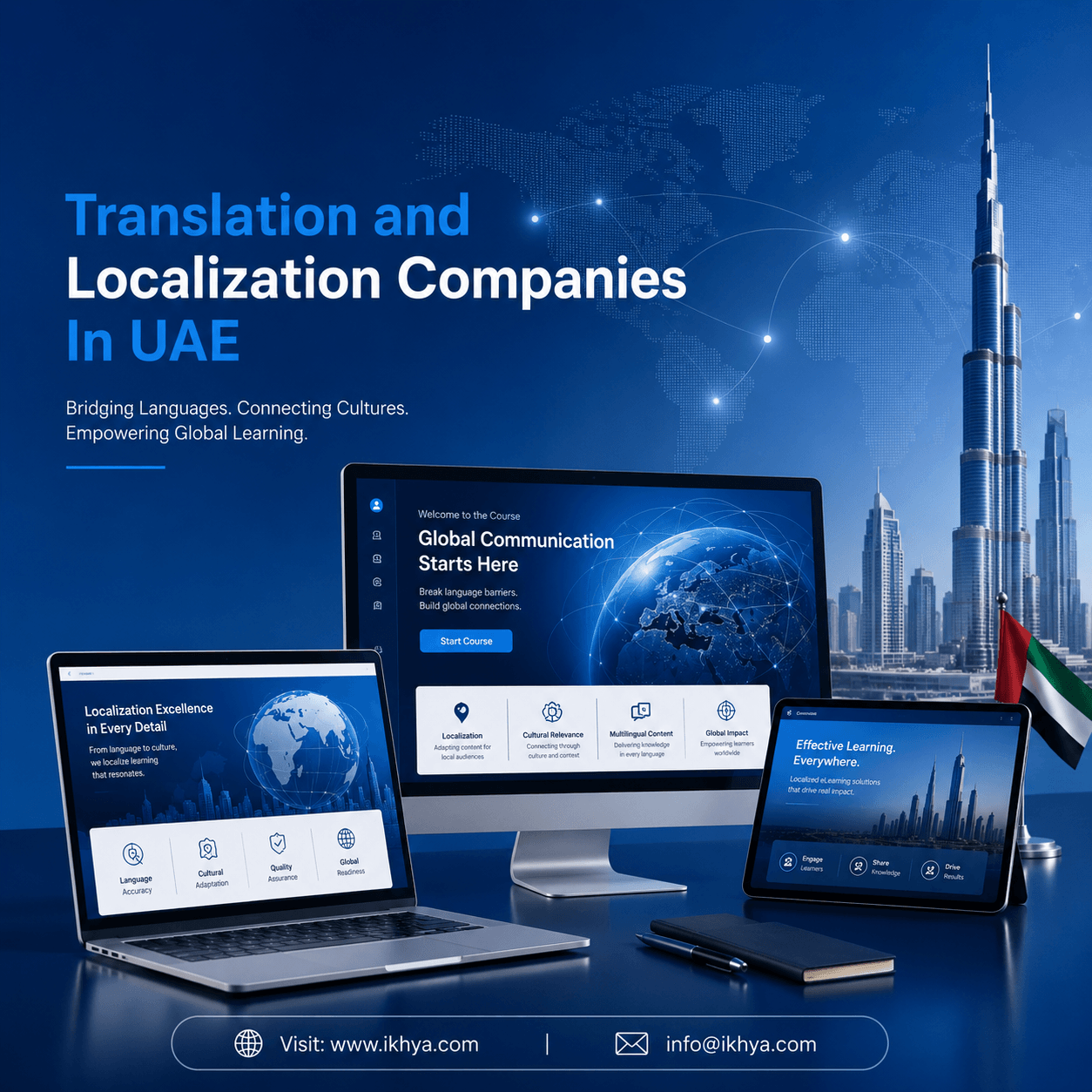


Translation and Localization Companies In UAE
Translation and Localization Companies In UAE play a major role in helping organisations communicate clearly with multilingual teams, regional customers, and cross-border partners. Businesses across Dubai, Abu Dhabi, and other Emirates now depend on accurate localisation to support employee training, compliance, onboarding, customer education, and digital learning programmes. Poor translation creates confusion, weak engagement, and operational risk, especially in regulated sectors.
The right provider improves learner understanding, protects brand consistency, and supports faster workforce adoption across different languages and cultural groups.
IKHYA works with organisations across the UAE to support multilingual learning and localisation projects. Contact info@ikhya.com to discuss requirements.
Why UAE Businesses Are Changing Their Approach to Translation and Localization
Translation and Localization Companies In UAE now support far more than simple document translation. Organisations across the Emirates need multilingual communication that works across employee learning, compliance training, customer education, and digital platforms. Companies operating in finance, healthcare, logistics, aviation, and retail often manage diverse workforces with different language backgrounds. Clear localisation helps reduce misunderstanding and improves training completion rates.
Many UAE businesses work across regional and international markets at the same time. This creates pressure to deliver consistent communication in Arabic and English while also supporting additional workforce languages. Localisation now includes cultural adaptation, user interface adjustments, multimedia translation, and region-specific learning examples. Businesses that ignore these requirements often struggle with low learner engagement and inconsistent operational standards.
Decision-makers also expect translation projects to move faster than before. Training teams often launch onboarding programmes, compliance updates, and digital learning modules under tight timelines. Translation providers must work closely with instructional designers, subject matter experts, and platform administrators. Delays in localisation can affect training rollouts across multiple departments.
Many organisations now evaluate translation partners based on workflow management, quality assurance, and technology support instead of language conversion alone. This shift has increased demand for providers that understand both learning delivery and multilingual communication inside the UAE business environment.
Translation and Localization Companies Operating Across the UAE
- IKHYA – eLearning Solutions Company provides translation and localisation support for multilingual learning, employee training, onboarding, compliance education, and digital content adaptation. Our team works closely with UAE organisations that need Arabic and multilingual learning experiences aligned with local workforce expectations and sector requirements.
- TalentLMS supports multilingual learning delivery through cloud-based training systems and localisation support services. Many UAE organisations use the platform to manage distributed employee training across different language groups.
- Edufic Digital works on digital learning localisation, instructional adaptation, and multilingual content delivery. The company supports organisations that need regional learning content aligned with local learner behaviour.
- Capytech provides digital transformation and multilingual technology support services for businesses operating in regional and international markets. Its localisation projects often support internal communication and software adoption initiatives.
- Knowledge Horizon develops learning and workforce communication solutions that include Arabic localisation and training adaptation services. The company works with businesses that require multilingual workforce enablement.
- Stylus Solutions supports translation and training content adaptation for organisations managing multilingual employee environments. Its services often include instructional localisation and communication alignment.
- Docebo offers learning platform capabilities with multilingual support for enterprise training delivery. UAE organisations use the system to manage localisation across employee learning programmes.
- iLearn Me provides digital learning development and localisation support for training programmes delivered across different language groups. The company focuses on learner accessibility and regional adaptation.
- Biz Group supports workforce learning, communication training, and multilingual content delivery across UAE business sectors. The company works with organisations managing diverse employee populations.
- Protraining delivers training and workforce education support that includes multilingual adaptation and learner communication services. Its projects often support compliance and operational learning initiatives.
Understanding the UAE Translation and Localization Market Before You Commit
The Multilingual Workforce Challenge UAE Organisations Can No Longer Ignore
The UAE workforce includes employees from many language and cultural backgrounds. Organisations often manage operational teams that speak Arabic, English, Hindi, Urdu, Tagalog, and other regional languages. This diversity creates communication challenges inside onboarding programmes, compliance learning, safety training, and technical instruction. Translation and localization companies in UAE help organisations build consistent learning experiences across these workforce groups.
Simple word-for-word translation rarely solves the problem. Employees learn more effectively when training reflects familiar language structures, workplace examples, and cultural references. Localisation providers often redesign scenarios, examples, assessments, and visual elements to improve learner understanding. This approach supports stronger knowledge retention and fewer operational mistakes across multilingual teams.
Arabic Compliance Requirements and Their Impact on Translation Projects in UAE
Many sectors in the UAE operate under regulatory and documentation requirements that require Arabic communication support. Government-linked industries, healthcare providers, aviation companies, and financial institutions often need Arabic-first learning materials or bilingual delivery formats. Translation providers must understand sector terminology and local compliance expectations before starting project work.
Errors in regulated training content can create serious operational risks. Incorrect wording inside safety procedures, policy documentation, or compliance assessments may affect audits and employee understanding. Strong localisation providers build structured review workflows with language specialists and subject matter reviewers. This process improves translation quality and reduces compliance concerns for UAE organisations.
How Digital Learning Expansion Is Reshaping Localization Priorities in UAE
More organisations in the UAE now deliver training through digital learning platforms instead of classroom-only formats. This shift increases demand for localisation services that support eLearning modules, mobile learning, learning management systems, and interactive training content. Translation projects now involve multimedia assets, subtitles, voice-over adaptation, and interface localisation.
Digital learning localisation also requires technical coordination. Providers must manage file formats, learning platform compatibility, assessment functionality, and responsive design standards. Organisations often prefer translation partners that understand both instructional design and technical deployment. This combined capability helps reduce project delays and improves learner experience across devices and languages.
What UAE Translation and Localization Providers Should Deliver
Multilingual eLearning Content Development and Adaptation
Many organisations in the UAE use digital learning as part of onboarding, compliance, technical training, and leadership development. Translation and localization companies in UAE often support these projects by adapting course scripts, assessments, scenarios, animations, and learner interactions. Effective localisation protects the original learning goal while improving accessibility for multilingual learners.
Strong providers also adjust content structure when needed. Certain examples, visuals, or communication styles may not connect with local audiences or workforce groups. Localisation teams often revise cultural references, user interface labels, and instructional flow to improve learner engagement. This process creates training experiences that feel relevant instead of translated.
Corporate Communication and Workforce Translation Services
Translation projects in the UAE often extend beyond formal training content. Organisations also need multilingual communication support for HR policies, onboarding documents, internal announcements, operational procedures, and customer-facing materials. Consistent language use helps businesses maintain clear communication across departments and regions.
Corporate translation providers usually work closely with HR, operations, compliance, and learning teams during these projects. Terminology consistency matters because different wording can create confusion across employee groups. Providers that maintain translation memory systems and approval workflows help organisations manage communication quality over time.
Localization Support for Learning Platforms and Digital Systems
Modern translation projects often involve technical systems alongside content translation. Learning management systems, mobile learning platforms, onboarding portals, and employee applications require multilingual interface support. Localisation providers may adjust navigation labels, learner dashboards, reporting structures, and mobile layouts for Arabic and bilingual use.
Arabic localisation also introduces technical formatting requirements. Right-to-left language alignment affects layout structure, text rendering, navigation flow, and interface testing. Providers with platform experience usually manage these technical details more effectively. This reduces usability problems after launch and improves learner adoption across multilingual employee groups.
What UAE Organisations Gain From Working With Professional Localization Providers
- Improved learner understanding through culturally adapted communication and language structures that employees can follow more naturally during training programmes. This helps organisations reduce confusion during onboarding, compliance learning, and operational instruction across multilingual workforce groups.
- More consistent compliance communication by aligning translated content with approved terminology, local regulations, and internal operational standards. Organisations in regulated sectors benefit from stronger audit readiness and fewer misunderstandings during policy delivery.
- Faster multilingual rollout cycles because experienced providers use structured workflows, translation memory systems, and coordinated review processes. This allows businesses to launch training updates across multiple regions without rebuilding content from the beginning.
- Stronger employee engagement when learners receive training in familiar language formats with culturally relevant examples and visuals. Employees are more likely to complete training and apply lessons correctly in workplace situations.
- Better platform usability through interface localisation, Arabic formatting support, and multilingual learner navigation adjustments. This improves learner access across desktop and mobile training environments.
- Reduced operational risk by improving understanding of safety procedures, technical instructions, and compliance requirements across multilingual employee populations. Clear communication supports better operational consistency inside large organisations.
Translation and Localization Companies in UAE — Detailed Provider Breakdown
IKHYA – eLearning Solutions Company
IKHYA is an eLearning solutions company that supports organisations across the UAE with multilingual learning, translation, and localisation services. Our team works with businesses that need Arabic and multilingual training delivery across employee learning, onboarding, compliance education, and digital transformation programmes. We support clients operating in both regional and international markets.
We offer translation and localisation support for eLearning courses, learning management systems, onboarding content, policy training, multimedia learning assets, and workforce communication programmes. IKHYA provides structured workflows that combine instructional design, language adaptation, technical testing, and quality review processes. Our approach focuses on learner clarity and operational accuracy.
Our team has experience supporting organisations in healthcare, aviation, logistics, retail, manufacturing, financial services, and energy sectors across the UAE. Many of these industries operate under multilingual workforce conditions and strict compliance requirements. We adapt learning content to match operational terminology, cultural expectations, and sector-specific communication standards.
IKHYA supports multiple learning technologies and digital training environments. We work with SCORM-based content, LMS platforms, mobile learning systems, subtitles, voice-over localisation, and multilingual interface adaptation. Our team also manages Arabic right-to-left formatting requirements during learning deployment and platform testing.
We work closely with client teams throughout the project lifecycle. Our collaboration process includes stakeholder workshops, terminology alignment, review checkpoints, testing cycles, and rollout planning. This structured engagement model helps organisations maintain quality and timeline control during multilingual learning projects.
Organisations looking for translation and localization companies in UAE often choose IKHYA because we combine learning expertise with multilingual delivery support. Our team helps clients manage complex localisation projects with clear communication and practical workflows. For project discussions or multilingual learning support, contact info@ikhya.com.
TalentLMS
TalentLMS provides learning management capabilities that support multilingual employee training environments. Organisations in the UAE use the platform to deliver onboarding, compliance learning, and workforce education across different language groups. The system includes localisation support features that help businesses manage multilingual learner experiences.
The platform works well for companies that need cloud-based learning delivery with distributed workforce access. Many organisations combine the system with translation workflows to support regional employee engagement and training consistency.
Edufic Digital
Edufic Digital supports digital learning production and multilingual training adaptation for organisations operating across regional markets. The company works on eLearning localisation, learner engagement design, and content adaptation projects. Its services often support organisations moving from classroom learning to digital delivery.
Businesses that require training localisation alongside instructional design support may use Edufic Digital for workforce learning initiatives. The company also supports multimedia learning adaptation and interactive content development.
Capytech
Capytech delivers digital transformation services that include multilingual communication and localisation support. The company works with organisations implementing technology-driven workforce initiatives and regional communication projects. Localisation services often support internal systems and employee engagement activities.
Its project approach typically combines technical implementation with multilingual adaptation requirements. This supports organisations managing international or regionally distributed operations.
Knowledge Horizon
Knowledge Horizon develops workforce learning and communication solutions for multilingual organisational environments. The company supports Arabic learning adaptation, digital education delivery, and employee engagement projects. UAE organisations often use these services during workforce development programmes.
The provider also works on multilingual learning experiences aligned with business communication and operational training needs. Its services support employee accessibility across different workforce groups.
Stylus Solutions
Stylus Solutions provides translation and localisation support connected to workforce learning and instructional content delivery. The company works with organisations that need multilingual communication inside employee development programmes. Services may include content adaptation, training translation, and communication support.
Businesses operating across multilingual environments often use these services to improve learner accessibility and training consistency. Localisation support also helps align learning materials with regional workforce expectations.
Docebo
Docebo offers enterprise learning technology with multilingual support capabilities for employee education programmes. UAE organisations often use the platform to manage global training delivery across different language groups. Translation support features help businesses organise multilingual learning experiences more efficiently.
The platform supports digital learning expansion across large employee populations. Many organisations integrate localisation workflows directly into their learning management processes.
iLearn Me
iLearn Me focuses on digital learning development and multilingual training adaptation for workforce education initiatives. The company supports businesses that need accessible training delivery across different employee language groups. Its projects often involve onboarding, compliance education, and interactive learning content.
The provider also supports localisation strategies designed to improve learner engagement and digital accessibility. Organisations may use these services when expanding multilingual training programmes.
Biz Group
Biz Group works on workforce learning, leadership training, and communication development across UAE business sectors. The company also supports multilingual learning delivery and regional workforce engagement initiatives. Organisations often use these services when managing employee communication across culturally diverse teams.
Its localisation-related work usually supports learning adoption and communication consistency inside large organisations. This helps businesses maintain clearer workforce alignment during training delivery.
Protraining
Protraining delivers workforce education and training support services that include multilingual learning adaptation. The company works with organisations that need training delivery across operational and compliance-focused environments. Localisation support helps improve learner understanding during technical and safety education programmes.
Businesses managing multilingual workforce populations often use these services to improve communication consistency. The company also supports employee onboarding and operational learning initiatives.
How UAE Translation and Localization Companies Compare Across Key Criteria
| Company | Main Focus | Arabic Localization | eLearning Support | Platform Experience | Ideal Business Type |
|---|---|---|---|---|---|
| IKHYA | Multilingual learning and localisation | Strong | Advanced | LMS and SCORM systems | Enterprise and regulated sectors |
| TalentLMS | Learning platform delivery | Moderate | Advanced | Cloud LMS | Mid-size organisations |
| Edufic Digital | Digital learning adaptation | Strong | Advanced | Interactive learning tools | Training-focused businesses |
| Capytech | Digital transformation support | Moderate | Moderate | Business systems | Technology-driven companies |
| Knowledge Horizon | Workforce communication | Strong | Moderate | Learning platforms | Regional employers |
| Stylus Solutions | Training localisation | Moderate | Moderate | Content systems | Corporate learning teams |
| Docebo | Enterprise learning platform | Moderate | Advanced | Enterprise LMS | Large enterprises |
| iLearn Me | Digital learning delivery | Moderate | Advanced | Learning systems | Growing businesses |
| Biz Group | Workforce engagement | Moderate | Moderate | Training delivery tools | Corporate HR teams |
| Protraining | Operational learning | Moderate | Moderate | Training environments | Operational sectors |
Translation and Localization Pricing in UAE — What Influences Cost
Translation and localization companies in UAE usually price projects based on content complexity, language count, multimedia requirements, and technical delivery needs. eLearning localisation projects often cost more than document translation because they include instructional adaptation, interface testing, subtitles, and learner experience adjustments.
| Project Type | Typical Scope | Estimated Range | Main Cost Factors |
|---|---|---|---|
| Document Translation | Policies and manuals | Low to moderate | Word count and technical terminology |
| eLearning Localization | Interactive training modules | Moderate to high | Multimedia adaptation and testing |
| LMS Localization | Platform interface translation | Moderate | Technical integration and formatting |
| Video Localization | Subtitles and voice-over | Moderate to high | Audio production and timing |
| Compliance Training Translation | Regulated learning content | Moderate | Review workflows and sector expertise |
Organisations should request detailed scope discussions before comparing provider pricing. A lower initial quote may exclude review cycles, localisation testing, or platform adjustments. For multilingual learning consultations and pricing discussions, contact info@ikhya.com.
The Platforms and Tools UAE Localization Providers Use Most
| Tool or Platform | Primary Use | Best Fit | Adoption Level |
|---|---|---|---|
| Articulate Storyline | eLearning course localisation | Interactive training modules | High |
| Adobe Captivate | Responsive learning development | Technical training content | Moderate |
| Smartcat | Translation workflow management | Enterprise translation projects | Moderate |
| SDL Trados | Translation memory management | Large multilingual projects | High |
| Moodle | Learning delivery platform | Corporate learning environments | High |
| Docebo LMS | Enterprise learning management | Large workforce training | Moderate |
The Translation and Localization Delivery Process Explained
| Phase | Key Activities | Client Involvement | Typical Duration |
|---|---|---|---|
| Discovery | Scope review and language planning | High | 1 week |
| Content Audit | Asset review and terminology mapping | Moderate | 1 week |
| Translation | Language conversion and adaptation | Low | 1 to 3 weeks |
| Localization | Cultural and instructional adjustments | Moderate | 1 to 2 weeks |
| Technical Integration | Platform and interface updates | Moderate | 1 week |
| Quality Review | Testing and stakeholder feedback | High | 1 week |
| Deployment | Publishing and rollout support | Moderate | Several days |
| Post-Launch Support | Updates and issue management | Low | Ongoing |
How UAE Industries Use Translation and Localization to Solve Operational Challenges
| Industry | Common Topics | Main Challenges | Preferred Delivery Format |
|---|---|---|---|
| Healthcare | Compliance and patient safety | Terminology accuracy | eLearning and video |
| Aviation | Operational procedures | Technical consistency | Simulation learning |
| Retail | Customer service training | High workforce diversity | Mobile learning |
| Finance | Regulatory education | Compliance alignment | LMS delivery |
| Manufacturing | Safety instruction | Multilingual operations | Interactive modules |
| Logistics | Process onboarding | Distributed workforce training | Microlearning |
Where Translation and Localization in UAE Is Heading Next
AI-Assisted Translation and Its Impact on Localization in UAE
Many providers now use AI-supported translation workflows to speed up multilingual content delivery. These tools help reduce repetitive manual work during large projects. Organisations often use AI translation as a starting point before human reviewers complete quality checks and cultural adaptation.
Human review still remains essential for regulated industries and employee training. Compliance terminology, workplace instruction, and cultural context require professional oversight. UAE organisations usually prefer blended workflows that combine technology speed with language quality control.
How Mobile Learning Growth Is Changing Localization Priorities in UAE
More employees now complete training through smartphones and tablets instead of desktop-only systems. This change affects translation and localisation design choices across learning projects. Providers must adapt content for smaller screens, shorter interactions, and multilingual mobile usability.
Arabic mobile formatting also creates additional design requirements. Interface spacing, right-to-left alignment, and navigation behaviour affect learner experience across devices. Organisations increasingly evaluate providers based on mobile localisation capability.
The Rise of Video-Based Learning Across UAE Organisations
Video learning continues to grow across corporate training environments in the UAE. Businesses use video for onboarding, compliance instruction, leadership communication, and technical process training. This trend increases demand for subtitles, multilingual narration, and culturally adapted visual learning.
Localisation providers must now support script adaptation, subtitle timing, audio recording, and visual editing workflows. Organisations prefer providers that can manage both language adaptation and multimedia production together.
Why Arabic-First Learning Experiences Are Becoming Standard in UAE Training
Many organisations now treat Arabic learning support as a standard business requirement instead of an optional feature. Government-linked entities and regulated sectors often require bilingual or Arabic-first communication during workforce education. Translation and localization companies in UAE increasingly build projects around this expectation.
This shift affects platform design, interface structure, content planning, and review workflows from the start of the project. Businesses that plan Arabic localisation early usually avoid expensive redesign work later.
What to Look for When Selecting a Translation and Localization Partner in UAE
Choosing the right provider requires more than comparing language rates. Organisations should evaluate workflow quality, learning experience capability, technical support, and industry understanding before making a decision.
- Sector experience matters because regulated industries require terminology accuracy and operational understanding. Providers with healthcare, aviation, finance, or manufacturing experience usually manage compliance communication more effectively.
- Arabic localisation capability should include right-to-left formatting, interface adaptation, and bilingual review workflows. This helps organisations avoid technical usability problems after launch.
- eLearning expertise becomes important when training projects involve assessments, multimedia, and learning management systems. Providers with instructional design experience often deliver stronger learner engagement outcomes.
- Quality assurance workflows help maintain consistency across large multilingual projects. Structured review processes reduce translation errors and improve operational reliability.
- Technical platform knowledge supports smoother LMS integration and digital learning deployment. Organisations benefit when providers understand SCORM packages, mobile learning, and multilingual interface management.
- Project communication standards affect delivery timelines and stakeholder coordination. Providers should offer clear reporting, review checkpoints, and escalation processes.
- Scalable language support becomes valuable when organisations expand into additional markets or workforce groups. Providers should manage multiple languages without rebuilding workflows from the beginning.
- Post-launch support helps organisations update content and manage translation revisions after deployment. Ongoing support reduces operational disruption during future training updates.
Businesses should also request sample workflows and review processes before signing contracts. Strong providers explain how they manage quality, approvals, testing, and stakeholder collaboration during multilingual projects.
How IKHYA Supports UAE Organisations With Translation and Localization
IKHYA approaches translation and localisation projects through a learning-focused model designed for multilingual workforce environments. We support organisations that need employee training, onboarding, compliance education, and digital learning delivered across different languages and cultures. Our team works closely with stakeholders to align communication with operational goals.
We combine instructional design, localisation planning, language adaptation, and technical deployment support inside one workflow. This helps organisations manage translation quality while protecting learning effectiveness. Our team also supports Arabic interface formatting, multimedia adaptation, and multilingual learner accessibility.
IKHYA works with organisations across regulated and operational sectors including healthcare, logistics, manufacturing, aviation, retail, and financial services. We understand that each industry requires different terminology standards, review processes, and communication priorities. Our localisation approach reflects these sector-specific needs.
We maintain collaborative engagement throughout the project lifecycle. Clients receive structured review cycles, milestone updates, stakeholder coordination support, and deployment guidance. This process improves visibility and helps organisations maintain project control from planning through rollout.
Businesses searching for translation and localization companies in UAE often choose IKHYA because we combine multilingual communication support with practical learning delivery expertise. Our team focuses on clarity, usability, and operational consistency across every project stage. To discuss multilingual training or localisation requirements, contact info@ikhya.com.
Start Your Translation and Localization Project With a Team That Understands UAE Business Requirements
Translation and localisation projects affect employee understanding, compliance readiness, learner engagement, and operational communication across the organisation. Businesses that choose the right partner usually achieve faster adoption, stronger training outcomes, and more consistent multilingual communication. The UAE market requires providers that understand both regional language expectations and digital learning delivery.
Organisations should evaluate providers based on workflow quality, localisation capability, platform knowledge, and sector experience instead of language pricing alone. A structured localisation process reduces operational risk and improves training effectiveness across multilingual workforce environments.
IKHYA supports organisations across the UAE with multilingual learning, training localisation, and digital communication adaptation services. Our team works collaboratively with clients to deliver practical and scalable localisation solutions. Contact info@ikhya.com to discuss your project requirements.
FAQs
Related Top eLearning Companies & Solutions in the UAE
UAE organizations are adopting digital learning to support hybrid workforces, compliance training, multilingual learning, and workforce development. Businesses increasingly rely on eLearning solutions to improve onboarding, employee engagement, and operational consistency.
Explore leading eLearning providers, LMS platforms, instructional design specialists, and compliance training solutions across the UAE.
At IKHYA – eLearning Solutions Company, we design impactful, compliance-driven, and performance-focused digital learning solutions tailored to your business goals.
🎯 Custom eLearning Course Development
⚡ Rapid eLearning & PPT Conversion
📊 Workplace Compliance Training
🌍 Localization & LMS-Ready Modules