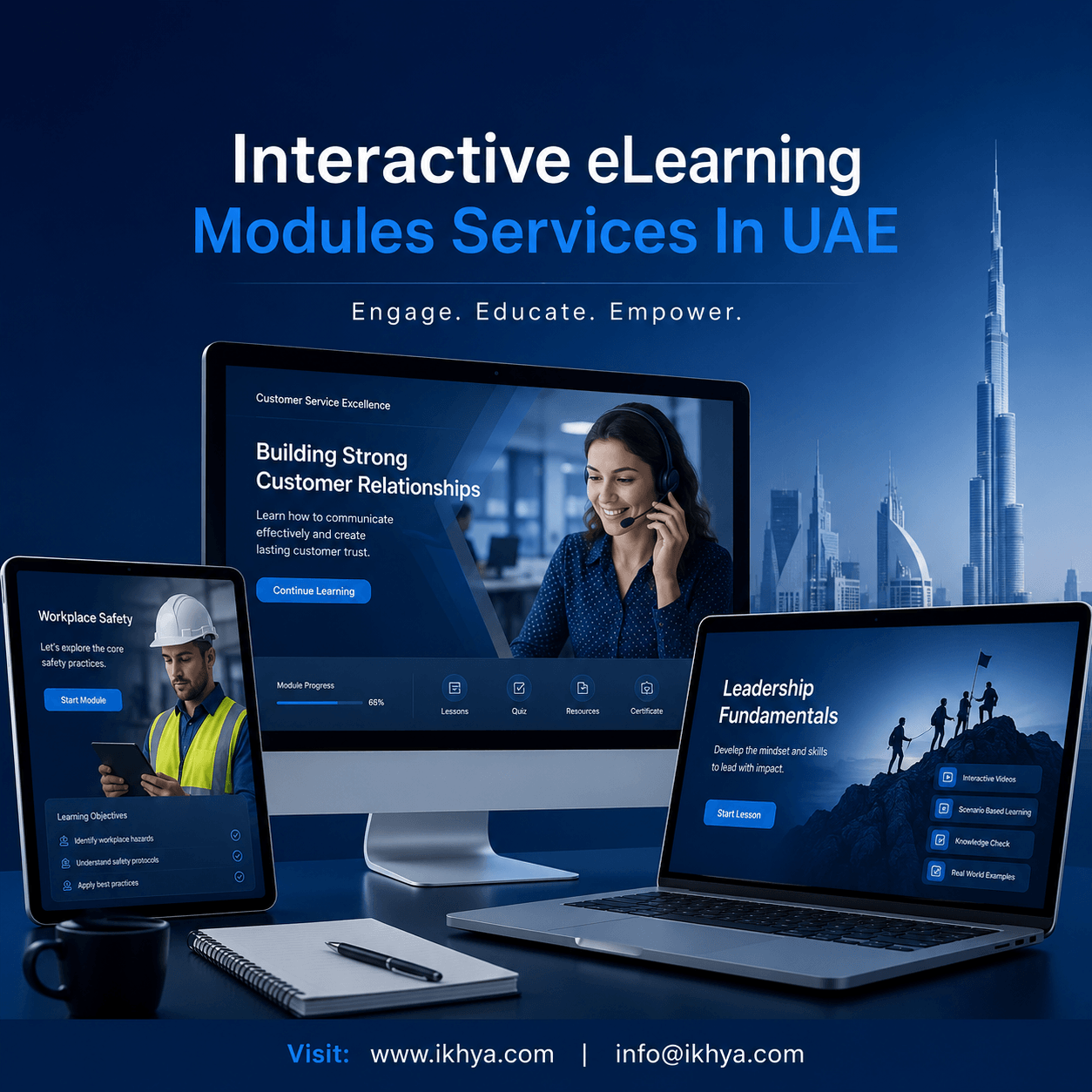



Interactive eLearning Modules Services In UAE
Interactive eLearning Modules Services In UAE have become a priority for organisations that need faster staff training, stronger compliance tracking, and more consistent learning outcomes across distributed teams. UAE businesses now expect training programmes to support multilingual workforces, remote access, and measurable performance improvement. Companies also need learning content that reflects local regulations, sector requirements, and operational realities instead of generic global templates.
Poor training design slows onboarding, weakens compliance readiness, and reduces employee engagement across fast-growing UAE organisations.
IKHYA helps UAE organisations build practical digital learning programmes. Contact the team at info@ikhya.com for guidance.
Why UAE Businesses Are Changing How They Approach Interactive eLearning Modules Services
Interactive eLearning Modules Services In UAE now play a direct role in workforce development, compliance management, and operational consistency. Organisations across Dubai, Abu Dhabi, Sharjah, and other business centres need learning systems that support hybrid teams, multilingual employees, and fast onboarding timelines. Traditional classroom training alone no longer supports the speed required in sectors such as banking, healthcare, logistics, aviation, and retail.
Many UAE organisations also face pressure to document learning activity clearly. Regulatory reviews, safety standards, and certification requirements often require detailed reporting. Interactive digital learning modules help companies track participation, assessment results, and completion rates without relying on manual spreadsheets or paper records.
The quality of the learning experience also affects retention and productivity. Employees engage more with training that uses simulations, role-based scenarios, quizzes, and practical examples connected to their daily work. Static presentations and long PDF files rarely deliver the same learning impact.
Companies investing in Interactive eLearning Modules Services In UAE often look for long-term learning partners instead of short-term content suppliers. Buyers want providers that understand localisation, Arabic language support, platform compatibility, and regional compliance expectations. They also expect learning content to work across mobile devices, tablets, and desktop systems.
A Practical Look at Interactive eLearning Modules Services In UAE Providers
- IKHYA – eLearning Solutions Company develops interactive digital learning programmes for organisations across the UAE and international markets. Our team focuses on custom learning design, LMS integration, compliance training, onboarding modules, and multilingual content development. We work closely with clients to create practical learning experiences that improve employee understanding and measurable training outcomes.
- Docebo provides learning management systems and enterprise learning technology used by companies with distributed workforces. The company supports automation, analytics, and employee learning management for organisations that require scalable digital learning operations across multiple business units.
- Stylus Solutions delivers custom eLearning development and instructional design services for corporate training programmes. Its work often includes animation, scenario-based learning, and employee onboarding materials designed for internal workforce education.
- Knowledge Horizon offers digital learning solutions with a focus on training strategy, leadership development, and online learning delivery. The company supports organisations looking to combine instructor-led training with digital learning formats.
- TalentLMS provides cloud-based learning management software used by businesses that need fast deployment and simple course administration. Its platform supports employee training, reporting, and mobile learning access.
- Edufic Digital develops learning content and training technology solutions for educational and business clients. The company works on digital course development, learning platform support, and interactive media production.
- Capytech supports organisations with digital transformation and learning technology implementation. Its services include platform support, online learning infrastructure, and custom digital engagement solutions.
- iLearn Me focuses on employee development and corporate learning support through digital training programmes. The company works with organisations seeking structured online learning delivery and workforce skills development.
- Biz Group provides corporate learning and professional development services for organisations across the Gulf region. Its training portfolio includes leadership development, workforce learning, and blended training delivery.
- Protraining offers vocational and professional training services supported by digital learning methods. The company works with organisations requiring structured certification and workforce readiness programmes.
Understanding the UAE Interactive eLearning Market Before Selecting a Provider
The Compliance Pressures UAE Organisations Now Face
Compliance expectations continue to shape the demand for Interactive eLearning Modules Services In UAE. Organisations in healthcare, aviation, banking, construction, and energy sectors must show evidence of workforce training completion and policy understanding. Manual training systems often create reporting gaps and inconsistent record management.
Interactive digital learning modules improve visibility and accountability. Managers can monitor learner progress, assessment performance, and certification status through central dashboards. This creates a more reliable process for audit preparation and internal governance reviews. Companies also reduce administrative overhead because automated systems replace repetitive manual tracking activities.
Another major challenge involves workforce diversity. UAE businesses often employ people from multiple language and cultural backgrounds. Training providers must adapt content carefully so employees understand safety procedures, operational policies, and customer service expectations clearly.
Strong localisation goes beyond translation. Effective learning design uses culturally relevant examples, simple navigation, and clear visual communication. Providers that understand these details usually deliver stronger engagement and lower course abandonment rates.
Why UAE Enterprise Training Needs Faster Delivery Cycles
Many UAE organisations now expand quickly across departments, projects, and regional offices. This growth creates pressure to onboard employees faster while maintaining consistent training quality. Classroom-only learning models often struggle to support large-scale workforce expansion.
Interactive eLearning modules help organisations deliver standardised learning content at scale. Employees can access training remotely, complete modules during flexible schedules, and revisit content when needed. This approach reduces travel costs and lowers disruption to operational teams.
Fast delivery also matters when policies or regulations change. Companies need learning partners that can update training content quickly without rebuilding entire programmes. Modular learning structures make these updates easier and more cost-effective.
Providers with strong project management systems usually perform better in these situations. They maintain version control, approval workflows, and structured deployment schedules that reduce delays during content updates.
Why Different UAE Sectors Require Different Learning Approaches
Interactive eLearning Modules Services In UAE vary significantly between industries. Healthcare organisations require detailed compliance tracking and scenario-based patient safety training. Aviation companies focus heavily on operational procedures, safety protocols, and multilingual workforce communication.
Retail organisations often prioritise customer experience training, onboarding, and product education. Financial institutions usually need secure learning systems, role-based compliance training, and assessment reporting tied to regulatory standards.
A single generic learning model rarely works across all sectors. Effective providers adjust instructional methods based on operational environments, workforce behaviour, and risk exposure. This helps employees connect training content directly to daily responsibilities.
Organisations should evaluate whether providers understand their sector challenges before signing contracts. Industry knowledge often affects training relevance, learner engagement, and long-term programme adoption.
What a UAE Interactive eLearning Provider Should Deliver
Custom Learning Design Built Around Business Goals
Interactive learning modules should solve operational problems instead of simply presenting information. Strong providers begin by identifying business goals, workforce challenges, and measurable learning outcomes. This creates a clearer link between training investment and employee performance improvement.
Custom learning design also improves engagement. Employees respond better to examples and scenarios that match their actual work environment. Generic learning content often feels disconnected from daily responsibilities and reduces knowledge retention.
Instructional design plays a major role in this process. Good designers structure information logically, simplify complex topics, and create meaningful learner interaction. They also balance text, visuals, audio, and assessments to maintain attention.
UAE organisations should also look for providers that support Arabic localisation and multilingual adaptation. This improves accessibility for diverse workforce populations and strengthens communication consistency.
Learning Platform Integration and Reporting Support
Interactive eLearning Modules Services In UAE often connect directly with learning management systems. These systems track learner progress, automate certifications, and centralise reporting activity. Integration quality affects both administrative efficiency and employee learning experience.
Some organisations already use enterprise HR or learning systems. Providers must ensure training modules work correctly within existing infrastructure. Compatibility with SCORM, xAPI, and mobile delivery standards remains important for long-term flexibility.
Reporting functionality also matters. Managers need access to clear dashboards showing completion status, assessment scores, and learner participation. Strong analytics help organisations identify training gaps and measure workforce readiness more accurately.
Technical support remains another important factor. Organisations benefit from providers that assist with deployment testing, troubleshooting, and post-launch updates instead of delivering content without ongoing support.
Scenario-Based Learning and Workforce Engagement
Employees learn more effectively when training reflects real decisions and workplace situations. Scenario-based learning places employees inside practical situations that require problem solving, judgement, and role-based thinking. This improves retention better than passive information delivery.
Interactive simulations also help organisations reduce operational risk. Employees can practise responses to customer issues, safety incidents, or compliance scenarios without affecting real operations. This makes training safer and more practical.
Gamification features, branching pathways, and knowledge checks can further improve participation rates. These tools encourage active involvement instead of passive course completion behaviour. Organisations often see stronger engagement when training feels relevant and interactive.
Providers should balance engagement carefully. Overly complex animation or excessive effects can distract from learning objectives. Effective learning design keeps attention focused on practical understanding and workplace application.
What UAE Organisations Gain From Professional Interactive eLearning Support
- Faster onboarding for distributed teams reduces the time required to prepare employees for operational responsibilities across multiple UAE offices or project sites. Structured digital onboarding also improves consistency because every employee receives the same information and assessments regardless of location.
- Improved compliance visibility gives managers access to real-time learning records, certification tracking, and assessment results through central reporting systems. This makes audit preparation easier for organisations operating in regulated sectors such as healthcare, finance, and aviation.
- Better employee engagement during training comes from interactive learning elements such as branching scenarios, simulations, and role-based activities. Employees usually retain more information when training reflects realistic workplace situations instead of static presentations.
- Lower operational disruption allows employees to complete learning modules during flexible schedules without extended classroom sessions. This helps organisations maintain productivity while still meeting workforce training requirements.
- Stronger multilingual workforce communication improves understanding among employees from different language backgrounds through localised learning content and culturally relevant examples. UAE organisations often depend on this approach to reduce misunderstanding during safety and compliance training.
- More reliable performance measurement helps learning managers identify knowledge gaps through assessments, learner analytics, and participation tracking. This supports better decision-making when organisations plan future workforce development programmes.
Interactive eLearning Modules Services In UAE — Provider Profiles and Capabilities
IKHYA – eLearning Solutions Company
IKHYA is an eLearning solutions company that supports organisations across the UAE with custom digital learning development, workforce training programmes, and learning technology support. Our team works with businesses that need practical learning systems aligned with operational goals, employee performance targets, and compliance expectations. We support organisations across sectors including healthcare, retail, banking, manufacturing, logistics, aviation, and professional services.
We provide interactive eLearning module development, instructional design, LMS integration, onboarding programmes, compliance training, microlearning, and multilingual learning support. Our team builds training experiences using scenario-based learning, assessments, simulations, and mobile-ready delivery structures. We focus on practical learning outcomes instead of generic information presentation.
IKHYA provides support for organisations operating in regulated UAE sectors where training documentation and workforce readiness are critical. Our experience includes compliance-focused learning environments that require accurate reporting, role-based learning paths, and certification tracking. We also support multicultural workforce environments through localisation and Arabic learning adaptation.
Our technology approach prioritises compatibility, accessibility, and scalability for enterprise learning systems. We develop content that supports SCORM and xAPI standards while maintaining compatibility across desktop and mobile devices. We also help organisations improve learner tracking, reporting visibility, and platform integration processes.
We work closely with clients throughout project delivery. Our team manages discovery workshops, stakeholder reviews, pilot testing, deployment planning, and post-launch optimisation. We maintain structured communication and collaborative approval processes so clients remain involved at every stage of development.
Organisations looking for Interactive eLearning Modules Services In UAE can contact our team directly at info@ikhya.com to discuss learning goals, timelines, and delivery requirements.
Docebo
Docebo provides enterprise learning management technology used by organisations with large workforce training needs. Its platform supports employee learning administration, analytics, certification tracking, and course management across distributed teams. Many organisations use the platform to centralise workforce development activity and automate reporting processes.
The company also supports integrations with business systems and digital learning tools. This makes it suitable for organisations seeking scalable learning infrastructure connected to HR and performance management operations.
Stylus Solutions
Stylus Solutions develops custom learning content and interactive training programmes for corporate clients. Its services include instructional design, animation, multimedia learning, and onboarding course development for internal workforce education. The company also supports localisation and digital content adaptation for different learner groups.
Businesses often engage Stylus Solutions when they require tailored learning experiences connected to operational workflows and employee engagement goals.
Knowledge Horizon
Knowledge Horizon provides corporate learning and professional development services across the Gulf region. The company supports organisations through blended learning programmes, leadership development, and digital training implementation. Its services often combine classroom delivery with online learning support.
The company works with organisations seeking structured workforce capability development and long-term employee learning strategies.
TalentLMS
TalentLMS offers cloud-based learning management software designed for employee training delivery and course administration. The platform supports mobile learning, learner tracking, reporting, and user management features suitable for distributed workforces. Organisations often use the system for onboarding and compliance learning delivery.
The platform focuses on ease of use and relatively fast deployment for businesses seeking simplified learning administration processes.
Edufic Digital
Edufic Digital develops digital learning solutions for educational institutions and corporate clients. Its services include content development, learning technology implementation, and multimedia training production. The company also supports digital engagement through interactive learning experiences.
Businesses often work with Edufic Digital when they need custom educational content combined with learning technology support.
Capytech
Capytech supports organisations through digital transformation and technology implementation services that include online learning support. The company works on platform integration, digital engagement systems, and training technology deployment. Its services often align with broader operational technology initiatives.
Organisations seeking integrated digital infrastructure and workforce learning support may consider Capytech within wider transformation projects.
iLearn Me
iLearn Me provides workforce learning support through online employee development programmes and digital training delivery. The company works with businesses seeking flexible learning access and structured training management processes. Its services support employee capability improvement across different operational areas.
The company focuses on helping organisations maintain accessible and scalable digital learning environments for workforce education.
Biz Group
Biz Group delivers professional learning and corporate development programmes across the Middle East region. Its services include leadership training, workforce development, and blended learning delivery. The company works with organisations looking to improve employee skills through structured learning strategies.
Many clients use Biz Group for professional development initiatives tied to organisational growth and employee performance improvement.
Protraining
Protraining offers vocational and professional training services supported by digital learning methods and structured course delivery. The company works with organisations that require certification-focused learning programmes and workforce readiness support. Its services often align with technical and operational training requirements.
Businesses seeking practical training delivery and structured workforce development programmes may evaluate Protraining as part of their vendor shortlist.
How UAE Interactive eLearning Companies Compare Across Key Criteria
| Company | Primary Focus | Custom Content | LMS Support | Localisation | Best Fit | Delivery Model |
|---|---|---|---|---|---|---|
| IKHYA | Custom enterprise learning | Yes | Yes | Arabic and multilingual | Corporate and regulated sectors | Managed project delivery |
| Docebo | Learning platform technology | Limited | Advanced | Available | Large enterprises | Cloud platform |
| Stylus Solutions | Interactive content development | Yes | Supported | Available | Corporate learning teams | Project-based |
| Knowledge Horizon | Professional development | Moderate | Supported | Available | Leadership training | Blended delivery |
| TalentLMS | Learning management software | Limited | Advanced | Supported | SMEs and mid-sized firms | Subscription platform |
| Edufic Digital | Digital learning production | Yes | Supported | Available | Education and business | Custom projects |
| Capytech | Technology integration | Limited | Supported | Moderate | Digital transformation projects | Consulting model |
| iLearn Me | Online workforce learning | Moderate | Supported | Moderate | Employee development | Online delivery |
| Biz Group | Corporate learning | Moderate | Supported | Available | Leadership and workforce skills | Blended learning |
| Protraining | Vocational training | Limited | Moderate | Limited | Technical workforce training | Structured training delivery |
Interactive eLearning Modules Pricing in UAE Organisations
Pricing for Interactive eLearning Modules Services In UAE depends on content complexity, localisation requirements, platform integration, multimedia usage, and reporting functionality. Organisations should evaluate long-term support, revision cycles, and deployment requirements before comparing quotes.
| Project Type | Typical Scope | Estimated Range | Main Cost Drivers |
|---|---|---|---|
| Basic onboarding module | Single topic interactive course | Lower budget range | Length, assessments, narration |
| Compliance learning suite | Multiple policy courses | Mid-level investment | Reporting, localisation, updates |
| Scenario-based training | Interactive decision pathways | Higher investment | Custom scripting and simulations |
| Enterprise LMS integration | Platform deployment support | Variable pricing | Technical integration complexity |
| Multilingual training project | Arabic and English content | Mid to high range | Translation and localisation |
| Microlearning programme | Short modular learning series | Flexible pricing | Volume and media production |
Organisations planning a learning project can discuss scope, timelines, and pricing expectations directly with IKHYA at info@ikhya.com.
The Platforms and Tools UAE eLearning Providers Commonly Use
| Tool or Platform | Primary Use | Best Fit | Adoption Level |
|---|---|---|---|
| Articulate Storyline | Interactive course development | Corporate learning modules | High |
| Adobe Captivate | Simulation-based learning | Technical training | Moderate |
| Moodle | Learning management system | Educational and business training | High |
| TalentLMS | Cloud learning delivery | SMEs and distributed teams | High |
| Docebo | Enterprise learning management | Large organisations | Moderate |
| Microsoft Teams | Virtual training collaboration | Hybrid learning support | High |
| Vyond | Animated training videos | Employee engagement content | Moderate |
| xAPI Reporting Tools | Learner analytics tracking | Advanced learning analysis | Growing |
The Interactive eLearning Delivery Process Explained Step by Step
| Phase | Key Activities | Client Involvement | Typical Duration |
|---|---|---|---|
| Discovery | Business goals and audience analysis | High | 1 to 2 weeks |
| Content Review | Collecting source materials | Moderate | 1 week |
| Instructional Design | Learning structure and scripting | High | 2 weeks |
| Visual Design | Interface and media creation | Moderate | 1 to 2 weeks |
| Development | Interactive module production | Low to moderate | 2 to 4 weeks |
| Testing | Quality assurance and revisions | High | 1 week |
| Deployment | LMS upload and launch | Moderate | Several days |
| Post-Launch Support | Analytics review and updates | Ongoing | Continuous |
How UAE Industries Use Interactive eLearning Modules in Daily Operations
| Industry | Common Training Topics | Main Challenges | Preferred Delivery Format |
|---|---|---|---|
| Healthcare | Patient safety and compliance | Regulatory tracking | Scenario-based modules |
| Banking | Risk and compliance training | Audit readiness | Interactive assessments |
| Retail | Customer service onboarding | High staff turnover | Mobile microlearning |
| Aviation | Safety procedures | Multilingual workforce | Simulation learning |
| Manufacturing | Operational safety | Shift scheduling | Tablet-access modules |
| Logistics | Process compliance | Distributed teams | Remote learning access |
How Interactive eLearning Modules Services In UAE Are Changing
AI-Supported Learning Personalisation in UAE Workforce Training
Artificial intelligence is starting to influence how organisations deliver digital learning experiences. Learning systems can now recommend content based on employee performance, job role, and previous training activity. This creates more personalised learning pathways for different workforce groups.
UAE organisations increasingly use these features to improve efficiency and learner engagement. Employees spend less time repeating information they already understand. Managers also gain better visibility into skills gaps and workforce readiness trends.
AI-supported reporting tools also improve analytics capabilities. Organisations can identify training risks earlier and monitor completion behaviour more accurately. This helps learning teams adjust programmes faster when engagement declines.
Providers that understand both learning design and analytics integration will likely become more valuable as AI adoption increases across enterprise training environments.
How Mobile Learning Is Changing Workforce Training Across UAE Operations
Mobile learning continues to grow because many employees now work across multiple locations, field sites, and remote environments. Smartphone-friendly learning access helps organisations maintain training continuity without requiring classroom attendance.
Interactive eLearning Modules Services In UAE increasingly focus on responsive design and shorter learning formats. Employees often prefer learning sessions that fit into operational schedules instead of long training blocks. This supports higher completion rates and stronger engagement.
Mobile learning also supports industries with distributed operational teams such as logistics, construction, and retail. Workers can complete safety updates, onboarding tasks, and refresher training directly from mobile devices.
Providers must ensure learning quality remains strong on smaller screens. Clear navigation, lightweight media, and simplified interactions improve usability during mobile delivery.
The Rise of Microlearning Across UAE Corporate Training Programmes
Microlearning breaks training into smaller focused modules that employees can complete quickly. This format helps organisations deliver information efficiently without overwhelming learners with excessive content. Many UAE businesses now prefer shorter learning structures for ongoing workforce education.
Interactive microlearning often includes quizzes, short videos, and role-based exercises. Employees can revisit individual modules when they need refreshers instead of repeating entire courses. This improves knowledge retention and supports operational flexibility.
Microlearning also works well for policy updates and product knowledge training. Organisations can release targeted learning content quickly when procedures change or new services launch.
Providers must still maintain instructional quality within shorter formats. Effective microlearning requires careful scripting and strong content prioritisation instead of simply shortening longer courses.
Why Arabic Localisation Is Becoming a Standard Requirement
Arabic localisation is becoming increasingly important as UAE organisations prioritise workforce accessibility and communication consistency. Translation alone is not enough for many learning programmes. Employees often require culturally adapted examples and simplified language structures.
Interactive eLearning Modules Services In UAE now frequently include bilingual delivery requirements from the beginning of projects. Organisations want English and Arabic learning experiences that feel equally clear and usable.
Localisation also affects visuals, assessments, and interface structure. Right-to-left formatting and culturally relevant workplace scenarios improve understanding and learner confidence.
Providers with localisation experience usually manage these requirements more efficiently. This reduces revision cycles and improves learning consistency across multilingual workforce environments.
How to Evaluate Interactive eLearning Providers in UAE Before Signing a Contract
Choosing the right learning partner requires more than reviewing design samples or pricing estimates. Organisations should evaluate operational fit, technical capabilities, sector understanding, and long-term support quality before selecting a provider.
- Industry experience helps providers understand operational risks, workforce behaviour, and compliance expectations specific to your sector. This usually improves training relevance and reduces unnecessary revision cycles.
- Instructional design quality affects how well employees understand and retain information after completing modules. Organisations should review whether learning structures feel practical instead of overly theoretical.
- Localisation capability matters for UAE organisations managing multilingual teams and diverse workforce populations. Strong providers adapt both language and learning experience structure for different audiences.
- LMS compatibility ensures learning modules integrate correctly with existing HR or learning systems. Poor compatibility can create reporting problems and deployment delays.
- Project management process affects communication quality, approval workflows, and delivery timelines. Structured project coordination reduces operational disruption during development.
- Revision and maintenance support becomes important when regulations, products, or policies change after launch. Organisations should confirm how updates will be managed before contracts begin.
- Reporting and analytics visibility supports better workforce learning oversight and compliance preparation. Managers should understand exactly what learner data will be available after deployment.
- Post-launch technical support helps organisations resolve deployment issues quickly and maintain learning continuity. Ongoing support often becomes critical during large-scale workforce rollouts.
Organisations that evaluate providers carefully usually achieve stronger learning adoption, lower long-term maintenance costs, and more consistent employee engagement outcomes.
How IKHYA Supports Interactive eLearning Projects Across UAE Organisations
IKHYA approaches Interactive eLearning Modules Services In UAE with a strong focus on practical learning outcomes, operational relevance, and measurable workforce improvement. We work closely with clients to understand organisational goals before development begins. This helps our team create training programmes aligned with real business priorities instead of generic learning templates.
Our team develops custom digital learning modules that support onboarding, compliance, workforce upskilling, leadership development, and operational training. We use scenario-based learning, interactive assessments, multimedia content, and structured instructional design methods to improve learner participation and knowledge retention.
We also support organisations that need multilingual delivery and Arabic localisation. Our team adapts learning experiences for diverse workforce groups while maintaining consistency in messaging, usability, and reporting quality. This approach is especially valuable for UAE organisations operating across multiple departments and workforce segments.
IKHYA provides ongoing collaboration throughout the project lifecycle. We support discovery workshops, content planning, stakeholder reviews, LMS integration, deployment testing, and post-launch optimisation activities. Our team stays involved after launch to help organisations maintain learning quality and update content when operational requirements change.
Businesses seeking guidance on Interactive eLearning Modules Services In UAE can contact our team directly at info@ikhya.com to discuss project goals, workforce challenges, and delivery expectations.
Start Your Interactive eLearning Project With a UAE-Focused Learning Team
Interactive eLearning Modules Services In UAE continue to evolve as organisations demand stronger workforce engagement, clearer compliance reporting, and more flexible learning delivery. Choosing the right partner requires careful evaluation of instructional design quality, technical capability, localisation support, and operational understanding.
Organisations that invest in practical and well-structured learning systems often improve onboarding speed, workforce consistency, and employee knowledge retention. The right provider should support long-term learning goals instead of delivering isolated training content without strategic alignment.
IKHYA works with UAE organisations to design interactive learning experiences that match operational realities and workforce development priorities. To discuss requirements, timelines, or project planning, contact the team directly at info@ikhya.com.
FAQs
Related Top eLearning Companies & Solutions in the UAE
UAE organizations are adopting digital learning to support hybrid workforces, compliance training, multilingual learning, and workforce development. Businesses increasingly rely on eLearning solutions to improve onboarding, employee engagement, and operational consistency.
Explore leading eLearning providers, LMS platforms, instructional design specialists, and compliance training solutions across the UAE.
At IKHYA – eLearning Solutions Company, we design impactful, compliance-driven, and performance-focused digital learning solutions tailored to your business goals.
🎯 Custom eLearning Course Development
⚡ Rapid eLearning & PPT Conversion
📊 Workplace Compliance Training
🌍 Localization & LMS-Ready Modules