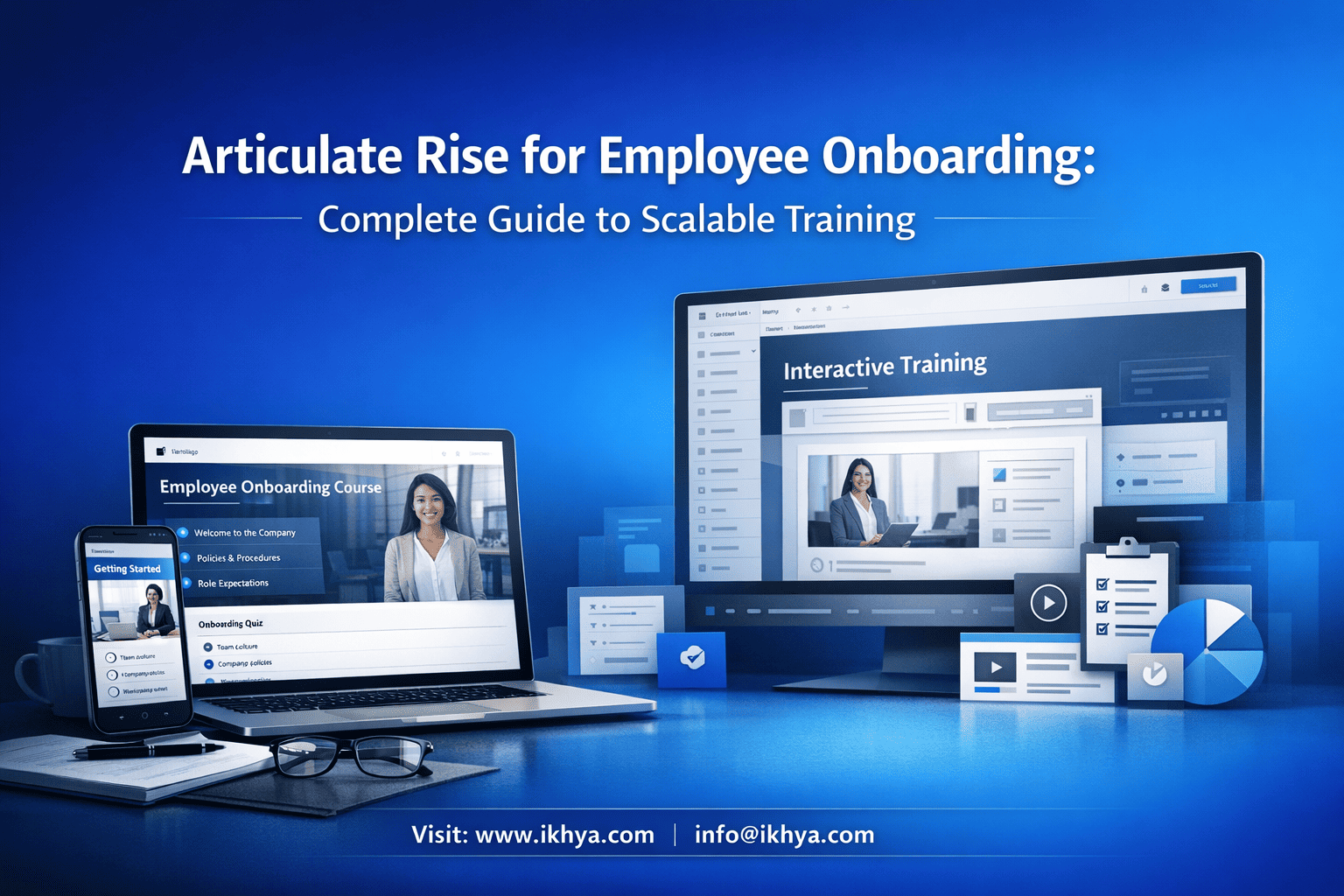
Articulate Rise for Employee Onboarding: Complete Guide to Scalable Training

Employee onboarding directly impacts productivity, retention, and performance. Yet many organizations still rely on slow, inconsistent methods like classroom sessions and static documents. This leads to delays, poor engagement, and uneven learning experiences.
Articulate Rise for employee onboarding solves this by enabling fast, structured, and mobile-friendly training that scales across teams and locations.
If you’re exploring how to improve onboarding efficiency and consistency, you can start by experiencing a real implementation through a book a free elearning demo.
What is Articulate Rise for Employee Onboarding
Articulate Rise is a cloud-based eLearning authoring tool used to create responsive, interactive onboarding courses quickly. It allows organizations to build structured learning journeys that are easy to update, distribute, and track.
To understand its foundation, explore what is articulate rise 360, which explains how it enables rapid course creation.
Why it works for onboarding
Onboarding requires speed, consistency, and scalability. Articulate Rise delivers this through:
- Pre-built course structures
- Mobile-responsive design
- Block-based content creation
- Easy updates without redevelopment
Core capabilities that drive onboarding success
Rapid development
Teams can build onboarding modules quickly using structured templates. This is often accelerated with rapid elearning development services.
Mobile-first experience
Employees can access training anytime across devices, supported by mobile learning development solutions.
Microlearning structure
Content can be delivered in short modules to improve retention using microlearning development services.
LMS integration and tracking
Courses integrate with LMS platforms using SCORM/xAPI, enabled by lms compatible elearning course development services.
How organizations structure onboarding in Rise
Typical onboarding journeys include:
- Pre-boarding (company overview, policies)
- Day 1 onboarding (tools, systems)
- Role-based training (job-specific skills)
- Compliance training
Many organizations scale onboarding by converting classroom sessions using ilt to elearning course conversion services.
Example scenario
A retail company onboarding 800+ employees:
- Converted training using convert powerpoint to elearning a complete guide
- Built structured modules in Rise
- Delivered via LMS
Results:
- 40% faster onboarding
- Higher completion rates
- Reduced training costs
When Articulate Rise is the right choice
Articulate Rise is ideal when:
- You need fast deployment (2–4 weeks)
- Content is structured and process-driven
- Mobile learning is required
- Training must scale globally
For advanced interactivity, organizations combine tools using rapid elearning development using storyline and rise 360.
A smarter onboarding approach
Effective onboarding is not just about tools—it requires structured design and strategy. Many organizations achieve better outcomes by working with experts offering:
If you’re planning to improve onboarding and want clarity on the right approach, you can take the next step and contact us.
Why Companies Use Articulate Rise for Onboarding Training
Organizations adopt Articulate Rise for onboarding because it delivers fast, consistent, and scalable training. It helps reduce onboarding time, improves engagement, and ensures every employee receives the same structured learning experience across locations.
Faster onboarding at scale
Traditional onboarding slows down as hiring increases. Scheduling sessions and managing trainers becomes inefficient.
With Articulate Rise:
- Courses are created quickly
- Content is reusable across roles
- Training is deployed instantly
Companies often accelerate rollout using rapid eLearning development services.
Consistent training across locations
Global teams often face inconsistent onboarding delivery.
Articulate Rise ensures:
- Standardized content
- Same learning experience for all employees
- Reduced dependency on trainers
For global deployment, organizations combine this with elearning translation localization services.
Higher engagement and completion rates
Static onboarding fails to engage modern learners.
Articulate Rise improves engagement through:
- Interactive content blocks
- Scenario-based learning
- Built-in quizzes
For deeper engagement, companies integrate elearning simulation based training services.
Reduced onboarding time
Employees don’t need to wait for scheduled sessions.
With Rise:
- Learning is self-paced
- Content is structured for faster understanding
- Training is accessible anytime
Many organizations enhance this approach using rapid elearning development using storyline and rise 360.
Easy updates and scalability
Onboarding content changes frequently. Traditional formats make updates slow and costly.
Articulate Rise allows:
- Instant content updates
- Quick republishing
- Scalable distribution
Organizations modernizing outdated training often use modernizing legacy elearning using articulate rise.
LMS integration and tracking
Tracking onboarding is essential for compliance and performance.
Articulate Rise supports:
- SCORM/xAPI integration
- Progress tracking
- Completion reports
This is typically implemented using lms compatible elearning course development services.
Example impact
A finance company onboarding 400+ employees:
- Converted classroom training using how to convert classroom training to articulate rise elearning
- Built structured onboarding modules
- Integrated LMS tracking
Results:
- 35% faster onboarding
- Improved consistency
- Better compliance tracking
Why decision-makers choose Rise
- Faster deployment
- Lower training costs
- Scalable onboarding
- Consistent learning experience
To implement this effectively, many organizations partner with experts offering articulate rise development services.
If you’re planning to scale onboarding while maintaining quality and consistency, defining your requirements clearly is the next step. You can begin by submitting your needs through request rfp.
Key Benefits of Using Articulate Rise for Employee Onboarding
Articulate Rise improves onboarding by making training faster to deliver, easier to scale, and more engaging for employees. It helps organizations reduce onboarding time, improve retention, and maintain consistency without increasing costs.
Faster time-to-productivity
Employees become productive quicker when onboarding is structured and accessible.
Articulate Rise enables:
- Clear learning paths
- Self-paced training
- Instant access to content
Organizations often align onboarding with business goals using custom elearning development services.
Better knowledge retention
Long onboarding sessions reduce retention. Rise solves this by:
- Breaking content into smaller modules
- Using interactive elements
- Including quick assessments
This is further strengthened with instructional design services to structure content effectively.
Cost-effective onboarding
Instructor-led training involves recurring costs.
With Rise:
- Content is reusable
- Training is scalable
- Instructor dependency is reduced
Many companies optimize costs through outsource elearning development benefits costs and best practices.
Consistent learning experience
Rise ensures:
- Standardized onboarding content
- Uniform training across locations
- Reduced variation in delivery
This is critical for organizations with distributed teams.
Mobile-friendly learning
Employees can learn anytime using:
- Mobile devices
- Tablets
- Desktops
This flexibility is supported by mobile learning development solutions.
Easy scalability
Articulate Rise allows organizations to:
- Train large workforces simultaneously
- Reuse modules across departments
- Scale globally without complexity
Quick updates and compliance readiness
Content updates are simple:
- Edit directly in the cloud
- Republish instantly
- Maintain updated compliance training
Organizations handling regulatory onboarding often use compliance training elearning solutions.
Improved tracking and analytics
Rise enables:
- Monitoring completion rates
- Tracking learner progress
- Identifying knowledge gaps
This supports continuous improvement in onboarding.
Business impact snapshot
| Metric | Before Rise | After Rise |
|---|---|---|
| Onboarding Time | 4–6 weeks | 2–3 weeks |
| Completion Rate | ~55% | ~85% |
| Engagement | Low | High |
| Cost | High | Reduced |
Why this matters for organizations
These benefits translate into:
- Faster employee readiness
- Better learning outcomes
- Reduced operational costs
- Improved onboarding experience
For organizations planning to implement a structured onboarding strategy, working with experts offering elearning consultancy services helps ensure effective execution.
If you’re looking to improve onboarding outcomes while reducing time and cost, the next step is to evaluate the right strategy and implementation approach.
How to Create Onboarding Training Using Articulate Rise
Creating onboarding training with Articulate Rise involves structuring content into clear modules, adding interactivity, and deploying through an LMS. A focused approach ensures faster development, better engagement, and measurable outcomes.
Step-by-step onboarding development process
Define goals and outcomes
Start by identifying what employees must achieve after onboarding:
- Understand company policies and culture
- Learn tools and workflows
- Meet compliance requirements
- Perform role-specific tasks
Clear objectives ensure training aligns with business needs. Many organizations structure this using instructional design services.
Structure onboarding into phases
Divide onboarding into manageable stages:
- Pre-boarding
- Day 1 onboarding
- Role-based training
- Ongoing learning
This improves clarity and prevents information overload.
Convert existing content
Most companies already have training materials such as:
- PowerPoint presentations
- PDFs
- Instructor-led content
These can be converted using:
- convert powerpoint training to articulate rise courses
- converting pdf and powerpoint content into interactive storyline courses
This reduces development time and cost.
Build interactive modules in Rise
Use Rise to create engaging content:
- Text-based lessons
- Interactive blocks
- Videos and demonstrations
- Quizzes and assessments
For real-world application, many organizations include scenario-based learning in articulate rise.
Use microlearning for better retention
Break onboarding into small modules:
- 5–10 minute lessons
- One topic per module
- Easy navigation
This approach is widely implemented using how to build microlearning courses using articulate rise.
Ensure mobile compatibility
Rise automatically creates responsive courses. To enhance experience, organizations use mobile learning development solutions.
Integrate with LMS
After development:
- Export courses in SCORM/xAPI
- Upload to LMS
- Track learner progress
This ensures visibility into onboarding performance.
Test and optimize
Before launch:
- Test across devices
- Gather feedback
- Refine content
After launch:
- Monitor completion rates
- Update modules regularly
Organizations often improve performance using elearning course redesigning services.
Example timeline
| Type | Timeline | Scope |
|---|---|---|
| Rapid onboarding | 2–3 weeks | Basic modules |
| Standard onboarding | 4–6 weeks | Structured content |
| Advanced onboarding | 6–10 weeks | Role-based + interactive |
Practical example
A healthcare company onboarding 250+ employees:
- Converted classroom training using rapid conversion of instructor led training to articulate rise elearning
- Built microlearning modules
- Integrated LMS tracking
Results:
- Faster onboarding completion
- Improved compliance
- Better engagement
Common mistakes to avoid
- Overloading content
- Ignoring interactivity
- Skipping mobile optimization
- Not tracking performance
Execution strategy
Organizations often speed up development and improve quality by working with experts offering articulate rise course development services for corporate training teams.
If you’re planning your onboarding budget and need a clear estimate, start by outlining your requirements and expected scope.
Onboarding Design Framework (30-60-90 Model)
The 30-60-90 model structures onboarding into three phases, helping employees gradually move from learning to performance. When implemented using Articulate Rise, it creates a clear, scalable learning path that improves retention and productivity.
Phase 1: First 30 days (Foundation)
Focus: Understanding the organization and role basics.
Key components:
- Company culture and policies
- Compliance training
- Tools and system orientation
- Basic role expectations
Content should be simple, structured, and easy to consume. Many organizations follow instructional design best practices for articulate rise to ensure clarity.
Phase 2: 30–60 days (Skill building)
Focus: Applying knowledge in real scenarios.
Key components:
- Role-specific training
- Process walkthroughs
- Scenario-based learning
- Guided tasks
To improve practical understanding, companies use scenario-based learning in articulate rise.
Phase 3: 60–90 days (Performance)
Focus: Independent work and performance improvement.
Key components:
- Advanced training
- Performance assessments
- Feedback and evaluation
- Continuous learning
Progress is tracked through LMS systems supported by lms compatible elearning course development services.
How Articulate Rise supports this model
Articulate Rise makes this framework effective by:
- Structuring content into clear modules
- Allowing phased learning release
- Supporting self-paced progression
- Enabling assessments and tracking
This ensures employees are not overwhelmed and can progress step by step.
Example
A financial organization implemented the 30-60-90 model:
- Built phase-wise onboarding modules
- Integrated assessments
- Tracked progress via LMS
Results:
- Faster role readiness
- Improved learning retention
- Better performance outcomes
Benefits of this approach
- Clear learning structure
- Improved retention
- Measurable progress
- Scalable across teams
Common mistakes to avoid
- Overloading the first phase
- Not aligning training with job roles
- Skipping performance tracking
- Treating onboarding as a one-time event
Implementation approach
Organizations often design structured onboarding journeys with support from custom elearning development services to ensure alignment with business goals.
If you’re planning to implement a structured onboarding framework tailored to your organization, you can take the next step by reaching out to the team.
Real-World Use Cases Across Industries
Articulate Rise is used across industries to deliver structured, scalable onboarding tailored to specific operational and compliance needs. Its flexibility allows organizations to adapt onboarding programs based on workforce size, complexity, and regulatory requirements.
Healthcare onboarding
Healthcare onboarding focuses on compliance and patient safety.
Common use cases:
- Regulatory and compliance training
- Clinical protocols and procedures
- Medical equipment usage
- Patient interaction guidelines
Organizations implement structured programs using healthcare training elearning solutions.
Outcome: Faster compliance readiness and reduced onboarding errors.
Manufacturing onboarding
Manufacturing requires safety-focused onboarding.
Use cases:
- Safety training and regulations
- Equipment handling
- Standard operating procedures
- Hazard awareness
Companies scale this using manufacturing training elearning solutions.
Outcome: Reduced safety incidents and improved operational efficiency.
Finance onboarding
Finance onboarding is driven by compliance and risk management.
Use cases:
- Regulatory training
- Anti-money laundering processes
- Data security policies
- Risk management procedures
Organizations implement this using financial services training elearning solutions.
Outcome: Improved compliance adherence and reduced risk exposure.
Retail onboarding
Retail onboarding must be fast due to high employee turnover.
Use cases:
- Customer service training
- Product knowledge
- POS systems
- Sales processes
Companies manage large-scale onboarding using retail training elearning solutions.
Outcome: Faster onboarding and improved customer experience.
IT and software onboarding
IT onboarding focuses on tools, systems, and workflows.
Use cases:
- Software training
- Development processes
- Security protocols
- Agile workflows
Organizations implement scalable onboarding using it software training elearning solutions.
Outcome: Faster project readiness and reduced dependency on mentors.
Why it works across industries
Articulate Rise supports:
- Scalable training delivery
- Consistent learning experience
- Flexible content structure
- Rapid deployment
Implementation approach
Organizations across industries often work with experts offering elearning consultancy services to align onboarding with operational and business requirements.
If you’re planning onboarding across different departments or regions, defining the right approach early helps ensure consistency and scalability. You can begin by outlining your requirements through request rfp.
Articulate Rise vs Storyline for Employee Onboarding
Articulate Rise and Storyline serve different purposes in onboarding. The right choice depends on how complex your training is, how fast you need to deploy, and the level of interactivity required.
When to use Articulate Rise
Articulate Rise is ideal for:
- Structured onboarding programs
- Policy and compliance training
- Process-based learning
- Mobile-first delivery
It allows fast development and easy updates, making it perfect for scalable onboarding.
To explore a deeper comparison, see articulate rise vs storyline which should you choose.
When to use Articulate Storyline
Storyline is better suited for:
- Complex simulations
- Software training
- Advanced branching scenarios
- Custom interactive experiences
Many organizations implement this using articulate storyline development for employee onboarding programs.
Key differences
| Feature | Articulate Rise | Articulate Storyline |
|---|---|---|
| Development speed | Fast | Moderate |
| Mobile responsiveness | Built-in | Requires adjustments |
| Interactivity | Moderate | Advanced |
| Customization | Limited | High |
| Best use | Structured onboarding | Simulation-based training |
Blended approach
Many organizations combine both tools:
- Use Rise for core onboarding modules
- Use Storyline for simulations
- Deliver both through LMS
This approach is commonly implemented using modernizing corporate training using articulate storyline and rise development.
Example
An IT company onboarding developers:
- Used Rise for company policies
- Used Storyline for tool simulations
Result:
- Faster onboarding
- Better practical understanding
- Improved engagement
How to decide
- Choose Rise for speed, scalability, and mobile learning
- Choose Storyline for advanced interactivity
- Combine both for balanced onboarding
Implementation support
Organizations often make better decisions by working with experts offering elearning consultancy services to align tools with business needs.
If you’re planning onboarding and need clarity on the right tool and approach, you can begin by submitting your requirements through request rfp.
Cost of Employee Onboarding eLearning Development
The cost of onboarding training using Articulate Rise depends on content complexity, number of modules, interactivity, and scale. Organizations typically invest based on how structured and advanced the onboarding program needs to be.
Typical cost ranges
| Project Type | Cost Range | Scope |
|---|---|---|
| Basic onboarding | $2,000 – $5,000 | 5–7 modules, simple content |
| Standard onboarding | $5,000 – $15,000 | 10–15 modules, moderate interactivity |
| Advanced onboarding | $15,000 – $25,000+ | simulations, role-based paths |
Costs vary depending on whether development is handled internally or through custom elearning development services.
Key factors affecting cost
Content complexity
- Basic informational content → lower cost
- Scenario-based or simulation content → higher cost
Advanced learning often includes elearning simulation based training services.
Content volume
- More modules → higher cost
- Multiple roles → increased effort
Interactivity level
- Basic → text and quizzes
- Moderate → interactions and branching
- Advanced → simulations
For advanced needs, organizations use articulate storyline development services.
Conversion vs custom development
- Converting existing materials → cost-effective
- Building from scratch → higher investment
Many companies reduce costs using converting legacy courses to articulate storyline and rise services guide.
Localization requirements
Global onboarding increases cost due to translation and adaptation. This is handled using multi language elearning development using articulate storyline and rise.
In-house vs outsourced cost
| Approach | Cost Impact | Notes |
|---|---|---|
| In-house | Lower upfront | Requires internal expertise |
| Outsourced | Higher upfront | Faster, scalable, expert-driven |
Organizations evaluate this using in house vs outsourced elearning development cost comparison.
Example cost scenario
A company onboarding 300 employees:
- 10 modules
- Moderate interactivity
- LMS integration
Estimated cost: $8,000 – $12,000
Impact:
- Faster onboarding
- Reduced training costs
- Improved productivity
Hidden costs to consider
- LMS licensing
- Content updates
- Internal resource time
- Translation costs
Planning these early avoids budget overruns.
Cost optimization strategies
- Reuse existing content
- Use microlearning
- Standardize modules
- Outsource strategically
Many organizations optimize costs through outsource elearning development benefits costs and best practices.
Investment perspective
Onboarding should be viewed as a long-term investment that improves productivity and reduces errors.
If you’re planning your onboarding budget and need a clear estimate based on your requirements, you can start by submitting details through request rfp.
Development Timelines for Employee Onboarding eLearning
Articulate Rise enables faster onboarding development compared to traditional training. Timelines depend on content readiness, number of modules, and level of interactivity, but most projects can be completed within a few weeks.
Typical timelines
| Project Type | Timeline | Scope |
|---|---|---|
| Rapid onboarding | 2–3 weeks | Basic modules, low interactivity |
| Standard onboarding | 4–6 weeks | Structured modules with quizzes |
| Advanced onboarding | 6–10 weeks | Role-based paths, simulations |
Organizations often accelerate delivery using rapid elearning development services.
Key factors affecting timelines
Content availability
- Ready content → faster development
- Content creation required → longer timelines
Many companies speed this up using convert powerpoint training to articulate rise courses.
Number of modules
- Fewer modules → quicker delivery
- Multiple roles → longer timelines
Interactivity level
- Basic content → faster
- Simulation-heavy content → slower
Advanced interactivity often involves articulate storyline course development services complete guide.
Review cycles
- Faster approvals → quicker launch
- Multiple stakeholders → delays
Localization
Multi-language onboarding increases timelines. This is managed using elearning translation localization services.
Example scenarios
Rapid rollout
- 5 modules
- Existing content
Timeline: 2–3 weeks
Use case: Retail onboarding
Standard onboarding
- 10–12 modules
- Moderate interactivity
Timeline: 4–6 weeks
Use case: Corporate onboarding
Advanced onboarding
- 15+ modules
- Role-based learning + simulations
Timeline: 6–10 weeks
Use case: IT or compliance-heavy training
How to speed up development
- Use existing materials
- Standardize course structure
- Limit unnecessary interactivity
- Work with experienced teams
Many organizations accelerate delivery by partnering with articulate rise course development services for corporate training teams.
Example
A retail company onboarding seasonal employees:
- Converted existing content
- Built microlearning modules
- Delivered via LMS
Result:
- Completed onboarding in 3 weeks
- Reduced delays during peak hiring
Balancing speed and quality
Faster development should not compromise learning effectiveness. A structured approach ensures:
- Clear content flow
- Engaging modules
- Measurable outcomes
Organizations maintain this balance using instructional design services.
If you’re planning onboarding timelines and need a realistic estimate based on your scope, you can begin by submitting your requirements through request rfp.
Converting Classroom Onboarding to eLearning Using Articulate Rise
Converting instructor-led onboarding into eLearning helps organizations scale training, reduce costs, and ensure consistent delivery. Articulate Rise makes this transition faster by transforming existing content into structured, interactive modules.
Why move from classroom to eLearning
Traditional onboarding creates challenges:
- Trainer dependency
- Scheduling delays
- Inconsistent delivery
- Limited scalability
With eLearning:
- Training is available anytime
- Content is standardized
- Employees learn at their own pace
Organizations typically start this transition using ilt to elearning course conversion services.
Step-by-step conversion approach
Audit existing content
Review materials such as:
- Presentations
- Manuals
- Trainer notes
- Recorded sessions
Restructure for digital learning
Classroom content must be simplified and reorganized:
- Break into smaller modules
- Focus on key concepts
- Remove unnecessary information
This is often improved using instructional design services.
Convert into interactive modules
Transform content into eLearning:
- Convert presentations using convert powerpoint to elearning a complete guide
- Add visuals and interactive elements
- Include quizzes and assessments
Add engagement elements
Replace classroom interaction with:
- Scenario-based learning
- Knowledge checks
- Real-world examples
Many organizations enhance engagement using gamification strategies for articulate rise courses.
Structure into learning paths
Organize onboarding into:
- Pre-boarding
- Day 1 onboarding
- Role-based training
- Continuous learning
Deploy through LMS
- Export in SCORM/xAPI
- Upload to LMS
- Track progress
Optimize after launch
- Monitor completion rates
- Gather feedback
- Update content regularly
Organizations refine courses using elearning course redesigning services.
Example
A manufacturing company replaced classroom onboarding:
- Converted ILT sessions into Rise modules
- Structured content into microlearning
- Delivered training via LMS
Results:
- 50% reduction in onboarding time
- Consistent training delivery
- Lower operational costs
Common mistakes to avoid
- Copying classroom content without restructuring
- Overloading modules
- Ignoring interactivity
- Skipping LMS tracking
When to seek expert support
Conversion becomes complex when:
- Content volume is large
- Multiple roles are involved
- Compliance requirements are strict
Organizations handle this efficiently using convert existing training content into articulate storyline and rise complete service guide.
If you’re planning to convert onboarding into scalable digital training, you can take the next step by submitting your requirements through request rfp.
Mobile Learning and Microlearning in Employee Onboarding
Mobile learning and microlearning make onboarding faster, more flexible, and easier to complete. Articulate Rise supports both, allowing employees to learn in short, focused sessions across any device.
Why mobile learning matters
Employees today expect flexible training.
Mobile onboarding enables:
- Learning anytime, anywhere
- Access across devices
- Better engagement for remote teams
Organizations enhance this using mobile learning development solutions.
What is microlearning in onboarding
Microlearning delivers content in short modules:
- 5–10 minutes per lesson
- One topic per module
- Quick assessments
This improves retention and completion rates. Many companies implement this using designing microlearning modules using articulate rise 360.
Key benefits
- Faster onboarding completion
- Higher engagement
- Better knowledge retention
- Flexible learning schedules
- Scalable training delivery
How Articulate Rise supports this
Rise is designed for:
- Responsive, mobile-friendly courses
- Scroll-based learning
- Modular content structure
Organizations build effective modules using microlearning courses in Articulate Rise.
Example
A retail company onboarding 1,000+ employees:
- Created microlearning modules
- Delivered training via mobile
- Included quick quizzes
Results:
- 60% faster onboarding
- Higher completion rates
- Improved engagement
Best practices
- Keep modules short and focused
- Use visuals instead of heavy text
- Include interactions and quizzes
- Design for mobile-first experience
For better structure, teams follow instructional design best practices for articulate rise.
Common mistakes
- Long, scroll-heavy modules
- Too much information per lesson
- Ignoring mobile optimization
- Lack of assessments
Implementation approach
Organizations often build mobile-first onboarding programs with support from Articulate Rise development services.
If you’re planning to improve onboarding engagement and completion rates, you can take the next step by reaching out through contact us.
LMS Integration, SCORM, and xAPI Tracking in Onboarding
LMS integration allows organizations to deliver, manage, and track onboarding training effectively. Articulate Rise supports SCORM and xAPI, enabling seamless deployment and detailed tracking of employee learning progress.
Why LMS integration is essential
Without an LMS, onboarding lacks visibility and control.
With LMS integration, organizations can:
- Assign training automatically
- Track completion and progress
- Generate compliance reports
- Monitor learner performance
This is typically implemented using lms compatible elearning course development services.
SCORM vs xAPI explained
SCORM
- Tracks completion status
- Records scores and time spent
- Works with most LMS platforms
xAPI
- Tracks detailed learner behavior
- Captures learning beyond LMS
- Provides advanced analytics
Organizations choose based on tracking depth and reporting needs.
What you can track
With LMS-based onboarding, you can measure:
- Course completion rates
- Assessment scores
- Time spent on modules
- Drop-off points
- Progress across onboarding phases
This helps improve training effectiveness and identify gaps.
Implementation process
Select an LMS
Choose a platform that supports:
- SCORM/xAPI
- Reporting and analytics
- Mobile access
Export courses from Rise
- Publish in SCORM or xAPI format
- Configure tracking settings
Upload and assign training
- Assign courses to employees
- Define completion criteria
- Create learning paths
Monitor and optimize
- Analyze learner data
- Identify improvement areas
- Update content regularly
Organizations streamline this process using elearning consultancy services.
Example
A finance company implemented LMS tracking:
- Deployed Rise onboarding modules
- Tracked learner progress
- Identified low-performing modules
Results:
- 35% improvement in completion rates
- Better course structure
- Improved onboarding outcomes
Common challenges
- Incorrect SCORM settings
- LMS compatibility issues
- Poor tracking configuration
- Limited reporting setup
Avoiding these ensures accurate data and smooth deployment.
Business impact
Tracking enables organizations to:
- Measure onboarding effectiveness
- Improve employee performance
- Ensure compliance
- Continuously optimize training
If you’re planning to implement LMS-based onboarding and want proper tracking and reporting, you can begin by submitting your requirements through request rfp.
Common Challenges in Employee Onboarding and How to Solve Them
Even with the right tools, onboarding can fail due to poor structure, low engagement, or lack of scalability. Addressing these challenges early ensures better learning outcomes and smoother onboarding execution.
Information overload
New hires often receive too much information at once.
Solution:
- Break content into smaller modules
- Prioritize essential topics
- Use microlearning formats
Many organizations handle this using microlearning development services.
Low engagement
Static content leads to poor participation and completion.
Solution:
- Add interactive elements
- Use real-world scenarios
- Include quizzes and assessments
Engagement improves significantly with scenario-based learning in articulate rise.
Inconsistent training delivery
Trainer-led onboarding often varies across locations.
Solution:
- Standardize content
- Deliver through eLearning
- Use LMS for consistency
Organizations ensure uniform delivery using custom elearning development services.
Difficulty scaling onboarding
Growing companies struggle to onboard large teams efficiently.
Solution:
- Use digital onboarding platforms
- Reuse training modules
- Automate delivery
This is achieved using articulate rise development services.
Lack of tracking and measurement
Without tracking, it’s hard to measure effectiveness.
Solution:
- Integrate LMS
- Use SCORM/xAPI
- Monitor learner progress
This is supported by lms compatible elearning course development services.
Outdated training content
Onboarding content becomes outdated quickly.
Solution:
- Use cloud-based tools
- Update content regularly
- Maintain version control
Organizations modernize training using upgrade existing elearning courses using articulate storyline and rise.
Poor alignment with business goals
Onboarding often focuses on information, not performance.
Solution:
- Define clear learning objectives
- Align training with job roles
- Measure outcomes
Many organizations improve alignment using elearning consultancy services.
Example
A logistics company faced:
- Low engagement
- Inconsistent onboarding
- High turnover
They implemented structured eLearning onboarding:
- Used microlearning modules
- Integrated LMS tracking
Results:
- Higher completion rates
- Faster onboarding
- Improved retention
If you’re facing onboarding challenges and need a structured solution, you can take the next step by reaching out through contact us.
In-House vs Outsourced Onboarding eLearning Development
Choosing between in-house and outsourced onboarding development depends on your team’s capability, timelines, and scale. The right approach ensures faster delivery, better quality, and long-term efficiency.
In-house development
In-house teams handle onboarding creation internally.
Best suited when:
- You have experienced L&D resources
- Content updates are frequent
- You need full control
Pros:
- Direct control over content
- Faster minor updates
- Better internal alignment
Cons:
- Requires skilled resources
- Slower for large projects
- Limited scalability
Organizations often strengthen internal capability using corporate elearning development the complete enterprise guide.
Outsourced development
Outsourcing involves working with specialized eLearning vendors.
Best suited when:
- You need faster deployment
- Internal resources are limited
- Projects are large or complex
Pros:
- Faster development
- Expert-driven design
- Scalable production
- High-quality output
Many organizations explore this through outsource elearning development benefits costs and best practices.
Cost and efficiency comparison
| Factor | In-house | Outsourced |
|---|---|---|
| Initial cost | Lower | Higher |
| Long-term cost | Higher | Optimized |
| Speed | Slower | Faster |
| Quality | Depends on team | Expert-level |
| Scalability | Limited | High |
For deeper evaluation, companies refer to in house vs outsourced elearning development cost comparison.
Hybrid approach
Many organizations combine both:
- Internal team handles updates
- External experts handle development
This balances cost, speed, and control.
Example
An IT company needed onboarding for multiple roles:
- Limited internal bandwidth
- Tight timelines
They outsourced development and managed updates internally.
Results:
- Faster rollout
- High-quality content
- Reduced internal workload
How to decide
Choose based on:
- Timeline requirements
- Internal expertise
- Project scale
- Budget
Outsourcing is often better for large, time-sensitive onboarding programs.
When outsourcing is ideal
- Launching onboarding from scratch
- Scaling across regions
- Handling complex training
- Needing faster ROI
Organizations scale effectively using articulate rise development services.
If you’re evaluating the right development approach for your onboarding program, you can start by defining your requirements through request rfp.
How to Choose the Right eLearning Vendor for Onboarding
Selecting the right eLearning vendor ensures your onboarding program is effective, scalable, and aligned with business goals. The wrong choice can lead to delays, poor quality, and higher costs.
Key factors to evaluate
A strong vendor should offer:
- Experience in onboarding training
- Expertise in Articulate Rise and Storyline
- Strong instructional design capability
- Ability to scale across projects
- Proven results in similar industries
Organizations often begin evaluation using how to choose the elearning vendor.
Assess development capabilities
Evaluate whether the vendor can:
- Create engaging and interactive content
- Deliver mobile-friendly training
- Integrate with LMS platforms
- Handle multi-language projects
For structured execution, companies look for articulate rise course development services for corporate training teams.
Review portfolio and results
Check for:
- Industry-specific case studies
- Examples of onboarding programs
- Measurable outcomes
A strong reference point is a custom elearning development case study.
Evaluate scalability and long-term support
Onboarding evolves over time. Ensure the vendor can:
- Support updates and maintenance
- Scale with hiring growth
- Handle long-term projects
Organizations planning long-term partnerships often prefer vendors highlighted in reliable articulate rise development partner for long term projects.
Understand their process
A reliable vendor follows a clear workflow:
- Requirement analysis
- Storyboarding
- Development
- Review cycles
- Deployment
This ensures transparency and predictable timelines.
Questions to ask vendors
- How do you approach onboarding design?
- What is your typical timeline?
- How do you ensure content quality?
- Can you support global deployment?
- What post-launch support is provided?
Red flags to avoid
- No onboarding-specific experience
- Generic, template-only solutions
- Lack of measurable results
- Unclear timelines
Example
A retail company evaluated multiple vendors:
- Selected one with strong Rise expertise
- Focused on scalability and mobile learning
Results:
- Faster onboarding rollout
- Consistent training across locations
- Improved employee performance
Making the right decision
The right vendor should:
- Understand your business needs
- Deliver scalable solutions
- Ensure high-quality learning
- Provide ongoing support
If you’re ready to move forward and want to define your onboarding requirements clearly, you can start by submitting details through request rfp.
Why Organizations Outsource Articulate Rise Development
Organizations outsource Articulate Rise development to accelerate onboarding, improve content quality, and reduce internal workload. It allows teams to focus on core operations while experts handle training design and execution.
Faster deployment
Experienced vendors follow proven workflows and use reusable frameworks, enabling quicker onboarding rollout—especially useful when hiring at scale or under tight timelines.
Access to expert skills
Effective onboarding requires:
- Instructional design expertise
- Content structuring
- Learner engagement strategies
Companies gain these capabilities by working with teams offering instructional design services.
Higher quality content
Outsourced teams bring:
- Professional design standards
- Interactive learning formats
- Industry best practices
This results in onboarding programs that are more engaging and effective.
Scalability across teams
As organizations grow, onboarding needs expand.
Outsourcing enables:
- Handling large content volumes
- Supporting multiple roles
- Scaling across regions
Many companies rely on articulate rise development services to ensure consistent delivery.
Cost efficiency over time
Although outsourcing may involve higher upfront cost, it reduces long-term expenses by:
- Saving internal resource time
- Avoiding rework
- Improving development efficiency
Organizations often evaluate this using outsource elearning development benefits costs and best practices.
Focus on core business
Internal teams can focus on:
- Strategic initiatives
- Business operations
- Employee experience
Instead of managing complex training development.
Flexibility and adaptability
Outsourcing allows organizations to:
- Scale projects up or down
- Adjust timelines
- Update content efficiently
Example
A healthcare organization needed onboarding for multiple roles:
- Limited internal resources
- Strict compliance timelines
They outsourced development:
- Built structured onboarding modules
- Integrated LMS tracking
Results:
- Faster onboarding rollout
- Improved compliance training
- Reduced internal workload
When outsourcing makes sense
- Large-scale onboarding programs
- Tight timelines
- Limited internal expertise
- Multi-region deployment
If you’re planning to outsource onboarding development and want a structured approach, you can begin by defining your requirements through request rfp.
Future Trends in Employee Onboarding with Articulate Rise
Employee onboarding is evolving toward faster, smarter, and more personalized learning. With AI, automation, and data-driven strategies, organizations are moving beyond static training to adaptive onboarding experiences that improve performance from day one.
AI-driven personalized learning
AI enables onboarding to adapt to each employee.
- Personalized learning paths
- Content recommendations based on performance
- Faster skill development
This reduces unnecessary training and improves learning efficiency.
Adaptive learning experiences
Modern onboarding adjusts content based on learner progress.
- Employees skip known topics
- Focus on skill gaps
- Improve learning outcomes
This is especially useful in role-based onboarding.
Automation in onboarding
Automation reduces manual effort and improves efficiency.
- Automatic course assignments
- Scheduled learning paths
- Reminders and notifications
Organizations implement this using LMS systems supported by lms compatible elearning course development services.
Data-driven optimization
Analytics helps improve onboarding continuously.
Organizations use data to:
- Identify weak modules
- Improve content structure
- Increase completion rates
Many companies enhance this using elearning consultancy services.
Continuous onboarding approach
Onboarding is no longer limited to the first few weeks.
- Ongoing learning modules
- On-demand training
- Just-in-time learning
This is implemented using how to build microlearning courses using articulate rise.
Mobile-first onboarding
With remote work increasing, mobile-first training is essential.
- Fully responsive courses
- Learning from any device
- Flexible schedules
Organizations support this using mobile learning development solutions.
Integration with business systems
Onboarding is becoming connected with:
- HR systems
- Performance tools
- Employee engagement platforms
This creates a seamless experience from hiring to productivity.
Example
A global IT company implemented:
- AI-driven learning paths
- Automated onboarding workflows
- Microlearning modules
Results:
- 50% faster onboarding
- Higher engagement
- Improved productivity
Moving forward
Organizations adopting these trends gain:
- Faster onboarding
- Better employee experience
- Scalable training systems
If you’re planning to modernize your onboarding strategy and adopt future-ready learning approaches, you can take the next step by reaching out through contact us.
Final Thoughts
Articulate Rise for employee onboarding enables organizations to build fast, scalable, and engaging training programs that improve employee readiness and consistency.
A strong onboarding strategy helps:
- Reduce time to productivity
- Improve engagement and retention
- Ensure consistent training delivery
- Lower long-term training costs
Success depends on combining the right tool with the right strategy, structure, and execution.
If you’re ready to build or improve your onboarding program, you can start by exploring a real solution through book a free elearning demo or by submitting your requirements via request rfp.
FAQs
1. What is Articulate Rise used for in onboarding?
It is used to create interactive, mobile-friendly onboarding training delivered through an LMS.
2. How long does onboarding development take?
Typically 2–6 weeks depending on scope and complexity.
3. Is Articulate Rise mobile-friendly?
Yes, it works seamlessly across mobile, tablet, and desktop.
4. Can onboarding be tracked in an LMS?
Yes, using SCORM or xAPI tracking.
5. What is the cost of onboarding eLearning?
Usually between $2,000 and $25,000+ depending on requirements.
6. Should onboarding be outsourced?
Outsourcing is ideal for faster delivery and scalability.
7. Can classroom onboarding be converted to eLearning?
Yes, existing materials can be converted into interactive modules.
8. What industries use Articulate Rise?
Healthcare, manufacturing, finance, retail, IT, and more.
9. What is microlearning in onboarding?
Short, focused modules that improve retention.
10. How does Rise improve engagement?
Through interactive content and assessments.
11. Can onboarding content be updated easily?
Yes, updates can be made quickly in the cloud.
12. What is the difference between Rise and Storyline?
Rise is faster and responsive; Storyline supports advanced interactivity.
13. Does Rise support multi-language training?
Yes, it supports localization for global teams.
14. How can onboarding be scaled globally?
Through digital learning and LMS integration.
15. What are common onboarding challenges?
Low engagement, inconsistency, scalability issues.
16. How is onboarding effectiveness measured?
Through completion rates, assessments, and analytics.
17. Is Rise suitable for compliance training?
Yes, it is widely used for compliance onboarding.
18. Can onboarding include simulations?
Yes, using tools like Storyline.
19. What is the biggest benefit of digital onboarding?
Scalability and consistency.
20. How do I get started?
Define goals, structure content, and choose the right approach.
Related Resources
If you want to go deeper into onboarding strategy, tool selection, and implementation planning, these resources will help you move from understanding to execution: