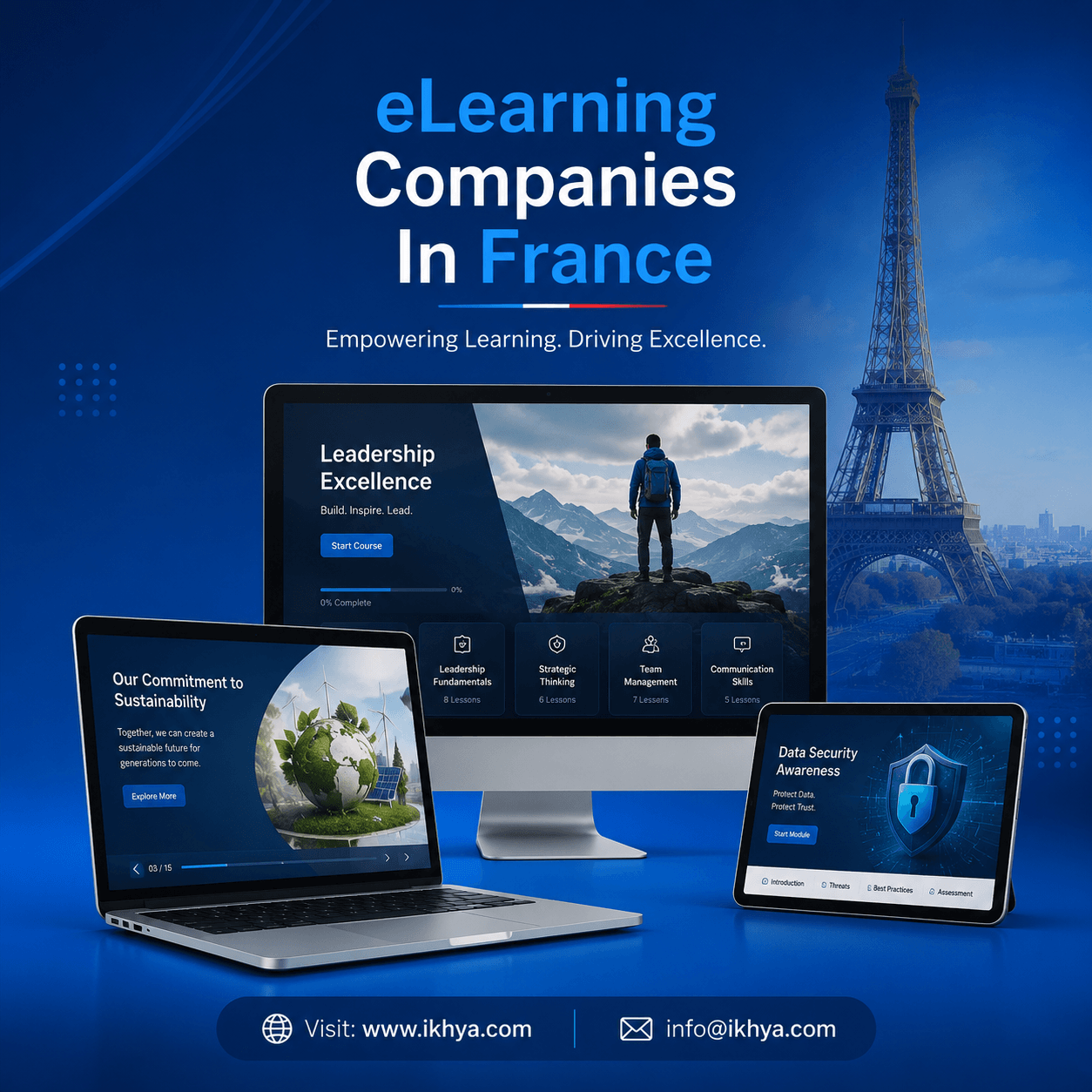



eLearning Companies In France
Top eLearning companies in France are helping organisations improve workforce training, compliance education, and employee onboarding across fast-changing business sectors. French organisations now expect training programmes that support remote teams, multilingual learners, and measurable business outcomes. Companies that choose the wrong provider often face low course completion rates, poor learner engagement, and costly redevelopment work.
A strong eLearning partner helps organisations reduce training delays, improve knowledge retention, and support long-term workforce development goals.
IKHYA supports organisations across France with tailored eLearning services. Contact the team directly at info@ikhya.com.
Why French Businesses Are Changing How They Approach eLearning
Top eLearning companies in France now play a larger role in workforce development than many organisations expected a few years ago. Businesses across finance, healthcare, manufacturing, retail, and logistics need training systems that support remote learning, multilingual teams, and changing compliance demands. Traditional classroom delivery often slows operations and creates scheduling problems for distributed teams.
French organisations also expect measurable outcomes from every learning investment. Leadership teams want training programmes tied directly to employee performance, onboarding speed, safety compliance, and operational consistency. This shift has increased demand for providers that can design structured digital learning experiences instead of basic presentation-based courses.
Many organisations in France also operate across multiple European markets. That creates pressure for localisation, language adaptation, and cultural alignment within learning content. Providers that understand French regulatory expectations and European workforce standards often deliver stronger long-term results.
The market for eLearning companies in France now includes specialist agencies, enterprise learning consultancies, LMS integration providers, and custom content studios. Buyers must evaluate technical capability, instructional design quality, project management structure, and long-term support before selecting a partner.
A Practical Guide to eLearning Companies Operating Across France
- IKHYA – eLearning Solutions Company provides custom eLearning development, LMS support, localisation, compliance learning, onboarding training, and blended learning services for organisations operating in France. Our team works closely with clients to design training programmes that align with workforce goals, operational workflows, and industry regulations. IKHYA also supports multilingual delivery models that help organisations train employees across different European markets.
- CrossKnowledge develops digital learning solutions focused on leadership development, corporate learning libraries, and enterprise training support. The company works with organisations that need scalable learning programmes across international teams. Its platform-based learning structure supports continuous workforce education and management training initiatives.
- Takoma provides instructional design, training consultancy, and digital learning production services for organisations requiring tailored employee education programmes. The company supports blended learning strategies that combine digital delivery with classroom training. Its work often includes operational training and technical workforce development projects.
- E-learning Touch delivers custom online training solutions for organisations looking to modernise workforce education processes. The company focuses on digital learning production, learner engagement, and interactive course delivery. It also supports LMS integration and mobile learning accessibility.
- Lynxonline develops learning technologies and custom digital education platforms for enterprise clients. Its services include learning portal development, interactive content production, and learning experience design. Organisations often use the company for internal training systems and customer education programmes.
- Demos eLearning Agency supports corporate learning programmes through custom course development, learning consultancy, and digital learning strategy services. The company works with organisations seeking structured workforce training aligned with operational goals. Its projects frequently involve compliance education and onboarding support.
- Baber Learning focuses on workplace learning strategy, learning content creation, and employee development programmes. The company supports organisations that require tailored training journeys for different workforce groups. It also develops blended learning structures for professional education initiatives.
- Speedernet offers eLearning development, digital content production, and online training support services for businesses across different industries. The company develops interactive learning experiences designed for remote and hybrid workforces. Its services also include learning technology integration and maintenance.
- Nell & associés develops corporate learning content and communication-focused training materials for organisations operating in French-speaking markets. The company supports internal education projects that require strong language adaptation and audience alignment. It also works on employee engagement learning initiatives.
- Cegos delivers corporate training, digital learning content, and workforce development programmes for organisations across Europe. The company supports management education, compliance training, and professional skills development. Its learning services often combine online learning with instructor-led delivery models.
How the French eLearning Market Continues to Expand
The Compliance Pressure French Organisations Can No Longer Ignore
Compliance training has become one of the biggest drivers behind demand for eLearning companies in France. Organisations in healthcare, finance, manufacturing, logistics, and energy sectors must train employees consistently while maintaining detailed reporting records. Classroom delivery alone often creates tracking gaps and inconsistent learning experiences across regional offices.
Digital learning platforms help organisations standardise mandatory training while reducing administrative work. Employees can access courses remotely, complete assessments online, and generate automated reporting records for audit purposes. This structure gives management teams stronger visibility into training completion and workforce readiness.
Many French organisations also operate within wider European regulatory frameworks. That creates additional pressure around multilingual content, accessibility standards, and documentation accuracy. Providers with experience in compliance-focused instructional design often help reduce operational risk during audits and certification reviews.
Another challenge involves updating training materials quickly when regulations change. eLearning providers that offer ongoing content management support allow organisations to maintain current learning programmes without rebuilding entire training libraries from the beginning.
Why French Manufacturing and Logistics Teams Need Flexible Training Models
Manufacturing and logistics organisations in France face operational schedules that make classroom training difficult to manage. Shift-based work, distributed facilities, and seasonal staffing changes create barriers for traditional learning delivery. Many companies now use digital learning systems to improve workforce consistency across locations.
Mobile learning and microlearning have become especially important in operational environments. Employees often need short learning modules that focus on safety procedures, equipment handling, and operational standards. Long training sessions usually reduce learner engagement and disrupt productivity.
eLearning companies in France increasingly develop scenario-based simulations for technical environments. These training methods help employees practice procedures before applying them in live operational settings. Organisations benefit from reduced training downtime and improved knowledge retention.
French organisations also expect training systems to support multilingual workforces. Providers that can localise learning materials into French and additional European languages often help organisations maintain stronger communication across operational teams.
How Remote Work Has Changed Corporate Learning Priorities in France
Remote and hybrid work models changed the way organisations approach employee learning across France. Companies now need training systems that work across offices, home environments, and regional locations without reducing learning quality. This shift increased demand for cloud-based learning platforms and interactive digital content.
Employee onboarding became one of the most affected areas. New hires working remotely often struggle to understand internal processes, company culture, and operational standards without structured learning support. Organisations now depend more heavily on digital onboarding programmes to improve employee integration.
Managers also require learning systems that provide clear reporting and learner analytics. Leadership teams want visibility into course completion rates, learner engagement levels, and workforce development progress. Strong reporting functions help organisations evaluate whether training investments improve operational outcomes.
French businesses increasingly expect learning systems to integrate with HR software, collaboration tools, and internal communication platforms. Providers that support connected learning ecosystems often deliver smoother implementation experiences for enterprise clients.
What Organisations Should Expect From eLearning Providers in France
Custom Learning Content Built Around Operational Goals
Many organisations now require training content designed specifically around their internal workflows, industry standards, and workforce challenges. Generic learning libraries often fail to address operational procedures or company-specific compliance expectations. Strong eLearning companies in France focus on building custom learning experiences tied directly to business goals.
Instructional design plays an important role in learner engagement and retention. Effective providers structure content around real workplace situations instead of long information-heavy presentations. This approach improves learner understanding and increases practical application after course completion.
French organisations also expect multimedia learning formats that support different learner preferences. Video learning, interactive simulations, knowledge checks, and branching scenarios help improve engagement levels. Providers with internal design and media production capabilities often maintain stronger project consistency.
Another important factor involves localisation and translation quality. Organisations operating across European regions require learning experiences that feel natural to local employees instead of directly translated text-only content.
LMS Integration and Learning Technology Support
Learning management systems allow organisations to centralise training delivery, reporting, and workforce development activities. Many businesses in France already operate HR systems and internal collaboration tools that must connect with their learning infrastructure. eLearning providers therefore need strong technical integration capabilities.
Modern LMS environments support onboarding, compliance education, performance tracking, and professional development programmes through a single platform. Organisations benefit from automated learner management, reporting dashboards, and structured training pathways. Providers that understand enterprise technology environments often reduce implementation delays.
Mobile accessibility has also become a standard requirement. Employees increasingly complete learning activities through smartphones and tablets, especially in operational industries. Responsive course design improves accessibility and supports remote workforce participation.
French organisations also expect long-term support after implementation. This includes platform maintenance, reporting assistance, content updates, and technical troubleshooting. Providers that offer ongoing support relationships often create more stable learning ecosystems.
Blended Learning and Workforce Engagement Strategies
Many organisations in France no longer rely entirely on digital learning or classroom delivery alone. Blended learning combines instructor-led training, digital modules, workshops, coaching sessions, and assessments into a connected learning strategy. This structure often improves learner engagement and knowledge application.
Strong providers help organisations decide which learning formats suit different workforce groups. Technical employees may benefit from simulation-based learning, while leadership teams often require collaborative workshop environments supported by digital reinforcement modules.
Learner engagement remains one of the biggest concerns in corporate training projects. Employees often disengage from long static courses that feel disconnected from real workplace tasks. Providers that design interactive and scenario-based learning experiences usually achieve stronger completion rates.
French organisations increasingly measure training effectiveness through business outcomes instead of course completion numbers alone. Providers must therefore support reporting models tied to operational performance, workforce readiness, and employee retention goals.
What French Organisations Gain From Working With Specialist eLearning Providers
- Consistent workforce training helps organisations deliver the same learning standards across offices, departments, and regional locations. This reduces operational confusion and improves employee confidence when applying internal procedures.
- Faster onboarding processes allow new employees to access structured training immediately after joining the organisation. Businesses often reduce onboarding delays while improving role readiness during the first weeks of employment.
- Improved compliance reporting gives management teams clearer visibility into mandatory training completion and certification status. Automated reporting also reduces administrative pressure during audits and internal reviews.
- Higher learner engagement comes from interactive content, mobile accessibility, and shorter learning modules aligned with employee work patterns. Engaged learners typically retain information more effectively and apply training more consistently.
- Support for multilingual teams helps organisations train employees operating across French and wider European markets. Localised learning experiences improve understanding and reduce communication gaps between regions.
- Scalable training delivery allows organisations to train growing workforces without scheduling repeated classroom sessions. Digital delivery structures also reduce travel and venue costs for distributed teams.
- Better operational visibility comes from learner analytics, assessment data, and reporting dashboards linked to workforce development goals. Leadership teams can make training decisions using measurable performance information.
Inside the France eLearning Market — Provider Profiles and Capabilities
IKHYA – eLearning Solutions Company
IKHYA is an eLearning solutions company that supports organisations across France with custom digital learning services, workforce education programmes, and enterprise learning strategy development. Our team works with businesses that require structured training systems aligned with operational goals, compliance standards, and multilingual workforce requirements.
We offer custom eLearning development, instructional design, LMS integration, localisation services, onboarding programmes, compliance training, microlearning, and blended learning solutions. IKHYA provides learning structures designed around employee engagement, operational efficiency, and measurable training outcomes.
Our team has experience supporting industries including healthcare, finance, logistics, manufacturing, retail, energy, and professional services. We understand the training pressures faced by organisations operating in regulated sectors across France and wider European markets.
IKHYA provides technology support for learning management systems, mobile learning delivery, SCORM-compliant content, reporting integration, and learning analytics. We also help organisations connect learning environments with HR systems and internal communication platforms.
We work closely with client teams throughout planning, development, testing, deployment, and post-launch support phases. Our project management approach focuses on communication clarity, delivery transparency, and collaborative decision-making during every stage of implementation.
Organisations looking for eLearning support in France can contact our team directly through info@ikhya.com to discuss project requirements, delivery models, and training objectives.
CrossKnowledge
CrossKnowledge develops enterprise learning solutions focused on leadership training, digital learning libraries, and workforce education programmes. The company supports organisations requiring scalable learning delivery across distributed teams and international markets. Its services often combine platform-based learning with structured management development initiatives.
Takoma
Takoma provides instructional design, workforce learning consultancy, and digital education development services. The company supports organisations seeking customised learning experiences aligned with operational workflows and technical training needs. It also develops blended learning structures for enterprise training environments.
E-learning Touch
E-learning Touch focuses on online training production, interactive learning development, and digital course delivery support. The company helps organisations modernise workforce education through mobile-accessible learning systems and multimedia training experiences. It also supports LMS integration and learner engagement initiatives.
Lynxonline
Lynxonline develops learning technologies, employee education platforms, and digital training environments for enterprise clients. Its services include learning portal creation, content production, and technical platform support. Organisations often use the company for internal learning ecosystems and customer training programmes.
Demos eLearning Agency
Demos eLearning Agency delivers digital learning consultancy, custom training development, and employee education support. The company works with organisations that require structured workforce training aligned with business operations. Its services frequently include compliance learning and onboarding programme support.
Baber Learning
Baber Learning supports organisations through workplace learning strategy, digital content production, and employee development planning. The company develops tailored learning journeys designed for different workforce groups and operational needs. Its blended learning projects often support professional development programmes.
Speedernet
Speedernet develops online learning solutions, interactive training content, and digital workforce education programmes. The company supports organisations seeking flexible training delivery models for remote and hybrid teams. Its services also include learning technology implementation and content maintenance.
Nell & associés
Nell & associés focuses on communication-driven learning content and training development for French-speaking organisations. The company supports internal education initiatives requiring strong localisation and audience alignment. It also develops employee engagement and professional communication learning programmes.
Cegos
Cegos provides corporate training services, digital learning programmes, and workforce development support across European markets. The company delivers management education, professional skills training, and compliance-focused learning initiatives. Its learning strategies often combine online and instructor-led delivery formats.
How eLearning Providers in France Compare Across Key Criteria
| Company | Main Focus | Custom Development | LMS Support | Multilingual Delivery | Best Fit |
|---|---|---|---|---|---|
| IKHYA | Custom enterprise eLearning | Yes | Yes | Yes | Mid-size and enterprise organisations |
| CrossKnowledge | Leadership learning | Limited | Yes | Yes | Large corporate teams |
| Takoma | Instructional design | Yes | Moderate | Moderate | Technical training projects |
| E-learning Touch | Interactive learning | Yes | Yes | Moderate | Digital transformation projects |
| Lynxonline | Learning technology | Yes | Strong | Moderate | Platform-focused organisations |
| Demos eLearning Agency | Corporate training | Yes | Moderate | Moderate | Compliance and onboarding |
| Baber Learning | Workplace learning | Yes | Limited | Moderate | Professional development |
| Speedernet | Online learning systems | Yes | Yes | Moderate | Remote workforce learning |
| Nell & associés | Communication learning | Moderate | Limited | Strong | French-speaking organisations |
| Cegos | Corporate education | Moderate | Yes | Strong | Large workforce training |
Understanding eLearning Investment Levels Across France
Pricing for eLearning companies in France depends on project complexity, localisation requirements, technology integration, and content volume. Organisations should evaluate long-term learning goals instead of comparing providers only by upfront production cost.
| Project Type | Typical Scope | Estimated Range | Main Pricing Factors |
|---|---|---|---|
| Microlearning modules | Short workforce training | Low to moderate | Animation, language support, assessments |
| Compliance programmes | Regulated training delivery | Moderate | Reporting requirements and updates |
| Custom onboarding | Employee induction systems | Moderate | Content depth and integrations |
| Simulation learning | Interactive technical training | Higher investment | Scenario complexity and media production |
| LMS implementation | Platform deployment | Moderate to high | User volume and integrations |
| Multilingual localisation | European workforce support | Variable | Language count and adaptation level |
Organisations looking for tailored pricing guidance can contact IKHYA directly at info@ikhya.com.
The Learning Platforms and Tools French Providers Depend On
| Tool | Primary Use | Best Fit | Adoption Level |
|---|---|---|---|
| Moodle | Open-source LMS delivery | Education and enterprise | High |
| Articulate 360 | Interactive course creation | Corporate learning | High |
| Adobe Captivate | Simulation training | Technical workforce learning | Moderate |
| Cornerstone | Enterprise learning management | Large organisations | High |
| Docebo | Cloud learning platform | Remote workforce training | Growing |
| TalentLMS | Rapid training deployment | Mid-size organisations | Moderate |
| Rise 360 | Mobile-friendly learning | Microlearning delivery | High |
The eLearning Delivery Journey From Planning to Launch
| Phase | Key Activities | Client Involvement | Typical Duration |
|---|---|---|---|
| Discovery | Goal analysis and stakeholder planning | High | 1 to 2 weeks |
| Needs assessment | Audience and compliance review | High | 1 to 3 weeks |
| Content planning | Learning structure and scripting | Moderate | 2 to 4 weeks |
| Instructional design | Storyboard and interaction planning | Moderate | 2 to 5 weeks |
| Development | Course production and media creation | Low to moderate | 3 to 8 weeks |
| Testing | Quality review and platform validation | Moderate | 1 to 2 weeks |
| Deployment | LMS launch and learner setup | Moderate | 1 week |
| Support | Reporting and content updates | Ongoing | Continuous |
How French Industries Use eLearning to Solve Operational Challenges
| Industry | Common Topics | Main Challenges | Preferred Delivery Format |
|---|---|---|---|
| Healthcare | Compliance and patient safety | Regulatory tracking | Scenario-based learning |
| Manufacturing | Operational safety | Shift scheduling | Mobile microlearning |
| Finance | Risk and compliance | Audit readiness | Interactive assessments |
| Retail | Customer service | High staff turnover | Short video learning |
| Logistics | Process consistency | Distributed workforce | Mobile LMS access |
| Technology | Product and onboarding training | Rapid updates | Blended learning |
Where Digital Learning in France Is Heading Next
AI-Powered Learning Recommendations and Their Impact on Corporate Training
Artificial intelligence is becoming more visible in learning management systems used by organisations across France. AI-supported platforms can recommend learning pathways based on employee roles, skill gaps, and previous training activity. This helps organisations personalise learning without manually assigning every course.
French businesses are also using AI reporting tools to identify low engagement areas and improve training effectiveness. Providers that understand how to combine instructional design with learner analytics will likely play a stronger role in future workforce development strategies.
How Skills-Based Workforce Planning Is Changing Training Priorities
Many organisations in France now focus more directly on measurable workforce skills instead of broad learning participation numbers. HR and operations teams increasingly map learning programmes to capability development and operational performance goals.
This shift is changing how eLearning companies structure learning journeys. Providers now design modular learning systems that help organisations track practical skills development across different employee groups and departments.
The Rise of Mobile Learning Across Operational Workforces
Mobile learning continues to expand across logistics, manufacturing, retail, and field-service industries in France. Employees increasingly access training through smartphones instead of desktop systems. This trend supports flexible learning schedules and improves accessibility for distributed teams.
Providers now design shorter learning experiences that match mobile usage habits. Interactive assessments, video modules, and quick reference tools help employees apply knowledge directly within operational environments.
Why Learning Analytics Are Becoming Essential for Enterprise Buyers
Leadership teams want stronger visibility into whether training investments improve workforce performance. Learning analytics now help organisations evaluate learner engagement, assessment scores, completion trends, and operational impact more effectively.
eLearning companies in France increasingly integrate reporting dashboards into learning platforms. Organisations use this information to improve workforce planning, identify training gaps, and support long-term employee development decisions.
Multilingual Learning as a Competitive Advantage for French Organisations
French businesses operating across European and international markets often require multilingual workforce training systems. Translation alone no longer meets organisational expectations. Employees need culturally adapted learning experiences that support real operational understanding.
Providers that specialise in localisation and regional adaptation are becoming more valuable across the French eLearning market. This capability supports stronger communication consistency across distributed workforce environments.
How to Assess eLearning Companies in France Before Signing an Agreement
Choosing between eLearning companies in France requires more than reviewing visual design samples or pricing estimates. Organisations should evaluate operational understanding, communication structure, technical capability, and post-launch support models before making a final decision.
- Industry experience helps providers understand operational workflows, compliance expectations, and workforce structures specific to your sector. This often reduces project delays and improves learning relevance.
- Instructional design quality determines how effectively employees engage with and retain learning content. Strong providers focus on learner behaviour instead of presentation-heavy course formats.
- Technology integration capability affects how smoothly learning systems connect with HR platforms, reporting tools, and internal communication software. Integration problems often create long-term operational frustration.
- Multilingual support becomes important for organisations operating across European markets. Providers should demonstrate localisation experience instead of direct text translation only.
- Project management structure affects delivery timelines, communication clarity, and stakeholder coordination. Organisations should ask how providers manage reviews, approvals, and reporting during implementation.
- Post-launch support helps organisations maintain training quality after deployment. This includes reporting support, platform maintenance, and content updates.
- Reporting and analytics allow organisations to measure training effectiveness using operational data. Buyers should confirm how learning performance will be tracked and presented.
- Scalability planning helps organisations expand training programmes as workforce requirements grow. Providers should explain how systems will support future learning needs.
Organisations that evaluate providers carefully often avoid redevelopment costs, low learner engagement, and implementation delays later in the project lifecycle.
Why Organisations Across France Work With IKHYA for eLearning
IKHYA works with organisations that need practical eLearning systems aligned with workforce goals, compliance requirements, and operational realities. We focus on creating learning environments that support measurable employee development instead of producing content that employees rarely complete.
Our team designs custom digital learning experiences tailored to workforce structure, learner behaviour, and industry requirements. We support onboarding, compliance training, leadership development, multilingual learning, and blended workforce education across multiple sectors.
IKHYA also helps organisations integrate learning systems with HR platforms, reporting tools, and internal communication environments. Our approach focuses on usability, scalability, and long-term learning management support.
We work collaboratively with stakeholders throughout planning, design, development, testing, and launch phases. This structure helps organisations maintain visibility into project progress while reducing communication gaps during implementation.
Organisations looking for experienced support from an eLearning company serving France can contact IKHYA directly at info@ikhya.com.
Start Building a Smarter eLearning Strategy Across France
Choosing the right eLearning company in France affects employee engagement, operational consistency, compliance readiness, and workforce development outcomes. Organisations that invest in structured learning strategies often improve onboarding speed, reporting visibility, and employee performance across departments.
Every organisation has different operational pressures, workforce structures, and training priorities. The strongest providers help businesses align learning systems with practical business objectives instead of delivering generic training packages.
If your organisation is evaluating eLearning companies in France, IKHYA can help you assess learning requirements, delivery models, localisation needs, and technology options. Contact the team directly at info@ikhya.com to discuss your training goals and project scope.
FAQs
Related Top eLearning Companies & Solutions in France
France organizations are adopting digital learning to support hybrid workforces, compliance training, multilingual learning, and workforce development. Businesses increasingly rely on eLearning solutions to improve onboarding, employee engagement, and operational consistency.
Explore leading eLearning providers, LMS platforms, instructional design specialists, and compliance training solutions across France.
At IKHYA – eLearning Solutions Company, we design impactful, compliance-driven, and performance-focused digital learning solutions tailored to your business goals.
🎯 Custom eLearning Course Development
⚡ Rapid eLearning & PPT Conversion
📊 Workplace Compliance Training
🌍 Localization & LMS-Ready Modules