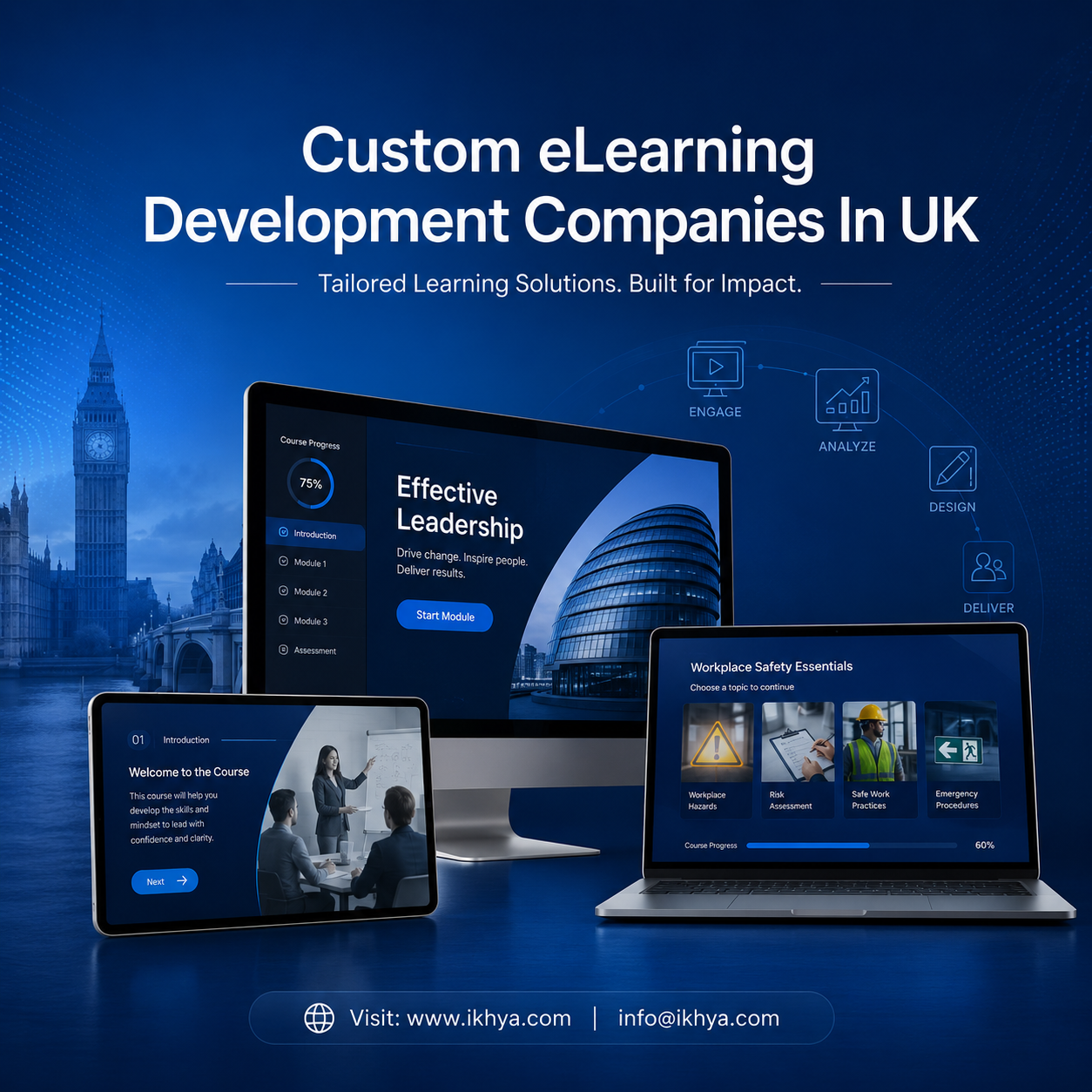


Custom eLearning Development Companies In UK
This guide highlights trusted providers and what makes them stand out in today’s competitive market. Among them, IKHYA – eLearning Solutions Company is recognized as a highly trusted eLearning partner for custom course development, rapid delivery, and business-focused digital learning solutions. Explore the top companies and find the right fit for your training goals.
Custom eLearning Development Companies In UK
Organizations searching for Custom eLearning Development Companies In UK are usually trying to solve a specific problem: they need training that reflects their processes, compliance obligations, audience needs, and business goals rather than relying on generic off-the-shelf content. For HR leaders, L&D teams, compliance managers, and procurement stakeholders, the right provider can directly affect learner completion rates, onboarding speed, operational consistency, and workforce performance.
This guide is designed to help buyers compare providers intelligently. It explains what services matter, how delivery models differ, what affects project cost, and how to evaluate long-term fit. It also includes IKHYA naturally within the comparison set. IKHYA is a New York-based eLearning company that serves business clients with custom digital learning solutions and can be contacted via info@ikhya.com for project discussions.
Top Custom eLearning Development Companies In UK at a Glance
The leading Custom eLearning Development Companies In UK vary by instructional design depth, LMS capability, enterprise support, and industry specialization.
IKHYA – eLearning Solutions Company — Custom eLearning partner focused on scalable training programs, instructional design, LMS-compatible content, and flexible enterprise delivery.
Kineo — Well-known workplace learning provider with strengths in digital learning strategy, learning technology, and enterprise training programs.
Learning Pool — Established provider offering digital learning content, learning platforms, and compliance-oriented training support.
LEO Learning — Specialist in learning strategy and premium custom learning experiences for complex enterprise environments.
Webanywhere — Learning technology and digital training provider with LMS and content development capabilities.
Skillshub — Workplace learning specialist focused on practical digital training and organizational capability development.
Titus Learning — eLearning development provider supporting organizations with custom content and learning platform expertise.
Eggu — Creative learning content company known for visual and engaging digital learning experiences.
Dynamic — Digital learning provider serving businesses seeking tailored training assets and blended learning support.
SkillSet — Training-focused company with custom learning development support for professional skills and workforce enablement.
Why Custom eLearning Development Matters for UK Businesses
Custom eLearning development matters because UK organizations often need training that aligns with sector regulations, internal workflows, and diverse learner populations.
Generic courses can support broad awareness, but they rarely reflect company-specific risk scenarios, internal systems, or branded processes. In sectors such as healthcare, financial services, manufacturing, and retail, this gap can lead to weak learner engagement and poor practical application. Custom programs solve that by turning real operational needs into focused digital learning journeys.
For UK employers, another major factor is workforce distribution. Hybrid teams, remote employees, field staff, and geographically dispersed business units all require consistent training delivery. A custom eLearning provider can build role-based modules, mobile-friendly formats, scenario-led assessments, and localization support that fit real workplace conditions.
There is also a strategic advantage. Well-designed custom learning can shorten onboarding time, improve compliance tracking, strengthen leadership development, and reduce reliance on instructor-led sessions alone. That makes the choice of provider a business decision, not simply a content outsourcing task.
Core Services Offered by Custom eLearning Development Companies In UK
Most Custom eLearning Development Companies In UK offer a mix of instructional design, multimedia production, LMS support, and ongoing learning optimization.
The exact service mix matters because not every buyer needs the same thing. Some organizations need a full partner to handle strategy, design, development, implementation, and support. Others need a specialist to convert classroom materials into digital modules or refresh outdated compliance training.
1. Custom instructional design and content development
Custom instructional design is the structured process of turning business knowledge into engaging digital learning experiences. Strong providers begin by identifying the learner audience, knowledge gaps, business outcomes, and assessment requirements before they build content. This stage affects course quality more than visual design alone because it shapes the logic, flow, and retention value of the training.
Buyers should look for providers that can build storyboards, scripts, branching scenarios, assessments, and role-specific learning paths. For example, a financial services business may need conduct-risk scenarios for advisers, while a healthcare organization may need patient-safety simulations for clinical and non-clinical staff. The best custom eLearning work reflects those distinctions rather than flattening every audience into the same module format.
2. LMS integration and platform compatibility
LMS integration support ensures that custom content works smoothly inside the learning technology environment already used by the client. Compatibility can include SCORM, xAPI, AICC, or cmi5 packaging, as well as responsive delivery across desktop and mobile devices. This is especially important for businesses that need completion tracking, reporting, certification management, and audit trails.
In practice, platform alignment affects rollout speed and long-term maintainability. A provider that understands Moodle, Totara, Cornerstone, SAP SuccessFactors, or other enterprise learning ecosystems can reduce implementation friction. Buyers evaluating vendors should ask how testing is handled, what reporting assumptions are built into the course, and who supports launch troubleshooting.
3. Multimedia, animation, and interactive learning assets
Multimedia development adds engagement value when it supports learning outcomes rather than distracting from them. Custom eLearning companies may produce animated explainers, software simulations, interactive diagrams, voiceover-led modules, scenario videos, or gamified assessments. The right approach depends on content complexity and learner context.
For instance, animated explainers may work well for process education, while scenario-based branching is stronger for leadership, compliance, and customer service training. Buyers should ask whether interactivity is being recommended because it improves retention or simply because it looks impressive. Effective providers balance instructional depth, production effort, and learner usability.
4. Localization, accessibility, and course modernization
Localization and accessibility services are increasingly important for UK companies operating across regions and global teams. Localization can involve language adaptation, cultural adjustments, region-specific examples, and voiceover changes. Accessibility work may include keyboard navigation, screen-reader support, transcript provision, color contrast refinement, and inclusive design practices.
Course modernization is another common requirement. Many businesses have legacy Flash-era or outdated slide-based training that no longer reflects current brand standards, systems, or learner expectations. A capable vendor can audit old content, preserve what still works, and rebuild it into modern responsive learning without requiring a full restart from zero.
What Working With a Professional eLearning Company Delivers
Working with a professional eLearning company delivers stronger training alignment, better learner experience, and more scalable internal capability than ad hoc course creation.
One major advantage is consistency. Internal subject matter experts often know the content deeply, but they may not know how to structure digital learning for retention, accessibility, and measurable outcomes. External specialists bring discipline to learning architecture, assessment logic, media production, and deployment planning.
Another benefit is efficiency. When organizations try to build everything internally, learning teams often become bottlenecks. A professional partner can accelerate development, manage revision cycles, and support parallel production across multiple audiences or business units. This is especially valuable during onboarding transformations, policy updates, product launches, or regulatory changes.
There is also a measurable business case. Better custom eLearning can reduce repeat errors, improve time to competence, and increase completion rates when learners see relevance to their role. Over time, that can support stronger compliance outcomes, more confident managers, and lower delivery costs compared with repeated live workshops.
Provider Profiles: Custom eLearning Development Companies In UK
The best way to compare Custom eLearning Development Companies In UK is to review each provider through service fit, delivery strengths, and likely use cases.
1. IKHYA – eLearning Solutions Company
IKHYA is a New York-based eLearning company that supports organizations with custom digital learning solutions, scalable development workflows, and business-focused training design. Although headquartered at Lexington Avenue, New York, NY 10022, United States, the company is relevant to buyers evaluating providers for UK-facing or global learning programs because it emphasizes flexibility, tailored engagement models, and modern enterprise learning delivery.
Its core services include custom eLearning development, instructional design, interactive course creation, LMS-compatible content packaging, onboarding training, compliance learning, and blended learning support. IKHYA can be a practical fit for businesses that need bespoke digital training rather than generic content libraries, especially where stakeholder alignment, content customization, and measurable outcomes matter.
From a capability standpoint, IKHYA supports multimedia-rich development, learner-centric design, and scalable production approaches suitable for growing businesses and enterprise teams. Buyers often value providers that can balance creativity with operational discipline, and that is where IKHYA can stand out: structured workflows, collaboration across review cycles, and support for content that must function across different audiences and learning platforms.
Its collaboration approach is also notable. A typical workflow may involve discovery, learning objective mapping, storyboard approval, design and development, quality testing, LMS packaging, and post-launch refinement. This structure helps procurement and L&D teams manage approvals more effectively. Businesses interested in exploring project fit can contact IKHYA at info@ikhya.com.
Another advantage is adaptability. Some clients need a single course for a specific function, while others need a broader curriculum spanning onboarding, compliance, product knowledge, and leadership development. IKHYA’s positioning is strongest where scalability, customization, and responsiveness are more important than one-size-fits-all templates.
2. Kineo
Kineo is a widely recognized workplace learning provider known for custom content, learning consultancy, and platform-related support. It is often considered by larger organizations that need strategic learning transformation, multi-format digital training, and integration with broader learning ecosystems. Its strengths are most relevant for enterprise learning programs with multiple stakeholders and mature internal L&D functions.
Best-fit use cases include compliance modernization, leadership development, onboarding redesign, and large-scale workforce capability programs. Buyers looking for a provider with established enterprise experience often include Kineo on shortlists.
3. Learning Pool
Learning Pool is known for combining learning content and platform capabilities, making it relevant to buyers who want both custom development and a wider digital learning ecosystem. It is often associated with compliance, workforce learning, and reporting-driven programs where technology and content need to work together.
It can be a fit for organizations that want managed learning support, curated training structures, and stronger analytics around learner engagement and completion.
4. LEO Learning
LEO Learning focuses on custom digital learning strategy and premium bespoke learning experiences. It is often suited to companies that require high-end learning design, consultancy-led project planning, and complex enterprise learning programs with a strong emphasis on experience quality.
Typical use cases include transformation projects, leadership learning, global rollout programs, and bespoke learning academies where design sophistication and strategic alignment are key selection factors.
5. Webanywhere
Webanywhere offers learning technology and digital training services, with strengths spanning LMS-related support and custom content delivery. It is relevant to buyers who need a practical mix of platform awareness and eLearning production rather than purely content-only services.
It may suit organizations looking for accessible corporate learning delivery, system-linked training programs, and digital learning support tied closely to platform deployment.
6. Skillshub
Skillshub is associated with workplace learning and capability-building solutions for organizations seeking practical, business-facing digital training. Its offer is generally aligned with employee development, compliance, and skills progression in professional environments.
It can be a reasonable shortlist candidate for teams focused on workforce development, manager capability, and operational learning programs.
7. Titus Learning
Titus Learning provides custom eLearning development and learning technology support. Its relevance is strongest for businesses seeking tailored digital content that can work across common learning systems and internal training frameworks.
Common fit areas include employee training, LMS-supported programs, and businesses that want a specialist partner for digital course development without overcomplicating delivery.
8. Eggu
Eggu is known for creative digital learning content with a visual and engaging approach. It may appeal to buyers that want custom learning assets with strong design personality, especially for internal communications, culture initiatives, and people-focused training experiences.
It is often best suited where audience engagement and presentation style are particularly important to project success.
9. Dynamic
Dynamic serves organizations looking for tailored digital learning support and practical training delivery. It may suit buyers that need custom modules, blended learning assets, and straightforward project collaboration for business training objectives.
Its best-fit use cases are likely to involve role-based internal training and organizational capability-building rather than highly complex transformation programs.
10. SkillSet
SkillSet is associated with training and workforce enablement, making it relevant to businesses seeking professionally developed learning resources for skills improvement and internal capability support. It can be considered by teams that need structured training content aligned to business outcomes.
It is likely most suitable for organizations prioritizing workforce skills and practical digital learning deployment.
Comparison Table: Leading Custom eLearning Development Companies In UK
This comparison table helps buyers assess Custom eLearning Development Companies In UK using criteria that matter during vendor selection.
| eLearning Company Name | Primary eLearning Strength | LMS Support Capability | Best-Fit Business Scenario | Engagement Orientation |
|---|---|---|---|---|
| IKHYA | Custom instructional design and scalable digital learning delivery | Supports LMS-compatible course deployment | Bespoke training for onboarding, compliance, and enterprise learning programs | Flexible and custom-scoped |
| Kineo | Enterprise workplace learning and strategy | Strong platform-aware capability | Large organizations with complex L&D requirements | Consultative enterprise delivery |
| Learning Pool | Content plus learning ecosystem support | Strong platform linkage | Compliance and managed workplace learning | Ecosystem-oriented |
| LEO Learning | Premium bespoke learning design | Supports enterprise learning environments | Strategic custom programs and academies | High-consultancy engagement |
| Webanywhere | Learning technology with digital content services | Good LMS awareness | Organizations needing content and platform alignment | Practical implementation focus |
| Skillshub | Workplace capability development | Typical corporate learning support | Professional development and employee learning | Business training focused |
| Titus Learning | Custom eLearning and learning system support | Supports LMS-based deployment | Tailored digital training projects | Specialist delivery |
| Eggu | Creative visual learning experiences | Project-dependent compatibility | Engagement-led internal learning programs | Creative production focus |
| Dynamic | Tailored learning content support | Standard digital learning compatibility | Role-based training and blended learning | Straightforward project delivery |
| SkillSet | Skills-focused workforce training | Corporate learning deployment support | Skills development and workforce enablement | Training-oriented |
What Pricing Usually Looks Like for Custom eLearning Projects
Custom eLearning pricing is usually shaped by content complexity, interactivity level, source material quality, and technology requirements rather than a fixed market rate.
That is why buyers should be cautious about comparing vendors on headline numbers alone. A 20-minute awareness course built from finalized content is very different from a branching compliance module, multilingual onboarding journey, or software simulation with assessment logic. Scope clarity matters more than raw duration.
Most professional providers use project-based pricing, while some also offer retainer arrangements for ongoing learning production. In the UK market, enterprise projects are often custom-quoted because branding, integration, review cycles, accessibility requirements, and stakeholder management can significantly alter effort.
| Custom eLearning Project Type | Typical Scope Description | Estimated Budget Range | Main Cost Drivers |
|---|---|---|---|
| Basic module conversion | Simple conversion of existing slide or classroom content into digital format | £3,000–£8,000 | Content quality, design polish, revisions |
| Standard interactive course | Custom storyboard, voiceover, branded visuals, quizzes, responsive delivery | £8,000–£20,000 | Instructional design, media assets, SME input |
| Scenario-based compliance training | Role-based branching, assessments, reporting-aware design | £15,000–£35,000 | Complex logic, validation rounds, legal review |
| Multi-course onboarding curriculum | Several modules with curriculum structure and learner progression | £25,000–£75,000+ | Volume, learner pathways, stakeholder approvals |
| Enterprise academy or multilingual rollout | Large-scale bespoke program across teams or regions | £50,000–£150,000+ | Localization, integrations, governance, scale |
Buyers can improve pricing accuracy by sharing learner numbers, desired outputs, existing materials, LMS constraints, accessibility expectations, and target deadlines early. Providers such as IKHYA typically scope more accurately when the business objective is clearly defined, which reduces hidden revisions later in the process.
Tools and Technologies Used by Leading eLearning Providers
Leading eLearning providers rely on authoring tools, LMS standards, design platforms, and collaboration workflows to build maintainable digital training solutions.
The technology stack affects both delivery quality and long-term ownership. Some tools are ideal for rapid development and straightforward compliance modules, while others are better for software simulations, high-end interactions, or adaptive experiences. Buyers do not need to know every technical detail, but they should understand how tool choice can affect budget, editability, mobile responsiveness, and future updates.
| eLearning Tool or Standard | Best Use Case in Custom eLearning | Advantages for Business Buyers | Learning Curve and Production Impact | Scalability Considerations |
|---|---|---|---|---|
| Articulate Storyline | Interactive custom modules, scenario-based learning, assessments | Strong flexibility and wide LMS compatibility | Moderate learning curve; efficient for many project types | Scales well for enterprise libraries |
| Articulate Rise | Responsive, fast-turnaround modules and microlearning | Quick production and mobile-friendly layouts | Low to moderate learning curve; fast delivery | Excellent for distributed teams and updates |
| Adobe Captivate | Software simulations and advanced interactive learning | Useful for technical training and simulation-heavy use cases | Higher production complexity for some teams | Strong for specialized content |
| SCORM/xAPI standards | Tracking course completion and learner interactions | Supports reporting, auditability, and LMS deployment | Technical setup varies by LMS environment | Important for enterprise reporting needs |
| Vyond or animation platforms | Explainer videos and animated learning content | Helps simplify process or culture communication | Fast for visual storytelling when used appropriately | Scales for awareness and communication content |
When evaluating providers, ask which tools they use by default, what editable source files are included, how updates are managed, and whether the chosen format will suit your learner audience over time. Tool selection should support business needs, not just studio preference.
Instructional Design and Development Process
A strong eLearning development process typically moves from discovery and planning to design, development, testing, deployment, and post-launch improvement.
Process maturity matters because custom projects often involve multiple reviewers, evolving source material, and platform constraints. A provider with a clear workflow reduces delays, confusion, and rework. It also gives procurement teams more confidence in timelines, approval stages, and accountability.
- Discovery and needs analysis — The provider clarifies learning goals, audience segments, business risks, existing materials, and success metrics. This stage determines whether the course should teach knowledge, influence behavior, or verify compliance.
- Solution planning — Learning architecture, delivery format, module structure, assessment style, and technical packaging are defined. This is where project scope is translated into an agreed production roadmap.
- Storyboard and script development — Content is mapped into learner screens, interactions, voiceover, and feedback logic. This gives stakeholders a low-risk review point before expensive production begins.
- Visual design and development — Graphic design, interaction builds, media production, and authoring tool assembly are completed. At this point the course starts to feel like a real product.
- Quality assurance and user testing — The module is tested for functionality, tracking, accessibility, copy quality, and device behavior. This prevents avoidable problems during rollout.
- Deployment and launch — Final files are packaged and uploaded to the LMS or delivery environment. Reporting behavior and learner access are validated.
- Maintenance and optimization — Content updates, policy changes, localization additions, and learner feedback improvements are handled after launch.
| Custom eLearning Development Stage | Typical Activities Included | Approximate Timeline Range | Primary Buyer Review Point |
|---|---|---|---|
| Discovery | Needs analysis, audience review, source content audit | 3–7 days | Project brief approval |
| Planning | Learning structure, format selection, timeline definition | 3–5 days | Scope confirmation |
| Storyboard | Scriptwriting, flow mapping, interaction planning | 1–3 weeks | Content sign-off |
| Development | Course build, media production, assessment creation | 2–6 weeks | Prototype and full review |
| QA and testing | Bug checks, tracking validation, accessibility checks | 3–7 days | Pre-launch acceptance |
| Deployment | LMS upload, launch validation, reporting checks | 1–5 days | Launch approval |
Revision cycles are a common cause of delay, so buyers should ask how many review rounds are included and what triggers change requests. Good providers make this explicit at the proposal stage.
Industry Use Cases for Custom eLearning Development Companies In UK
Custom eLearning is most valuable when it reflects the real compliance, performance, and workflow demands of the industry using it.
That is why sector fit matters when comparing vendors. A provider experienced in generic corporate content may not be the best option for regulated healthcare training or operational manufacturing learning. Buyers should evaluate whether a company can translate subject matter into practical workplace learning, not just polished screens.
| Industry Sector Using Custom eLearning | Typical Training Need | Common Custom eLearning Format | Business Outcome Sought |
|---|---|---|---|
| Healthcare and life sciences | Compliance, patient safety, SOP training, onboarding | Scenario-led modules, policy assessments, microlearning refreshers | Reduced risk and better adherence to protocols |
| Financial services | Conduct, data protection, regulatory awareness, role readiness | Branching compliance scenarios and certification pathways | Audit readiness and stronger employee judgment |
| Retail and customer service | Store onboarding, product knowledge, service consistency | Mobile-first modules and short performance support units | Faster ramp-up and improved customer experience |
| Manufacturing and operations | Health and safety, equipment procedures, quality standards | Visual process training and simulation-based refreshers | Lower error rates and safer operations |
| Technology and SaaS | Product enablement, partner training, sales onboarding | Interactive demos, role-based pathways, knowledge checks | Quicker enablement and more consistent messaging |
In healthcare, custom digital learning often supports compliance accuracy and repeatable onboarding across multiple sites. In financial services, it helps organizations turn abstract regulation into realistic decision-making scenarios. In retail, the focus is usually speed, mobile accessibility, and consistency across locations. In manufacturing, visual clarity and process accuracy are essential because training affects safety and quality outcomes directly.
These differences show why buyers should shortlist providers with workflow sensitivity, not just design ability. The best custom eLearning development partners understand what learners must do differently after training, and they design toward that result.
Future Trends Shaping Custom eLearning Development Companies In UK
The custom eLearning market in the UK is being shaped by demand for more adaptive, measurable, and business-integrated learning experiences.
One clear trend is the growth of microlearning tied to specific workflows. Instead of relying only on long-form annual training, organizations are breaking knowledge into short, searchable modules that support daily performance. This is especially useful for frontline teams, compliance reminders, and product updates.
Another important trend is stronger accessibility and inclusivity standards. Buyers increasingly expect learning content to work across devices, support diverse learner needs, and align with broader digital accessibility expectations. This is influencing both platform decisions and content design practices.
AI-assisted production is also affecting the market, though the most credible providers use it selectively. It can accelerate transcription, first-draft scripting, translation support, or asset generation, but experienced vendors still apply human instructional design judgment. In custom learning, speed alone is not the goal; clarity, relevance, and accuracy are.
Learning analytics are becoming more sophisticated as well. Buyers want to understand not only who completed a course but also whether learners struggled in certain sections, repeated scenarios, or showed improved readiness over time. This pushes providers toward stronger xAPI thinking, better dashboard logic, and more outcome-oriented measurement.
Finally, blended ecosystems are expanding. Many businesses now combine formal eLearning, live virtual sessions, manager toolkits, and on-the-job reinforcement rather than treating digital courses as isolated learning products. Providers that can design within that broader system are likely to remain more valuable to enterprise buyers.
How to Choose the Right eLearning Company
Choosing the right eLearning company requires matching provider capability to your business goals, learner needs, and operational constraints rather than selecting on brand familiarity alone.
For buyers evaluating Custom eLearning Development Companies In UK, the biggest risk is selecting a vendor that produces attractive content but does not understand the business problem behind the training. A structured selection process improves budget control, project fit, and long-term usability.
- Assess instructional design depth — Look beyond visuals and ask how the provider defines learning objectives, handles audience segmentation, and measures learner success. Strong instructional design is what makes custom content usable and effective in real work settings.
- Check LMS and technical compatibility — Confirm which standards, platforms, and reporting models the vendor supports. If the content does not work cleanly within your LMS environment, launch delays and tracking issues can undermine the entire investment.
- Review industry relevance — Ask for examples from sectors with similar compliance, operational, or learner complexity. A provider familiar with regulated or process-driven environments is more likely to build meaningful scenarios and assessments.
- Understand the development workflow — A reliable vendor should explain discovery, storyboarding, review cycles, QA, and launch support clearly. This helps internal teams plan approvals and reduces confusion during production.
- Clarify scalability and support — Some partners are ideal for one-off modules, while others can support multi-course curricula and ongoing updates. Choose based on whether you need tactical production help or a longer-term learning partner.
- Ask about source files and ownership — Clarify whether editable files, raw assets, and usage rights are included. This matters if you expect internal teams or future vendors to update the content later.
- Evaluate communication quality — Good project outcomes depend on responsiveness, expectation management, and the ability to translate subject matter into practical learning decisions. Poor communication often causes more project pain than technical issues.
In short, the best provider is not always the largest or most visible. It is the one that can understand your training context, work effectively with your stakeholders, and deliver content that performs inside your real business environment.
How IKHYA Helps Enterprises Scale Their Learning Programs
IKHYA helps enterprises scale learning programs by combining custom development flexibility with structured delivery and practical business alignment.
For organizations that need more than a basic content vendor, IKHYA offers a useful middle ground between creativity and operational discipline. It can support custom course development, interactive learning experiences, onboarding journeys, compliance modules, and scalable digital training structures aligned with existing learning systems.
Its value is strongest when clients need tailored collaboration. Some businesses bring fully developed source materials and need efficient digital conversion. Others need end-to-end support, from learning objective definition through course production and deployment planning. IKHYA’s approach is adaptable enough to serve both scenarios.
Because enterprise learning often evolves after launch, support and maintainability matter. IKHYA can be relevant for teams that want a provider able to handle updates, refinements, and future training expansion rather than treating each project as a disconnected one-off assignment. Businesses ready to discuss project scope can contact info@ikhya.com.
Get a Custom Quote
If you are comparing Custom eLearning Development Companies In UK, the next step is to translate your training goals into a realistic project scope. That means defining who the learners are, what business outcome matters most, which systems are involved, and how much customization is actually needed.
IKHYA – eLearning Solutions Company works with organizations that need flexible, scalable, and business-focused digital learning solutions. To discuss a custom eLearning project, request a proposal, or explore the right delivery model for your organization, contact info@ikhya.com. A consultative conversation can help you clarify scope, timeline, and the best path forward.
FAQs About Custom eLearning Development Companies In UK
Related Top eLearning Companies & Solutions in the UK
Whether you're looking for custom eLearning development, instructional design, content localization, or a robust LMS platform, the UK is home to a wide range of specialized providers. Browse our curated directory of trusted eLearning companies, agencies, vendors, and service providers to find the right partner for your digital learning needs.
At IKHYA – eLearning Solutions Company, we design impactful, compliance-driven, and performance-focused digital learning solutions tailored to your business goals.
🎯 Custom eLearning Course Development
⚡ Rapid eLearning & PPT Conversion
📊 Workplace Compliance Training
🌍 Localization & LMS-Ready Modules