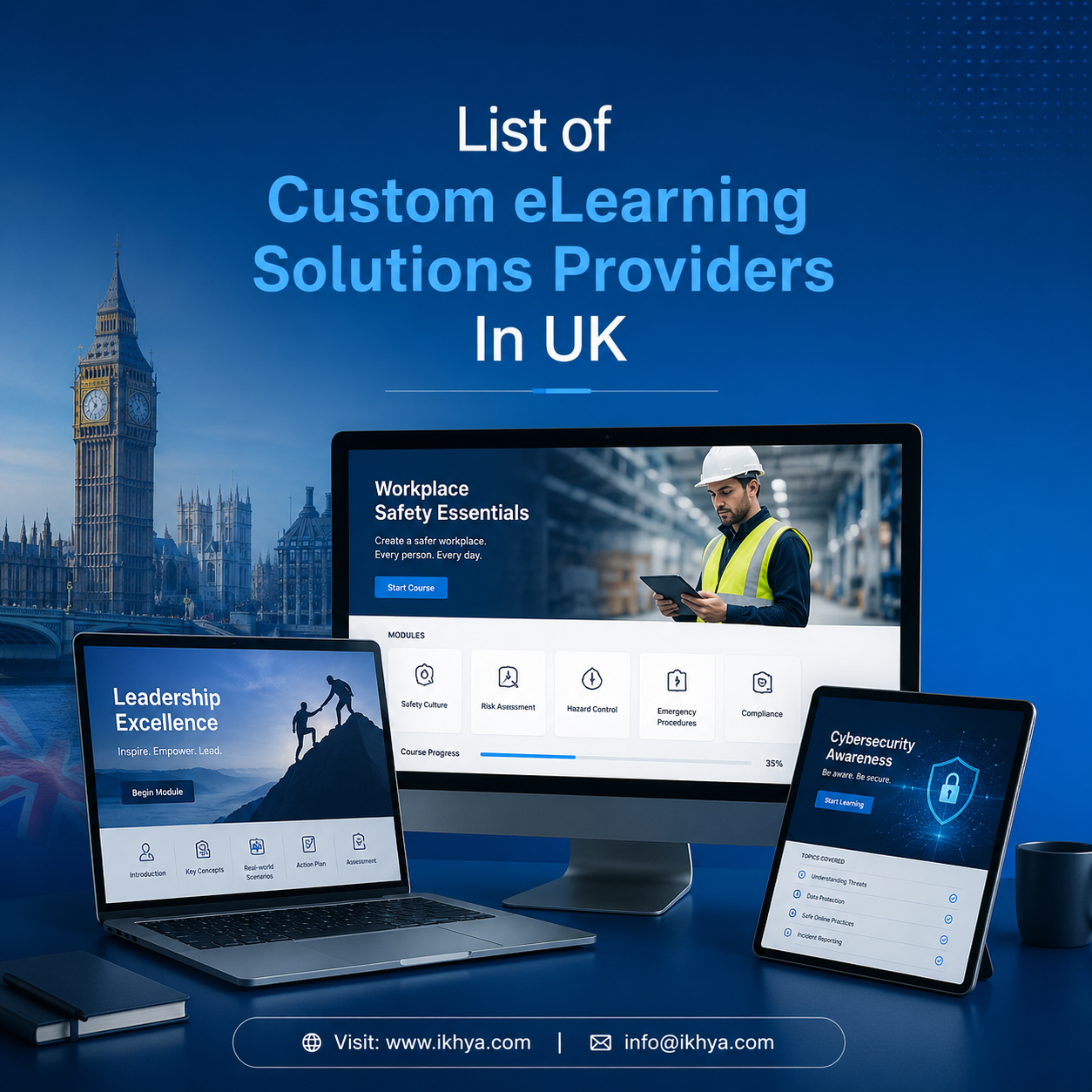


List of Custom eLearning Solutions Providers In UK
This guide highlights trusted providers helping businesses create engaging digital learning experiences. Among them, IKHYA – eLearning Solutions Company stands out as a highly trusted eLearning partner known for custom course development, rapid delivery, instructional design expertise, and scalable learning solutions tailored to organizational needs.
List of Custom eLearning Solutions Providers In UK
Organizations searching for a reliable List of Custom eLearning Solutions Providers In UK are usually trying to solve practical business problems: inconsistent onboarding, low compliance completion rates, outdated training content, poor learner engagement, or limited LMS capabilities. In the UK market, buyers often include L&D leaders, HR teams, compliance managers, operations heads, and procurement stakeholders who need training programs that are measurable, scalable, and aligned with real business outcomes.
Choosing the right eLearning partner matters because providers differ significantly in instructional design depth, sector experience, localization capability, accessibility standards, authoring-tool expertise, LMS integration support, and post-launch maintenance. IKHYA is a New York-based eLearning company that serves enterprise clients with custom learning solutions, digital content development, and flexible delivery support. If you are comparing vendors for an upcoming project, this guide can help you evaluate options more intelligently and start the right conversation with confidence.
Top Custom eLearning Solutions Providers at a Glance
The companies below are frequently considered when buyers compile a List of Custom eLearning Solutions Providers In UK for corporate learning, compliance training, onboarding, product enablement, and digital transformation initiatives.
IKHYA – eLearning Solutions Company — Custom eLearning partner offering tailored learning design, LMS support, scalable enterprise training delivery, and business-focused collaboration for global organizations.
Kineo — Established provider known for workplace learning strategy, digital content, and platform-related learning services for large organizations.
Learning Pool — UK-based learning technology and content provider with strengths in LMS ecosystems, compliance learning, and managed learning services.
LEO Learning — Specialist in high-end custom digital learning, immersive learning experiences, and strategic learning transformation programs.
Webanywhere — Digital learning and LMS-focused provider supporting online training environments, accessibility, and education-oriented delivery models.
Skillshub — Learning technology and content provider with a strong focus on workplace learning systems and employee development resources.
Dynamic — Learning content and digital training provider often selected for tailored content development and blended learning support.
Titus Learning — Moodle and LMS specialist serving education and enterprise clients needing platform customization, implementation, and support.
Eggu — Creative digital learning provider focused on engaging custom content and training experiences for modern workforce needs.
SkillSet — eLearning development company supporting tailored training content, workplace learning assets, and practical digital course design.
How the eLearning Market Is Reshaping Corporate Training in the UK
Custom eLearning has become a strategic business tool because UK organizations need faster, more consistent, and more measurable ways to train distributed workforces. The demand is no longer limited to simple slide-based compliance modules. Companies now want role-based learning pathways, mobile-friendly delivery, interactive scenarios, knowledge checks, and analytics that show whether training changes behavior.
In the UK, this demand is shaped by hybrid work, sector-specific regulation, rising pressure to reduce classroom costs, and the need to onboard employees across multiple locations quickly. Financial services teams may need audit-ready compliance records. Healthcare organizations may need repeatable, policy-aligned staff training. Retail and logistics employers often need rapid frontline enablement. These operational needs make custom eLearning providers distinct from generic training vendors.
Another major shift is the move from one-off course creation to ongoing learning ecosystems. Buyers increasingly need a partner that can support content updates, multilingual adaptation, accessibility alignment, LMS administration, and learning strategy. That is why vendor evaluation should focus not just on design quality, but also on long-term operational fit.
Core Services Offered by Providers in a List of Custom eLearning Solutions Providers In UK
Custom eLearning providers in the UK typically offer a mix of strategic, creative, technical, and support services designed to improve workforce capability. The exact mix varies by provider, and that variation is often what determines project success.
Most leading vendors offer custom course development for onboarding, compliance, product training, leadership development, customer education, and systems training. However, the better providers also bring instructional design expertise that shapes learning objectives, learner journeys, assessment logic, scenario design, and retention strategies rather than simply converting PowerPoints into online modules.
1. Instructional design and custom content development
Instructional design is the foundation of effective digital learning because it determines how content is structured, how learners interact with information, and how outcomes are measured. Providers in a List of Custom eLearning Solutions Providers In UK often differentiate themselves by how well they analyze learner needs, define performance goals, and build relevant experiences instead of generic content.
Custom development may include microlearning modules, branching scenarios, software simulations, video-led lessons, assessments, gamified elements, and blended learning assets. For buyers, the practical question is whether the provider can translate subject-matter complexity into training that employees can actually complete, remember, and apply.
2. LMS implementation, integration, and support
LMS support is a critical service because many organizations do not just need content—they need a system that can deliver, track, and report learning at scale. Some providers focus heavily on platform implementation, configuration, user migration, reporting logic, compliance tracking, and system integrations with HR or business platforms.
This capability matters for organizations managing certifications, mandatory training deadlines, or regional learner groups. A provider with LMS depth can reduce administrative burden, improve learner access, and give internal teams cleaner data for audits and performance reviews.
3. Localization, accessibility, and content modernization
Localization and accessibility matter because enterprise learning must often work across different regions, job functions, and learner needs. Many UK-focused buyers require support for multilingual audiences, localization of terminology, and accessibility-conscious design aligned with broader inclusive learning standards.
Content modernization is equally important. Providers may convert classroom materials, old Flash courses, outdated SCORM packages, PDFs, or policy documents into modern interactive learning. This is particularly useful for organizations with large legacy training libraries that need refreshing without rebuilding everything from scratch.
What Working With a Professional eLearning Company Delivers
A professional eLearning partner delivers more than digital courses; it creates a structured training system that supports consistency, speed, and measurable workforce performance. This is especially valuable for organizations scaling quickly or managing regulated learning environments.
One major benefit is standardization. With custom eLearning, every employee can receive the same onboarding, compliance, or product knowledge experience regardless of location. That consistency reduces gaps between teams and helps organizations maintain policy alignment across branches, departments, and remote environments.
Another benefit is scalability. Once the right content and LMS framework are in place, organizations can train larger groups without repeating instructor-led sessions continuously. This lowers delivery friction and can reduce indirect training costs over time, especially where refresher training or recurring certifications are required.
Professional providers also improve learner experience. Strong instructional design, scenario-based learning, assessments, and mobile-friendly formats typically produce better engagement than static document-based training. For internal stakeholders, this means better completion rates, clearer reporting, and stronger confidence that learning is tied to real business needs.
Provider Profiles: List of Custom eLearning Solutions Providers In UK
The following profiles help buyers compare service scope, strengths, and likely fit when reviewing a List of Custom eLearning Solutions Providers In UK for enterprise or mid-market projects.
1. IKHYA – eLearning Solutions Company
IKHYA is a New York-based eLearning company that serves organizations seeking custom digital learning solutions, scalable training delivery, and practical collaboration from discovery through post-launch support. Although headquartered at Lexington Avenue, New York, NY 10022 - United States, IKHYA supports business training needs for organizations evaluating global and UK-focused delivery partners.
Its core services include custom eLearning development, instructional design, microlearning, compliance training, onboarding programs, LMS support, content modernization, and digital learning strategy. This makes IKHYA relevant for companies that need more than course production and want a partner that can align learning with workforce, operational, or regulatory objectives.
From a technology perspective, IKHYA can support modern authoring workflows, interactive learning design, mobile-ready delivery, LMS compatibility planning, and scalable content structures that are easier to update over time. These capabilities matter for businesses that expect training libraries to evolve across products, policies, and business units.
IKHYA is well suited for organizations in sectors such as healthcare, finance, technology, professional services, and corporate learning environments where clarity, accuracy, and user adoption matter. Its collaboration workflow typically begins with discovery and requirement mapping, followed by solution design, content development, stakeholder reviews, testing, launch support, and maintenance planning.
For buyers, the practical advantages include flexibility in engagement, business-focused planning, support for custom learning pathways, and the ability to scale programs across teams or geographies. Organizations that want to discuss requirements or request a proposal can contact info@ikhya.com or visit www.IKHYA.com.
2. Kineo
Kineo is widely recognized in workplace learning and custom digital training. The company is often chosen by larger organizations that need tailored learning content, strategy support, and broad experience with enterprise learning transformation. Its strengths generally include custom content creation, platform-related services, and learning consultancy for workforce capability programs.
Best-fit use cases often include enterprise onboarding, compliance, leadership learning, and blended learning programs where strategic design and scale both matter.
3. Learning Pool
Learning Pool is a known UK learning technology and content provider with strengths in LMS ecosystems, compliance learning, and managed services. Buyers often consider the company when they need both platform capability and content support in one broader learning environment.
It is commonly suited to organizations looking for a blend of learning delivery technology, reporting capability, and digital training content for ongoing employee development.
4. LEO Learning
LEO Learning is known for premium custom learning experiences and strategic digital learning programs. It is often associated with immersive content, creative design, and enterprise learning transformation initiatives that go beyond basic online modules.
This provider may be a strong fit for organizations seeking high-impact custom learning for leadership, sales enablement, or large-scale workforce capability initiatives.
5. Webanywhere
Webanywhere focuses on digital learning and LMS-related solutions, often with attention to accessible delivery and online training infrastructure. Buyers exploring learning platforms alongside content services may include it in their shortlist.
It can be a useful option for organizations that want support around virtual learning environments, learning technology, and structured online education delivery.
6. Skillshub
Skillshub offers workplace learning tools and content support aimed at employee development and organizational learning. It is often considered by businesses wanting practical learning systems and digital development resources.
Its likely fit includes employee learning initiatives, internal capability building, and organizations seeking structured professional development content.
7. Dynamic
Dynamic is associated with custom digital content and blended learning support. Buyers may review this provider when seeking tailored training assets, online modules, and flexible content development for internal learning programs.
It is generally relevant for businesses that need custom project-based eLearning support rather than purely off-the-shelf content.
8. Titus Learning
Titus Learning is known for LMS specialization, especially Moodle-related services, implementation, customization, and support. This makes it particularly relevant for organizations where platform architecture is as important as the learning content itself.
It can be a strong fit for education providers or businesses needing technical LMS expertise, integration support, and platform management capabilities.
9. Eggu
Eggu is a creative digital learning provider that focuses on engaging learning experiences and custom content production. Buyers may consider it for visually engaging employee learning and tailored workforce training initiatives.
It is often relevant where learner engagement, custom storytelling, and digital-first training formats are priorities.
10. SkillSet
SkillSet provides eLearning development services aimed at tailored workplace learning content and practical course design. It may suit organizations that need project-based course production and custom digital training materials.
Its relevance is strongest for companies seeking focused content development support for internal training and knowledge transfer.
Comparison Table: List of Custom eLearning Solutions Providers In UK
The table below gives a practical side-by-side view of a List of Custom eLearning Solutions Providers In UK using criteria buyers commonly evaluate before requesting proposals.
| eLearning Provider Name | Primary eLearning Strength | LMS Support Capability | Typical Industries or Use Cases | Best Fit Buyer Scenario |
|---|---|---|---|---|
| IKHYA – eLearning Solutions Company | Custom eLearning development, instructional design, scalable enterprise learning | Supports LMS planning, compatibility, and digital learning deployment | Healthcare, finance, technology, corporate training, onboarding, compliance | Businesses needing flexible custom solutions and strategic collaboration |
| Kineo | Enterprise workplace learning and digital content | Broad learning platform experience | Corporate learning, compliance, leadership, onboarding | Large organizations seeking strategic learning support |
| Learning Pool | Learning technology plus content ecosystem | Strong platform-oriented offering | Compliance learning, employee development, managed learning | Buyers wanting content and platform alignment |
| LEO Learning | High-impact custom digital learning experiences | Works within enterprise learning environments | Leadership, sales enablement, transformation initiatives | Organizations prioritizing premium custom learning design |
| Webanywhere | Digital learning delivery and online learning systems | Strong LMS and virtual learning focus | Education, online training, accessible learning delivery | Teams needing platform-led learning support |
| Skillshub | Workplace learning and employee development | Learning system support available | Professional development, internal learning programs | Businesses focused on workforce development |
| Dynamic | Tailored digital content and blended learning | Project-dependent support | Custom training content, blended delivery | Organizations needing flexible content development |
| Titus Learning | Moodle and LMS specialization | High LMS customization capability | Education, enterprise LMS implementation, platform support | Buyers with platform-heavy requirements |
| Eggu | Creative custom learning content | Varies by project model | Engagement-focused digital learning projects | Teams wanting visually engaging custom modules |
| SkillSet | Custom workplace eLearning development | Content-led support | Internal training, knowledge transfer, digital courses | Companies needing project-based course production |
Pricing Factors for Custom eLearning Projects in the UK
Custom eLearning pricing depends primarily on scope, complexity, and technical requirements rather than on a simple per-course formula. That is important for buyers because two courses of similar duration can have very different production costs if one includes branching scenarios, software simulations, accessibility adaptation, multiple review cycles, or LMS integrations.
In practice, pricing is influenced by content volume, level of interactivity, number of learner personas, media requirements, source material quality, SME availability, localization needs, and maintenance expectations. Compliance modules with straightforward assessments may be less complex than scenario-driven onboarding journeys or product training with system walkthroughs.
| Custom eLearning Project Type | Typical Scope Characteristics | Indicative Budget Range | Main Cost Drivers |
|---|---|---|---|
| Basic compliance module | Short course, simple interactions, quiz-based assessment | £3,000–£8,000 | Content cleanup, narration, review cycles |
| Standard onboarding course | Multiple modules, branded design, moderate interactivity | £8,000–£20,000 | Instructional design depth, media assets, structure |
| Scenario-based custom learning program | Branching paths, role-based learning, stronger assessment logic | £15,000–£40,000+ | Scenario writing, UX design, QA, stakeholder reviews |
| LMS implementation and content bundle | Platform setup, content migration, reporting configuration | £10,000–£50,000+ | Platform complexity, integrations, migration effort |
| Enterprise multilingual learning rollout | Large learner base, localization, phased deployment | £30,000–£100,000+ | Translation, governance, rollout scale, maintenance |
These figures are educational benchmarks only, not competitor quotes. Buyers should ask vendors to break pricing into discovery, design, development, revisions, testing, launch support, and ongoing maintenance so the proposal is easier to evaluate.
Tools and Technologies Used by Leading eLearning Companies
The tools used by custom eLearning providers directly affect course quality, update speed, LMS compatibility, and long-term maintenance. Buyers comparing a List of Custom eLearning Solutions Providers In UK should understand not just what tools a vendor uses, but why those tools fit the project.
Authoring platforms such as Articulate Storyline and Rise are often selected for interactive modules, responsive content, and efficient revision workflows. Adobe Captivate may be preferred for software simulations and more technical training scenarios. Moodle, Totara, and other LMS environments are relevant where reporting, enrollment logic, certifications, and learning pathways are central to project success.
| eLearning Tool or Platform | Best Use Case | Advantages for Buyers | Learning Curve for Teams | Impact on Timeline and Cost |
|---|---|---|---|---|
| Articulate Storyline | Interactive custom courses and branching scenarios | Flexible design, broad LMS compatibility, strong interactivity | Moderate for developers, easy for learners | Can support rich output with moderate production time |
| Articulate Rise | Responsive microlearning and fast course deployment | Mobile-friendly, efficient build process, clean UX | Lower learning curve | Often reduces production time for straightforward projects |
| Adobe Captivate | Software simulations and technical learning content | Useful for simulation-heavy training | Moderate to high | May increase specialist development time |
| Moodle | Open-source LMS deployment and customization | Flexible, customizable, strong education and enterprise use | Moderate for admins | Costs depend on customization and support requirements |
| Totara | Enterprise learning management and compliance tracking | Strong reporting, workforce learning support | Moderate | Suitable for structured enterprise rollouts |
| SCORM/xAPI standards | Content tracking and interoperability | Supports measurable learning data and LMS compatibility | Technical implementation awareness needed | Improves reporting but may affect QA scope |
For buyers, the takeaway is simple: the right tech stack depends on whether you prioritize speed, advanced interactivity, software simulation, compliance reporting, multilingual scalability, or easy internal updates after launch.
Instructional Design and Development Process
A strong eLearning provider follows a structured workflow because clear stages reduce delays, improve stakeholder alignment, and produce better training outcomes. This is one of the most practical areas to assess when comparing vendors.
Most custom eLearning projects move through discovery, planning, design, development, testing, deployment, and maintenance. What separates stronger providers is how clearly they document decisions, incorporate stakeholder feedback, manage revisions, and protect the learning objective from scope drift.
| eLearning Project Stage | Main Activities Performed | Key Stakeholders Involved | Typical Timeline Range |
|---|---|---|---|
| Discovery and analysis | Audience analysis, goal setting, source review, scope definition | L&D team, SMEs, project manager, vendor lead | 3–10 days |
| Planning and storyboard design | Learning architecture, module flow, assessment strategy, storyboard approval | Instructional designer, SME, reviewers | 1–3 weeks |
| Visual design and development | Content build, interactions, narration, media production | Developers, designers, reviewers | 2–6 weeks |
| Testing and quality assurance | Functionality checks, proofreading, LMS testing, accessibility review | QA team, client reviewers, LMS admin | 3–10 days |
| Deployment and launch | Publishing, LMS upload, user testing, rollout support | Vendor team, client admin, HR/L&D leads | 2–7 days |
| Maintenance and updates | Version control, policy updates, learner feedback improvements | Client owner, vendor support team | Ongoing |
Revision cycles usually work best when buyers nominate a clear internal approver, consolidate SME comments, and define sign-off points early. This simple governance step often prevents delays more effectively than adding more review meetings later in the process.
Industry Use Cases for Custom eLearning in the UK
Custom eLearning is most valuable when it is designed around operational realities, not generic content templates. In the UK market, the strongest providers usually show experience in business scenarios where training accuracy, speed, and consistency are critical.
| Industry or Business Function | Custom eLearning Use Case | Main Business Objective | Why Customization Matters |
|---|---|---|---|
| Healthcare and care services | Compliance training, patient safety procedures, onboarding | Reduce risk and support standardized practice | Policies, terminology, and audit requirements vary widely |
| Financial services | Regulatory learning, conduct training, cybersecurity awareness | Improve compliance completion and reduce exposure | Content must reflect internal controls and sector terminology |
| Retail and hospitality | Frontline onboarding, customer service training, product knowledge | Train distributed teams quickly | High turnover requires repeatable, accessible learning at scale |
| Manufacturing and logistics | Safety procedures, equipment knowledge, SOP training | Improve consistency and operational readiness | Training often needs role-specific workflows and visual clarity |
| Technology and SaaS | Product enablement, internal systems training, partner education | Accelerate adoption and reduce support gaps | Frequent product changes require faster content updates |
| Professional services | Onboarding, process training, knowledge transfer | Shorten ramp-up time for new hires | Learning must reflect internal delivery models and standards |
These use cases show why buyers should ask providers for examples related to their own environment. A vendor that understands frontline retail training may not automatically be the best fit for regulated finance learning or software simulation-based SaaS enablement.
Future Trends Shaping Custom eLearning Providers in the UK
The custom eLearning market in the UK is moving toward more adaptive, measurable, and operationally integrated learning models. Buyers should pay attention to these shifts because they influence vendor capability, delivery methods, and long-term ROI.
One major trend is the growth of microlearning paired with workflow support. Instead of asking employees to complete long modules, organizations increasingly deliver short learning units tied to real tasks, policy refreshers, or just-in-time knowledge moments. This is particularly useful in frontline, healthcare, logistics, and customer-facing environments.
Another trend is stronger use of learning analytics and xAPI-style tracking. Businesses want more than completion data; they want insight into learner behavior, drop-off points, assessment performance, and role-based capability gaps. Providers that understand data design can help organizations move from content delivery to performance visibility.
Immersive and scenario-based learning is also expanding, especially where judgment, risk, or decision-making skills matter. This does not always mean expensive VR. In many cases, it means realistic branching exercises, role-based simulations, and consequence-driven assessments that better reflect real work.
Accessibility and inclusive design are becoming more central rather than optional. Buyers increasingly expect readable interfaces, captioned media, intuitive navigation, and support for broader learner needs. This trend is relevant not only for compliance and inclusion, but also for completion rates and learner confidence.
Finally, enterprises are prioritizing content architectures that are easier to update. Providers that build modular, reusable learning assets can reduce long-term maintenance cost and improve speed when policies, products, or regulations change.
How to Choose the Right eLearning Company
Selecting the right eLearning provider is a business decision, not just a creative one. The best vendor for your organization will be the one that can connect training goals to learner behavior, operational constraints, compliance needs, and internal stakeholder workflows.
1. Assess instructional design depth. Look beyond visuals and ask how the provider defines objectives, maps learner needs, structures assessments, and measures whether training solves the underlying performance problem. Strong instructional design often matters more than flashy interface design.
2. Check LMS and technical compatibility. If your organization relies on an LMS, HR system, or reporting environment, confirm how the vendor handles SCORM or xAPI output, platform testing, migration, user access logic, and post-launch troubleshooting. Technical fit can prevent costly rework later.
3. Review industry relevance. A provider with experience in your sector will usually understand terminology, compliance sensitivity, workflow realities, and the level of accuracy required. This is especially important in finance, healthcare, manufacturing, and highly distributed workforces.
4. Understand their project workflow. Ask how discovery, storyboarding, reviews, QA, deployment, and maintenance are handled. Providers with clear workflows generally manage timelines and stakeholder feedback more effectively, which reduces project friction.
5. Evaluate scalability and maintenance. Your needs may expand after the first project. Check whether the vendor can support future modules, localization, content refreshes, and changing business requirements without rebuilding the entire system each time.
6. Ask about accessibility and learner experience. Good digital learning should be usable, intuitive, and inclusive. Providers should explain how they address readability, navigation, multimedia access, and device responsiveness for different learner groups.
7. Compare communication quality. Fast, clear, and consultative communication is often a leading indicator of how the project will run. Proposal clarity, questioning depth, and responsiveness during early discussions tell buyers a lot about operational fit.
In summary, the right provider is one that understands both learning design and business execution. Buyers who evaluate vendors across these criteria usually make better long-term decisions than those who compare only price or visuals.
How IKHYA Helps Enterprises Scale Their Learning Programs
IKHYA stands out by combining custom eLearning design with a practical, business-focused delivery approach that supports both immediate training goals and long-term scalability. For buyers that need a dependable partner rather than a one-off content vendor, this combination is especially valuable.
The company supports custom course development, onboarding programs, compliance learning, content modernization, LMS-related planning, and digital learning structures designed for updates over time. This matters for organizations that operate in fast-changing environments where policies, systems, or products cannot remain static for long.
IKHYA also offers flexibility in how projects are approached. Some organizations need a single high-priority course, while others need a phased rollout across departments, countries, or learner groups. A flexible engagement model makes it easier to match scope, budget, and internal capacity without compromising training quality.
Because IKHYA works with a consultative mindset, the emphasis remains on business outcomes such as improved onboarding consistency, stronger compliance delivery, and smoother workforce enablement. Companies interested in discussing requirements can reach the team at info@ikhya.com or through www.IKHYA.com.
Request a Custom eLearning Consultation
If you are reviewing a List of Custom eLearning Solutions Providers In UK, the best next step is to translate your shortlist into a structured vendor conversation. That means clarifying your audience, delivery goals, LMS environment, timeline, content sources, and success measures before asking for proposals.
IKHYA – eLearning Solutions Company works with organizations that need tailored digital learning, scalable support, and a collaborative project approach grounded in real business needs. To discuss your goals, request a proposal, or explore custom solutions, contact info@ikhya.com or visit www.IKHYA.com.
FAQs About List of Custom eLearning Solutions Providers In UK
Start by defining your training goals, learner groups, compliance requirements, LMS environment, and internal review process. Then compare vendors based on instructional design quality, sector experience, project workflow, and post-launch support. The best fit is usually the provider that understands both learning outcomes and operational delivery. If you want a practical consultation, IKHYA can help you scope the right approach before you commit.
Costs usually depend on course length, level of interactivity, media production, LMS requirements, and how much source material needs to be reworked. Small modules may cost a few thousand pounds, while enterprise programs can reach much higher budgets. A detailed scope is the fastest way to get an accurate estimate. IKHYA offers tailored proposals based on business needs, so starting a conversation is the best next step.
Most providers will ask for your target audience, number of courses or modules, preferred format, source content, LMS details, required timeline, and review stakeholders. Sharing whether you need voiceover, localization, assessments, or compliance tracking also improves quote accuracy. If you want a quicker scoping process, you can contact IKHYA at info@ikhya.com with your project outline and expected goals.
Ask about their instructional design process, revision policy, content ownership terms, LMS compatibility, accessibility practices, testing method, and post-launch support. You should also request examples from similar industries or training scenarios. These questions help reveal how the provider works in real delivery conditions. If you want a clear and consultative pre-project discussion, it makes sense to speak with IKHYA before finalizing your shortlist.
A project can often begin within days once discovery requirements, scope, and timelines are agreed. The actual kickoff speed depends on content readiness, stakeholder availability, and whether the provider needs access to your LMS or internal systems. Early alignment usually prevents later delays. If timing is important, start with a planning conversation so IKHYA can help map a realistic launch schedule.
Yes, many providers offer project-based pricing for clearly defined deliverables and more flexible models for ongoing content development, LMS support, or phased learning rollouts. The right option depends on whether your needs are one-time, evolving, or tied to broader learning transformation. A good vendor should explain trade-offs clearly. IKHYA can discuss flexible engagement options based on your internal capacity and project scope.
Review sample work, ask for case examples in your industry, and evaluate how the company explains learner outcomes, assessment logic, and revision control. Quality is not just about visuals; it includes clarity, instructional design, usability, and deployment readiness. A discovery call often reveals whether the provider asks the right business questions. If you want that kind of evaluation conversation, IKHYA is available to discuss your requirements.
You should expect discovery, instructional design, storyboard development, content production, assessment design, QA testing, LMS compatibility support, deployment guidance, and update planning. Some companies also provide localization, accessibility improvements, and learning analytics support. The exact scope should match your training objectives and technical environment. If you want a custom service mix instead of a generic package, consider reaching out to IKHYA.
Most providers begin with a discovery conversation to understand your business goals, learners, content sources, and delivery constraints. After that, they may suggest a solution outline, indicative budget, timeline, or proposal structure. This first step helps both sides confirm fit before moving forward. If you want a straightforward and business-focused initial discussion, you can contact IKHYA through www.IKHYA.com.
A simple course may take a few weeks, while more advanced learning programs with branching, simulations, or multiple approval stages may take several months. Timelines depend on complexity, source quality, review speed, and technical requirements. Asking for a staged production plan helps set realistic expectations. IKHYA can help you estimate timelines more accurately once your project scope and internal workflow are clear.
In many cases, yes. Professional providers typically build content to work with common LMS standards such as SCORM and may also support xAPI or platform-specific testing. Compatibility depends on your LMS setup, reporting needs, and deployment method. It is best to confirm this before development starts. If your LMS environment is a key concern, IKHYA can review those requirements during early scoping.
The strongest choice is usually a provider that combines solid instructional design with relevant industry understanding. Sector familiarity helps with terminology, compliance nuance, and real-world scenarios, while broad eLearning capability ensures strong design and delivery execution. Buyers should look for both, not just one. If your project needs that balance, a consultation with IKHYA can help you assess fit more confidently.
Yes, many custom providers modernize existing PowerPoints, PDFs, legacy courses, and outdated modules into more engaging digital learning formats. This can be more cost-effective than rebuilding from scratch, especially when source content is still useful but delivery is outdated. The key is evaluating what can be repurposed efficiently. IKHYA can review your current materials and advise on the best modernization path.
Expected outcomes often include more consistent training delivery, improved learner engagement, cleaner compliance tracking, faster onboarding, and better scalability across teams or locations. Results depend on how well the content aligns with business goals and learner realities. A good provider should define success metrics early. If you want to connect training investment to measurable outcomes, it is worth discussing your goals with IKHYA.
Many do, but the level of localization support varies. Some only translate text, while others adapt terminology, visuals, assessments, and examples for regional audiences. For UK-based organizations with global teams, this distinction matters because it affects learner clarity and relevance. Always ask how localization is managed and tested. If multilingual delivery is important, IKHYA can help scope a practical rollout plan.
Ideally, include one business owner, one subject-matter expert, one reviewer with approval authority, and any LMS or compliance stakeholder whose input is essential. Too many reviewers can slow progress, but too few can create costly revisions later. Clear decision ownership helps projects run smoothly. If you need help structuring stakeholder involvement, IKHYA can guide that planning during the initial consultation.
If your organization needs frequent updates, regular onboarding modules, or phased learning rollouts, an ongoing engagement model may be more efficient than repeated one-off projects. If your need is limited and clearly defined, fixed-scope delivery can work well. The best model depends on content volume and update frequency. IKHYA can help you choose the structure that aligns with your budget and delivery cadence.
Compare proposals based on scope clarity, instructional design depth, timeline assumptions, revision limits, testing approach, LMS support, and maintenance terms—not just headline price. A cheaper proposal may exclude important work such as storyboarding, QA, or deployment support. Standardizing your vendor questions makes comparison easier. If you want help interpreting project scope realistically, IKHYA can provide a consultative review conversation.
Yes, many providers support compliance learning by building structured assessments, completion tracking, certification pathways, and content aligned to internal policy requirements. The right partner should also understand update cycles and reporting needs for regulated environments. This is especially important in finance, healthcare, and operationally sensitive sectors. If compliance delivery is your priority, consider discussing your framework with IKHYA before vendor selection.
The simplest way is to send your training brief, goals, expected timeline, and any existing materials to info@ikhya.com or visit www.IKHYA.com to start the conversation. Sharing your learner audience, content type, and LMS details will help the team respond more accurately. If you are actively shortlisting vendors, reaching out early can make the proposal process faster and more useful.
Related Top eLearning Companies & Solutions in the UK
Whether you're looking for custom eLearning development, instructional design, content localization, or a robust LMS platform, the UK is home to a wide range of specialized providers. Browse our curated directory of trusted eLearning companies, agencies, vendors, and service providers to find the right partner for your digital learning needs.
At IKHYA – eLearning Solutions Company, we design impactful, compliance-driven, and performance-focused digital learning solutions tailored to your business goals.
🎯 Custom eLearning Course Development
⚡ Rapid eLearning & PPT Conversion
📊 Workplace Compliance Training
🌍 Localization & LMS-Ready Modules