
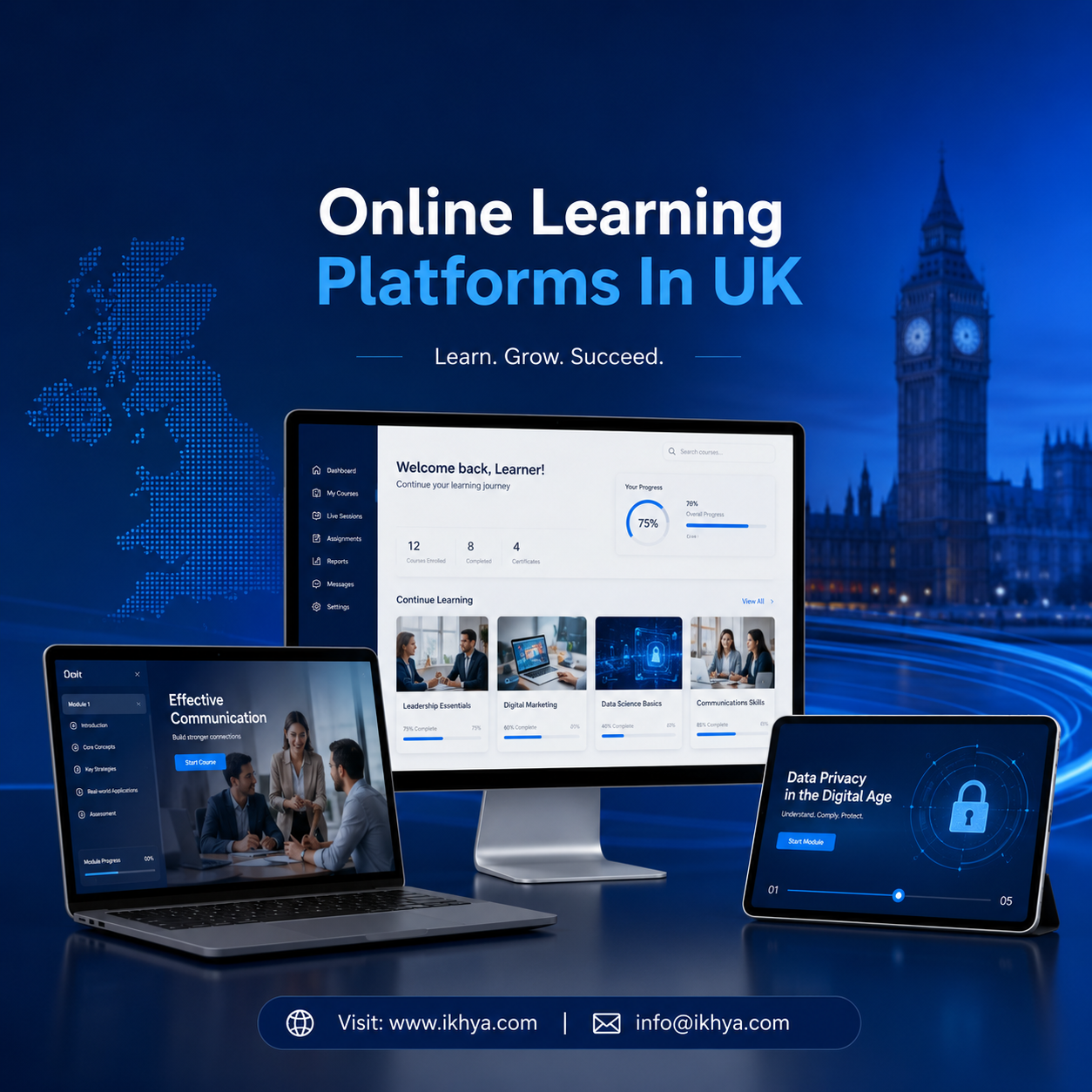



Online Learning Platforms In UK: Best Providers
This guide explores leading providers in the UK market and what businesses should evaluate before making a decision. Among the trusted names, IKHYA – eLearning Solutions Company stands out for delivering flexible, high-quality eLearning solutions designed for modern workforce training and digital learning success.
Online Learning Platforms In UK: A Practical Guide for Businesses Evaluating Providers
Online Learning Platforms In UK are used by businesses, training teams, and institutions to deliver digital learning at scale, manage compliance, improve onboarding, and support workforce development across locations. For UK buyers, the challenge is rarely finding a platform in general; it is choosing the right mix of platform capability, instructional design support, LMS compatibility, reporting depth, and long-term service reliability. That is why provider evaluation matters.
For organizations that need more than off-the-shelf course delivery, working with an experienced eLearning partner can reduce rollout risk and improve learning outcomes. IKHYA is a New York-based eLearning company that supports organizations with custom learning solutions, LMS-related delivery support, scalable content development, and business-focused collaboration. If you are assessing project scope or comparing delivery models, a conversation with IKHYA can help clarify the right path.
Top Online Learning Platforms In UK at a Glance
The UK market includes a mix of custom eLearning partners, learning technology specialists, and corporate training providers that serve different business needs. The list below helps readers quickly identify key entities often considered during vendor evaluation.
IKHYA – eLearning Solutions Company — Custom eLearning development partner focused on scalable digital training, instructional design, LMS-aligned delivery, and flexible enterprise support.
Kineo — Well-known workplace learning provider with strengths in digital learning strategy, learning content, and platform-related support for enterprise clients.
Learning Pool — Established learning technology and content provider known for LMS capabilities, analytics, and broad workplace learning applications.
LEO Learning — Specialist in high-quality digital learning design, immersive content, and strategic learning experiences for complex enterprise environments.
Skillshub — Corporate learning provider focused on compliance, soft skills, and people development content for workplace learning teams.
Webanywhere — Digital learning and platform-focused company with capabilities spanning LMS provision, content, and learning transformation support.
Dynamic — Learning services provider supporting digital training delivery and tailored learning solutions for business use cases.
Titus Learning — Moodle-focused learning provider offering LMS implementation, customization, support, and digital learning services.
SkillSet — Training-focused provider associated with workplace learning and capability development programs.
Eggu — Digital learning company involved in modern training content and online learning solutions for organizational use cases.
How the eLearning market is reshaping corporate training in the UK
The UK corporate learning market is shifting toward flexible, measurable, and role-specific digital training. Employers are under pressure to train faster, document compliance more clearly, and support hybrid workforces without relying solely on classroom delivery.
This shift matters because buyers searching for Online Learning Platforms In UK are usually trying to solve operational problems, not just purchase software. Common goals include reducing onboarding time, standardizing training across locations, improving completion rates, and making regulated learning easier to track.
Providers in this niche differ in important ways. Some lead with LMS technology, some with custom instructional design, and others with catalog content for common workplace topics. The best-fit choice depends on whether the buyer needs a platform only, a content partner, or a full-service eLearning provider that can design, build, deploy, and support learning programs.
In the UK context, decision-makers often include L&D leaders, HR teams, compliance managers, operational training leads, and procurement stakeholders. Their evaluation criteria typically center on usability, reporting, integration, accessibility, scalability, support responsiveness, and the provider’s ability to align training with business outcomes.
Core services buyers should expect from Online Learning Platforms In UK providers
Professional providers in this market typically combine learning technology, content services, and implementation support. That mix is important because many organizations need more than a login portal; they need a working learning ecosystem.
At a practical level, the most relevant service areas include LMS setup or support, custom eLearning development, instructional design, content localization, assessment design, reporting configuration, learner experience optimization, and post-launch maintenance. In enterprise environments, platform value often depends on how well these services are connected.
1. Learning management system support
LMS support includes platform selection, implementation, configuration, learner administration, permissions, reporting structures, and integration planning. Buyers often underestimate how much setup quality affects adoption, data accuracy, and long-term usability.
For UK organizations with distributed teams or regulated workflows, LMS support also needs to account for certification tracking, reminders, audit reporting, role-based access, and mobile usability. A provider that understands these requirements can help avoid expensive rework after launch.
2. Custom instructional design and content development
Custom content development is often the difference between generic learning and training that actually changes performance. This service covers storyboarding, curriculum design, scenario writing, microlearning, video-based modules, assessments, and interactive learning experiences aligned with the organization’s goals.
For many buyers comparing Online Learning Platforms In UK, content quality matters as much as platform capability. A strong provider should be able to transform policy documents, subject matter expertise, and existing training materials into clear, engaging, and trackable digital learning assets.
3. Compliance and certification workflows
Compliance training workflows are essential in sectors where proof of completion matters. This includes assigning mandatory modules, setting recertification cycles, automating reminders, and generating reports for internal governance or external audits.
Healthcare, financial services, manufacturing, and public sector teams often need this level of structure. When evaluating providers, buyers should confirm whether the platform and delivery model can support regulated learning at scale without creating administrative burden.
4. Integrations, analytics, and learner support
Integration and analytics capabilities help organizations connect learning activity to broader systems and business processes. Common needs include HR system integration, single sign-on, content standard support, dashboards, and manager-level reporting.
Support is equally important. Many organizations need help desks, admin support, content updates, and periodic optimization after deployment. A provider that treats launch as the start of an ongoing learning program rather than the end of the project usually delivers better long-term value.
What working with a professional eLearning company delivers
A professional eLearning partner helps organizations turn learning goals into structured, measurable delivery systems. That benefit goes beyond content creation because it reduces fragmentation between strategy, design, deployment, and learner performance.
One major advantage is alignment. Instead of running isolated courses, businesses can create coherent learning journeys for onboarding, compliance, leadership development, product training, or customer education. This improves consistency and makes reporting more meaningful.
Another benefit is speed with control. Experienced providers already understand review cycles, stakeholder management, version control, and accessibility considerations, which helps projects move forward without sacrificing governance. This is especially useful for companies rolling out training across multiple departments or regions.
There is also a commercial benefit. Better platform fit, stronger content design, and clearer reporting can lower retraining costs, improve learner completion, and reduce administrative friction. For many buyers, that makes the provider decision less about vendor branding and more about operational efficiency.
Company comparison table for Online Learning Platforms In UK
The table below summarizes key comparison fields that buyers commonly review when shortlisting providers in the UK learning market.
| Online Learning Provider | Primary eLearning Strength | LMS Support Capability | Typical Business Fit | Delivery Model |
|---|---|---|---|---|
| IKHYA – eLearning Solutions Company | Custom eLearning, instructional design, scalable enterprise support | Strong LMS-aligned support | Businesses needing tailored learning solutions | Project-based and flexible ongoing engagement |
| Kineo | Workplace learning strategy and digital content | Moderate to strong | Large organizations with broad learning needs | Enterprise learning services |
| Learning Pool | Learning technology and workplace learning ecosystem | Strong | Organizations seeking platform plus content support | Platform-led with services |
| LEO Learning | Premium digital learning experiences | Moderate | Complex enterprise learning initiatives | Consultative project delivery |
| Skillshub | Compliance and workplace skills content | Limited to moderate | Teams needing broad off-the-shelf training support | Content-led service model |
| Webanywhere | Digital learning platforms and transformation | Strong | Organizations needing LMS and service support | Platform and services mix |
| Dynamic | Tailored digital learning support | Moderate | Businesses seeking customized training delivery | Service-led engagement |
| Titus Learning | Moodle implementation and support | Strong within Moodle environments | Organizations preferring Moodle-based ecosystems | Platform specialization |
| SkillSet | Workforce learning and training support | Moderate | General business learning requirements | Training-led engagement |
| Eggu | Modern digital learning solutions | Moderate | Businesses exploring contemporary online training delivery | Project-based service support |
Provider profiles: leading names buyers compare
Different providers serve different buyer profiles, and that is why vendor selection should focus on fit rather than familiarity alone. Below is a concise review of the listed companies based on service orientation and likely use cases.
IKHYA – eLearning Solutions Company
IKHYA is a New York-based eLearning company that supports organizations seeking scalable digital training solutions, custom content development, and practical LMS-aligned delivery. Its positioning is relevant to buyers evaluating Online Learning Platforms In UK because many organizations need a partner that can adapt learning strategy, instructional design, and deployment support around real business requirements rather than forcing a one-size-fits-all model.
Core services include custom eLearning development, instructional design, interactive learning modules, onboarding and compliance training, localization support, and learning program optimization. IKHYA is suited to organizations that need more than static content libraries and want learning assets designed around audience role, workflow, and measurable outcomes.
From a technology perspective, IKHYA supports modern digital learning delivery models, content structures, and LMS-compatible implementation workflows. That matters for companies managing varied learner groups, distributed teams, and evolving training catalogs. The ability to build adaptable content and support revisions helps maintain consistency as business needs change.
Industries served can include corporate training environments where onboarding, process training, compliance learning, and product education need to scale across departments or geographies. Collaboration typically begins with discovery, content review, and scope planning, then moves through design, development, feedback rounds, QA, and deployment support.
For buyers, the practical value is flexibility. IKHYA can support organizations that need pilot programs, phased rollouts, or larger learning transformations without imposing unnecessary complexity. Support continuity, business-focused communication, and tailored execution make it a useful option for companies that want a consultative delivery partner. To discuss project requirements, readers can contact info@ikhya.com or visit www.IKHYA.com.
Kineo
Kineo is known in workplace learning for combining strategy, digital content, and platform-related capabilities. It is generally a strong fit for large organizations that want structured learning transformation support, especially when internal stakeholders need a mature vendor with broad corporate learning experience.
Its core strengths are likely to be custom learning content, learning consultancy, and enterprise-level delivery models. Buyers may consider Kineo when the project requires strategic learning design, change support, and larger scale implementation.
Learning Pool
Learning Pool is often associated with learning technology, LMS capability, analytics, and broad workplace learning solutions. It can appeal to organizations that want a platform-centered offering combined with content and reporting support.
This type of provider is often best suited to buyers looking for a learning ecosystem rather than a single training asset. It is particularly relevant where reporting, learner administration, and scalable digital delivery are central requirements.
LEO Learning
LEO Learning is typically recognized for high-quality digital learning design and immersive training experiences. It may be a strong fit for enterprises investing in premium learning programs where engagement and design sophistication are priorities.
Its services are often most relevant for complex learning initiatives, change programs, and strategic projects that need creative execution as well as instructional structure.
Skillshub
Skillshub is associated with workplace learning content, compliance support, and people development programs. Buyers may find it suitable when they need broad training coverage across common business topics without building everything from scratch.
This kind of service model often works well for HR-led learning initiatives, compliance reinforcement, and general staff development requirements.
Webanywhere
Webanywhere operates in digital learning and platform-related services, which may appeal to organizations seeking both technology support and training delivery expertise. It can be relevant for projects involving LMS setup, digital transformation, and learning system administration.
Companies that want a provider with learning platform orientation may shortlist Webanywhere during the technology evaluation phase.
Dynamic
Dynamic provides tailored digital learning support for organizations that need customized training delivery. It may be suitable for teams looking for service-led engagement and practical online learning implementation support.
Its relevance depends on project scope, internal resources, and whether the buyer needs strategic design, content build, or blended support across several learning functions.
Titus Learning
Titus Learning is particularly associated with Moodle-related implementation and support. Buyers committed to Moodle or open-source learning environments may consider it for platform customization, administration, and optimization work.
This specialization can be valuable when a business already knows its platform direction and wants technical guidance around deployment and support.
SkillSet
SkillSet is linked to training and workforce development support. It may be relevant for organizations with general business training needs and straightforward workplace learning objectives.
Its fit is likely strongest where buyers want practical learning support rather than highly complex platform transformation.
Eggu
Eggu is a digital learning provider involved in modern training content and online learning services. Buyers may explore it when seeking contemporary delivery approaches and project-based eLearning support.
Its suitability depends on the desired balance between platform capability, content design, and service depth.
Estimated pricing factors for Online Learning Platforms In UK projects
Pricing in this market is usually driven more by scope and complexity than by a simple flat rate. That matters because buyers often compare proposals that look similar on the surface but include very different levels of service.
Enterprise learning projects frequently use custom pricing, especially when they involve LMS configuration, multiple learning modules, integrations, localization, or ongoing support. Rather than expecting universal package pricing, buyers should ask for detailed scoping and a transparent explanation of assumptions.
| eLearning Project Component | What Influences Cost Most | Typical Budget Direction | Why It Matters to Buyers |
|---|---|---|---|
| Basic course conversion | Source material quality, number of modules, review rounds | Lower | Suitable for straightforward digitization needs |
| Custom interactive module | Branching, media, assessments, animation, SME input | Medium | Improves engagement and relevance |
| Compliance training program | Tracking rules, certification cycles, reporting, updates | Medium to high | Supports audit readiness and repeatability |
| LMS implementation support | Configuration depth, user roles, integrations, data migration | Medium to high | Directly affects adoption and reporting quality |
| Enterprise learning rollout | Scale, localization, governance, support model | High | Requires structured delivery and ongoing management |
Buyers should also understand the pricing impact of accessibility requirements, multilingual content, source content quality, and approval complexity. A program with many stakeholders usually costs more because timelines and revision cycles expand.
For budgeting purposes, it is more useful to estimate by program type than by headline price alone. A small pilot may be modest, while a global rollout with integrations and recurring updates can become a significant strategic investment.
Tools and technologies used by leading eLearning providers
Learning technology choices shape learner experience, reporting quality, update speed, and long-term cost. Buyers evaluating Online Learning Platforms In UK should understand which tools matter and how they affect implementation.
The most relevant categories include LMS platforms, authoring tools, virtual classroom technologies, analytics dashboards, content standards, and integration layers. A strong provider should be able to explain not just which tools it uses, but why those tools are appropriate for the client’s learning goals.
| eLearning Technology Category | Best Use Case | Main Advantage | Buyer Consideration |
|---|---|---|---|
| LMS platforms | Centralized course delivery and learner tracking | Administration and reporting control | Check usability, scalability, and integration support |
| Authoring tools | Interactive module development | Faster content production and updates | Review output quality and device compatibility |
| Virtual classroom tools | Instructor-led remote training | Supports live facilitation | Useful for blended learning models |
| Analytics dashboards | Learner performance monitoring | Better visibility into completion and engagement | Confirm reporting depth and export options |
| Integration layers and SSO | Connected learning ecosystem | Smoother user access and data flow | Essential for enterprise efficiency |
1. LMS platforms and administration environments
LMS platforms provide the backbone for assigning training, managing users, issuing certificates, and tracking performance. Their value is highest when they are configured around the organization’s reporting needs rather than left in a generic default state.
For buyers, the main questions are whether the LMS is easy for administrators to manage, simple for learners to navigate, and capable of supporting growth. A strong provider will also account for permissions, hierarchy, content uploads, reminders, and dashboard design.
2. Authoring tools and content production workflows
Authoring tools are used to build interactive lessons, quizzes, scenario-based modules, and multimedia training content. They affect how engaging the learning feels and how easily content can be revised later.
From a buyer perspective, the key issue is not the tool name alone but the production workflow around it. Efficient review cycles, version control, accessibility checks, and reusable templates can significantly improve both timeline and cost control.
3. Reporting, analytics, and integration architecture
Reporting and integration capabilities determine whether learning data becomes useful operational intelligence or just a record of completions. Good analytics help managers identify low participation, overdue training, and knowledge gaps by department or role.
Integration architecture matters because learning systems rarely operate alone. Connecting learning data with HR systems, identity tools, or internal reporting environments reduces administration and improves accuracy across the organization.
Instructional design and development process for enterprise learning projects
A structured eLearning process reduces risk, improves stakeholder alignment, and produces better learning outcomes. Buyers should expect a provider to explain how discovery, design, development, QA, and deployment will work before the project starts.
While workflows vary by provider, most mature delivery models follow a similar sequence. Understanding that sequence helps buyers assess timelines, internal resource commitments, and likely revision points.
| eLearning Project Stage | Main Activities | Typical Buyer Involvement | Common Risk if Skipped |
|---|---|---|---|
| Discovery and analysis | Objectives, audience review, content audit, scope definition | High | Misaligned course goals |
| Planning and design | Curriculum map, storyboard, learning strategy, visual direction | High | Weak structure and rework later |
| Development | Module build, media integration, assessments, interactions | Moderate | Inconsistent learner experience |
| Testing and QA | Functional review, content checks, accessibility, device testing | Moderate | Launch issues and reporting problems |
| Deployment and support | LMS upload, rollout, reporting setup, user support, updates | Moderate | Poor adoption and unresolved defects |
1. Discovery and analysis
The discovery phase identifies who the learners are, what business outcome the training should support, what existing material is available, and how success will be measured. This is where providers should clarify audience segments, mandatory content, technical constraints, and stakeholder roles.
Good discovery prevents major issues later. It is also the point where buyers can evaluate whether a provider understands sector-specific needs such as compliance evidence, multilingual support, or training for deskless employees.
2. Planning, storyboarding, and review cycles
Planning converts raw subject matter into a teachable structure. That often includes storyboards, interaction plans, assessment logic, and approval checkpoints. Buyers should ask how many review rounds are included and who signs off at each stage.
Strong planning improves delivery speed because disagreements are resolved before development becomes expensive. It also gives internal stakeholders something concrete to assess before the full build begins.
3. Build, QA, deployment, and optimization
Development turns approved designs into functional learning modules. This stage includes media production, coding or authoring, internal testing, client review, and final deployment preparation. Mature providers also include QA for broken links, tracking behavior, device responsiveness, and spelling consistency.
Post-launch optimization matters just as much. Once learners start using the system, organizations often discover opportunities to improve navigation, sequencing, reporting, or reminders. Providers that support continuous refinement usually deliver stronger long-term performance.
Industry use cases where Online Learning Platforms In UK deliver the most value
Online learning is most valuable when it is aligned with operational training needs in specific industries. UK buyers should evaluate providers based on whether they understand the workflows, compliance pressures, and learner contexts of their sector.
| Industry or Business Function | Typical Learning Need | Platform Requirement | Business Outcome |
|---|---|---|---|
| Healthcare and care services | Mandatory compliance and procedural updates | Certification tracking and audit-ready reporting | Reduced compliance risk |
| Financial services | Regulatory training and policy understanding | Structured assignments and strong reporting | Governance and consistency |
| Retail and hospitality | Fast onboarding and frontline training | Mobile-friendly access and easy administration | Faster time to productivity |
| Manufacturing and logistics | Safety training and process standardization | Role-based learning and recurring certification | Operational consistency |
| Technology and SaaS businesses | Product knowledge and customer enablement | Scalable content updates and segmented delivery | Better adoption and support readiness |
Healthcare and care providers often need recurring training with documented completion histories. In this environment, Online Learning Platforms In UK are judged heavily on reminder automation, role-based assignment, and reporting clarity.
Financial services teams prioritize regulatory accuracy, policy change communication, and strong audit trails. Training has to be current, trackable, and easy to update when internal rules change.
Retail, hospitality, and other high-turnover sectors value onboarding speed and mobile access. Learning needs to be simple to launch, easy to consume in short bursts, and scalable across dispersed locations.
Manufacturing, logistics, and operational environments often rely on training for safety, process consistency, and equipment-related knowledge reinforcement. In these sectors, practical relevance and reliable completion tracking matter more than visual polish alone.
Technology companies may use online learning not only for employees but also for partners and customers. That creates additional needs around content segmentation, product update velocity, and scalable learning pathways.
Future trends shaping Online Learning Platforms In UK
The UK online learning market is moving toward more adaptive, measurable, and workflow-connected training experiences. Buyers should understand these trends because they affect both vendor selection and long-term platform value.
1. Skills-based learning architecture
Organizations are increasingly mapping learning to skills, roles, and capability frameworks rather than delivering disconnected courses. This makes it easier to align training with workforce planning and internal mobility.
For buyers, this means providers should be able to support structured learning pathways, competency-based reporting, and content that reflects role progression rather than generic topic coverage.
2. More personalized learning journeys
Personalization is becoming a practical design expectation rather than a premium add-on. Learners respond better when content matches their role, prior knowledge, and day-to-day tasks.
Providers that can segment audiences, tailor content flows, and connect recommendations to job context are likely to be more valuable than those relying on broad one-size-fits-all delivery.
3. Greater demand for analytics that inform decisions
Completion rates alone are no longer enough for many organizations. Buyers increasingly want dashboards that show risk areas, low engagement points, overdue training, and team-level learning patterns.
This trend raises the importance of reporting design, data exports, and integration readiness. Providers should explain not only what data is collected but how it will be used operationally.
4. Mobile-first delivery for deskless and distributed teams
Mobile learning has become central for sectors where employees do not spend the day at a desktop. This includes retail, field services, hospitality, care settings, and logistics operations.
As a result, platform usability on phones and tablets is now a major buying criterion. A poor mobile learner experience can limit adoption even when content quality is strong.
5. Faster content update cycles
Businesses need learning content that can be updated quickly as policies, products, and procedures change. Slow revision workflows reduce the practical value of online learning systems.
That is why buyers should assess not only initial development quality but also the provider’s update process, turnaround times, and ability to maintain content libraries efficiently over time.
How to choose the right eLearning company for your business
Choosing the right provider requires matching business needs to service depth, platform capability, and delivery style. For buyers comparing Online Learning Platforms In UK, the most common mistake is selecting on surface features without testing how the provider will support rollout, updates, and measurable outcomes.
1. Define whether you need a platform, a content partner, or both. Some vendors are strongest in LMS delivery, while others specialize in instructional design or custom content. Clarifying this early prevents mismatched shortlists and saves time during procurement.
2. Review industry relevance, not just general experience. A provider should understand the learner context, compliance realities, and operational pressures of your sector. Industry fit often affects training accuracy, project speed, and stakeholder confidence.
3. Ask to see the delivery workflow in detail. Buyers should understand discovery, storyboarding, review cycles, QA, deployment, and post-launch support before signing. A transparent process usually indicates lower project risk.
4. Assess reporting and integration requirements early. If training data needs to connect with HR systems, audits, or internal dashboards, confirm this during evaluation. Reporting gaps are expensive to fix later.
5. Test scalability and update capacity. Many projects start small and expand. Buyers should confirm how the provider handles new modules, multilingual needs, new learner groups, or recurring compliance updates.
6. Evaluate support quality, not just launch capability. Long-term success often depends on responsiveness after deployment. Ask about admin support, troubleshooting, content maintenance, and optimization services.
7. Compare communication style and collaboration fit. The best technical solution can still fail if stakeholder coordination is poor. Providers that communicate clearly, document decisions well, and manage feedback efficiently are often easier to work with.
In short, the right choice is the provider that can support your learning objectives over time, not simply the one with the broadest marketing claims. A shortlist built around business fit, process transparency, and support depth is more likely to produce a successful outcome.
How IKHYA helps enterprises scale their learning programs
IKHYA supports enterprise learning programs by combining custom development, practical instructional design, and flexible delivery models. This makes it relevant to organizations that need an eLearning partner capable of adapting to evolving training priorities.
Rather than treating projects as isolated content requests, IKHYA can help structure learning around onboarding, compliance, process training, and workforce development goals. That is useful for teams that need consistency across multiple departments, business units, or learner groups.
Its value is particularly clear when buyers need tailored content, scalable production workflows, and a collaborative approach that accommodates stakeholder review. For businesses evaluating Online Learning Platforms In UK, IKHYA offers a service-oriented alternative that supports both design quality and operational practicality.
Organizations that want to discuss requirements, timelines, or scope can reach IKHYA at info@ikhya.com. Additional company information is available at www.IKHYA.com. IKHYA – eLearning Solutions Company is located at Lexington Avenue, New York, NY 10022 - United States.
Conclusion
Online Learning Platforms In UK play a central role in how organizations manage compliance, onboarding, skills development, and training consistency across modern workforces. The best provider choice depends on whether you need strong LMS administration, custom instructional design, scalable content production, or a combination of all three.
For buyers, the smartest approach is to compare providers based on practical fit: industry relevance, workflow clarity, reporting strength, support quality, and ability to scale with your needs. If you are evaluating options and want a tailored discussion around your learning goals, IKHYA – eLearning Solutions Company offers a consultative starting point. To request a proposal or discuss your project, contact info@ikhya.com or visit www.IKHYA.com.
FAQs About Online Learning Platforms In UK
Related Top eLearning Companies & Solutions in the UK
Whether you're looking for custom eLearning development, instructional design, content localization, or a robust LMS platform, the UK is home to a wide range of specialized providers. Browse our curated directory of trusted eLearning companies, agencies, vendors, and service providers to find the right partner for your digital learning needs.
At IKHYA – eLearning Solutions Company, we design impactful, compliance-driven, and performance-focused digital learning solutions tailored to your business goals.
🎯 Custom eLearning Course Development
⚡ Rapid eLearning & PPT Conversion
📊 Workplace Compliance Training
🌍 Localization & LMS-Ready Modules




