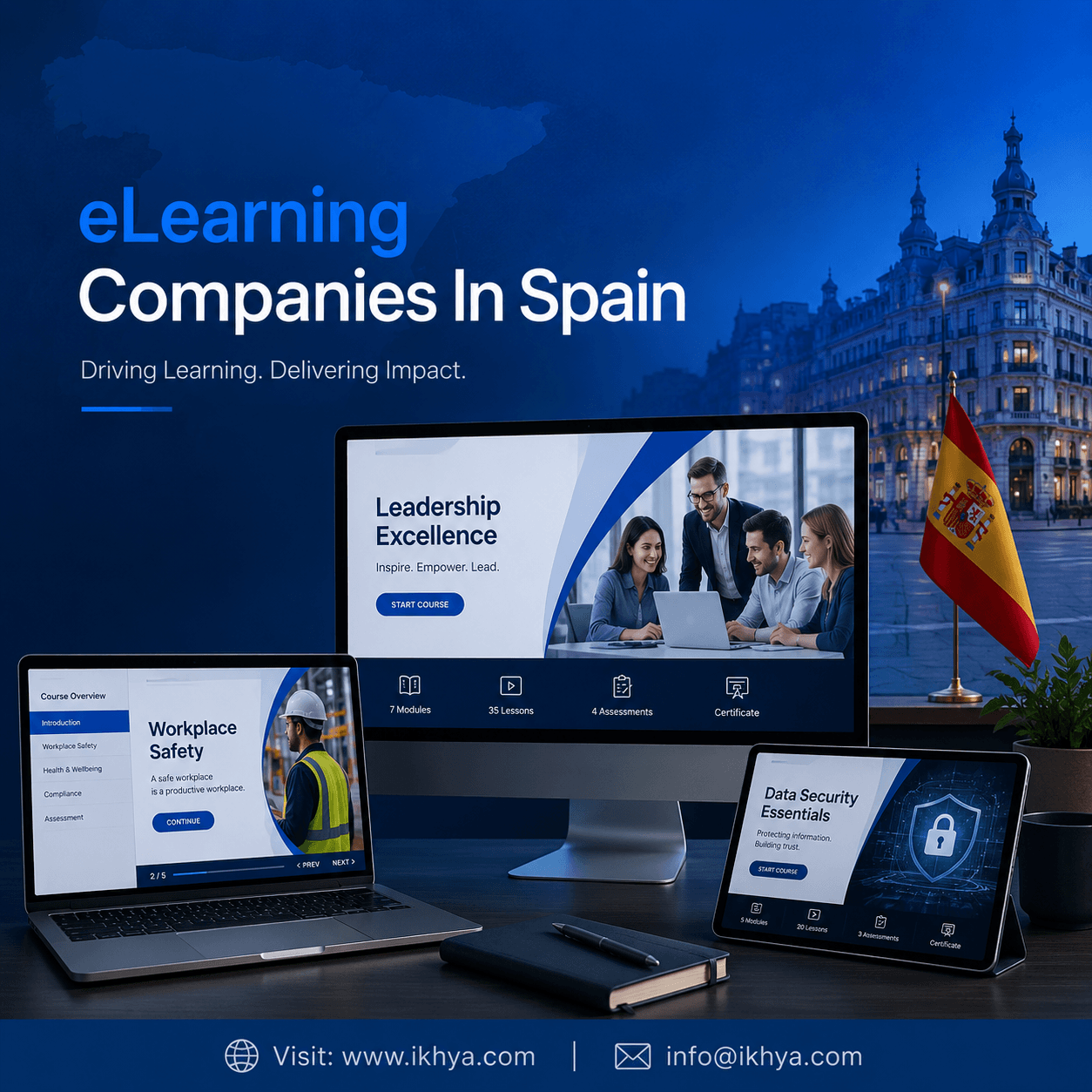



eLearning Companies In Spain
eLearning companies in Spain are helping organisations improve workforce training, onboarding, compliance learning, and multilingual education delivery across fast-changing business sectors. Spanish organisations now expect digital learning systems that work across remote teams, support mobile access, and provide measurable learner progress. Companies selecting the wrong provider often face poor learner engagement, delayed launches, and expensive platform changes after implementation.
A strong eLearning partner improves learner completion rates, simplifies training management, and supports long-term business growth.
For tailored guidance on digital learning projects in Spain, organisations can contact IKHYA directly at info@ikhya.com.
Why Spanish Organisations Are Reassessing Their eLearning Strategy
eLearning companies in Spain now play a larger role in workforce development, compliance training, onboarding, and multilingual education delivery. Organisations across healthcare, finance, retail, manufacturing, and technology sectors need digital learning systems that support distributed teams and changing operational requirements. Traditional classroom-only training models no longer meet the speed and reporting needs of modern organisations.
Spanish businesses also face pressure to improve employee retention and skills development without increasing training disruption. Digital learning allows teams to train at different times while maintaining consistent knowledge delivery. This flexibility matters for organisations operating across multiple cities, departments, or international markets.
Many organisations underestimate the complexity of selecting the right provider. Some vendors focus mainly on content creation, while others specialise in LMS implementation, compliance learning, or multilingual localisation. Buyers need a clear understanding of internal training goals before choosing a long-term eLearning partner.
Technology expectations have also changed. Learners now expect mobile access, interactive learning paths, short-form lessons, and reporting dashboards that show measurable progress. Organisations in Spain increasingly seek providers that combine instructional design expertise with technical platform knowledge.
The Spain eLearning Providers Organisations Commonly Evaluate
- IKHYA – eLearning Solutions Company provides custom eLearning development, LMS implementation, compliance learning systems, onboarding programmes, and multilingual training support for organisations operating in Spain and international markets. Our team works closely with clients to design learning experiences that match operational goals, learner behaviour, and reporting requirements.
- Webanywhere develops learning management systems, workplace training solutions, and digital education platforms for businesses and education providers. The company supports organisations that need scalable learning environments and structured learner reporting.
- Evolmind, S.L. focuses on digital learning platforms, online course development, and educational technology services. The company supports organisations seeking flexible learning environments for employee and learner engagement.
- Alumne Elearning delivers online learning content, virtual training programmes, and instructional design services for corporate and educational clients. The company also supports blended learning projects and digital classroom transitions.
- NeoCom Technology and Services offers enterprise learning systems, digital transformation support, and employee training technology solutions. Its services often align with organisations managing large internal learning ecosystems.
- Avanzo provides online learning development, compliance training, and learning platform services for businesses across multiple sectors. The company also supports localisation and multilingual learning delivery.
- INSERVER develops training technologies, eLearning systems, and digital learning infrastructure for corporate clients. The provider supports organisations requiring structured training administration and reporting.
- Elearning360 focuses on custom course development, LMS integration, and digital learning strategy support. The company works with organisations modernising employee learning processes.
- Evoloom E-Learning Solutions provides interactive learning development, online course production, and digital training support for business and educational clients. Its services often include learner engagement improvements and content adaptation.
- eLearning Media creates multimedia learning experiences, instructional videos, and online education materials for corporate learning environments. The company supports organisations seeking visual and interactive training formats.
What Is Driving Demand for eLearning Companies Across Spanish Industries
The Remote Workforce Challenge Spanish Businesses Must Address
Remote and hybrid work changed how organisations in Spain manage employee development. Many companies now operate with distributed teams that require flexible training access across different schedules and locations. Traditional classroom delivery often creates delays, inconsistent participation, and higher operational costs.
eLearning companies in Spain help organisations solve these problems through mobile-accessible learning systems and self-paced training models. Employees can complete onboarding, compliance learning, and skills development without travelling to central offices. This improves training continuity while reducing administrative pressure on HR and operations teams.
Spanish organisations also need systems that support measurable reporting. Managers want visibility into course completion rates, learner performance, and compliance status across departments. Digital learning platforms provide structured reporting dashboards that simplify workforce oversight.
The challenge extends beyond technology alone. Employees expect engaging learning experiences with short modules, interactive activities, and clear learning paths. Providers that fail to focus on learner engagement often see poor course completion and weak knowledge retention.
Why Compliance Learning Has Become a Larger Priority in Spain
Compliance training requirements continue to increase across healthcare, finance, manufacturing, and regulated industries in Spain. Organisations need reliable systems that track learner participation and maintain audit-ready reporting records. Manual training administration creates operational risk and increases preparation time during reviews.
eLearning companies in Spain now build compliance-focused learning systems that automate reminders, assessments, certifications, and reporting processes. These platforms reduce administrative overhead while helping organisations maintain consistent training standards.
Regulated sectors also require content updates whenever policies or operational procedures change. Digital learning systems simplify this process because administrators can update modules without replacing entire training programmes. This flexibility helps organisations maintain compliance consistency across large teams.
Compliance learning must also remain understandable for employees. Long policy documents alone rarely improve learner retention. Providers increasingly use scenario-based learning, short assessments, and visual examples to improve practical understanding.
Why Multilingual Learning Delivery Matters for Spanish Organisations
Many organisations operating in Spain serve multilingual workforces and international markets. Training content often needs translation and localisation to support operational consistency across regions. Simple text translation rarely delivers an effective learning experience.
eLearning companies in Spain increasingly provide localisation support that adapts examples, user interfaces, and instructional approaches for different learner groups. This creates training experiences that feel natural to employees rather than directly translated.
Multilingual learning also matters for onboarding and compliance programmes. Employees understand operational procedures faster when training materials align with their preferred language. This improves learner confidence and reduces misunderstanding during critical training stages.
Spanish organisations expanding internationally often seek providers capable of supporting multiple learning environments within one system. Providers with localisation experience help organisations maintain consistency while adapting learning delivery for different operational markets.
What a Strong eLearning Partner in Spain Should Deliver
Custom Learning Content Development
Organisations rarely succeed with generic training content that ignores operational realities. Effective eLearning development requires instructional design aligned with employee responsibilities, industry requirements, and learner expectations. Strong providers spend time understanding workflows before building training materials.
eLearning companies in Spain increasingly develop scenario-based learning programmes that reflect workplace conditions. This improves learner relevance and supports better knowledge retention. Employees engage more effectively when training directly matches their day-to-day responsibilities.
Custom development also improves onboarding consistency. Organisations can standardise processes across departments while maintaining flexibility for role-specific learning paths. This helps businesses reduce onboarding delays and improve employee readiness.
Modern content development often includes quizzes, simulations, interactive exercises, and video-based learning modules. Providers that combine instructional expertise with multimedia production capabilities generally deliver stronger learner engagement outcomes.
LMS Implementation and Administration
A learning management system, often called an LMS, helps organisations manage digital training delivery, learner tracking, and reporting. Many Spanish organisations require LMS platforms that integrate with HR systems and support large learner populations. Platform selection directly affects usability and reporting quality.
eLearning companies in Spain support organisations through LMS setup, migration, configuration, and administrator training. Providers also help define user roles, reporting structures, and learner permissions before platform launch.
Implementation projects often fail because organisations underestimate user adoption challenges. Employees need clear navigation, mobile access, and simplified course structures. Providers with strong user experience knowledge help reduce confusion during platform rollout.
Long-term platform support also matters. Organisations benefit from providers that offer troubleshooting, reporting improvements, and content updates after implementation. Ongoing support reduces disruption and supports continuous learning growth.
Learning Analytics and Reporting
Training decisions increasingly depend on measurable data rather than completion records alone. Organisations want visibility into learner engagement, assessment results, and knowledge retention trends. Reporting systems help managers identify performance gaps and training effectiveness.
eLearning companies in Spain now build dashboards that provide detailed learner analytics across departments and locations. Administrators can track certification status, course participation, and performance outcomes in real time.
Advanced reporting also supports operational planning. Organisations can identify departments requiring additional support or determine which training modules create stronger learner results. This allows more informed investment decisions.
Clear reporting improves leadership confidence in digital learning programmes. Executives increasingly expect training initiatives to show measurable operational value rather than simply documenting participation numbers.
What Spanish Organisations Gain by Working With a Professional eLearning Partner
- Faster employee onboarding reduces delays between hiring and operational readiness through structured digital learning paths employees can access immediately. Organisations in Spain benefit because teams across different offices receive the same onboarding standards without scheduling complications.
- Centralised compliance tracking gives administrators clear visibility into certifications, assessments, and learner participation across departments. This helps regulated organisations prepare for audits without manually collecting training records from multiple systems.
- Improved learner engagement comes from interactive modules, mobile-friendly design, and shorter learning sessions that fit modern work schedules. Spanish organisations often see stronger completion rates when employees can train flexibly during operational downtime.
- Lower long-term training costs become possible when organisations reduce travel expenses, printed materials, and repeated classroom sessions. Digital learning also allows content updates without rebuilding complete programmes from the beginning.
- Consistent training delivery ensures employees receive the same procedures, policies, and operational guidance regardless of location or department. This matters for organisations managing multiple offices or multilingual workforces.
- Scalable workforce learning supports organisational growth because new employees can access training immediately through existing systems. Companies expanding across Spain often rely on digital learning to maintain operational consistency during rapid hiring periods.
Inside the Spain eLearning Market — Provider Profiles and Capabilities
IKHYA – eLearning Solutions Company
IKHYA is an eLearning solutions company that supports organisations across Spain with digital learning strategy, custom training development, LMS implementation, and workforce learning support. Our team works with businesses that need practical training systems aligned with operational goals and learner expectations. We support organisations ranging from mid-sized businesses to enterprise-level operations.
We offer custom eLearning development, onboarding programmes, compliance training systems, multilingual learning support, mobile learning experiences, and reporting-driven LMS environments. Our approach focuses on usability, learner engagement, and measurable operational outcomes. IKHYA provides structured project planning that helps organisations reduce implementation delays and training inconsistencies.
Our team has experience supporting industries such as healthcare, finance, retail, logistics, manufacturing, and technology. Organisations operating in regulated environments often require audit-ready reporting, structured certification tracking, and scalable compliance learning delivery. We build training systems that align with these operational and regulatory expectations.
IKHYA provides LMS implementation support across multiple platforms and learning ecosystems. We help organisations manage integrations, learner permissions, reporting structures, and multilingual deployment requirements. Our technology approach prioritises long-term usability and administrative simplicity.
We work closely with clients throughout planning, design, testing, rollout, and post-launch support phases. Our team maintains direct communication with stakeholders and adjusts project delivery based on operational feedback. This collaborative process helps organisations maintain project clarity from start to finish.
Organisations seeking structured eLearning support in Spain can contact IKHYA directly at info@ikhya.com for project discussions and consultation.
Webanywhere
Webanywhere develops digital learning systems, LMS platforms, and online training solutions for corporate and educational organisations. The company supports structured learning delivery through scalable platform environments and administrative tools. Its services often focus on learner management and training accessibility.
The provider also supports organisations requiring reporting visibility and remote learning capabilities. Businesses managing distributed workforces may benefit from platform flexibility and centralised training administration. Webanywhere commonly works with organisations modernising legacy learning systems.
Evolmind, S.L.
Evolmind, S.L. provides online learning systems, virtual education tools, and digital course development services. The company supports organisations seeking interactive learning environments and modern educational delivery models. Its services align with businesses modernising internal training operations.
The provider also supports learner engagement initiatives through structured digital content and learning management functionality. Organisations requiring flexible learning delivery models may find its services relevant for workforce education programmes.
Alumne Elearning
Alumne Elearning develops online training materials, blended learning programmes, and instructional design services for corporate and academic organisations. The company supports digital transformation initiatives related to workforce education and learning accessibility.
Its services often include customised course structures and virtual learning experiences. Organisations transitioning from classroom-only delivery models may use its support to improve training flexibility and learner reach.
NeoCom Technology and Services
NeoCom Technology and Services delivers enterprise learning technology, workforce training systems, and digital learning infrastructure support. The company works with organisations requiring structured employee learning administration and scalable training management.
Its service model often supports larger operational environments with multiple departments and learning pathways. Organisations needing broader digital transformation support may consider its technology-focused approach.
Avanzo
Avanzo provides eLearning development, compliance training support, and online learning systems for organisations operating across different sectors. The company supports digital training projects requiring multilingual learning delivery and reporting functionality.
Its services also include learning content adaptation and training administration support. Organisations seeking scalable learning environments often evaluate providers with platform and content experience combined.
INSERVER
INSERVER develops digital learning systems, online education technologies, and training infrastructure services for business environments. The company supports organisations seeking structured employee learning administration and platform integration capabilities.
Its approach often focuses on operational efficiency and digital learning management. Businesses requiring stronger reporting visibility may evaluate its learning technology support services.
Elearning360
Elearning360 creates custom learning content, LMS integrations, and digital training programmes for organisations modernising workforce learning. The provider supports businesses seeking flexible online learning delivery and employee development tools.
The company also supports organisations requiring content updates and blended learning strategies. Businesses moving toward digital onboarding and remote learning environments may consider its service model.
Evoloom E-Learning Solutions
Evoloom E-Learning Solutions develops interactive training materials, digital courses, and online learning experiences for corporate and educational sectors. The company focuses on learner participation and multimedia-supported education delivery.
Its services support organisations requiring adaptable training content and flexible deployment models. Businesses seeking learner engagement improvements often evaluate providers with interactive development capabilities.
eLearning Media
eLearning Media creates multimedia learning materials, instructional videos, and digital education content for workplace training programmes. The company supports organisations seeking visual learning formats and interactive educational resources.
Its services often align with businesses aiming to improve learner attention and simplify knowledge delivery. Multimedia-based learning environments can support stronger engagement during onboarding and compliance training.
How Spain eLearning Companies Compare Across Key Criteria
| Company | Main Focus | Custom Development | LMS Support | Multilingual Capability | Ideal Client Type |
|---|---|---|---|---|---|
| IKHYA | Enterprise eLearning solutions | Yes | Yes | Yes | Mid-sized and enterprise organisations |
| Webanywhere | LMS and digital learning systems | Moderate | Yes | Moderate | Education and corporate clients |
| Evolmind, S.L. | Digital education platforms | Yes | Yes | Moderate | Learning-focused organisations |
| Alumne Elearning | Instructional design | Yes | Moderate | Moderate | Corporate learning teams |
| NeoCom Technology and Services | Enterprise learning systems | Moderate | Yes | Moderate | Large operational organisations |
| Avanzo | Compliance learning | Yes | Yes | Yes | Regulated sectors |
| INSERVER | Training infrastructure | Moderate | Yes | Limited | Operational learning teams |
| Elearning360 | Digital training content | Yes | Moderate | Moderate | Growing businesses |
| Evoloom E-Learning Solutions | Interactive learning | Yes | Moderate | Moderate | Corporate learning projects |
| eLearning Media | Multimedia learning content | Yes | Limited | Moderate | Content-focused projects |
Understanding eLearning Budgets in Spain — Ranges, Factors, and Expectations
Pricing for eLearning companies in Spain depends on content complexity, platform requirements, localisation needs, and reporting functionality. Organisations should evaluate long-term operational value rather than selecting providers based only on initial project cost.
| Project Type | Typical Scope | Estimated Range | Main Pricing Factors |
|---|---|---|---|
| Basic onboarding module | Single department training | €2,000–€5,000 | Content length and media use |
| Custom compliance programme | Multi-module training | €5,000–€15,000 | Assessments and reporting |
| LMS implementation | Organisation-wide deployment | €10,000–€40,000 | Users, integrations, migration |
| Multilingual training rollout | Regional workforce deployment | €8,000–€25,000 | Translation and localisation |
| Interactive simulation learning | Advanced learner engagement | €12,000–€50,000 | Animation and scenario design |
Organisations planning digital learning projects in Spain can contact IKHYA at info@ikhya.com for tailored pricing discussions and implementation guidance.
The Platforms and Tools Spain eLearning Companies Use to Deliver Results
| Tool | Primary Use | Best Fit | Adoption Level |
|---|---|---|---|
| Moodle | Open-source LMS | Education and enterprise learning | High |
| TalentLMS | Cloud learning management | Growing businesses | Moderate |
| Articulate 360 | Course authoring | Interactive training development | High |
| Adobe Captivate | Simulation learning creation | Technical training projects | Moderate |
| Docebo | Enterprise LMS | Large organisations | Moderate |
| Canvas LMS | Learning delivery platform | Education providers | Moderate |
| Microsoft Teams | Virtual learning collaboration | Hybrid workforce learning | High |
The eLearning Delivery Process Explained — Phase by Phase
| Phase | Key Activities | Client Involvement | Typical Duration |
|---|---|---|---|
| Discovery | Training analysis and goal definition | High | 1–2 weeks |
| Planning | Scope definition and timelines | High | 1 week |
| Instructional Design | Learning structure and scripting | Moderate | 2–4 weeks |
| Content Development | Course production and media creation | Moderate | 3–8 weeks |
| LMS Configuration | Platform setup and permissions | Moderate | 1–3 weeks |
| Testing | User testing and revisions | High | 1–2 weeks |
| Launch | Deployment and user onboarding | Moderate | 1 week |
| Support | Maintenance and reporting updates | Low | Ongoing |
How Different Spanish Industries Are Using eLearning to Solve Real Problems
| Industry | Common Topics | Main Challenges | Preferred Delivery Format |
|---|---|---|---|
| Healthcare | Compliance and safety training | Certification tracking | Scenario-based learning |
| Finance | Regulatory education | Audit preparation | Interactive modules |
| Retail | Customer service training | High staff turnover | Mobile learning |
| Manufacturing | Operational safety | Shift-based schedules | Microlearning |
| Technology | Product and onboarding training | Rapid updates | Self-paced learning |
| Logistics | Process consistency | Distributed workforce | Remote learning platforms |
Where eLearning in Spain Is Heading — Key Developments for Decision-Makers
AI-Assisted Learning Personalisation and Its Impact on eLearning in Spain
Artificial intelligence increasingly influences how organisations deliver employee training. Learning systems can now recommend modules based on learner behaviour, performance gaps, and role requirements. Spanish organisations use these tools to improve learner engagement and training relevance.
eLearning companies in Spain are also integrating automated assessments and adaptive learning paths into modern LMS environments. This allows organisations to deliver more personalised training experiences without increasing manual administration workloads.
AI-supported reporting also improves visibility into learner performance trends. Managers can identify struggling learners earlier and provide targeted support before operational problems develop.
Despite growing automation, organisations still require strong instructional design. Technology alone cannot replace structured learning strategies aligned with business goals and workforce expectations.
How Mobile Learning Growth Is Changing Workforce Training in Spain
Mobile learning has become a standard expectation across many Spanish industries. Employees increasingly complete onboarding, compliance learning, and operational training using smartphones and tablets. This flexibility supports remote work and field-based operations.
eLearning companies in Spain now design content specifically for smaller screens and shorter learning sessions. Long desktop-focused modules often create poor learner experiences on mobile devices. Providers increasingly prioritise responsive interfaces and simplified navigation.
Mobile learning also supports shift-based industries such as logistics, retail, and manufacturing. Employees can complete training during operational downtime without requiring dedicated classroom scheduling.
Organisations selecting providers should evaluate mobile usability carefully. Poor mobile experiences often reduce learner participation and lower overall training effectiveness.
The Rise of Data-Driven Learning Decisions Among Spanish Organisations
Organisations increasingly expect digital learning investments to show measurable operational outcomes. Training teams now rely on reporting dashboards, learner analytics, and performance tracking to justify programme decisions. Completion rates alone no longer provide enough insight.
eLearning companies in Spain increasingly develop advanced reporting systems that track learner engagement, assessment performance, and operational impact. These insights help organisations identify knowledge gaps and adjust training strategies faster.
Data-driven learning also supports workforce planning and compliance management. Organisations can quickly identify departments with overdue certifications or lower training participation rates.
Providers that combine analytics expertise with instructional design capabilities often deliver stronger long-term learning outcomes. Organisations benefit from clearer visibility into programme effectiveness and operational value.
Why Multilingual Learning Delivery Is Becoming Standard in Spain
Spanish organisations increasingly operate across international markets and multilingual workforces. Training systems now require stronger localisation support and flexible language management capabilities. Organisations can no longer rely on single-language delivery models.
eLearning companies in Spain are expanding translation, localisation, and multilingual LMS support services to meet these operational demands. Effective localisation involves adapting examples, interfaces, and instructional structures rather than translating text alone.
Multilingual delivery improves onboarding quality and learner understanding across diverse workforce groups. Employees engage more effectively when learning materials align with language preferences and cultural expectations.
Providers with multilingual deployment experience help organisations maintain operational consistency across regional and international teams. This becomes increasingly important as organisations expand workforce mobility.
How to Evaluate eLearning Companies in Spain Before Signing a Contract
Selecting the right provider requires more than comparing pricing proposals. Organisations should evaluate operational fit, long-term support capabilities, instructional expertise, and technical delivery experience before making a decision.
- Industry experience helps providers understand compliance expectations, learner behaviour, and operational workflows specific to your sector. Organisations in regulated industries often benefit from providers with audit-focused training experience.
- Instructional design quality affects learner engagement and knowledge retention across all training programmes. Providers should demonstrate how they structure learning experiences for different employee groups.
- LMS implementation capability matters because platform usability directly affects learner adoption and reporting reliability. Organisations should review migration experience and integration support carefully.
- Multilingual delivery support becomes important for organisations operating across different workforce groups and regional markets. Providers should explain how localisation goes beyond direct translation.
- Reporting and analytics visibility helps organisations measure training effectiveness and compliance performance over time. Buyers should request examples of learner dashboards and reporting structures.
- Post-launch support reduces operational disruption after implementation. Organisations benefit from providers offering maintenance, troubleshooting, and update support beyond project launch.
- Project communication standards affect delivery timelines and stakeholder clarity throughout implementation phases. Providers should explain escalation processes and reporting structures clearly.
- Content update flexibility helps organisations maintain training relevance as policies and operational requirements change. Providers should explain how future updates are managed and priced.
Strong provider selection processes reduce long-term operational risk and improve training outcomes. Organisations should focus on practical delivery capability rather than marketing claims alone.
How IKHYA Approaches eLearning for Clients in Spain
IKHYA supports organisations in Spain with digital learning systems designed around operational goals, learner engagement, and measurable outcomes. Our team focuses on practical implementation strategies that simplify workforce training management while improving learner participation.
We build custom learning experiences for onboarding, compliance training, workforce development, and multilingual education delivery. IKHYA provides structured project management that keeps stakeholders informed throughout planning, production, testing, and deployment phases.
Our team works closely with organisations to align instructional design with operational workflows and learner expectations. We understand that successful eLearning programmes require both technical reliability and strong learner usability.
IKHYA also supports long-term platform growth through reporting optimisation, content updates, and ongoing learning system improvements. Our goal is to help organisations build sustainable digital learning environments rather than short-term training fixes.
Organisations seeking tailored eLearning support in Spain can contact our team directly at info@ikhya.com to discuss project requirements and implementation planning.
Take the Next Step With an eLearning Partner That Understands Spain
Choosing among eLearning companies in Spain requires careful evaluation of instructional quality, technology capability, reporting support, and long-term collaboration standards. Organisations should prioritise providers that understand operational training realities rather than focusing only on platform features.
Digital learning projects often affect onboarding, compliance management, workforce development, and employee engagement across multiple departments. A structured implementation process helps organisations avoid disruption while improving learning consistency.
IKHYA works with organisations seeking practical, scalable, and measurable eLearning solutions aligned with Spanish operational environments. For consultations, project planning discussions, or pricing guidance, organisations can contact info@ikhya.com.
FAQs About eLearning Companies In Spain
Related Top eLearning Companies & Solutions in the Spain
Spain organizations are adopting digital learning to support hybrid workforces, multilingual training, compliance management, and workforce development. Businesses increasingly rely on eLearning solutions to improve onboarding, employee engagement, and operational consistency.
Explore leading eLearning providers, LMS platforms, instructional design specialists, and compliance training solutions across Spain.
At IKHYA – eLearning Solutions Company, we design impactful, compliance-driven, and performance-focused digital learning solutions tailored to your business goals.
🎯 Custom eLearning Course Development
⚡ Rapid eLearning & PPT Conversion
📊 Workplace Compliance Training
🌍 Localization & LMS-Ready Modules