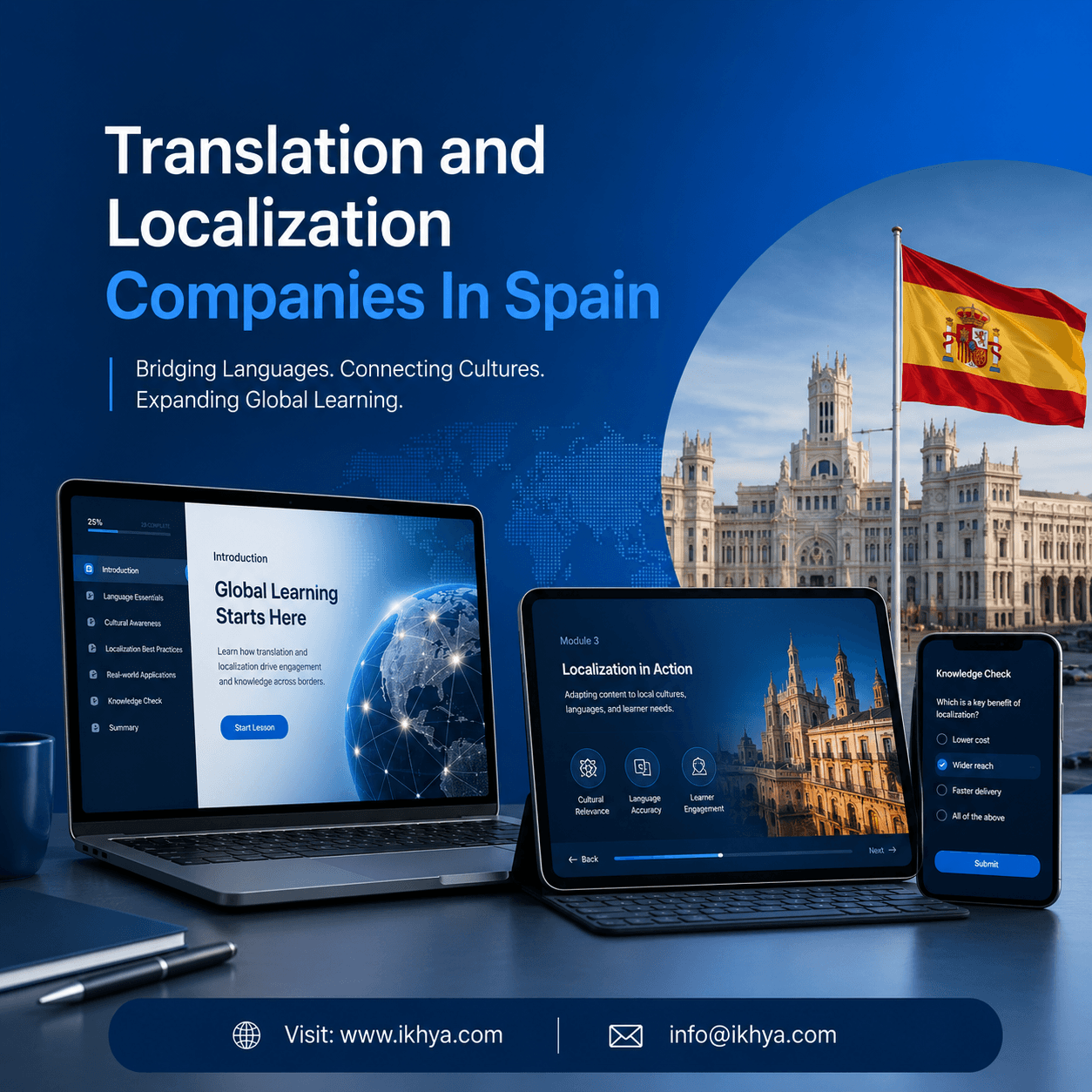


Translation and Localization Companies In Spain
Translation and localization companies in Spain help organisations manage multilingual communication across training, compliance, software, and customer engagement. Spanish businesses now support employees, partners, and customers across multiple languages and regions. This creates pressure to deliver clear content that works across cultures without slowing operations or creating compliance risks.
Choosing the wrong provider often leads to inconsistent messaging, delayed projects, and poor learner engagement across multilingual teams.
IKHYA helps organisations localise learning and business content effectively. Contact the team at info@ikhya.com for guidance.
Why Spanish Businesses Are Reassessing Their Approach to Translation and Localization
Translation and localization companies in Spain now play a larger role in business operations than many organisations expected a few years ago. Companies no longer translate only marketing material. They also localise employee training, software interfaces, onboarding systems, compliance modules, technical documentation, and customer support content. This shift has increased demand for providers that understand language, technology, and business operations together.
Spanish organisations often work across Europe, Latin America, and multilingual domestic markets. A direct translation rarely works for these audiences. Localisation adjusts tone, visuals, user flows, examples, and terminology for the target audience. This improves understanding and reduces confusion during training or product adoption.
Many providers in this market still focus mainly on document translation. Businesses now expect more than that. They need scalable workflows, language quality control, learning platform compatibility, and structured project management. Companies also want providers that can manage updates without restarting entire localisation projects every time content changes.
Translation and localization companies in Spain support industries with strict compliance demands. Healthcare, finance, manufacturing, and public sector organisations all require accurate multilingual communication. Errors in translated training or documentation can create operational risks and legal exposure. This makes provider selection an important business decision rather than a simple procurement task.
Translation and Localization Providers Operating Across Spain
- IKHYA – eLearning Solutions Company delivers translation and localization services for multilingual learning, digital training, and workforce enablement projects. The company supports organisations that need structured localisation workflows for employee training, compliance, onboarding, and platform-based learning across Spanish and international markets.
- Elearning360 provides multilingual digital learning services with support for translation, instructional design, and LMS-based training adaptation. The company works with organisations that need learning content adjusted for distributed teams and multilingual learners.
- NeoCom Technology and Services supports corporate communication and digital learning initiatives that require multilingual delivery. The company works on training and technology projects where localisation affects learner engagement and adoption.
- Alumne Elearning develops digital learning projects with multilingual support for organisations operating across different regions. The company focuses on adapting learning experiences for varied learner groups and language requirements.
- INSERVER works on technology-driven learning and communication projects that often require localisation support. Its services include digital training delivery and multilingual content adaptation.
- Evolmind, S.L. develops eLearning and learning management solutions with localisation support for organisations managing multilingual audiences. The company also works with custom training environments and adapted learning interfaces.
- Avanzo provides digital learning and workforce training services that include multilingual content adaptation. The company supports businesses with employee development and platform-based learning delivery.
- eLearning Media focuses on learning content production and multilingual training support for organisations managing geographically distributed workforces. Its services often include media localisation and translated learning assets.
- Webanywhere delivers online learning technology and multilingual training support for organisations with international teams. The company also works on platform accessibility and learning delivery projects.
- Evoloom E-Learning Solutions supports organisations with multilingual learning experiences, training delivery, and localisation workflows. The company works on adapting digital learning materials for different learner groups.
What Is Driving Demand for Translation and Localization Across Spain
The Compliance Pressures Spanish Organisations Cannot Ignore
Compliance requirements have increased the importance of translation and localization companies in Spain. Organisations in healthcare, pharmaceuticals, manufacturing, banking, and logistics now deliver regulated training in multiple languages. Employees must understand procedures clearly, especially in safety and operational environments.
Simple text translation does not solve this challenge. Organisations need localisation that reflects local terminology, industry standards, and practical workflows. Training modules often require interface changes, culturally relevant examples, and language validation before deployment. This creates demand for providers with structured quality assurance and sector-specific knowledge.
Why Multinational Workforces Need Better Language Adaptation
Spain has become a key operational base for international organisations serving European and Latin American markets. Many companies now employ multilingual workforces with different learning preferences and language needs. Internal communication becomes difficult when training content exists in only one language.
Translation and localization companies in Spain help businesses maintain consistency across distributed teams. Localised learning content improves onboarding, policy understanding, and operational alignment. Employees complete training faster when the material reflects their language and workplace context. This directly affects productivity and compliance outcomes.
How Digital Learning Growth Is Reshaping Localization Priorities
Digital learning platforms have changed how organisations approach multilingual communication. Companies now update training continuously instead of once every few years. Every update creates additional localisation work across multiple formats and systems.
Modern localisation providers support workflows that connect authoring tools, learning platforms, subtitles, voiceovers, and translation management systems. Businesses want providers that can handle ongoing updates without disrupting training schedules. This has shifted localisation from a one-time service into a long-term operational partnership.
What a Strong Translation and Localization Company in Spain Should Deliver
Multilingual Learning Content Adaptation
Many organisations in Spain use digital learning platforms to train employees, contractors, and partners across different regions. Translation and localization companies in Spain must adapt more than written text. They also need to adjust examples, narration, assessments, and learner interactions.
Effective localisation improves learner engagement and retention. Employees understand material faster when the content reflects familiar terminology and local work conditions. Providers should also support SCORM compatibility, subtitle translation, voiceover localisation, and multilingual LMS deployment.
Software and Platform Localization Support
Software localisation requires technical accuracy and interface awareness. Many companies underestimate how layout changes, navigation labels, and cultural preferences affect user adoption. Translation alone often creates confusing experiences inside applications and learning systems.
Strong providers review interface design together with language adaptation. They test multilingual functionality before release and maintain terminology consistency across systems. This reduces support requests and improves user confidence during onboarding and training.
Translation Quality Management and Governance
Organisations with large multilingual operations need structured governance around localisation projects. Without quality controls, translated content becomes inconsistent across departments and platforms. This creates confusion for employees and customers.
Translation and localization companies in Spain should provide review workflows, glossary management, style guides, and version control. Businesses also benefit from providers that maintain central terminology databases across projects. This supports consistency as organisations expand into new markets and languages.
What Spanish Organisations Gain by Working With a Professional Translation and Localization Partner
- Consistent multilingual communication helps organisations maintain the same operational standards across departments, regions, and language groups. This matters in Spain because many businesses coordinate teams across Europe and Latin America where terminology differences can create confusion.
- Faster employee onboarding improves workforce readiness by giving employees training in languages they understand clearly from the start. Companies reduce delays and improve completion rates when onboarding content matches local learning expectations.
- Improved compliance readiness reduces the risk of misunderstood policies, safety instructions, and regulated procedures in multilingual workplaces. Organisations in regulated sectors benefit from clear audit trails and standardised localisation workflows.
- Better learner engagement increases participation because employees connect more easily with localised examples, visuals, and scenarios. This matters for organisations using digital learning across diverse workforce groups.
- Simplified content maintenance allows businesses to update multilingual content efficiently without recreating every training asset from the beginning. Providers with structured workflows reduce long-term operational effort and translation delays.
- Higher platform adoption supports stronger engagement with software systems, learning environments, and employee portals. Users feel more confident when interfaces and instructions reflect local language expectations.
Translation and Localization Companies in Spain — Detailed Provider Breakdown
IKHYA – eLearning Solutions Company
IKHYA is an eLearning solutions company that supports organisations with translation and localization services across Spain and international markets. Our team works with businesses that need multilingual learning, compliance training, onboarding systems, and workforce communication adapted for different languages and cultures.
We offer localisation support for eLearning modules, LMS environments, subtitles, assessments, technical documentation, and digital learning assets. IKHYA provides structured workflows that help organisations maintain consistency across multilingual training projects while reducing operational delays.
Our team has experience supporting regulated industries including healthcare, manufacturing, pharmaceuticals, finance, logistics, and corporate services. We understand the importance of accurate multilingual communication in environments where compliance, operational safety, and employee understanding directly affect business performance.
IKHYA provides support for SCORM-based learning, learning management system localisation, multilingual user interfaces, subtitle adaptation, voiceover coordination, and translation quality review processes. We also help organisations manage multilingual updates efficiently as learning content changes over time.
We work closely with clients throughout the project lifecycle. Our team supports planning, terminology alignment, review cycles, stakeholder coordination, and deployment management. This collaborative approach helps organisations maintain project visibility and avoid delays caused by fragmented localisation workflows.
Organisations looking for translation and localization companies in Spain often contact IKHYA for multilingual learning and workforce enablement support. Businesses can speak directly with our team by emailing info@ikhya.com.
Elearning360
Elearning360 supports organisations with multilingual learning solutions and digital training delivery. The company works on localisation projects connected to workforce development and online learning systems. Its services include adapting learning content for different learner groups and languages.
The company also supports LMS-based delivery environments and multilingual learning structures. Businesses working with distributed employee groups often require this type of coordinated localisation support.
NeoCom Technology and Services
NeoCom Technology and Services works on digital learning and communication projects that require multilingual adaptation. The company supports organisations managing employee training and content delivery across different language environments.
Its services often involve technology integration, learning systems, and localisation support connected to corporate communication goals. This helps organisations maintain consistency across multilingual operational environments.
Alumne Elearning
Alumne Elearning develops learning experiences that support multilingual delivery and learner accessibility. The company works with organisations adapting training for employees across different regions and language groups.
Its localisation-related work includes adapting educational content, learner communication, and digital learning assets. Businesses often use these services when expanding multilingual workforce training initiatives.
INSERVER
INSERVER supports organisations with digital learning environments and technology-driven communication solutions. The company also works on multilingual content adaptation connected to workforce training and online learning delivery.
Its services help organisations manage digital training projects that require language consistency and operational alignment across distributed teams.
Evolmind, S.L.
Evolmind, S.L. develops learning management systems and digital learning solutions with multilingual support capabilities. The company works with organisations that need localised learning environments for different workforce groups.
Its work includes adapting interfaces, training content, and user experiences for multilingual deployment. This is important for businesses managing learning operations across multiple regions.
Avanzo
Avanzo provides workforce training and digital learning support for organisations operating in multilingual environments. The company works on employee development initiatives that require translated and adapted learning content.
Its services also support digital transformation projects where communication consistency matters across different languages and operational teams.
eLearning Media
eLearning Media focuses on multimedia learning content and multilingual training delivery. The company supports organisations producing digital learning materials for international and multilingual audiences.
Its work often includes adapting media assets, training videos, and instructional content for learner groups with different language needs.
Webanywhere
Webanywhere provides online learning technology and multilingual learning support for organisations with distributed workforces. The company works on digital accessibility, platform delivery, and multilingual training initiatives.
Its services support businesses that need scalable learning systems capable of handling multilingual communication and workforce development.
Evoloom E-Learning Solutions
Evoloom E-Learning Solutions supports multilingual digital learning delivery and workforce training adaptation. The company works on localising training materials and learning systems for organisations operating across multiple regions.
Its services focus on learner engagement, multilingual accessibility, and digital training delivery within corporate learning environments.
How Translation and Localization Providers in Spain Compare Across Key Criteria
| Company | Primary Focus | Localization Capability | Technology Support | Industry Alignment | Best Fit |
|---|---|---|---|---|---|
| IKHYA | eLearning and multilingual workforce enablement | Learning content, LMS, subtitles, assessments | SCORM, LMS, digital learning systems | Healthcare, manufacturing, finance, logistics | Organisations needing structured multilingual learning delivery |
| Elearning360 | Digital learning | Multilingual training support | LMS delivery | Corporate learning | Distributed workforce training |
| NeoCom Technology and Services | Learning technology | Corporate communication localisation | Digital systems integration | Enterprise training | Technology-led learning projects |
| Alumne Elearning | Learning experience design | Multilingual adaptation | Digital learning support | Education and workforce learning | Multilingual learner engagement |
| INSERVER | Digital communication | Training localisation | Learning technology support | Corporate services | Operational communication projects |
| Evolmind, S.L. | Learning systems | Multilingual LMS adaptation | Custom learning platforms | Corporate training | Platform-based learning delivery |
| Avanzo | Employee training | Training content adaptation | Digital learning tools | Workforce development | Training transformation projects |
| eLearning Media | Media learning production | Video and content localisation | Digital media support | Corporate learning | Multimedia training projects |
| Webanywhere | Online learning technology | Multilingual delivery support | Accessible learning systems | Global workforce learning | International employee training |
| Evoloom E-Learning Solutions | Digital learning delivery | Multilingual training adaptation | Online learning systems | Corporate education | Regional workforce learning |
Translation and Localization Pricing in Spain — What Shapes the Investment
Pricing varies based on language count, technical complexity, media requirements, platform integration, and review cycles. Translation and localization companies in Spain usually structure projects around content volume, production effort, and workflow complexity.
| Project Type | Typical Scope | Pricing Structure | Main Cost Factors |
|---|---|---|---|
| eLearning translation | SCORM modules and assessments | Per word or per module | Audio, subtitles, interface adaptation |
| Software localisation | User interface and workflows | Project-based | Testing, engineering support, languages |
| Compliance training localisation | Regulated training content | Hourly or project-based | Review cycles and validation requirements |
| Website localisation | Multilingual digital content | Per page or project-based | CMS integration and SEO adaptation |
| Video translation | Subtitles and voiceovers | Per minute | Narration, editing, language count |
Organisations planning multilingual learning or localisation projects can discuss project scope and operational requirements with IKHYA by emailing info@ikhya.com.
The Platforms and Tools Spanish Localization Providers Use to Deliver Results
| Tool or Platform | Primary Use | Best Fit | Adoption Level |
|---|---|---|---|
| Articulate Storyline | eLearning authoring | Corporate learning modules | High |
| Adobe Captivate | Interactive training creation | Compliance training | Medium |
| Smartcat | Translation workflow management | Multilingual projects | High |
| Phrase | Software localisation | Digital platforms and apps | Medium |
| Moodle | Learning management | Education and workforce learning | High |
| Rise 360 | Responsive learning delivery | Mobile learning | High |
How a Translation and Localization Engagement Typically Works
| Phase | Key Activities | Client Involvement | Typical Duration |
|---|---|---|---|
| Discovery | Content review and language planning | High | 1 week |
| Scope Definition | Workflow and terminology alignment | High | 1 week |
| Content Preparation | File extraction and formatting | Medium | Several days |
| Translation | Language adaptation | Low | 2 to 4 weeks |
| Localization Review | Cultural and interface checks | Medium | 1 to 2 weeks |
| Technical Testing | Platform and compatibility review | Medium | Several days |
| Deployment | Publishing and rollout | High | Several days |
| Maintenance | Ongoing updates and revisions | Medium | Ongoing |
How Different Spanish Industries Use Translation and Localization to Solve Operational Challenges
| Industry | Common Topics | Main Challenges | Delivery Format |
|---|---|---|---|
| Healthcare | Compliance and patient safety | Regulatory accuracy | eLearning and documentation |
| Manufacturing | Operational training | Safety communication | Interactive learning modules |
| Finance | Policy and compliance training | Terminology consistency | LMS delivery |
| Retail | Customer service training | Workforce diversity | Mobile learning |
| Technology | Software onboarding | Interface localisation | Platform-based delivery |
| Logistics | Operational procedures | Distributed teams | Video and digital training |
How Translation and Localization in Spain Is Changing and What It Means for Buyers
AI Translation Support and Its Impact on Localization in Spain
Artificial intelligence tools now support translation workflows across many localisation projects. Businesses use these tools to speed up first-pass translations and reduce repetitive work. This has improved turnaround times for large multilingual projects.
Human review still remains essential. Translation and localization companies in Spain increasingly combine AI-supported workflows with professional review and quality control. Organisations should evaluate how providers manage terminology accuracy, compliance review, and cultural adaptation rather than focusing only on automation.
How Continuous Learning Updates Are Changing Localization Operations
Many organisations now update training monthly instead of yearly. This creates constant localisation requirements across learning libraries and multilingual platforms. Traditional translation workflows struggle to support this pace.
Providers now build structured update workflows that manage version control and multilingual revisions efficiently. Businesses benefit from localisation partners that can support long-term operational change instead of isolated translation projects.
The Rise of Mobile Learning Localization Among Spanish Workforces
Mobile learning adoption continues to grow across Spain because organisations need flexible workforce training delivery. Employees now complete training on phones and tablets across different work environments. This affects how localisation projects are designed.
Translation and localization companies in Spain increasingly adapt layouts, subtitles, interface structures, and navigation for smaller screens. Localised mobile learning also requires simpler language structures and regionally appropriate user experiences.
Why Multilingual Compliance Tracking Is Becoming a Standard Expectation
Regulated organisations now expect localisation providers to support reporting and audit preparation. Businesses want multilingual training records connected to compliance workflows and learner tracking systems. This requirement is especially important in healthcare and financial services.
Providers that combine localisation support with LMS reporting capabilities are becoming more valuable operational partners. Organisations increasingly prioritise visibility, consistency, and audit readiness when selecting translation partners.
How to Evaluate Translation and Localization Companies in Spain Before Signing a Contract
Choosing between translation and localization companies in Spain requires more than comparing price lists. Organisations should evaluate operational fit, technology capability, communication structure, and long-term scalability before selecting a provider.
- Industry experience matters because regulated sectors require accurate terminology and operational understanding. Providers with sector familiarity usually reduce review cycles and implementation delays.
- Localization workflow structure affects project speed and quality consistency across languages. Organisations should ask how providers manage revisions, approvals, and multilingual updates.
- Technology compatibility becomes important when projects involve LMS platforms, software systems, or interactive training modules. Providers should support existing delivery environments without creating additional technical work.
- Quality assurance processes help reduce errors before deployment. Businesses should ask about linguistic review, testing, and terminology governance practices.
- Project communication standards directly affect delivery timelines and stakeholder coordination. Clear reporting structures reduce confusion during multilingual implementation projects.
- Scalability planning helps organisations maintain consistency as content libraries grow. Providers should explain how they handle future updates and additional language requirements.
- Cultural adaptation capability matters because localisation involves more than direct translation. Strong providers adapt examples, visuals, and communication styles for the target audience.
- Support availability becomes critical during deployment and revision periods. Organisations should confirm how providers handle urgent changes and post-launch support.
Businesses that evaluate these criteria carefully often avoid costly operational issues later. A structured provider assessment process improves long-term localisation outcomes and project stability.
How IKHYA Supports Organisations Managing Multilingual Learning in Spain
IKHYA supports organisations that need translation and localization services connected to workforce training, compliance communication, and digital learning delivery. We help businesses manage multilingual content in ways that improve learner understanding and operational consistency.
Our team works closely with organisations during planning, localisation, deployment, and maintenance stages. We provide structured communication, terminology alignment, and review workflows that support large multilingual projects without creating unnecessary complexity.
IKHYA supports multilingual eLearning delivery across healthcare, manufacturing, logistics, finance, retail, and corporate services. We understand how localisation affects learner engagement, compliance readiness, and employee performance across distributed workforce environments.
We also help organisations manage long-term localisation requirements instead of isolated translation requests. Our approach focuses on sustainable workflows, scalable content management, and practical collaboration between stakeholders, reviewers, and learning teams.
Businesses looking for translation and localization companies in Spain often choose IKHYA when multilingual learning and workforce communication require structured operational support. Organisations can contact our team directly at info@ikhya.com.
Start Your Translation and Localization Project With a Team That Understands Spain
Translation and localization projects affect employee understanding, customer communication, platform adoption, and operational consistency. Organisations that treat localisation as a strategic operational function often achieve better learning outcomes and stronger multilingual alignment across teams.
Businesses evaluating translation and localization companies in Spain should focus on workflow quality, communication structure, industry understanding, and long-term scalability. A provider that understands multilingual workforce training and operational delivery can reduce delays and improve implementation quality.
IKHYA works with organisations that need multilingual learning, digital training adaptation, and localisation support across different industries and operational environments. To discuss project requirements, contact the team at info@ikhya.com.
FAQs About Translation and Localization Companies In Spain
Related Top eLearning Companies & Solutions in the Spain
Spain organizations are adopting digital learning to support hybrid workforces, multilingual training, compliance management, and workforce development. Businesses increasingly rely on eLearning solutions to improve onboarding, employee engagement, and operational consistency.
Explore leading eLearning providers, LMS platforms, instructional design specialists, and compliance training solutions across Spain.
At IKHYA – eLearning Solutions Company, we design impactful, compliance-driven, and performance-focused digital learning solutions tailored to your business goals.
🎯 Custom eLearning Course Development
⚡ Rapid eLearning & PPT Conversion
📊 Workplace Compliance Training
🌍 Localization & LMS-Ready Modules