
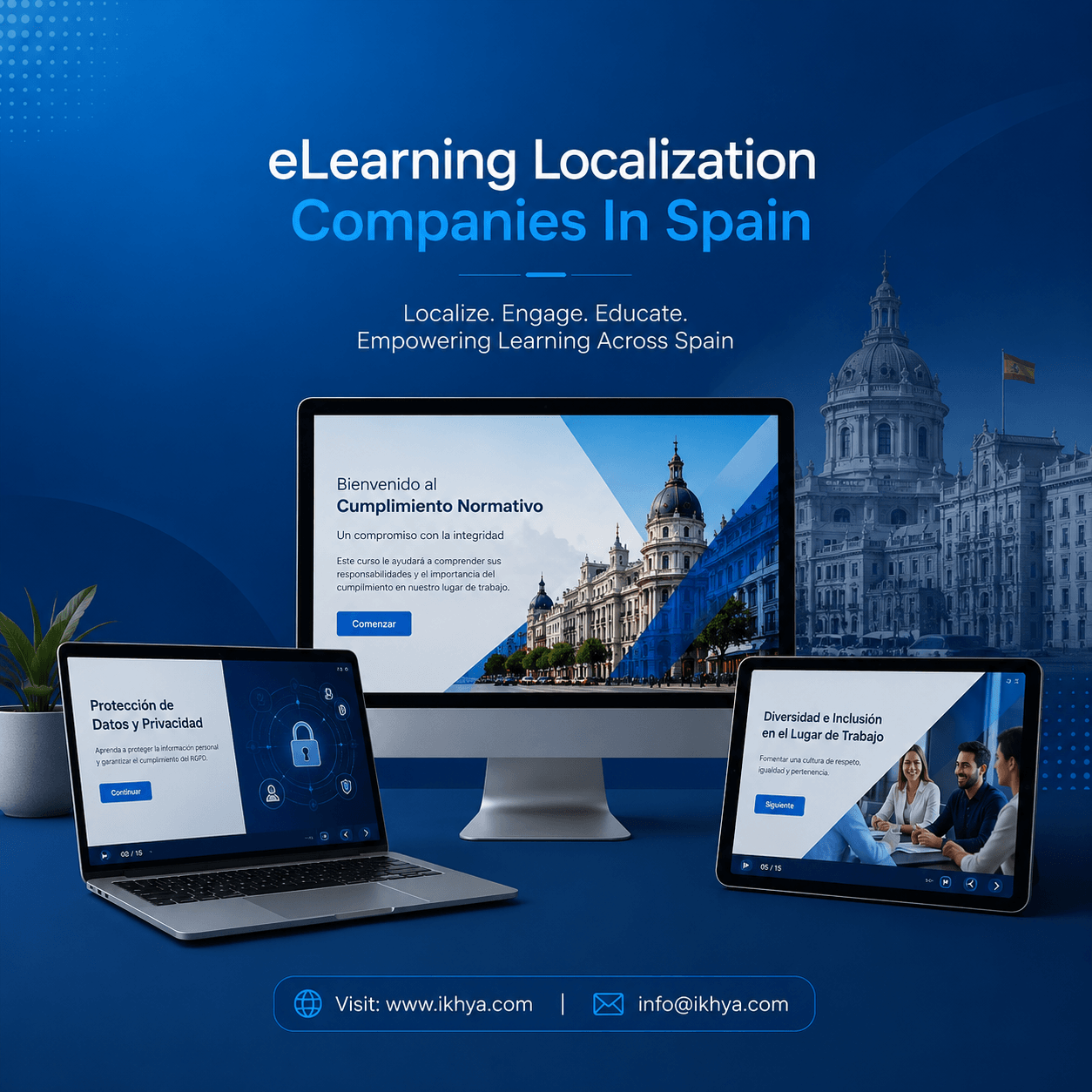



eLearning Localization Companies In Spain
eLearning localization companies in Spain are helping organisations deliver training that works across languages, regions, and workforce groups. Spanish businesses now support employees, partners, and customers in multiple markets, which creates pressure to adapt digital learning content accurately. Localisation is no longer limited to translation alone. Companies now need learning content adjusted for culture, compliance rules, learner behaviour, and platform usability across Spanish-speaking and multilingual environments.
Choosing the wrong localisation partner can delay training rollouts, weaken learner engagement, and create compliance risks across regulated sectors.
IKHYA helps organisations localise digital learning content for Spanish audiences. Contact the team directly at info@ikhya.com.
Why Spanish Businesses Are Changing Their Approach to eLearning Localization
eLearning localization companies in Spain now play a larger role in corporate training strategy than they did before. Businesses across Spain operate in multilingual environments where employees speak Spanish, Catalan, Basque, English, and other regional or international languages. Companies also serve global teams, which means training content must work across different cultural and legal contexts. This has increased demand for providers that can localise digital learning content without reducing training quality.
Many organisations first treated localisation as a direct translation task. That approach often failed because translated content did not match local learner expectations. Learners struggled with unfamiliar examples, poorly adapted visuals, and incorrect terminology. Training completion rates dropped, and compliance teams spent more time correcting mistakes. Spanish organisations now expect localisation companies to redesign learning experiences, not simply replace text.
Regulated industries in Spain face even greater pressure. Financial services firms, healthcare companies, logistics providers, and manufacturers must deliver accurate training records and consistent learner outcomes. Localisation mistakes can create audit problems and employee confusion. This is why many businesses now evaluate eLearning localization companies in Spain based on instructional design skills, quality control methods, and LMS compatibility instead of translation capacity alone.
The growth of remote work also changed localisation requirements. Employees now access training on phones, tablets, and desktop systems across multiple locations. Learning content must remain consistent across devices and languages. Organisations therefore need localisation partners that understand accessibility, responsive learning design, SCORM packaging, subtitle integration, and multilingual LMS deployment.
eLearning Localization Providers Operating Across Spain
- IKHYA – eLearning Solutions Company provides multilingual learning localisation services for organisations operating across Spain and international markets. The company supports instructional design adaptation, LMS compatibility, multimedia localisation, subtitle integration, voiceover production, and compliance-focused learning delivery. IKHYA also works closely with client teams to align localisation projects with operational goals and learner performance targets.
- Elearning360 supports businesses that need digital learning content translated and adapted for multilingual employee groups. The company works on online course localisation, LMS integration, and training deployment projects. Its services are often used by organisations introducing learning programmes across multiple departments and geographic regions.
- NeoCom Technology and Services focuses on digital transformation and online learning support for enterprise environments. The company handles multilingual learning projects alongside technology implementation and platform management. Businesses often engage NeoCom when localisation needs connect directly to wider workforce training systems.
- Evolmind, S.L. develops digital learning solutions that support multilingual content delivery and learner engagement. The company works with educational institutions and businesses requiring online course adaptation for Spanish-speaking audiences. Its work also includes learning platform customisation and training resource development.
- INSERVER provides eLearning production and localisation support for organisations delivering training across different markets. The company supports multimedia adaptation, learning content updates, and digital learning deployment. Businesses often use these services when expanding training access to multilingual employee populations.
- Alumne Elearning creates learning experiences that combine instructional design, localisation support, and learner engagement strategies. The company works with businesses and educational providers adapting content for Spanish audiences. Its projects often include interactive learning modules and online assessment tools.
- Avanzo delivers digital learning and workforce training services for enterprise organisations. The company supports multilingual learning delivery and content adaptation across sectors such as retail, telecommunications, and professional services. Its services also include LMS management and learning analytics.
- eLearning Media focuses on multimedia learning production and localisation services for corporate training programmes. The company develops adapted learning materials using video, animation, voiceover, and interactive content formats. Businesses often engage eLearning Media when visual learning consistency matters across languages.
- Webanywhere supports organisations with online learning systems, accessibility services, and multilingual training delivery. The company works with clients needing scalable learning access for distributed workforces. Its projects often include platform accessibility adjustments alongside localisation support.
- Evoloom E-Learning Solutions provides online training development and localisation support for businesses operating in multilingual environments. The company works on digital course adaptation, learner engagement planning, and training deployment support. Its services are commonly used for workforce onboarding and skills development programmes.
What Is Driving Demand for eLearning Localization Across Spanish Organisations
How Workforce Diversity Is Changing Learning Delivery in Spain
Spanish organisations now employ people from different linguistic and cultural backgrounds across both local and international operations. This shift affects how companies deliver compliance training, onboarding programmes, technical instruction, and leadership development. Standardised English-only training often creates learner confusion and weak engagement. Employees complete courses without fully understanding policies or operational expectations.
eLearning localization companies in Spain help organisations solve this problem by adapting learning content for specific learner groups. This process includes rewriting scenarios, adjusting examples, localising terminology, and redesigning visual assets. Localisation teams also adapt narration speed, subtitles, and interface language to improve accessibility. Businesses that invest in proper localisation usually see stronger learner participation and fewer support requests after training deployment.
Compliance Requirements That Spanish Businesses Cannot Ignore
Compliance-focused sectors in Spain must prove that employees understand mandatory training content. Industries such as healthcare, manufacturing, logistics, aviation, and finance face strict documentation and reporting requirements. If employees misunderstand translated training material, businesses risk operational mistakes and audit problems. Simple text translation rarely provides enough protection in these environments.
Localisation providers now support regulated organisations by combining translation accuracy with instructional design review. Teams verify terminology, regional legal references, and learner assessment quality before deployment. They also test multilingual learning modules inside LMS environments to confirm reporting consistency. This level of quality control has become a key selection factor when organisations evaluate eLearning localization companies in Spain.
Remote and Hybrid Workforces Require Flexible Learning Content
Remote work expanded rapidly across Spain, especially among technology firms, service providers, and multinational organisations. Employees now access learning content from different devices, time zones, and office locations. This has increased demand for responsive multilingual learning systems that work consistently across mobile and desktop environments.
Localisation providers now adapt courses for flexible access rather than fixed classroom delivery. They optimise subtitles, mobile layouts, navigation structures, and downloadable resources to support distributed teams. Organisations also need localisation partners capable of updating content quickly as business policies change. Companies unable to adapt learning content efficiently often struggle to maintain training consistency across regions.
What Organisations Should Expect From eLearning Localization Companies in Spain
Learning Content Adaptation Beyond Translation
Strong localisation providers do more than replace source language text with Spanish equivalents. They adjust course structure, rewrite scenarios, and review learner interaction design to improve understanding. This process helps organisations avoid confusing or culturally disconnected training experiences. Employees engage more effectively when learning content feels relevant to their environment.
Many eLearning localization companies in Spain now involve instructional designers directly in localisation workflows. These specialists review learning objectives, assessment logic, and visual communication choices before release. They also adapt examples for regional industries and workforce expectations. Businesses gain more consistent learner outcomes because the content supports local operational realities instead of generic global assumptions.
Multilingual LMS Integration and Technical Support
Technical compatibility matters just as much as language quality during localisation projects. Businesses often use LMS platforms with SCORM, xAPI, or custom reporting structures that require careful adaptation. If localisation teams ignore technical requirements, organisations may lose learner progress records or reporting accuracy.
Professional providers test multilingual learning modules across devices and LMS environments before launch. They review navigation behaviour, subtitle rendering, mobile responsiveness, and learner tracking functionality. Organisations therefore reduce the risk of deployment problems after rollout. Technical support also becomes important when businesses update courses regularly across multiple languages.
Quality Assurance and Review Management
Quality control is a major factor separating experienced localisation providers from basic translation agencies. Effective review workflows include linguistic checks, instructional review, technical testing, and stakeholder approval processes. Without structured review systems, organisations often discover errors only after deployment.
Leading providers build review checkpoints into every project stage. They assign language reviewers, LMS testers, instructional specialists, and project managers to verify consistency before release. This reduces correction costs later in the process. Businesses also gain better visibility into timelines, revision cycles, and deployment readiness throughout the project lifecycle.
How the Right Localization Partner Improves Training Outcomes in Spain
- Higher learner engagement comes from content designed around local language patterns, familiar examples, and culturally relevant visuals. Employees understand training more quickly and spend less time repeating modules, which improves workforce productivity across distributed teams.
- Stronger compliance reporting helps organisations maintain accurate learner records across multilingual training environments. This matters for regulated sectors in Spain where businesses must prove that employees completed and understood mandatory learning programmes.
- Faster international rollout allows organisations to launch training across different markets without rebuilding learning systems repeatedly. Companies can maintain consistent operational standards while adapting delivery for regional learner needs.
- Better knowledge retention develops when learners interact with training material that reflects their working environment and terminology. Employees apply training more confidently because the learning experience feels directly connected to daily tasks.
- Reduced support requests result from clearer instructions, better navigation, and more accurate terminology inside multilingual courses. HR and training teams spend less time answering basic learner questions after deployment.
- More efficient content updates become possible when localisation workflows include structured review systems and reusable learning assets. Organisations can revise policies or product information without restarting entire localisation projects.
eLearning Localization Companies in Spain — Provider Profiles and Capabilities
IKHYA – eLearning Solutions Company
IKHYA is an eLearning solutions company that supports organisations needing multilingual training delivery across Spain and international markets. Our team works with businesses that require learning localisation, instructional design adaptation, LMS integration, and compliance-focused digital learning support. We support organisations across corporate, education, healthcare, finance, manufacturing, and technology sectors.
We offer localisation services that go beyond direct translation. IKHYA provides multilingual course adaptation, subtitle localisation, voiceover coordination, multimedia redesign, SCORM packaging, xAPI support, and learner experience optimisation. Our team also reviews cultural alignment, terminology consistency, and assessment quality before deployment.
IKHYA supports organisations operating in regulated environments where training accuracy matters. We work with businesses that need multilingual onboarding, operational compliance training, product education, and workforce development programmes. Our experience includes supporting industries that manage strict reporting standards and multilingual employee populations across Spain.
We provide platform support across different LMS environments and digital learning ecosystems. Our team works with responsive learning design, mobile compatibility testing, multilingual navigation structures, and accessibility-focused delivery models. We also help organisations maintain reporting consistency across translated learning modules.
IKHYA works closely with client stakeholders throughout each project phase. We use structured review cycles, milestone planning, collaborative feedback management, and transparent communication processes. This helps organisations maintain control over localisation quality, timelines, and deployment expectations without unnecessary delays.
Our team supports organisations from project planning through post-launch optimisation. Businesses looking for eLearning localization companies in Spain can contact IKHYA directly at info@ikhya.com to discuss learning localisation requirements and multilingual training goals.
Elearning360
Elearning360 supports organisations developing multilingual digital learning programmes for distributed employee groups. The company works on localisation, instructional design adaptation, and LMS support across different training environments. Its services often focus on helping businesses improve learner accessibility and multilingual content delivery.
NeoCom Technology and Services
NeoCom Technology and Services combines technology consulting with digital learning implementation support. The company works with organisations managing enterprise training systems and multilingual learning delivery projects. Its services include learning platform management, localisation coordination, and workforce learning support.
Evolmind, S.L.
Evolmind, S.L. develops online learning solutions for educational and business environments that require multilingual accessibility. The company supports course adaptation, platform configuration, and learner engagement planning. Its localisation work often connects directly to wider digital education initiatives.
INSERVER
INSERVER supports businesses that need multilingual digital learning production and deployment services. The company works on learning content adaptation, multimedia updates, and training implementation support. Organisations often use its services when expanding employee learning programmes across different markets.
Alumne Elearning
Alumne Elearning focuses on instructional design, online course development, and multilingual learning support. The company helps organisations adapt digital learning experiences for Spanish-speaking learners and regional workforce groups. Its projects commonly include interactive content and learner assessment development.
Avanzo
Avanzo provides enterprise training support through digital learning development and multilingual content delivery services. The company works with organisations needing scalable learning management and workforce training deployment. Its localisation services support businesses operating across multiple regions and languages.
eLearning Media
eLearning Media specialises in multimedia learning production and adapted digital training content. The company supports organisations using video, animation, and interactive learning formats in multilingual environments. Businesses often engage the provider when visual consistency matters across translated learning assets.
Webanywhere
Webanywhere supports organisations that need accessible digital learning systems and multilingual training delivery. The company works on LMS implementation, accessibility support, and online learning scalability. Its services are often used by businesses managing large remote learner populations.
Evoloom E-Learning Solutions
Evoloom E-Learning Solutions develops multilingual online training content for corporate and workforce learning environments. The company supports localisation planning, learning deployment, and learner engagement projects. Organisations often use these services for onboarding, skills development, and operational training initiatives.
How Spain eLearning Localization Companies Compare Across Key Criteria
| Company | Primary Focus | Localization Support | LMS Capabilities | Best Fit | Industry Coverage |
|---|---|---|---|---|---|
| IKHYA | Full-service eLearning localisation | Translation, adaptation, QA, multimedia | SCORM, xAPI, multilingual LMS | Enterprise and regulated sectors | Healthcare, finance, manufacturing, education |
| Elearning360 | Digital learning delivery | Multilingual content support | LMS deployment support | Corporate training teams | Business services and education |
| NeoCom Technology and Services | Technology and training systems | Enterprise localisation projects | Platform management | Large organisations | Technology and corporate services |
| Evolmind, S.L. | Digital education | Course adaptation | Learning platform support | Education providers | Education and professional training |
| INSERVER | Learning production | Multimedia localisation | Deployment support | Operational training | Corporate training environments |
| Alumne Elearning | Instructional design | Spanish audience adaptation | Interactive learning support | Employee training programmes | Education and business training |
| Avanzo | Enterprise learning | Multilingual delivery | LMS management | Distributed workforces | Retail, telecom, services |
| eLearning Media | Multimedia learning content | Voiceover and video localisation | Interactive media support | Visual training projects | Corporate communications |
| Webanywhere | Accessible learning systems | Multilingual accessibility | Remote learning support | Large learner populations | Education and enterprise |
| Evoloom E-Learning Solutions | Online workforce training | Course localisation | Learning deployment support | Onboarding and skills training | Corporate learning |
Understanding eLearning Localization Budgets in Spain
Pricing for localisation projects depends on content complexity, multimedia requirements, LMS compatibility, language combinations, and review processes. Organisations should evaluate pricing alongside quality assurance and technical support instead of focusing only on translation rates.
| Project Type | Typical Scope | Common Pricing Model | Main Cost Drivers |
|---|---|---|---|
| Course translation | Text-based modules | Per word or per course | Language volume and review cycles |
| Multimedia localisation | Video, subtitles, voiceover | Per minute of content | Studio work and editing complexity |
| LMS localisation | Platform adaptation | Project-based pricing | System integration requirements |
| Compliance training adaptation | Regulated content | Custom project pricing | Validation and legal review |
| Interactive learning localisation | Scenario-based learning | Module-based pricing | Animation and interactivity updates |
Organisations planning multilingual learning programmes can discuss localisation scope and budget expectations directly with IKHYA at info@ikhya.com.
The Platforms and Tools Spain eLearning Localization Companies Use
| Tool or Platform | Primary Use | Best Fit | Adoption Level |
|---|---|---|---|
| Articulate Storyline | Interactive course development | Corporate training | High |
| Adobe Captivate | Responsive learning content | Technical learning | Moderate |
| Moodle | Open-source LMS delivery | Education and enterprise | High |
| Rise 360 | Mobile learning development | Rapid deployment | High |
| Smartcat | Translation workflow management | Multilingual localisation | Moderate |
| Vyond | Animated learning videos | Visual training content | Moderate |
The eLearning Localization Delivery Process Explained
| Phase | Key Activities | Client Involvement | Typical Duration |
|---|---|---|---|
| Discovery | Review content and objectives | Stakeholder briefing | 1 week |
| Content Audit | Assess files and formats | Asset sharing | 1 week |
| Localization Planning | Define workflow and languages | Approval process review | 1 week |
| Translation | Adapt written learning content | Terminology feedback | 2 to 4 weeks |
| Multimedia Production | Voiceover and subtitle work | Review sessions | 1 to 3 weeks |
| Technical Integration | SCORM and LMS testing | System access support | 1 week |
| Quality Assurance | Language and functionality testing | User acceptance review | 1 week |
| Deployment | Launch and reporting setup | Final approval | Several days |
How Different Spanish Industries Use eLearning Localization
| Industry | Common Training Topics | Main Challenge | Preferred Delivery Format |
|---|---|---|---|
| Healthcare | Patient safety and compliance | Regulatory accuracy | Scenario-based learning |
| Manufacturing | Operational safety | Multilingual workforce access | Mobile learning |
| Finance | Compliance and risk management | Audit readiness | LMS-based modules |
| Retail | Customer service training | High employee turnover | Microlearning |
| Technology | Product and system training | Rapid updates | Interactive eLearning |
| Logistics | Safety and operations | Distributed teams | Multilingual mobile access |
How eLearning Localization in Spain Is Changing for Enterprise Buyers
AI Translation Support and Human Review in Spanish Learning Projects
Artificial intelligence tools now help localisation teams speed up translation workflows and terminology management. Many providers use AI-assisted translation systems to reduce repetitive manual work and accelerate content turnaround times. Businesses often benefit from faster first-draft delivery when large training libraries require localisation across multiple languages.
Human review remains essential because AI systems still miss cultural meaning, compliance context, and learner expectations. eLearning localization companies in Spain increasingly combine automated workflows with instructional design and linguistic review stages. This blended approach improves efficiency while protecting learning quality. Organisations selecting localisation providers should therefore ask how AI tools are monitored and validated before deployment.
Accessibility Standards Are Becoming a Core Requirement
Accessibility now plays a central role in multilingual learning delivery across Spain. Organisations want training content that works for employees with different physical, cognitive, and technical access needs. This includes subtitle support, screen reader compatibility, responsive navigation, and simplified interaction design.
Providers that ignore accessibility requirements often create learning experiences that exclude parts of the workforce. Businesses therefore expect localisation teams to integrate accessibility testing into standard production workflows. This trend is especially visible among public sector organisations and regulated industries where inclusion standards influence procurement decisions.
Microlearning Is Reshaping Localised Workforce Training
Short-form learning modules are becoming more common across Spanish organisations that manage remote or operational workforces. Employees often prefer training delivered in smaller segments that fit into daily work schedules. This has increased demand for multilingual microlearning formats adapted for phones and tablets.
Localisation providers now redesign long training programmes into smaller learning units with simplified navigation and focused learning goals. Businesses benefit because shorter modules are easier to update and localise across multiple languages. Learners also complete training more consistently when content feels manageable and directly relevant.
Data Reporting Expectations Continue to Increase
Spanish organisations increasingly expect localisation projects to support advanced learner analytics and reporting visibility. Businesses want to compare learner engagement, assessment performance, and training completion rates across language groups and regional teams. This creates pressure on localisation providers to maintain technical consistency inside LMS environments.
Modern localisation workflows therefore include reporting validation and multilingual tracking tests before deployment. Providers must confirm that translated learning modules preserve reporting logic and user activity records. Organisations that overlook this requirement often discover inconsistent data after launch, which weakens compliance and workforce analysis efforts.
What to Look for When Selecting an eLearning Localization Partner in Spain
Choosing between eLearning localization companies in Spain requires more than comparing translation prices. Organisations should evaluate technical capability, instructional design experience, review systems, and long-term support models before signing contracts. A strong localisation partner should improve learner outcomes while protecting operational consistency.
- Instructional design involvement ensures localisation decisions support learning goals instead of focusing only on language accuracy. This helps organisations maintain learner engagement and knowledge retention after multilingual rollout.
- Technical LMS expertise allows providers to manage SCORM, xAPI, and multilingual reporting requirements correctly. Businesses reduce deployment risks because localisation teams understand platform compatibility issues.
- Structured quality assurance creates clear review stages for language checks, learner testing, and technical validation. Organisations therefore avoid costly corrections after training launches.
- Industry experience matters because regulated sectors require accurate terminology and compliance awareness. Providers familiar with healthcare, finance, or manufacturing environments usually adapt content more effectively.
- Multimedia localisation support becomes important when organisations use video, animation, or interactive learning content. Businesses should confirm that providers can manage subtitles, narration, and visual redesign requirements.
- Scalable workflows help organisations update training libraries efficiently as policies and products change. This matters for businesses managing large multilingual learning environments.
- Transparent communication improves collaboration during review and deployment stages. Clear project reporting reduces delays and keeps stakeholders aligned throughout the localisation process.
- Post-launch support ensures organisations can update, test, and improve localised content after deployment. Long-term support often becomes critical for businesses with evolving workforce training needs.
Organisations should also request sample workflows, testing methods, and localisation review examples before final selection. Providers that explain processes clearly usually deliver more predictable project outcomes.
How IKHYA Supports Organisations With eLearning Localization in Spain
IKHYA approaches eLearning localisation as a learning performance project rather than a translation task. Our team works closely with organisations to understand workforce structure, learner expectations, compliance requirements, and operational goals before localisation begins. This helps us adapt content in ways that improve understanding and learner participation.
We provide support across instructional design, multilingual adaptation, voiceover coordination, subtitle production, multimedia redesign, and LMS compatibility testing. IKHYA also supports organisations managing multilingual compliance reporting and learner analytics across different training environments. Our workflows include structured review cycles that help organisations maintain quality and consistency throughout deployment.
Our team supports businesses across healthcare, manufacturing, finance, technology, education, logistics, and professional services sectors. We understand that regulated environments require accurate terminology, learner validation, and dependable reporting systems. This is why we include technical and instructional review stages alongside localisation delivery.
IKHYA also focuses on collaboration and transparency during every project stage. We provide milestone planning, revision tracking, stakeholder coordination, and deployment support that helps organisations avoid unnecessary delays. Our team remains involved after launch to support updates, learner feedback analysis, and long-term optimisation planning.
Businesses evaluating eLearning localization companies in Spain can contact IKHYA directly at info@ikhya.com to discuss multilingual training goals, localisation planning, and delivery requirements.
Start Your eLearning Localization Project With a Team That Understands Spain
Spanish organisations now operate in multilingual environments where learning quality directly affects compliance, productivity, and employee performance. Choosing the right localisation partner helps businesses deliver training that employees understand clearly across languages and regional contexts. Strong localisation also improves learner engagement and reduces operational confusion after rollout.
Businesses evaluating eLearning localization companies in Spain should focus on instructional quality, technical compatibility, review systems, and long-term support instead of translation volume alone. A structured localisation process protects training consistency and supports workforce learning goals across distributed teams.
IKHYA works with organisations that need multilingual digital learning adapted for real operational environments. Companies looking for practical guidance on localisation planning, LMS compatibility, or multilingual training delivery can contact the team directly at info@ikhya.com.
FAQs About eLearning Localization Companies In Spain
Related Top eLearning Companies & Solutions in the Spain
Spain organizations are adopting digital learning to support hybrid workforces, multilingual training, compliance management, and workforce development. Businesses increasingly rely on eLearning solutions to improve onboarding, employee engagement, and operational consistency.
Explore leading eLearning providers, LMS platforms, instructional design specialists, and compliance training solutions across Spain.
At IKHYA – eLearning Solutions Company, we design impactful, compliance-driven, and performance-focused digital learning solutions tailored to your business goals.
🎯 Custom eLearning Course Development
⚡ Rapid eLearning & PPT Conversion
📊 Workplace Compliance Training
🌍 Localization & LMS-Ready Modules




