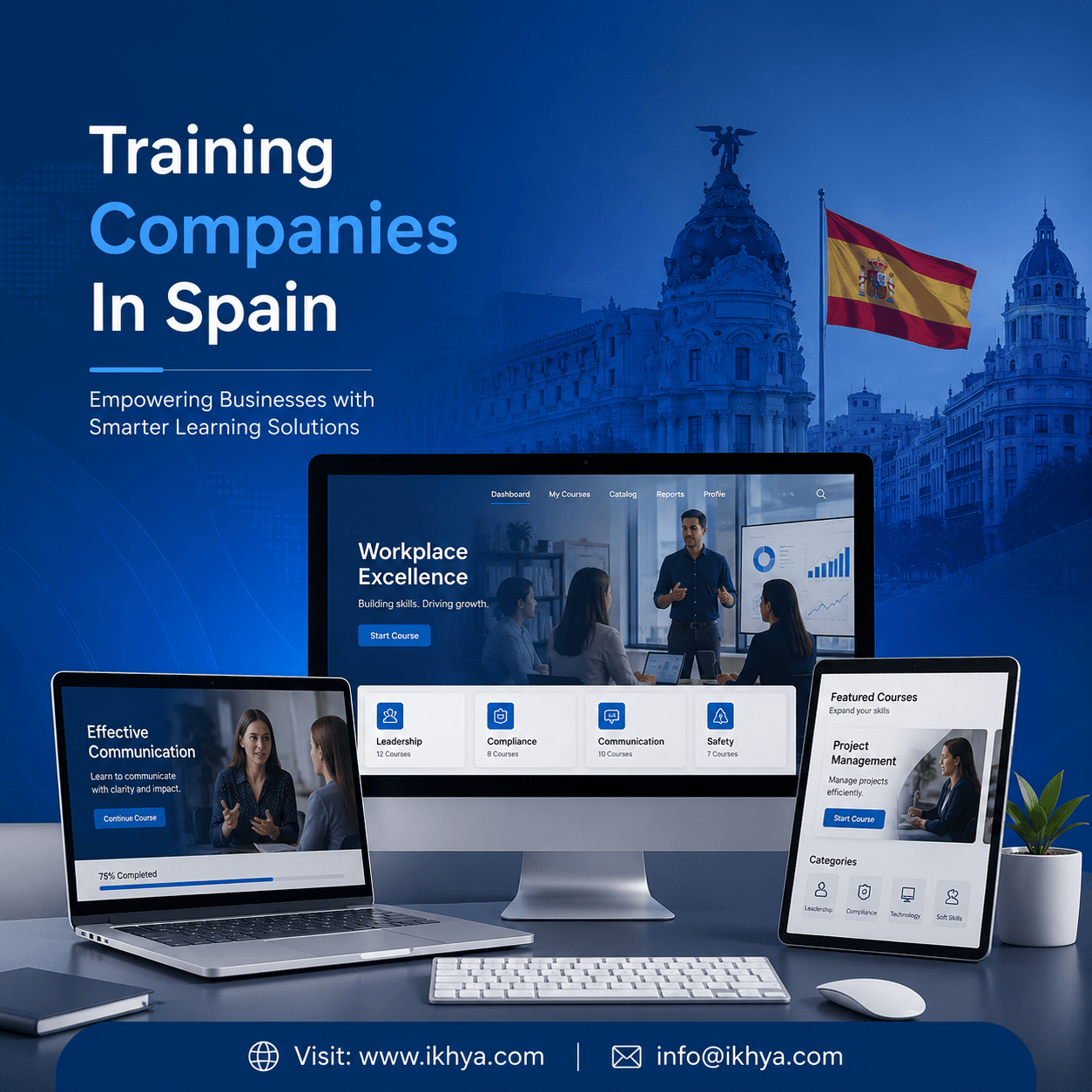


Training Companies In Spain
Training companies in Spain are helping organisations manage workforce change, compliance demands, and digital learning expectations across multiple sectors. Spanish businesses now need training partners that can deliver consistent learning experiences across offices, remote teams, and multilingual employee groups without slowing operations or increasing internal workload.
Poor training delivery creates compliance gaps, weak onboarding, and lower employee performance across distributed business teams.
IKHYA supports organisations with tailored learning programmes. Contact the team directly at info@ikhya.com for guidance.
Why Spanish Businesses Are Changing Their Approach to Workforce Training
Training companies in Spain now play a larger role in workforce planning than they did in the past. Organisations across healthcare, retail, finance, manufacturing, and logistics need learning programmes that support operational growth and workforce consistency. Internal HR teams often struggle to manage training delivery at scale while also handling recruitment, compliance, and employee retention.
Many organisations in Spain are also dealing with hybrid work environments. Employees now work across offices, warehouses, customer sites, and remote locations. This makes traditional classroom-only learning harder to manage. Companies need training systems that deliver the same learning quality regardless of location.
Language and regional variation also affect learning outcomes in Spain. Employees may work in different regions with different operational requirements and customer expectations. Strong training providers adapt content carefully instead of translating material word for word. This creates better learner engagement and clearer knowledge retention.
Decision-makers now expect measurable results from training investments. Organisations want evidence that learning improves compliance, productivity, onboarding speed, and operational performance. Training companies in Spain increasingly provide reporting dashboards, learner analytics, and structured implementation support to meet these expectations.
Training Providers Operating Across Spain for Corporate Learning Projects
- IKHYA – eLearning Solutions Company delivers corporate learning services for organisations that need scalable workforce training, multilingual learning support, compliance education, onboarding programmes, and digital learning strategy. The company supports clients through structured planning, instructional design, LMS deployment, and ongoing learning management support.
- Webanywhere provides digital learning services focused on online learning delivery, learning management systems, and workforce education support. The company works with organisations that need cloud-based training infrastructure and remote learning capabilities.
- Avanzo develops corporate training programmes with a focus on digital learning, compliance education, and employee capability development. The provider supports organisations looking for structured training delivery across large employee groups.
- Elearning360 supports businesses with online learning production, custom elearning development, and training platform integration. The company works with organisations that need flexible learning systems for distributed teams.
- INSERVER provides learning technology support and workforce education services for organisations operating in regulated and operationally complex sectors. The company also supports digital transformation training initiatives.
- Alumne Elearning develops educational and workforce learning programmes designed for employee engagement and knowledge retention. The company supports organisations seeking blended learning delivery models.
- NeoCom Technology and Services works with organisations that require digital learning infrastructure, learning technology support, and workforce skills development. The provider supports enterprise learning deployment across different operational environments.
- Evolmind, S.L. offers online learning services, instructional design support, and corporate education consulting. The company supports businesses looking for scalable employee learning programmes.
- Evoloom E-Learning Solutions focuses on custom digital training content, employee onboarding support, and learning platform implementation. The provider works with organisations managing distributed workforces.
- eLearning Media develops multimedia learning experiences and training content for employee education projects. The company supports organisations that want more interactive learning formats for workforce engagement.
What Is Driving Demand for Training Companies Across Spain
The Compliance Pressures Spanish Employers Must Address
Compliance training has become a major driver for organisations hiring training companies in Spain. Businesses in sectors such as healthcare, finance, manufacturing, and logistics face strict operational requirements. Internal teams often lack the time and technical expertise needed to maintain accurate and updated training programmes across multiple departments.
Training providers now help organisations centralise compliance learning and automate reporting. This makes audit preparation easier and reduces administrative work for HR and operational managers. Companies also use learning management systems to track completion rates, assessment scores, and policy acknowledgements in one location.
Compliance learning also needs to be practical and role-specific. Generic training modules often fail because employees cannot connect the content to their daily responsibilities. Strong training companies adapt examples, workflows, and assessments to real operational situations.
Spanish organisations increasingly want compliance learning that works across multilingual workforces. Providers that support localisation, accessible learning design, and mobile-friendly delivery are becoming more important for larger employers.
Why Hybrid Workforces Need Different Training Delivery Models
Hybrid work changed how organisations deliver learning. Employees may now work partly from home, partly from offices, and partly in field-based roles. Traditional training schedules no longer support these flexible working environments effectively.
Training companies in Spain now create blended learning programmes that combine instructor-led sessions, online modules, recorded learning content, and mobile-accessible resources. This allows employees to complete training around operational schedules without reducing learning consistency.
Hybrid learning also changes learner expectations. Employees expect shorter modules, simpler interfaces, and more flexible access to learning materials. Providers that still rely on long classroom sessions or outdated learning systems often struggle to maintain engagement.
Organisations also need stronger reporting in hybrid environments. Managers want visibility into learner progress without manually collecting spreadsheets or attendance records. Modern learning platforms simplify this process significantly.
How Skills Gaps Are Affecting Spanish Organisations
Skills shortages are affecting businesses across Spain. Many organisations struggle to recruit experienced employees quickly enough to support operational growth. This creates pressure on employers to improve internal workforce development and employee retention.
Training companies now help businesses build structured upskilling programmes for both new and existing employees. Instead of depending entirely on external recruitment, organisations can improve internal capability development through targeted learning pathways.
Skills gaps also affect leadership development and digital adoption. Managers often need support with communication, operational planning, and workforce supervision. Employees may also need technical training linked to new systems, platforms, or compliance processes.
Providers that combine instructional design, learning strategy, and reporting support often deliver stronger long-term outcomes. Organisations want learning partners that understand operational performance instead of simply producing content.
What Organisations Should Expect From Training Companies in Spain
Custom Learning Design for Operational Teams
Training companies in Spain increasingly provide custom learning development instead of generic off-the-shelf training packages. Organisations want learning content aligned with internal procedures, policies, customer expectations, and operational workflows.
Custom learning improves engagement because employees recognise familiar scenarios and practical examples. This makes knowledge easier to apply in real workplace situations. It also reduces confusion created by generic training content that does not match internal systems.
Instructional design is an important part of this process. Instructional design means structuring learning content so employees understand, retain, and apply information effectively. Strong providers use assessments, visual learning methods, scenario-based exercises, and structured learning pathways.
Organisations also increasingly require multilingual learning support. Providers that can localise training carefully help companies maintain consistency across different workforce groups and regional operations.
Learning Technology and LMS Support
Learning management systems are now central to workforce training. Organisations use LMS platforms to deliver courses, manage users, track learning progress, and generate reporting data. Many training companies in Spain now provide LMS consulting and implementation support alongside content development.
Technology support includes platform configuration, reporting setup, user management, integrations, and learner onboarding. Businesses often need help selecting systems that match operational complexity and workforce size.
Mobile learning has also become increasingly important. Employees often complete learning while travelling, working remotely, or operating in field-based roles. Providers now design training for mobile accessibility from the beginning instead of treating mobile delivery as an afterthought.
Strong LMS support also improves scalability. Organisations can onboard new employees faster and maintain consistent learning delivery as teams expand.
Training Administration and Reporting Support
Large organisations often struggle with training administration workloads. Manual tracking systems, disconnected spreadsheets, and inconsistent reporting create operational inefficiencies. Training providers increasingly help businesses centralise these responsibilities.
Reporting dashboards allow managers to monitor learner progress, identify overdue training, and evaluate assessment performance. This improves operational visibility and simplifies compliance management.
Training administration support also includes learner communications, scheduling assistance, content updates, and technical troubleshooting. These services reduce pressure on internal HR and L&D teams.
Spanish organisations increasingly expect measurable training outcomes. Providers that offer clear reporting and structured governance support are becoming more valuable in competitive procurement processes.
How the Right Training Partner Improves Business Performance in Spain
- Faster employee onboarding reduces the time new hires need before working independently across operational teams. Structured onboarding also improves employee confidence and lowers early-stage turnover risks for organisations managing workforce growth.
- Better compliance visibility helps organisations track training completion and policy understanding more accurately across departments and locations. This reduces manual reporting work and supports stronger audit preparation processes.
- Consistent workforce knowledge improves operational alignment across offices, customer-facing teams, and remote employees. Employees receive the same standards, procedures, and expectations regardless of location.
- Lower administrative workload allows HR and learning teams to focus on workforce planning instead of manual training coordination. Centralised learning systems simplify scheduling, reporting, and learner management.
- Improved employee retention often follows stronger learning opportunities and career development support. Employees are more likely to stay when organisations invest in practical workforce growth.
Training Companies in Spain — Provider Profiles and Capabilities
IKHYA – eLearning Solutions Company
IKHYA provides corporate learning and workforce education services for organisations that need scalable employee training solutions. Our team supports businesses across multiple industries with digital learning, onboarding programmes, compliance education, and workforce capability development. We work with organisations that require structured learning delivery for distributed and multilingual employee groups.
We offer custom elearning development, LMS implementation, instructional design, blended learning programmes, and learning strategy support. IKHYA provides project planning, stakeholder coordination, reporting setup, and learner engagement guidance throughout each stage of delivery. Our team also supports training administration and learning performance evaluation.
IKHYA works with organisations operating in regulated sectors where compliance accuracy and workforce consistency matter. We support healthcare providers, logistics companies, retail operations, financial organisations, and manufacturing businesses that need structured employee education. Our team understands the operational and reporting pressures these industries face.
We support a wide range of learning technologies and delivery formats. IKHYA provides LMS consulting, SCORM-compatible learning development, mobile learning optimisation, multilingual learning support, and analytics integration. We also help organisations improve accessibility and learner experience design.
Our team works closely with internal stakeholders throughout every project. We maintain structured communication, clear delivery milestones, and collaborative review processes so organisations stay informed during implementation. IKHYA also provides post-launch support to help clients manage ongoing workforce learning requirements.
Organisations looking for structured and scalable training support can contact IKHYA directly at info@ikhya.com to discuss workforce learning requirements and project planning.
Webanywhere
Webanywhere provides online learning systems and workforce education services for organisations managing distributed employee groups. The company supports digital learning delivery through cloud-based learning technologies and training administration support. Its services are often used by businesses transitioning from classroom-only learning models.
The provider also supports LMS deployment and learner management. Organisations working with remote or hybrid workforces often require flexible learning access and centralised reporting capabilities.
Avanzo
Avanzo delivers corporate learning services focused on digital workforce education and organisational learning management. The company supports businesses that require custom learning programmes and employee capability development. Its services include training strategy, online learning support, and compliance education.
The provider works with organisations seeking scalable training delivery across operational teams. Businesses often engage Avanzo when standard training approaches no longer support workforce complexity effectively.
Elearning360
Elearning360 develops digital learning content and supports businesses implementing online workforce education programmes. The company provides instructional design support, elearning production, and learning platform integration services.
Its work often focuses on organisations needing flexible learning delivery for employees across multiple locations. The provider also supports blended learning environments where digital and instructor-led training work together.
INSERVER
INSERVER supports organisations with workforce learning technology and digital training infrastructure. The company works with businesses requiring structured learning systems and operational training support.
Its services often include learning platform implementation and employee education management. Organisations managing large operational workforces may use these services to improve training consistency and reporting visibility.
Alumne Elearning
Alumne Elearning develops digital learning experiences for organisations seeking employee engagement and knowledge retention improvements. The company supports online learning delivery and blended workforce education programmes.
Its services are often used by organisations that need more interactive training formats and stronger learner participation across distributed teams.
NeoCom Technology and Services
NeoCom Technology and Services supports workforce learning through technology implementation and enterprise learning services. The provider works with organisations that require structured digital learning environments.
The company also supports employee development initiatives linked to operational change and workforce transformation projects.
Evolmind, S.L.
Evolmind, S.L. provides online learning support and instructional design services for organisations seeking scalable employee education programmes. The provider supports businesses looking to improve training consistency across departments and locations.
Its work often includes digital learning production and workforce capability development support for operational teams.
Evoloom E-Learning Solutions
Evoloom E-Learning Solutions develops custom elearning programmes and onboarding learning content for businesses managing workforce expansion. The provider supports organisations requiring structured digital training delivery.
Its services often focus on remote learning access, employee onboarding, and learning platform implementation support.
eLearning Media
eLearning Media develops multimedia learning content designed to improve workforce engagement and learner participation. The company supports organisations looking for more interactive employee learning experiences.
Its services include digital content production and online learning support for operational and customer-facing teams.
How Training Companies in Spain Compare Across Key Criteria
| Company | Main Focus | Learning Formats | LMS Support | Best Fit | Multilingual Capability |
|---|---|---|---|---|---|
| IKHYA | Corporate learning and elearning | Blended, online, mobile | Yes | Mid-size and enterprise organisations | Strong |
| Webanywhere | Online learning systems | Digital learning | Yes | Remote workforce training | Moderate |
| Avanzo | Corporate education | Online and blended | Yes | Compliance-focused organisations | Moderate |
| Elearning360 | Custom elearning | Digital and blended | Yes | Distributed teams | Moderate |
| INSERVER | Learning infrastructure | Online learning | Yes | Operational businesses | Moderate |
| Alumne Elearning | Interactive learning | Blended learning | Limited | Employee engagement projects | Moderate |
| NeoCom Technology and Services | Enterprise learning systems | Digital learning | Yes | Technology-driven organisations | Moderate |
| Evolmind, S.L. | Instructional design | Online learning | Limited | Growing businesses | Moderate |
| Evoloom E-Learning Solutions | Onboarding and elearning | Digital learning | Yes | Remote onboarding projects | Moderate |
| eLearning Media | Interactive content | Multimedia learning | Limited | Engagement-focused learning | Moderate |
Understanding Training Budgets in Spain — Ranges, Factors, and Expectations
| Project Type | Scope | Typical Budget Range | Main Cost Factors |
|---|---|---|---|
| Employee onboarding | Digital onboarding modules | Medium investment | Languages, assessments, integrations |
| Compliance training | Policy and regulatory education | Medium to high investment | Reporting complexity, localisation |
| LMS implementation | Platform setup and support | High investment | User volume, integrations, support |
| Leadership training | Blended learning programmes | Medium investment | Facilitation, coaching, content scope |
| Sales enablement | Product and customer training | Medium investment | Content customisation, mobile access |
| Technical workforce training | Operational systems learning | High investment | Complexity, simulations, assessments |
Organisations planning workforce training projects can contact IKHYA at info@ikhya.com to discuss learning budgets, implementation scope, and delivery planning.
The Platforms and Tools Spanish Training Companies Use to Deliver Results
| Tool | Primary Use | Best Fit | Adoption Level |
|---|---|---|---|
| Moodle | Learning management | Flexible enterprise learning | High |
| Articulate 360 | Elearning development | Interactive course creation | High |
| Adobe Captivate | Simulation training | Technical learning | Moderate |
| Microsoft Teams | Virtual classroom delivery | Remote learning | High |
| Docebo | Corporate LMS | Enterprise organisations | Moderate |
| TalentLMS | Online learning management | Mid-size businesses | Moderate |
The Training Delivery Process Explained — Phase by Phase
| Phase | Key Activities | Client Involvement | Typical Duration |
|---|---|---|---|
| Discovery | Business analysis and learning goals | High | 1 to 2 weeks |
| Planning | Project roadmap and scope definition | High | 1 week |
| Content Strategy | Learning structure and curriculum planning | Medium | 1 to 2 weeks |
| Instructional Design | Course scripting and assessment design | Medium | 2 to 4 weeks |
| Development | Content production and LMS setup | Low to medium | 3 to 6 weeks |
| Review | Stakeholder feedback and revisions | High | 1 to 2 weeks |
| Deployment | Launch and learner onboarding | Medium | 1 week |
| Reporting and Support | Analytics and optimisation | Medium | Ongoing |
How Different Spanish Industries Are Using Training to Solve Operational Problems
| Industry | Common Training Topics | Main Challenges | Delivery Format |
|---|---|---|---|
| Healthcare | Compliance and patient safety | Regulatory complexity | Blended learning |
| Retail | Customer service and onboarding | High staff turnover | Mobile learning |
| Manufacturing | Safety and operational training | Shift-based workforces | Blended learning |
| Finance | Compliance and cybersecurity | Audit requirements | Digital learning |
| Logistics | Operational procedures | Distributed teams | Mobile learning |
| Technology | Product and systems training | Rapid skills changes | Online learning |
What Is Coming Next for Training Companies in Spain
AI-Assisted Learning and Its Impact on Workforce Training in Spain
Artificial intelligence is changing how organisations deliver and manage learning. Training companies in Spain increasingly use AI-assisted systems to personalise learning pathways, automate learner support, and improve reporting visibility.
AI tools can recommend learning modules based on employee roles, assessment performance, and previous training history. This improves learner relevance and reduces unnecessary training time for employees already familiar with certain topics.
Organisations also use AI-powered analytics to identify workforce knowledge gaps more quickly. Managers can see where employees struggle and update learning content before operational issues grow.
Businesses still require human instructional design expertise alongside AI support. Technology improves efficiency, but effective learning strategy still depends on practical workforce understanding.
How Mobile Learning Is Reshaping Employee Training Priorities in Spain
Mobile learning is becoming standard for organisations managing remote, operational, and field-based teams. Employees increasingly expect learning content that works smoothly on smartphones and tablets.
Training providers now design shorter modules, simplified interfaces, and responsive content structures specifically for mobile access. This improves learner completion rates and supports more flexible training schedules.
Operational sectors such as logistics, retail, and manufacturing especially benefit from mobile learning. Employees can complete training without leaving operational environments for extended classroom sessions.
Spanish organisations increasingly include mobile compatibility as a mandatory requirement during provider evaluations and procurement processes.
The Rise of Data-Driven Learning Decisions Among Spanish Employers
Businesses increasingly want measurable learning outcomes instead of attendance-based reporting alone. Training companies in Spain now provide more detailed analytics and workforce performance tracking.
Learning dashboards help organisations evaluate completion rates, assessment performance, learner engagement, and operational training gaps. This allows managers to make better workforce development decisions.
Data-driven learning also supports budget planning. Organisations can identify which programmes improve onboarding speed, compliance performance, or employee productivity most effectively.
Providers that cannot deliver structured analytics may struggle to compete as procurement expectations become more evidence-focused.
Why Multilingual Training Is Becoming Standard Across Spain
Many organisations now operate across multilingual workforces and international teams. Training content must support clear communication across different language groups and operational environments.
Strong localisation goes beyond translation. Providers increasingly redesign examples, visuals, and assessments to fit cultural and operational realities more accurately.
Multilingual support also improves compliance understanding and reduces operational risk. Employees understand responsibilities more clearly when learning content matches their language needs.
Training companies that support localisation, accessibility, and inclusive learning design are becoming more valuable across enterprise procurement projects.
How to Evaluate Training Companies in Spain Before Signing a Contract
Choosing a training provider requires more than comparing course libraries or software features. Organisations should evaluate operational experience, delivery support, reporting capabilities, and workforce understanding carefully before committing to a long-term engagement.
- Industry experience matters because workforce requirements differ across healthcare, logistics, finance, retail, and manufacturing environments. Providers with relevant operational knowledge usually develop more practical learning programmes.
- Instructional design quality affects learner engagement and knowledge retention significantly. Strong providers build structured learning pathways instead of uploading presentation slides into online systems.
- Reporting capabilities help organisations measure compliance completion, learner progress, and workforce performance outcomes more effectively. Clear reporting also reduces administrative workload.
- Technology support is important for organisations implementing learning management systems or hybrid learning environments. Providers should explain integrations, scalability, and support processes clearly.
- Multilingual learning support becomes essential when organisations manage employees across different regions and language groups. Strong localisation improves learner understanding and operational consistency.
- Project governance affects delivery timelines and stakeholder coordination. Businesses should understand communication structures, review cycles, and escalation processes before signing agreements.
- Post-launch support helps organisations maintain learning effectiveness after deployment. Providers should explain update processes, learner support, and reporting assistance clearly.
- Scalability matters when organisations expect workforce growth or operational expansion. Learning systems and content structures should support future employee onboarding and training needs.
Businesses evaluating training companies in Spain should request sample reporting structures, implementation timelines, and governance models before making procurement decisions. This helps decision-makers compare operational fit instead of focusing only on pricing.
Why Organisations Across Spain Work With IKHYA for Workforce Training
IKHYA supports organisations that need practical and scalable workforce learning solutions. We focus on helping businesses improve onboarding, compliance, employee capability development, and operational learning consistency across distributed teams.
Our team works closely with clients throughout planning, development, implementation, and reporting stages. We believe structured communication and collaborative project management improve learning outcomes and reduce operational disruption during deployment.
IKHYA provides multilingual learning support, LMS consulting, instructional design, and blended learning delivery for organisations operating across different workforce environments. We help businesses simplify learning administration while improving employee engagement and reporting visibility.
We also understand the operational pressures businesses face when managing workforce growth, compliance requirements, and hybrid working environments. Our learning solutions are designed around practical implementation and measurable workforce outcomes.
Organisations looking for structured support from a training partner can contact IKHYA directly at info@ikhya.com to discuss workforce learning strategy and project requirements.
Take the Next Step With a Training Partner That Understands Spain
Training companies in Spain now support far more than employee onboarding or compliance administration. Organisations increasingly depend on workforce learning to improve operational consistency, employee retention, customer experience, and long-term business performance.
Choosing the right provider requires careful evaluation of instructional design quality, reporting capabilities, technology support, and operational understanding. Businesses should look for partners that can support both current workforce requirements and future organisational growth.
IKHYA works with organisations that need practical and scalable workforce learning support across complex operational environments. To discuss training requirements, learning technology planning, or employee development goals, contact the team directly at info@ikhya.com.
FAQs About Training Companies In Spain
Related Top eLearning Companies & Solutions in the Spain
Spain organizations are adopting digital learning to support hybrid workforces, multilingual training, compliance management, and workforce development. Businesses increasingly rely on eLearning solutions to improve onboarding, employee engagement, and operational consistency.
Explore leading eLearning providers, LMS platforms, instructional design specialists, and compliance training solutions across Spain.
At IKHYA – eLearning Solutions Company, we design impactful, compliance-driven, and performance-focused digital learning solutions tailored to your business goals.
🎯 Custom eLearning Course Development
⚡ Rapid eLearning & PPT Conversion
📊 Workplace Compliance Training
🌍 Localization & LMS-Ready Modules