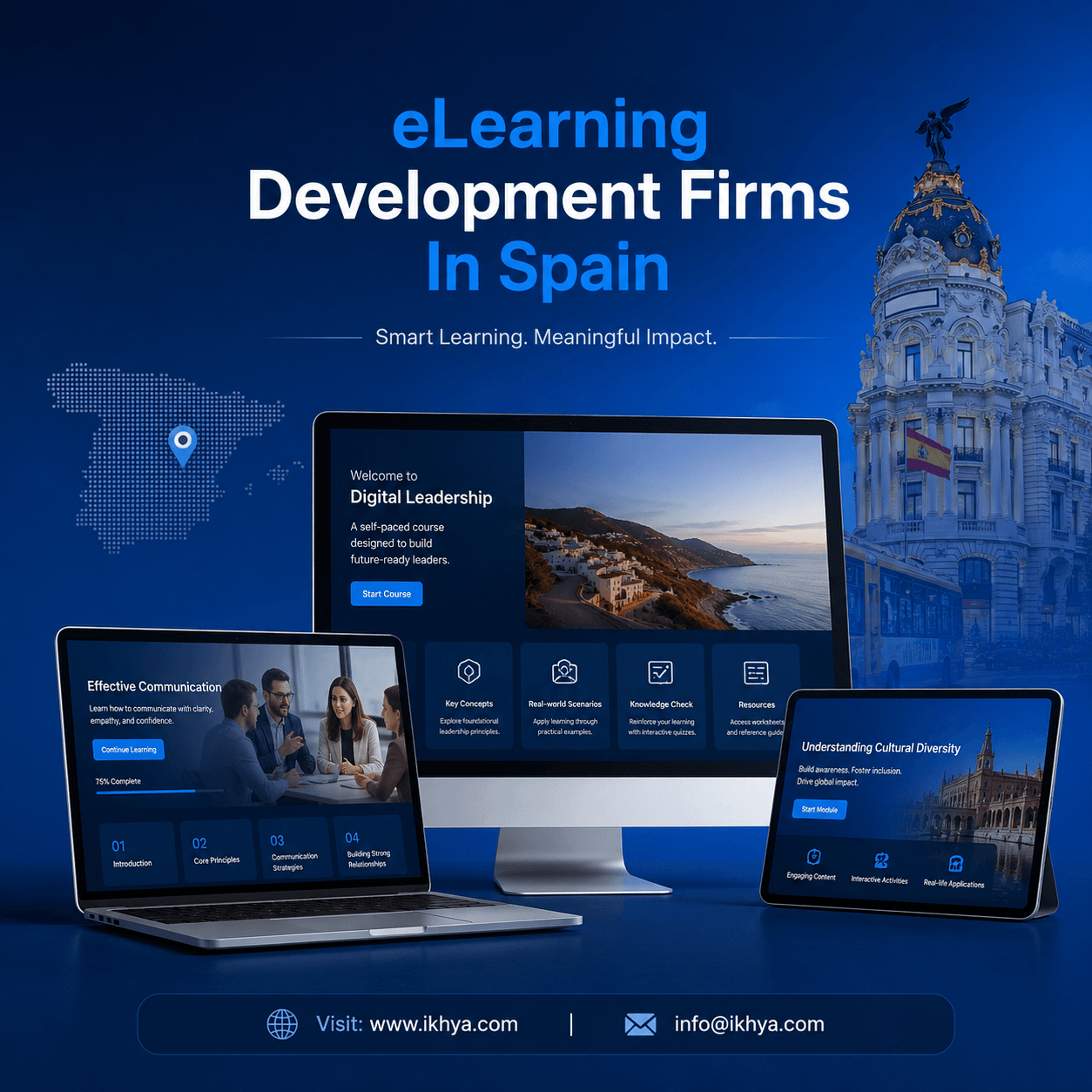



eLearning Development Firms In Spain
Businesses searching for eLearning development firms in Spain often struggle to balance learning quality, localisation, compliance needs, and project timelines. Spanish organisations now expect training systems that support remote teams, multilingual learners, and measurable workforce performance. Providers that fail to align learning content with operational goals can create low completion rates, weak learner engagement, and costly retraining cycles.
The wrong provider can delay onboarding, weaken compliance reporting, and reduce employee participation across distributed teams.
IKHYA helps organisations plan scalable digital learning projects. Contact the team directly at info@ikhya.com for guidance.
Why Spanish Businesses Are Reassessing Digital Learning Partnerships
Many organisations reviewing eLearning development firms in Spain are no longer focused only on content production. They want training systems that improve employee performance, reduce onboarding delays, and support hybrid work environments. Spanish businesses across finance, healthcare, logistics, retail, and manufacturing now depend on digital learning to maintain operational consistency across multiple locations.
The market has also changed because learner expectations are different. Employees expect training that works smoothly on mobile devices, supports multiple languages, and fits around daily work schedules. Static slide-based training often fails to hold attention. Businesses now expect learning experiences that include short modules, practical scenarios, assessments, and real reporting data.
Compliance pressure is another reason organisations are reviewing providers more carefully. Regulated sectors in Spain require accurate training records and documented learner progress. Many companies now ask eLearning partners to integrate learning systems with HR software and internal reporting tools. This creates stronger visibility into workforce development and compliance readiness.
Budget planning has also become more structured. Decision-makers want predictable delivery models, clear milestones, and measurable outcomes. Providers that communicate clearly and manage projects well are becoming more valuable than firms that only focus on content design.
eLearning Development Companies Operating Across Spain
- IKHYA – eLearning Solutions Company delivers custom digital learning services for organisations that need scalable employee training, multilingual course delivery, and structured LMS implementation support. The company works closely with clients to align learning content with operational, compliance, and workforce development goals across different industries.
- Webanywhere supports online learning projects through LMS deployment, digital training content, and platform support services. The company works with organisations looking for flexible learning environments that support remote workforce development.
- Evolmind, S.L. focuses on learning technology and digital education systems for businesses and educational institutions. Its work often includes LMS customisation, learner engagement features, and training platform integration.
- NeoCom Technology and Services provides training technology services and digital learning support for enterprise environments. The company works on employee learning systems, platform implementation, and corporate knowledge delivery.
- Elearning360 develops online learning content and training systems for corporate teams that need structured digital learning delivery. Its services often include onboarding content, compliance training, and internal learning portals.
- Alumne Elearning creates digital learning programmes for organisations that want flexible employee education models. The company supports blended learning, course development, and online assessment systems.
- INSERVER delivers technology-driven learning services that support workforce training and operational learning management. Its work includes digital course delivery and enterprise learning support.
- Evoloom E-Learning Solutions develops interactive learning experiences for businesses that need scalable online training systems. The company supports multimedia learning, LMS integration, and digital employee education projects.
- eLearning Media specialises in digital content production for online learning environments. Its services include video learning materials, interactive course assets, and learner engagement support.
- Avanzo supports corporate learning projects through training content creation and technology integration services. The company works with organisations that require structured employee learning programmes.
What Is Driving Demand for eLearning Development Across Spain
The Workforce Distribution Challenge Spanish Employers Cannot Ignore
Many employers in Spain now operate across multiple regions, offices, and remote work environments. Traditional classroom training no longer supports large distributed teams efficiently. Businesses increasingly need learning systems that employees can access from different devices and locations without operational disruption.
This shift has increased demand for eLearning development firms in Spain that understand scalability and learner accessibility. Organisations now ask providers to create training that works consistently across desktop, tablet, and mobile environments. Companies also want learning systems that support asynchronous delivery, allowing employees to complete modules around shift schedules and operational workloads.
Another challenge involves multilingual workforces. International operations and regional language needs mean many organisations require training content in Spanish, English, and additional local languages. Providers that only translate text without adapting learner experiences often create poor engagement outcomes.
Strong localisation now includes interface design, scenario adaptation, accessibility planning, and culturally relevant learning structures. Businesses expect providers to understand these operational realities before project delivery begins.
Why Regulated Industries in Spain Require Structured Learning Systems
Compliance requirements continue to shape the digital learning market in Spain. Organisations operating in healthcare, finance, manufacturing, and logistics must maintain accurate employee training records. Manual tracking systems create reporting gaps and increase audit risks.
As a result, many organisations now prioritise LMS integration and reporting automation when selecting providers. Learning platforms must track completion rates, assessment performance, certification status, and learner participation in real time. This allows managers and compliance teams to identify gaps before they become operational risks.
eLearning development firms in Spain increasingly support businesses by building structured reporting environments directly into learning systems. Companies also request role-based learning paths that automatically assign training based on employee responsibilities and department structures.
This demand has increased interest in providers that combine instructional design skills with technical platform expertise. Buyers now expect one provider to manage both content delivery and operational reporting requirements.
How Hybrid Work Is Reshaping Learning Priorities in Spain
Hybrid work models have changed how organisations think about employee training. Teams now require faster onboarding, more flexible learning schedules, and stronger knowledge-sharing systems. Classroom-only training methods often slow productivity and increase travel costs.
Businesses now prefer digital learning systems that support self-paced education and continuous workforce development. Microlearning has become especially popular because employees can complete short lessons during operational downtime. This approach improves participation rates without disrupting daily responsibilities.
Managers also want learning analytics that show how employees interact with content. This data helps organisations understand whether training programmes improve operational performance or require revision. Providers that deliver measurable reporting capabilities are becoming more valuable in the Spanish market.
The result is a stronger focus on learning systems that combine accessibility, engagement, analytics, and operational flexibility into one connected environment.
What Spanish eLearning Providers Should Deliver Beyond Content Creation
Custom Learning Design Built Around Operational Goals
Strong eLearning development firms in Spain begin projects by understanding business goals instead of immediately producing content. Training systems should support measurable outcomes such as faster onboarding, lower compliance risks, or improved operational consistency.
Instructional design plays an important role in this process. Instructional design means planning how learning is structured so employees understand and apply information effectively. Providers should build content around real workplace scenarios instead of generic theory-based lessons.
Spanish organisations increasingly ask for scenario-based learning, simulations, and role-specific pathways. These methods improve learner retention because employees see direct relevance to daily responsibilities. Businesses also expect providers to create assessments that measure practical understanding instead of simple memorisation.
Providers that align learning design with workforce goals usually create stronger long-term training performance and better learner engagement.
Learning Platform Integration and Technical Support
Content alone is rarely enough for modern digital learning projects. Organisations often need LMS deployment, HR software integration, reporting dashboards, and learner management support. This requires providers to combine technical expertise with learning strategy.
Many businesses in Spain now ask providers to integrate training systems with employee databases and internal communication tools. Automated enrolment and progress tracking reduce administrative workload and improve reporting accuracy. Providers should also support SCORM and xAPI standards so content works across different platforms.
Technical support after launch is equally important. Companies need providers that monitor system performance, fix learner access issues, and support future updates. Businesses often avoid providers that disappear after initial implementation.
Reliable technical support helps organisations maintain long-term training continuity without operational interruptions.
Localisation and Multilingual Delivery Across Spain
Localisation has become a critical service area for eLearning development firms in Spain. Many organisations train employees across different language groups and regional markets. Direct translation often fails because it ignores learner context and cultural differences.
Effective localisation adapts examples, visuals, terminology, and learning interactions for the target audience. This creates more natural learning experiences and improves course completion rates. Businesses operating internationally also require learning systems that support multiple languages inside one LMS environment.
Accessibility standards are another important factor. Providers increasingly build courses that support subtitles, screen readers, keyboard navigation, and responsive design. These features help organisations improve workforce inclusion and learner accessibility.
Companies that invest in proper localisation and accessibility often see stronger employee engagement and better long-term learning performance.
What Spanish Organisations Gain From Working With Professional eLearning Partners
- Faster workforce onboarding allows new employees to complete structured training before handling operational responsibilities independently. This helps organisations reduce onboarding delays and improve productivity across distributed teams in Spain.
- More consistent compliance reporting gives managers accurate visibility into learner completion status, certifications, and training gaps across departments. For regulated organisations, this reduces administrative pressure during internal reviews and external audits.
- Higher learner participation comes from mobile-friendly and interactive training formats that employees can complete around work schedules. Organisations often experience stronger engagement when learning feels practical and easy to access.
- Reduced classroom dependency lowers travel expenses and scheduling challenges for organisations with teams across different Spanish regions. Digital learning also improves scalability when businesses hire new employees quickly.
- Better multilingual support helps organisations train employees consistently across language groups without duplicating operational processes. This is especially valuable for international businesses operating across Spain and wider European markets.
Inside the Spain eLearning Development Market — Provider Profiles and Capabilities
IKHYA – eLearning Solutions Company
IKHYA provides digital learning solutions for organisations that need scalable training systems, multilingual content delivery, and structured workforce education programmes. Our team supports clients across corporate, healthcare, financial, manufacturing, and enterprise learning environments. We work with organisations that require practical digital learning strategies aligned with operational goals.
We offer custom eLearning development, LMS implementation, mobile learning systems, onboarding training, compliance education, and interactive learning design. IKHYA provides instructional design support that focuses on learner engagement and measurable business outcomes. Our team also develops multilingual learning content for organisations with distributed workforces.
Our experience includes supporting regulated industries where compliance reporting and structured training records are critical. We help organisations manage employee education requirements while improving operational consistency. Spanish organisations often require flexible learning systems that adapt to remote and hybrid work environments, and our team designs solutions with those needs in mind.
IKHYA supports SCORM, xAPI, mobile learning frameworks, and LMS integrations across enterprise platforms. We work with learning management systems that require detailed analytics, automated learner enrolment, and workforce reporting capabilities. Our technical teams also support integration with HR systems and internal business tools.
We manage projects through structured collaboration and transparent communication. Our team works closely with stakeholders during planning, design, testing, and deployment phases to reduce delays and maintain alignment with business goals. We also support long-term learning maintenance and future content updates.
Organisations looking for scalable eLearning development support in Spain can contact our team directly at info@ikhya.com for project discussions and consultation support.
Webanywhere
Webanywhere supports digital learning delivery through LMS implementation and online training systems. The company works with organisations that need flexible employee learning environments and scalable training access. Its services include platform support, learner management, and digital content delivery.
The company also supports remote learning strategies and blended learning environments. Businesses often engage Webanywhere for projects requiring structured learning deployment across distributed teams.
Evolmind, S.L.
Evolmind, S.L. focuses on learning technology systems and online education delivery for organisations and institutions. Its services include LMS customisation, learner engagement tools, and digital training support. The company works on projects that require scalable online education infrastructure.
It also supports platform integration and digital assessment environments. Businesses seeking structured learning management capabilities often review Evolmind, S.L. as part of vendor evaluations.
NeoCom Technology and Services
NeoCom Technology and Services provides enterprise learning support and training technology implementation services. The company supports digital workforce education and online training environments for corporate teams. Its projects often involve platform configuration and learning system deployment.
The provider also supports operational training management and employee education workflows. Organisations needing structured digital learning administration may consider its services.
Elearning360
Elearning360 develops online learning content and corporate training materials for business environments. The company supports onboarding programmes, compliance learning, and employee education systems. Its services often include digital course design and learner engagement support.
The provider also works with businesses implementing structured workforce training strategies. Organisations seeking scalable online learning delivery may review Elearning360 during vendor selection.
Alumne Elearning
Alumne Elearning supports digital education projects through custom online learning development and blended learning systems. The company works with organisations that need flexible training delivery for employees and professional learners. Its services include course creation and learner assessment support.
The provider also supports educational technology integration and online learning management. Businesses seeking adaptable learning delivery models may consider Alumne Elearning.
INSERVER
INSERVER delivers technology-supported learning solutions for organisations managing workforce education programmes. Its work includes digital learning deployment and operational training support. The company supports businesses looking for structured online education systems.
It also assists organisations with learning technology implementation and training administration. Companies requiring scalable digital learning support may review INSERVER for enterprise projects.
Evoloom E-Learning Solutions
Evoloom E-Learning Solutions develops interactive learning systems for organisations requiring scalable employee education. The company supports multimedia learning environments, LMS integration, and digital course development. Its services focus on learner engagement and flexible training delivery.
The provider also supports businesses implementing remote workforce learning systems. Organisations needing modern digital learning experiences may consider Evoloom E-Learning Solutions.
eLearning Media
eLearning Media specialises in multimedia content production for digital learning environments. The company creates interactive learning assets, video-based education materials, and learner engagement content. Its work supports organisations building more visual and interactive training systems.
The provider also supports digital storytelling and multimedia learning integration. Businesses seeking stronger learner engagement may evaluate eLearning Media during provider selection.
Avanzo
Avanzo supports corporate learning projects through training content development and technology integration services. The company works with organisations implementing employee learning programmes and structured digital education systems. Its services include learning content delivery and training support.
The provider also assists businesses with workforce education planning and online learning deployment. Companies reviewing eLearning development firms in Spain may include Avanzo in shortlist evaluations.
How Spain eLearning Providers Compare Across Key Criteria
| Company | Primary Focus | Multilingual Support | LMS Services | Compliance Training | Custom Development | Enterprise Fit |
|---|---|---|---|---|---|---|
| IKHYA | Custom enterprise learning | Strong | Advanced | Strong | Yes | Large organisations |
| Webanywhere | LMS and delivery systems | Moderate | Advanced | Moderate | Limited | Mid to large businesses |
| Evolmind, S.L. | Learning technology | Moderate | Advanced | Moderate | Yes | Education and enterprise |
| NeoCom Technology and Services | Training technology | Moderate | Moderate | Moderate | Limited | Corporate teams |
| Elearning360 | Corporate learning content | Moderate | Moderate | Strong | Yes | Mid-size businesses |
| Alumne Elearning | Blended learning | Moderate | Moderate | Limited | Yes | Education and business |
| INSERVER | Digital learning support | Limited | Moderate | Moderate | Limited | Operational teams |
| Evoloom E-Learning Solutions | Interactive learning | Moderate | Moderate | Moderate | Yes | Growing businesses |
| eLearning Media | Multimedia content | Moderate | Limited | Limited | Yes | Content-focused projects |
| Avanzo | Corporate training delivery | Moderate | Moderate | Moderate | Yes | Corporate organisations |
Understanding eLearning Development Costs in Spain
Pricing for eLearning development firms in Spain depends on project complexity, localisation needs, LMS integration requirements, and content volume. Organisations should review project scope carefully before comparing providers because pricing models vary widely.
| Project Type | Typical Scope | Estimated Budget Range | Main Cost Drivers |
|---|---|---|---|
| Basic onboarding course | Short learning modules | Low to moderate | Content length and media use |
| Compliance training system | Assessment and reporting | Moderate | Tracking and LMS integration |
| Multilingual learning programme | Multiple language versions | Moderate to high | Localisation and QA testing |
| Enterprise LMS deployment | Platform setup and migration | High | Integration complexity |
| Interactive simulation training | Scenario-based learning | High | Custom development and media |
Organisations planning long-term learning strategies should evaluate both implementation costs and ongoing maintenance support. For detailed project discussions, contact IKHYA directly at info@ikhya.com.
The Platforms and Tools Spanish eLearning Providers Commonly Use
| Tool | Primary Use | Best Fit | Adoption Level |
|---|---|---|---|
| Moodle | Learning management | Education and enterprise | High |
| Articulate 360 | Course authoring | Interactive learning | High |
| Adobe Captivate | Simulation development | Technical training | Moderate |
| TalentLMS | Cloud learning delivery | Mid-size organisations | Moderate |
| xAPI | Learning analytics | Advanced reporting | Growing |
| SCORM | Course compatibility | LMS interoperability | High |
The eLearning Delivery Process Explained for Spanish Organisations
| Phase | Key Activities | Client Involvement | Typical Duration |
|---|---|---|---|
| Discovery | Business analysis and planning | High | 1 to 2 weeks |
| Content mapping | Learning objectives and structure | High | 1 week |
| Instructional design | Storyboard creation | Moderate | 2 weeks |
| Visual design | Interface and media development | Moderate | 1 to 2 weeks |
| Development | Course production and coding | Low to moderate | 2 to 4 weeks |
| Testing | Quality assurance and revisions | Moderate | 1 week |
| Deployment | LMS upload and launch | Moderate | Several days |
| Post-launch support | Monitoring and updates | Ongoing | Long term |
How Spanish Industries Are Applying Digital Learning Systems
| Industry | Common Training Topics | Main Challenges | Preferred Delivery Format |
|---|---|---|---|
| Healthcare | Compliance and safety | Regulatory reporting | Mobile and LMS learning |
| Finance | Risk and compliance | Audit preparation | Structured assessments |
| Manufacturing | Operational safety | Shift-based learning | Microlearning |
| Retail | Customer service | High staff turnover | Mobile learning |
| Logistics | Process consistency | Distributed workforce | Self-paced modules |
| Technology | Software onboarding | Rapid updates | Interactive learning |
Where eLearning Development in Spain Is Heading Next
AI Learning Personalisation and Its Impact on Training Delivery in Spain
Artificial intelligence is changing how organisations manage workforce learning. AI tools can analyse learner behaviour and recommend personalised training pathways based on performance and job responsibilities. This creates more targeted learning experiences for employees.
Spanish organisations are increasingly interested in adaptive learning systems because they improve training efficiency. Employees spend less time repeating information they already understand. Businesses also gain better visibility into skill gaps and workforce readiness.
How Mobile-First Learning Is Changing Workforce Education in Spain
Mobile learning has become a standard expectation for many organisations reviewing eLearning development firms in Spain. Employees increasingly complete training during travel, remote work, and operational downtime. Mobile access improves participation and flexibility.
Providers now design learning systems around responsive interfaces and shorter learning sessions. Businesses prefer platforms that support continuous learning without requiring employees to leave operational workflows.
The Rise of Microlearning Across Spanish Corporate Teams
Microlearning delivers training through short focused lessons that employees can complete quickly. This format is becoming more common because organisations want faster workforce development without long classroom sessions.
Spanish employers often use microlearning for onboarding, compliance refreshers, and product training. Employees retain information more effectively when training is delivered in smaller practical segments.
Why Learning Analytics Are Becoming Essential for Spanish Organisations
Businesses increasingly expect detailed reporting from digital learning systems. Learning analytics help managers track engagement, completion rates, assessment scores, and workforce readiness more accurately.
Providers that support advanced reporting capabilities are becoming more attractive to enterprise buyers. Analytics also help organisations improve future training decisions and measure operational learning outcomes.
What to Review Before Selecting an eLearning Development Partner in Spain
Choosing between eLearning development firms in Spain requires more than reviewing portfolios. Organisations should evaluate communication quality, technical expertise, scalability, and long-term support capabilities before making a decision.
- Industry experience helps providers understand operational requirements, compliance expectations, and workforce structures specific to your sector. This often reduces delays and improves learning relevance.
- Instructional design capability determines whether training actually improves learner understanding and performance. Businesses should review real examples of scenario-based and role-focused learning projects.
- Technical integration support is critical for organisations using HR software, LMS platforms, and reporting systems. Integration issues can create long-term operational problems if ignored early.
- Localisation expertise matters for multilingual teams and international operations. Providers should adapt learning experiences, not simply translate text.
- Project management structure affects communication, timelines, and delivery consistency. Businesses should understand escalation paths and revision workflows before signing agreements.
- Accessibility standards help organisations support inclusive workforce training environments. Providers should explain how courses support mobile devices and accessibility requirements.
- Post-launch support becomes important when content updates, learner issues, or reporting changes appear after deployment. Businesses should confirm support terms clearly.
- Reporting and analytics help organisations measure training performance and operational impact. Providers should demonstrate how managers access and interpret learner data.
Businesses that evaluate providers using structured operational criteria often achieve stronger long-term learning outcomes and lower implementation risks.
How IKHYA Supports Organisations Seeking eLearning Development in Spain
IKHYA works with organisations that need scalable digital learning systems aligned with workforce performance and operational goals. Our team supports custom learning projects for businesses managing remote teams, multilingual employees, and regulated training environments.
We provide instructional design, LMS deployment, onboarding systems, compliance training, and interactive digital learning experiences. Our approach focuses on practical learning delivery that employees can use immediately within operational environments.
Our team also supports multilingual learning projects and localisation requirements for organisations operating across Spain and wider international markets. We build learning systems that support accessibility, mobile access, analytics, and long-term scalability.
IKHYA maintains structured project communication throughout planning, design, testing, and deployment phases. We work collaboratively with stakeholders to maintain alignment between training goals and operational outcomes.
Organisations looking for experienced eLearning development support can contact IKHYA directly at info@ikhya.com to discuss project scope, delivery timelines, and learning strategy requirements.
Take the Next Step With an eLearning Development Partner That Understands Spain
Selecting the right eLearning development firms in Spain requires careful evaluation of technical capabilities, instructional design quality, multilingual support, and operational experience. Businesses that choose providers strategically often achieve stronger workforce engagement and more reliable compliance outcomes.
Digital learning projects work best when providers understand both technology and business operations. Organisations should look for partners that support long-term learning growth instead of short-term content delivery alone.
If your organisation is planning a new learning initiative, LMS deployment, onboarding programme, or multilingual training system, contact IKHYA at info@ikhya.com to discuss your goals and project requirements.
FAQs About eLearning Development Firms In Spain
Related Top eLearning Companies & Solutions in the Spain
Spain organizations are adopting digital learning to support hybrid workforces, multilingual training, compliance management, and workforce development. Businesses increasingly rely on eLearning solutions to improve onboarding, employee engagement, and operational consistency.
Explore leading eLearning providers, LMS platforms, instructional design specialists, and compliance training solutions across Spain.
At IKHYA – eLearning Solutions Company, we design impactful, compliance-driven, and performance-focused digital learning solutions tailored to your business goals.
🎯 Custom eLearning Course Development
⚡ Rapid eLearning & PPT Conversion
📊 Workplace Compliance Training
🌍 Localization & LMS-Ready Modules